
Brasnova Energy Materials Inc. Capela Gold Project Returns up to 4.13 g/t Gold from Rock Chip Sampling
Brasnova Energy Materials (TSXV:BEM, OTC:PMDRF) reported analytical results from 23 surface rock chip samples at the Capela Gold Project in Pintadas, Bahia, Brazil.
Sentiment and the balance of points
Rhea-AI Sentiment reads the wording of the document, how positive or negative its language is on a 1 to 5 scale. The balance of points shown with the takes weighs what the document actually discloses, so the two can disagree, for example when a trial that missed its main goal is described in upbeat language.
Rhea-AI Summary
Brasnova Energy Materials (TSXV:BEM, OTC:PMDRF) reported analytical results from 23 surface rock chip samples at the Capela Gold Project in Pintadas, Bahia, Brazil. Twenty-two samples returned gold values between 0.241 g/t and 4.13 g/t Au, confirming a mineralized north-south corridor about 120 metres long and up to 25 metres wide.
According to Brasnova Energy Materials, gold mineralization is hosted in sheared, hydrothermally altered granitic to granodioritic rocks with potassic alteration, silicification and sulphidation, and disseminated pyrite with subordinate chalcopyrite and pyrrhotite. Multi-element data indicate enrichment in Au, Cu, Zn, Pb, Ag, As and Mo. All assays passed the company’s QA/QC program.
Positive
- 22 of 23 rock chip samples returned gold values ≥0.241 g/t Au
- Peak rock chip assay of 4.13 g/t Au from sample BGP-ROCK-002
- Mineralized corridor traced for ~120 m length and up to 25 m width
- Polymetallic association with elevated Cu, Zn, Pb, Ag, As, Mo in altered granitic rocks
- All reported assays passed Brasnova’s internal QA/QC verification procedures
Negative
- None.
AI-generated analysis. How Rhea-AI works. Not financial advice.




Vancouver, British Columbia--(Newsfile Corp. - July 14, 2026) - Brasnova Energy Materials Inc. (TSXV: BEM) ("BEM" or the "Company") is pleased to announce analytical results from 23 rock chip samples collected from surface at the Capela Gold Project in Pintadas, Bahia, Brazil. The program follows the field activities announced on May 11, 2026, and was designed to verify historical gold occurrences and assess the continuity of mineralization within the Capela Target.
Twenty-two of the 23 samples returned encouraging gold results with values ranging from 0.241 g/t Au to 4.13 g/t Au, confirming a mineralized north-south-trending corridor approximately 120 meters long and up to 25 meters wide. Additional results include 1.734 g/t Au, 1.435 g/t Au and 1.170 g/t Au.
The mineralized trend defined by the current rock chip sampling remains open to the north and south along strike and laterally to the east and west, as the boundaries of the gold-bearing system have not yet been delineated.
HIGHLIGHTS
- 22 of 23 rock chip samples returned encouraging gold results above 0.241 g/t Au.
- Peak assay of 4.13 g/t Au from sample BGP-ROCK-002.
- Mineralization is defined along an approximately 120-metre-long, north-south-trending outcrop corridor.
- Gold is hosted by sheared and hydrothermally altered granitic to granodioritic rocks.
- Observed alteration includes potassic alteration, silicification and sulphidation, with disseminated pyrite and subordinate chalcopyrite and pyrrhotite.
GEOLOGICAL CONTEXT AND MINERALIZATION
The Capela Project occurs within a structurally complex geological setting characterized by dextral and sinistral shear zones and regional fold structures (Figure 2). Geological mapping indicates that the target lies near the contact between granodioritic, granitic and metavolcanic-metasedimentary units, with mapped hydrothermal alteration developed within the broader intrusive and structural corridor (Figure 1).
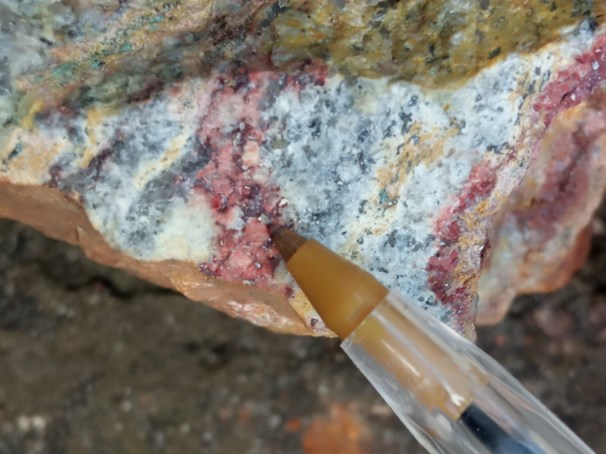
Figure 1: Sulphide mineralization hosted within hydrothermally altered granitic rock, showing disseminated sulphides associated with silicified and reddish potassic-altered zones.
To view an enhanced version of this graphic, please visit:
https://images.newsfilecorp.com/files/5386/305075_66f2cf31c49b6a31_001full.jpg
Rock chip samples were collected from granitic to granodioritic outcrops affected by intense ductile-brittle shearing and pervasive hydrothermal alteration. Sulphide mineralization is dominated by disseminated pyrite, visually estimated at approximately 1
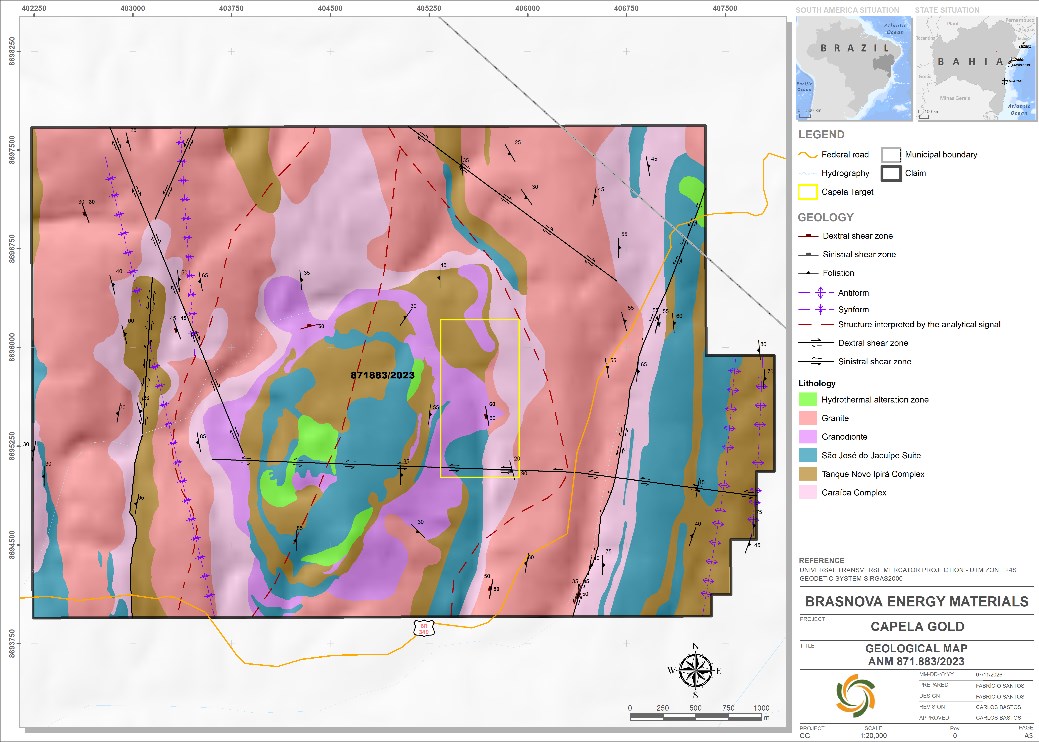
Figure 2: Geological map of the Capela Gold Project showing the Capela Target within claim ANM 871.883/2023 and the principal lithological and structural features.
To view an enhanced version of this graphic, please visit:
https://images.newsfilecorp.com/files/5386/305075_66f2cf31c49b6a31_002full.jpg
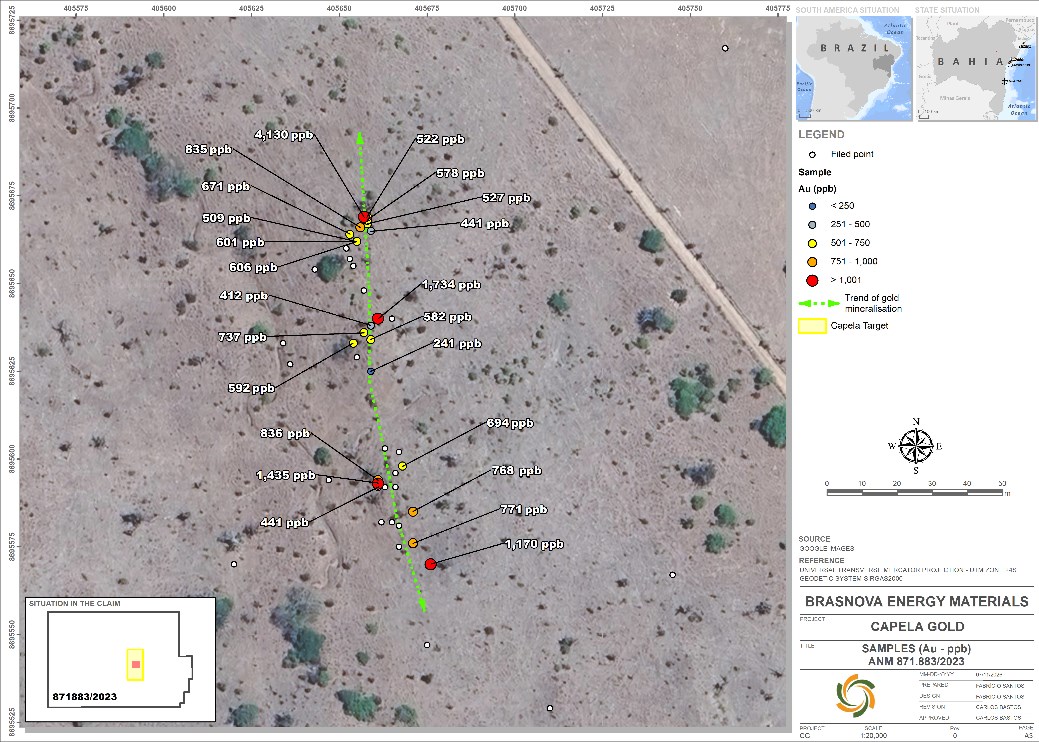
Figure 3: Distribution of rock chip samples and gold results along the interpreted north-south mineralized trend at the Capela Target.
To view an enhanced version of this graphic, please visit:
https://images.newsfilecorp.com/files/5386/305075_66f2cf31c49b6a31_003full.jpg
ANALYTICAL RESULTS
The analytical results (Table 1) indicate a hydrothermal system hosted within granitic rocks, characterized by potassic alteration, silicification and sulphidation, together with enrichment in gold (Au), copper (Cu), zinc (Zn), lead (Pb), silver (Ag), arsenic (As) and molybdenum (Mo). This geochemical association is consistent with the circulation of mineralizing hydrothermal fluids and the precipitation of polymetallic sulphides along structurally favorable zones.
Table 1: Analytical results from rock chip samples collected at the Capela Target.
| Sample | UTM E | UTM N | Au ppb | Ag ppm | As ppm | Cu ppm | Fe % | K % | Pb ppm | S % | Zn ppm |
| BGP-ROCK-002 | 405657 | 8695669 | 4,130 | 0.84 | 7 | 150.5 | 1.84 | 4.76 | 188.9 | 0.93 | 51 |
| BGP-ROCK-003 | 405658 | 8695667 | 527 | 0.44 | 3 | 675.5 | 1.5 | 3.65 | 336.5 | 1.73 | 1162 |
| BGP-ROCK-004 | 405656 | 8695666 | 835 | 0.77 | 6 | 277.2 | 1.98 | 4.72 | 239.8 | 1.72 | 1633 |
| BGP-ROCK-005 | 405659 | 8695665 | 441 | 0.71 | 3 | 729.4 | 1.78 | 4.57 | 237.8 | 1.28 | 1921 |
| BGP-ROCK-006 | 405661 | 8695640 | 1,734 | 0.67 | 4 | 151.4 | 2.13 | 5.46 | 44.1 | 1.37 | 59 |
| BGP-ROCK-007 | 405659 | 8695638 | 412 | 0.29 | 4 | 347.2 | 2.04 | 5.75 | 72.2 | 1.11 | 69 |
| BGP-ROCK-008 | 405657 | 8695636 | 737 | 0.54 | 5 | 187.2 | 1.79 | 5.93 | 71.9 | 1.53 | 11 |
| BGP-ROCK-009 | 405654 | 8695633 | 592 | 0.61 | 5 | 341.1 | 1.75 | 4.65 | 180 | 1.91 | 55 |
| BGP-ROCK-010 | 405659 | 8695634 | 582 | 0.58 | 5 | 354.6 | 1.75 | 5.33 | 93.4 | 1.59 | 51 |
| BGP-ROCK-011 | 405659 | 8695625 | 241 | 0.31 | 4 | 220.3 | 0.68 | 5.91 | 51.3 | 0.21 | 13 |
| BGP-ROCK-012 | 405661 | 8695594 | 836 | 0.57 | 5 | 653.5 | 3.25 | 5.66 | 73.0 | 3.65 | 6 |
| BGP-ROCK-014 | 405661 | 8695593 | 1,435 | 0.74 | 4 | 72.3 | 2.0 | 5.97 | 93.9 | 0.72 | 42 |
| BGP-ROCK-015 | 405661 | 8695592 | 441 | 0.65 | 5 | 707.6 | 2.9 | 5.77 | 136.3 | 3.13 | 1343 |
| BGP-ROCK-016 | 405668 | 8695598 | 694 | 0.92 | 4 | 345.3 | 2.78 | 5.88 | 54.9 | 2.05 | 10 |
| BGP-ROCK-017 | 405658 | 8695668 | 578 | 0.58 | 4 | 255.0 | 1.73 | 2.97 | 90.2 | 1.35 | 954 |
| BGP-ROCK-018 | 405658 | 8695669 | 522 | 0.55 | 5 | 322.7 | 1.93 | 4.49 | 81.6 | 0.93 | 263 |
| BGP-ROCK-019 | 405655 | 8695662 | 601 | 0.61 | 3 | 378.3 | 1.76 | 4.96 | 271.2 | 1.71 | 453 |
| BGP-ROCK-020 | 405671 | 8695585 | 768 | 0.64 | 1 | 233.3 | 2.55 | 5.79 | 206.3 | 1.04 | 742 |
| BGP-ROCK-021 | 405671 | 8695576 | 771 | 0.6 | 5 | 449.4 | 2.5 | 4.82 | 418.7 | 1.87 | 1656 |
| BGP-ROCK-022 | 405676 | 8695570 | 1,170 | 1.0 | 6 | 688.8 | 1.61 | 4.52 | 357.5 | 1.02 | 772 |
| BGP-ROCK-023 | 405653 | 8695664 | 671 | 0.23 | 7 | 80.2 | 1.13 | 4.49 | 46.4 | 0.43 | 25 |
| BGP-ROCK-024 | 405655 | 8695662 | 509 | 0.5 | 5 | 235.0 | 2.14 | 5.19 | 275.3 | 1.57 | 776 |
| BGP-ROCK-025 | 405700 | 8695464 | 5 | 0.02 | 3 | 3.4 | 0.54 | 3.36 | 15 | 0.01 | 10 |
SAMPLE PREPARATION, ANALYSIS AND QA/QC
Samples were submitted to SGS laboratory in Vespasiano, Minas Gerais, Brazil, for preparation and geochemical analysis. Gold was analyzed by fire assay, while multi-element analysis was completed by ICP-OES/MS following multi-acid digestion.
In addition to the laboratory's internal quality assurance and quality control procedures, Brasnova implements an independent QA/QC program that includes certified reference materials and blank samples, with a minimum of one CRM and one blank inserted into every analytical batch. All results reported in this release passed the Company's internal QA/QC verification prior to compilation and reporting.
QUALIFIED PERSON COMMENTARY
QP Mr. Carlos Henrique Lourenço Bastos commented:
"We are encouraged by these analytical results, which confirm the presence of gold mineralization at the Capela Project. The mineralization appears to be associated with sulphide-rich hydrothermal fluids.
The standout result from sample BGP-ROCK-002, which returned approximately 4.0 g/t Au, highlights the potential of this target. Our next step is to better delineate the potential extent of the mineralization through stream sediment sampling and additional ground geochemical and geophysical surveys."
ABOUT THE CAPELA GOLD PROJECT
The Capela Gold Project is an early-stage gold exploration asset associated with a dome-shaped intrusive granodioritic system (Figure 4), structurally controlled by NW-SE and NE-SW corridors. Previous geological mapping identified hydrothermal alteration, sulphide-bearing outcrops, gossan zones and quartz-sulphide veinlets, features commonly associated with intrusion-related gold systems.
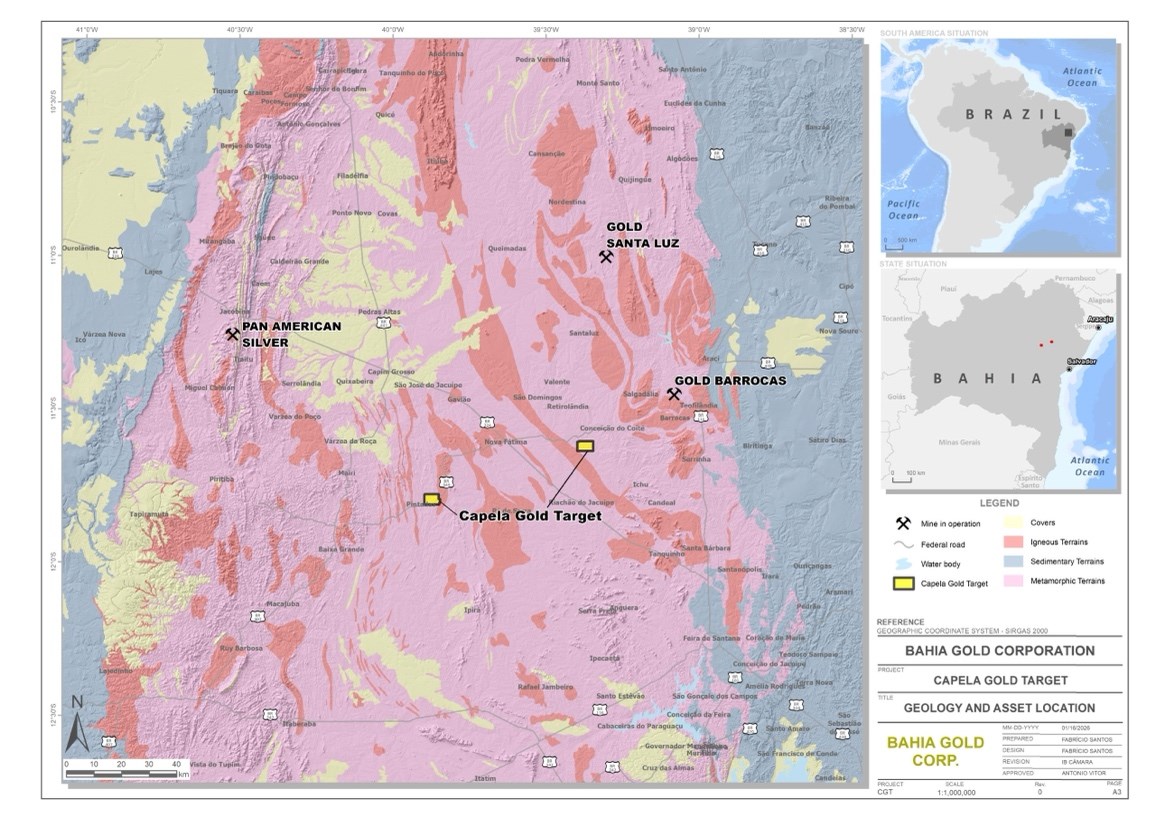
Figure 4: Capela Gold Project in proximity to Jacobina Gold Complex (Pan American Silver) and Santa Luz Bahia Complex.
To view an enhanced version of this graphic, please visit:
https://images.newsfilecorp.com/files/5386/305075_66f2cf31c49b6a31_004full.jpg
The project is currently undergoing technical advancement under the NI 43-101 framework, with ongoing activities supervised as part of the Company's exploration and validation strategy.
QUALIFIED PERSON
Mr. Carlos Henrique Lourenço Bastos is a Senior Geologist, M.Sc., and an independent Qualified Person registered with the Brazilian Commission for Resources and Reserves (CBRR). He is a Fellow of the Australasian Institute of Mining and Metallurgy (FAusIMM) and a member of the Society for Mining, Metallurgy & Exploration (SME).
Mr. Bastos has over 30 years of experience in mineral exploration and mining projects in Brazil and abroad, including resource estimation, QA/QC implementation, mine planning and supervision of drilling and exploration programs.
ABOUT BRASNOVA ENERGY MATERIALS INC.
Brasnova Energy Materials is focused on securing, developing and monetizing Brazilian critical materials assets and related materials technologies, to build shareholder value.
On behalf of the Board of Directors of
BRASNOVA ENERGY MATERIALS INC.
Joel Rovaris Ferari CEO -Brasnova
info@brasnovaem.com
FOR THE ADEQUACY OR ACCURACY OF THIS RELEASE
The information contained herein contains "forward-looking statements" within the meaning of applicable securities legislation. Forward-looking statements relate to information that is based on assumptions of management, forecasts of future results, and estimates of amounts not yet determinable. Any statements that express predictions, expectations, beliefs, plans, projections, objectives, assumptions or future events or performance are not statements of historical fact and may be "forward-looking statements".
Neither the TSX Venture Exchange nor its Regulation Services Provider (as that term is defined in policies of the TSX Venture Exchange) accepts responsibility for the adequacy or accuracy of this release.

To view the source version of this press release, please visit https://www.newsfilecorp.com/release/305075
FAQ
AI-generated questions and answers. How Rhea-AI works. Not financial advice.