
PMET Conducts Large Scale Caesium Sampling Program at CV13
PMET advances its BerryPick caesium sampling at CV13 toward feasibility-level testwork, underpinned by large lithium and caesium mineral resources.
Sentiment and the balance of points
Rhea-AI Sentiment reads the wording of the document, how positive or negative its language is on a 1 to 5 scale. The balance of points shown with the takes weighs what the document actually discloses, so the two can disagree, for example when a trial that missed its main goal is described in upbeat language.
Rhea-AI Summary
PMET Resources (PMETF) reports progress on its BerryPick program, having collected more than 2.5 tonnes of pollucite pegmatite from outcrop at the Vega Caesium Zone within the CV13 pegmatite.
The material is being obtained using very large diameter shallow core (~30 cm, <60 cm deep) on a grid, providing large fragments needed for advanced ore sorting and feasibility-level testwork while avoiding costlier blasting or PQ coring. The company aims to generate 500–1,000 kg of pollucite concentrate for development testwork and downstream caesium chemical studies, including potential future programs with Koch Technology Solutions. Ore sorting testwork is anticipated to begin in Q4 2026, with results expected in the first half of 2027. The property hosts a consolidated lithium-tantalum Mineral Resource of 108.0 Mt at 1.40% Li2O (Indicated) and 33.4 Mt at 1.33% Li2O (Inferred), plus a pollucite-hosted caesium resource of 0.69 Mt at 4.40% Cs2O (Indicated) and 1.70 Mt at 2.40% Cs2O (Inferred).
Positive
- More than 2.5 tonnes of pollucite pegmatite collected from Vega Zone outcrop
- BerryPick aims to produce 500–1,000 kg of pollucite concentrate for development testwork
- Ore sorting testwork planned to start in Q4 2026 with results expected in H1 2027
- Consolidated Mineral Resource totals 108.0 Mt at 1.40% Li2O (Indicated) and 33.4 Mt at 1.33% Li2O (Inferred)
- Pollucite-hosted caesium resource of 0.69 Mt at 4.40% Cs2O (Indicated) and 1.70 Mt at 2.40% Cs2O (Inferred)
- Positive lithium-only Feasibility Study on CV5 with 84.3 Mt at 1.26% Li2O Probable Reserve
Negative
- Assay results for visual pollucite estimates are not expected until mid 2027
- Final composite grades and ore sorting outcomes will only be known after testwork completion in H1 2027, delaying clarity on economics
Details
News Market Reaction – PMETF
On Sep 9, the first trading day after this news, PMETF closed 0.73% above the previous close.
Data tracked by StockTitan Argus for the Sep 9 session.
AI-generated analysis. How Rhea-AI works. Not financial advice.




Collection of pollucite pegmatite samples at scale supports ongoing development studies including further concentrate recovery and downstream caesium chemical testwork
Highlights
- More than 2.5 tonnes of pollucite pegmatite collected to date from outcrop at the Vega Zone (CV13).
- Collection utilizing very large diameter drill core (~30 cm) from a grid of shallow holes (<60 cm) over mineralized outcrop offering significant advantages:
- Larger size fragments (~30 cm) and larger quantity of sample.
- Fast and low-cost collection method.
- Pollucite concentrate derived from these samples will support larger scale downstream chemical testwork programs and industry product engagement.
- The Company continues engaging with strategic caesium players downstream, including building on its existing relationship with Koch Technology Solutions for chemical processing.
- Samples of pollucite pegmatite outcrop will continue to be collected as practical through the fall, with ore sorting testwork anticipated to begin in Q4 2026.
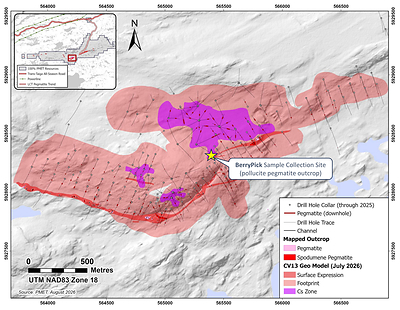
PMET Resources Inc. (the "Company" or "PMET") (TSX: PMET) (ASX: PMT) (OTCQX: PMETF) (FSE: R9GA) is pleased to provide an update on its previously announced program targeting the collection of multiple tonne samples of pollucite pegmatite, supporting ongoing development testwork for concentrate production and downstream initiatives (collectively, the "BerryPick" program). The sample is being collected from an outcrop of the Vega Caesium Zone at the CV13 Pegmatite, where previous channel sampling returned 3.0 m at
More than 2.5 tonnes of pollucite pegmatite has been collected to date by way of an innovative shallow coring sampling program utilizing very large diameter drill core (~30 cm) from a grid of shallow holes (<60 cm) over the mineralized outcrop occurrence (Figure 1, Figure 2, Figure 3, and Figure 4). The core samples collected from the outcrop will be composited and submitted for ore sorting testwork, including geochemical analysis, which is anticipated to commence in Q4 2026. Final grades of composites will be announced with ore sorting test program results when received and compiled.
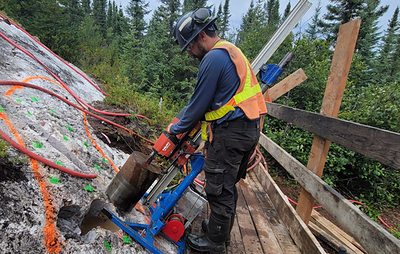
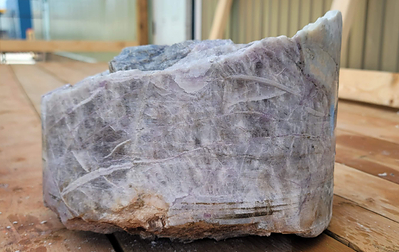
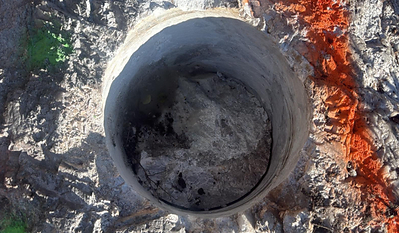
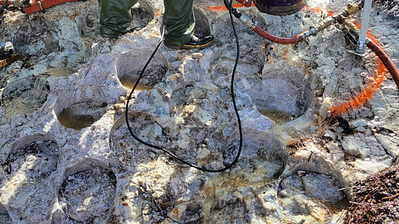
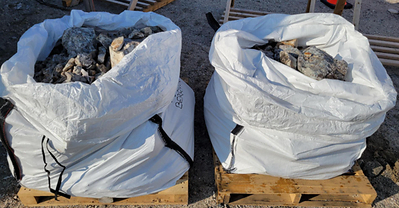
Pollucite (as described in Figure 1, Figure 2, Figure 3, and Table 1) has been determined based on visual identification, portable XRF readings on site, as well as prior sampling and geochemical assay of the outcrop (see news release dated April 9, 2025). The core samples collected from the outcrop will be composited and submitted for ore sorting testwork, including geochemical analysis, which is anticipated to commence in Q4 2026. Final grades of composites will be announced with ore sorting test program results when received and compiled. Visual estimates of mineral abundance should never be considered a proxy or substitute for laboratory analyses where concentrations or grades are the factor of principal economic interest. Visual estimates also potentially provide no information regarding impurities or deleterious physical properties relevant to valuations.
Figure Number | Nature of Occurrence | Visual Estimates of Mineral(s) & Abundance | Expected Timing of Assays |
Figure 1 (Top) | Massive/veined | > lepidolite & spodumene, remainder feldspar>quartz | Mid 2027 |
Figure 1 (Bottom) | Massive/veined | > minor feldspar/quartz | Mid 2027 |
Figure 2 (Top) | Massive/veined | > lepidolite & spodumene, remainder feldspar>quartz | Mid 2027 |
Figure 2 (Bottom) | Massive/veined | > lepidolite & spodumene, remainder feldspar>quartz | Mid 2027 |
Figure 3 | Massive/veined | ~ feldspar>quartz (LEFT); < spodumene/lepidolite, minor feldspar>quartz (RIGHT) | Mid 2027 |
Sample Collection Methodology and Testwork
The sample collection methodology undertaken in the BerryPick program offers significant advantages. It provides larger diameter samples (~30 cm) required for more advanced ore sorting testwork. Having larger size pegmatite fragments (upwards of 30 cm) is required for future feasibility level data and allows for a more accurate assessment of recovery behavior during a mining operation as the sample better approximates blasted Run of Mine material after crushing compared to drill core.
Prior testwork had been limited to NQ (4.8 cm) and HQ (6.4 cm) core sizes as this was what material size was available, which was sufficient to support initial testwork programs. The BerryPick program samples will provide much larger size fragments at greater volume suitable for feasibility level assessment.
The current sampling program methodology also avoids the alternative (and significantly more expensive) methods of collection for large-size fragments at sufficient scale (which could include blasting and/or PQ coring – 8.5 cm) to support more advanced test programs. Further, it allows for large quantities of representative pollucite concentrate sample to be generated over a much shorter time period.
The Company's primary objective of this program is to produce 500 – 1,000 kg of pollucite concentrate to support ongoing development testwork for pollucite concentrate production and downstream caesium chemical testwork. This would include potential future chemical testwork programs with Koch Technology Solutions, as the Company furthers engagement with strategic partners in the caesium industry downstream (see news releases dated April 15, 2026 and July 12, 2026).
The Company will continue to collect pollucite pegmatite samples as practical through the fall with ore sorting testwork anticipated to begin in Q4 2026 with results anticipated to be received and announced in the first half of 2027.
In addition to being one of the largest lithium-tantalum pegmatite Mineral Resources1 and lithium pegmatite Mineral Reserves2 globally, the Property also hosts the world's largest in-situ pollucite-hosted caesium pegmatite Mineral Resource, comprising 0.69 Mt at
________________________ | |
1Consolidated MRE (CV5 + CV13 pegmatites) totals 108.0 Mt at | |
2Probable Mineral Reserve of 84.3 Mt at |
Qualified/Competent Person
The technical and scientific information in this news release that relates to the Mineral Resource Estimate, exploration, and metallurgical results (including BerryPick as described herein) for the Company's properties is based on, and fairly represents, information compiled by Mr. Darren L. Smith, M.Sc., P.Geo., who is a Qualified Person as defined by National Instrument 43-101 – Standards of Disclosure for Mineral Projects ("NI 43-101"), and member in good standing with the Ordre des Géologues du
Mr. Smith is an Executive and Vice President of Exploration for PMET Resources Inc. and holds common shares, Restricted Share Units (RSUs), Performance Share Units (PSUs), and options in the Company.
Mr. Smith has sufficient experience, which is relevant to the style of mineralization, type of deposit under consideration, and to the activities being undertaken to qualify as a Competent Person as described by the Australasian Code for Reporting of Exploration Results, Mineral Resources and Ore Reserves (the JORC Code). Mr. Smith consents to the inclusion in this news release of the matters based on his information in the form and context in which it appears.
The information in this news release that relates to the Mineral Reserve Estimate and Feasibility Study is based on, and fairly represents, information compiled by Mr. Frédéric Mercier-Langevin, Ing. M.Sc., who is a Qualified Person as defined by NI 43-101, and member in good standing with the Ordre des Ingénieurs du
Mr. Mercier-Langevin is the Chief Operating and Development Officer for PMET Resources Inc. and holds common shares, RSUs, PSUs, and options in the Company.
About PMET Resources Inc.
PMET Resources Inc. is a pegmatite critical mineral exploration and development company focused on advancing its district-scale
In late 2025, the Company announced a positive lithium-only Feasibility Study on the CV5 Pegmatite for the Shaakichiuwaanaan Property and declared a maiden Mineral Reserve of 84.3 Mt at
________________________ | |
3See Feasibility Study news release dated October 20, 2025. Probable Mineral Reserve cut-off grade is |
The Project hosts a Consolidated Mineral Resource4 totalling 108.0 Mt at
This news release has been approved by
"KEN BRINSDEN"
Kenneth Brinsden, President, CEO, & Managing Director
Disclaimer for Forward-Looking Information
This news release contains "forward-looking statements" and "forward-looking information" within the meaning of applicable securities laws.
All statements, other than statements of present or historical facts, are forward-looking statements. Forward-looking statements involve known and unknown risks, uncertainties and assumptions and accordingly, actual results could differ materially from those expressed or implied in such statements. You are hence cautioned not to place undue reliance on forward-looking statements. Forward-looking statements are typically identified by words or expressions such as "supports", "ongoing",, "continues", "building", "anticipated", "advancing", "objectives" or variations of such words or expressions and phrases or statements that certain actions, events or results "may", "could", "would", "might" or "will" be taken, occur or be achieved.
Forward-looking statements include, but are not limited to, statements concerning the timing of certain activities mentioned in this press release, the savings expected from the current sampling methodology program as well as the ability to to produce >500 kg to potentially >1 tonne of pollucite concentrate from the program.
Forward-looking statements are based upon certain assumptions and other important factors that, if untrue, could cause actual results to be materially different from future results expressed or implied by such statements. There can be no assurance that forward-looking statements will prove to be accurate. Key assumptions upon which the Company's forward-looking information is based include, without limitation, the ability to obtain the required financing to bring the Project to development, the ability to make discoveries, the potential of each of tantalum, lithium and caesium, that proposed exploration work on the Property and the results therefrom will continue as expected, the accuracy of reserve and resource estimates, the classification of resources and the assumptions on which the reserve and resource estimates are based, long-term demand for lithium (spodumene), tantalum (tantalite), and caesium (pollucite) supply, and that exploration and development results continue to support management's current plans for the Property's development.
______________________ |
4 Consolidated MRE (CV5 + CV13 pegmatites) is reported at an Li2O cut-off grade of |
Forward-looking statements are also subject to risks and uncertainties facing the Company's business, any of which could have a material adverse effect on the Company's business, financial condition, results of operations and growth prospects. Readers should review the detailed risk discussion in the Company's most recent Annual Information Form filed on SEDAR+, for a fuller understanding of the risks and uncertainties that affect the Company's business and operations.
Although the Company believes its expectations are based upon reasonable assumptions and has attempted to identify important factors that could cause actual actions, events or results to differ materially from those described in forward-looking statements, there may be other factors that cause actions, events or results not to be as anticipated, estimated or intended. There can be no assurance that forward-looking information will prove to be accurate. If any of the risks or uncertainties mentioned above, which are not exhaustive, materialize, actual results may vary materially from those anticipated in the forward-looking statements.
The forward-looking statements contained herein are made only as of the date hereof. The Company disclaims any intention or obligation to update or revise any forward-looking statements, whether as a result of new information, future events or otherwise, except to the extent required by applicable law. The Company qualifies all of its forward-looking statements by these cautionary statements.
Competent Person Statement (ASX Listing Rules)
The information in this news release that relates to the Feasibility Study ("FS") for the Shaakichiuwaanaan Project, which was first reported by the Company in a market announcement titled "PMET Resources Delivers Positive CV5 Lithium-Only Feasibility Study for its Large-Scale Shaakichiuwaanaan Project" dated October 20, 2025 (
The Mineral Resource and Mineral Reserve Estimates in this release were first reported by the Company in accordance with ASX Listing Rules 5.8 and 5.9 in market announcements titled "World's Largest Pollucite-Hosted Caesium Pegmatite Deposit" dated July 20, 2025 (
Appendix 1 – JORC Code 2012 Table 1 (ASX Listing Rule 5.8.2)
Section 1 – Sampling Techniques and Data
Criteria | JORC Code explanation | Commentary |
Sampling techniques |
|
|
Drilling techniques |
|
|
Drill sample recovery |
|
|
Logging |
|
|
Sub-sampling techniques and sample preparation |
|
|
Quality of assay data and laboratory tests |
|
|
Verification of sampling and assaying |
|
|
Location of data points |
|
|
Data spacing and distribution |
|
|
Orientation of data in relation to geological structure |
|
|
Sample security |
|
|
Audits or reviews |
|
|
Section 2 – Reporting of Exploration Results
Criteria | JORC Code explanation | Commentary |
Mineral tenement and land tenure status |
|
|
Exploration done by other parties |
|
|
Geology |
|
|
Drill hole Information |
|
|
Data aggregation methods |
|
|
Relationship between mineralization widths and intercept lengths |
|
|
Diagrams |
|
|
Balanced reporting |
|
|
Other substantive exploration data |
|
|
Further work |
|
|
 View original content to download multimedia:https://www.prnewswire.com/news-releases/pmet-conducts-large-scale-caesium-sampling-program-at-cv13-302872782.html
SOURCE PMET Resources Inc.
FAQ
AI-generated questions and answers. How Rhea-AI works. Not financial advice.
What sampling method is PMET using in the BerryPick program at CV13?
The BerryPick program uses a grid of shallow drill holes in outcrop, each to a depth of less than 60 cm, extracting very large diameter core of approximately 30 cm. This approach yields large pegmatite fragments that better approximate crushed Run of Mine material and are suitable for advanced ore sorting and feasibility-level testwork, while avoiding more expensive options such as blasting or PQ coring.
What is the purpose of the pollucite concentrate PMET plans to produce?
The company’s primary objective is to produce 500–1,000 kg of pollucite concentrate to support ongoing development testwork for pollucite concentrate production and downstream caesium chemical testwork. This includes potential future chemical testwork programs with Koch Technology Solutions and engagement with other strategic caesium industry partners.
When will PMET’s ore sorting testwork on the Vega Zone material take place?
Composite samples from the collected pollucite pegmatite are anticipated to be submitted for ore sorting testwork, including geochemical analysis, beginning in Q4 2026. Results from this testwork are expected to be received and announced in the first half of 2027.
What prior caesium grades have been reported at the Vega Caesium Zone?
Previous channel sampling at the Vega Caesium Zone within the CV13 pegmatite returned 3.0 m at 9.43% Cs2O, as referenced by the company from an earlier news release dated April 9, 2025.
How does PMET characterize the scale and location of its Shaakichiuwaanaan Property?
The Shaakichiuwaanaan Property is described as a district-scale, 100%-owned pegmatite critical mineral project in the Eeyou Istchee James Bay region of Quebec, Canada. It is accessible year-round by all-season road and is proximal to regional hydropower infrastructure, with the CV5 pegmatite located approximately 13 km south of the Trans-Taiga Road and powerline corridor.
What caution does PMET provide about visual estimates of pollucite abundance?
The company states that visual estimates of mineral abundance, including those guided by portable XRF readings and prior sampling, should never be considered a proxy or substitute for laboratory analyses where grades are the principal economic factor. Visual estimates may provide no information on impurities or deleterious physical properties relevant to valuations.