
End of Year AI Report: More higher ed students embrace AI for active learning; educators see instructional opportunities
Pearson (PSON.L) released new insights showing increased AI adoption in higher education.
Rhea-AI Summary
Pearson (PSON.L) released new insights showing increased AI adoption in higher education. Students using Pearson's AI tools are 4x more likely to engage in active studying, with an 11-percentage-point increase in students reporting better grades and study efficiency. Usage data reveals that students using AI-generated flashcards were nearly 3x more likely to return and practice.
The analysis shows 38% of student inputs demonstrate higher cognitive complexity, while 25% involved critical thinking skills. AI sessions in MyLab and Mastering increased 95% from fall 2023 to 2024. Faculty adoption is also growing, with 77% of surveyed educators envisioning AI integration in teaching methods, particularly for generating examples, providing tutoring services, and developing instructional content.
Positive
- AI study tools users 4x more likely to engage in active studying
- 95% increase in AI sessions from fall 2023 to 2024
- 77% of faculty members plan to integrate AI in teaching methods
- 38% of student inputs show higher cognitive complexity
- AI-generated flashcard users show 3x higher engagement rates
Negative
- None.
Details
News Market Reaction – PSO
In the trading session that priced this news, PSO declined 1.47%, reflecting a mild negative market reaction.
Data tracked by StockTitan Argus on the day of publication.
AI-generated analysis. How Rhea-AI works. Not financial advice.




- Higher ed students using Pearson AI tools are 4x as likely to engage in active and efficient studying
- More students report AI is helping them get better grades and study more efficiently
77% of faculty envision using AI to enhance teaching methods, including AI-based tutoring and instructional content
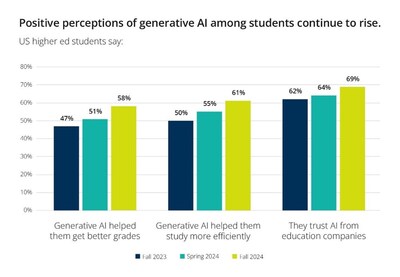
Pearson, in partnership with Morning Consult, conducted its third consecutive semester surveying US college students to track their evolving use and perception of AI. The survey of more than 1,000 students shows an 11-percentage-point increase in students reporting that AI has helped them get better grades and study more efficiently.
Pearson user data shows AI tools promote active and efficient studying
This fall, Pearson learning science researchers analyzed student study behavior in eTextbooks with embedded AI study tools from fall '23 through spring '24. The analysis showed many students advancing from passive to active study, which fosters better retention of information and is associated with a deeper understanding of concepts. Active study behaviors include notetaking, self-testing and spaced practice, rather than behaviors like memorization and cramming, which are characteristic of passive studying.
Key insights from the fall 2024 usage trends include:
- More Active Studying: Students using AI study tools were 4x as likely to remain or become active, efficient studiers compared to those who did not use the AI study tools.
- Advanced Learning:
38% of student inputs to the AI explain study tool in Campbell Biology show students engaging at a higher level of cognitive complexity, such as applying, analyzing or evaluating information. - Higher-Order and Critical Thinking:
25% of student inputs to the AI explain study tool in Campbell Biology specifically involved analysis or evaluation associated with critical thinking skills.
In addition, Pearson usage data shows students who used AI-generated flashcards in their eTextbook were nearly three times more likely to return and practice than students without AI-generated flashcards, indicating high engagement.
In Pearson's MyLab and Mastering study platform, AI sessions increased
"This data underscores the importance of active learning, and the role AI can play in enhancing student engagement," said Emily Lai, vice president of learning impact measurement. "We employ learning science principles to create features that promote active learning to help students succeed and develop skills for their academic and professional lives. We are excited to see AI making quality learning easier for today's busy students."
Faculty see opportunity for AI implementation
Higher education faculty are increasingly seeing the potential of AI in the classroom. According to a Pearson survey conducted with Intertwine Insights,
Top ways faculty are interested in using AI:
- Generating additional examples and sourcing materials to enrich lessons (
41% ). - Providing AI-based tutoring services to assist students with challenging concepts (
40% ). - Developing instructional content to make lesson planning more efficient (
39% ). - Creating AI-generated study tools such as outlines, flashcards, practice tests and study guides (
35% ).
This growing interest in AI by faculty complements the positive student data, highlighting a broader trend of AI integration in education.
More than two million US higher education students currently have access to AI study tools in more than 100 MyLab and Mastering titles and nearly 350 eTextbook titles, with many titles featuring AI in global editions. Thousands of US educators also have access to AI instructor tools in nearly 60 MyLab and Mastering titles that allow them to efficiently create customized assignments for their students. The availability of these features to students and educators marks Pearson's commitment to learning experiences with AI features for studying, learning and instruction.
Pearson's application of generative AI is part of a product development process that is driven by learning science and subject matter experts. With more than
To learn more, read the Pearson 2024 End of Year AI Report for Higher Education.
About Pearson
At Pearson, our purpose is simple: to help people realize the life they imagine through learning. We believe that every learning opportunity is a chance for a personal breakthrough. That's why our c. 18,000 Pearson employees are committed to creating vibrant and enriching learning experiences designed for real-life impact. We are the world's lifelong learning company, serving customers in nearly 200 countries with digital content, assessments, qualifications, and data. For us, learning isn't just what we do. It's who we are. Visit us at pearsonplc.com.
Media Contact:
Sami Miller, Sami.Miller@Pearson.com
 View original content to download multimedia:https://www.prnewswire.com/news-releases/end-of-year-ai-report-more-higher-ed-students-embrace-ai-for-active-learning-educators-see-instructional-opportunities-302330254.html
SOURCE Pearson
FAQ
AI-generated questions and answers. How Rhea-AI works. Not financial advice.