
Powermax Minerals Identifies Priority Rare Earth Element Targets at the Hopkins REE Project, Ontario
Rhea-AI Summary
Powermax Minerals (OTCQB:PWMXF) reported results of a desktop study for its Hopkins Rare Earth Element Project in northeastern Ontario. The 6,145-hectare project is divided into Block A and Block B.
The study ranks Block A as Priority #1 with five target areas (A1–A5) and Block B as Priority #2 with two targets (B1–B2). A Weight-of-Evidence model links the highest REE prospectivity to coincident TREO anomalies, radiometric ratios, gravity highs and magnetic tilt derivative features, supporting a margin- and structure-controlled REE exploration model and guiding detailed sampling and mapping programs.
Positive
- Desktop study defines prioritized REE targets across Hopkins Project Blocks A and B
- Block A designated Priority #1 with five REE target areas A1–A5
- Block B defined as Priority #2 with two margin-related targets B1–B2
Negative
- None.
News Market Reaction – PWMXF
In the Jun 11 session, PWMXF gained 4.95%, reflecting a moderate positive market reaction.
Data tracked by StockTitan Argus on the day of publication.
AI-generated analysis. How Rhea-AI works. Not financial advice.




Toronto, Ontario--(Newsfile Corp. - June 11, 2026) - Powermax Minerals Inc. (CSE: PMAX) (OTCQB: PWMXF) (FSE: T23) ("Powermax" or the "Company") is pleased to announce that it has received a desktop study for its Hopkins Rare Earth Element ("REE") Project located in the Cochrane District of northeastern Ontario. The desktop study evaluated publicly available geological, geophysical, geochemical and historical exploration datasets to assess REE prospectivity and establish priorities for future field programs on the Hopkins REE tenements.
The desktop study was prepared for Powermax by Shahab Tavakoli, P.Geo., Geophysicist and Geospatial Data Scientist, and focused on exploration targeting across Blocks A and B of the Hopkins REE Project. The work integrated whole-rock geochemical data with regional airborne magnetic and radiometric surveys acquired by the Ontario Geological Survey over the Smooth Rock Falls area, along with gravity data and historical exploration information for the Clay-Howells alkalic intrusive complex..
The Hopkins REE Project comprises 13 mineral claims organized into two claim blocks covering approximately 6,145 hectares. Block A consists of 11 contiguous claims covering approximately 5,479 hectares, while Block B consists of two claims covering approximately 666 hectares on the east side of the Mattagami River. The Project is located approximately 45 kilometres north-northeast of Kapuskasing, within the Porcupine Mining Division, and is situated in the highly prospective based on the datasets reviewed, "the Kapuskasing Structural Zone", a regional corridor reported to host REE-bearing alkaline intrusions.
Desktop Study Highlights
- The study identifies Block A as Priority #1 and Block B as Priority #2 for follow-up REE exploration.
- Block A hosts five priority target areas (A1 through A5), where clusters of high-prospectivity cells coincide with major structural features interpreted from the magnetic tilt derivative. Area A1, located on the north bank of the Kapuskasing River in southern Block A, is interpreted as the highest-ranked target generated by the desktop study, and is recommended for detailed rock sampling, structural mapping and possible soil geochemistry.
- Block B contains two target zones, identified as B1 and B2, along the intrusive margin where ENE-trending structures support moderate but localized REE potential.
- The Weight-of-Evidence (WofE) model indicates that REE prospectivity is highest where strongly anomalous TREO values align with elevated Th/K, elevated U/K, variable Th/U, high gravity responses, and positive extrema in the magnetic tilt derivative (TDR). These coincident geophysical and geochemical signatures highlight magnetite- and iron-rich structural or lithological zones considered favourable for REE mineralization.
- The study supports a margin- and structure-controlled REE exploration model, where late-stage carbonatitic and metasomatic processes may have focused REE enrichment along intrusion margins, internal breaks and structural corridors.
Priority Target Areas
The desktop study concludes that REE prospectivity at Hopkins is driven by the convergence of multiple geological and geophysical indicators rather than any single dataset. The highest-priority target areas occur where structural lineaments, gravity gradients, radiometric anomalies, and historical TREO values coincide to define structurally focused, geochemically evolved zones considered favourable for REE mineralization.
| Target Area | Priority | Key Interpretation | Recommended Follow-up |
| A1 | Highest priority | Highest ranked hotspot in southern Block A, north bank of Kapuskasing River; interpreted an overlap of favourable structure and REE fertility indicators. | Detailed rock sampling, structural mapping and possible soil geochemistry to define corridor width. |
| A2-A5 | Priority #1 group | High-prospectivity cells on the datasets reviewed in Block A overlapping major TDR lineaments and favourable radiometric/geophysical signatures. | Prospecting, mapping, rock sampling and ground verification of geophysical and radiometric anomalies. |
| B1-B2 | Priority #2 group | Structurally focused zones along intrusive margin; ENE-trending structures support localized REE potential. | Targeted mapping, prospecting and sampling of margin-related structures and western-boundary anomalies. |
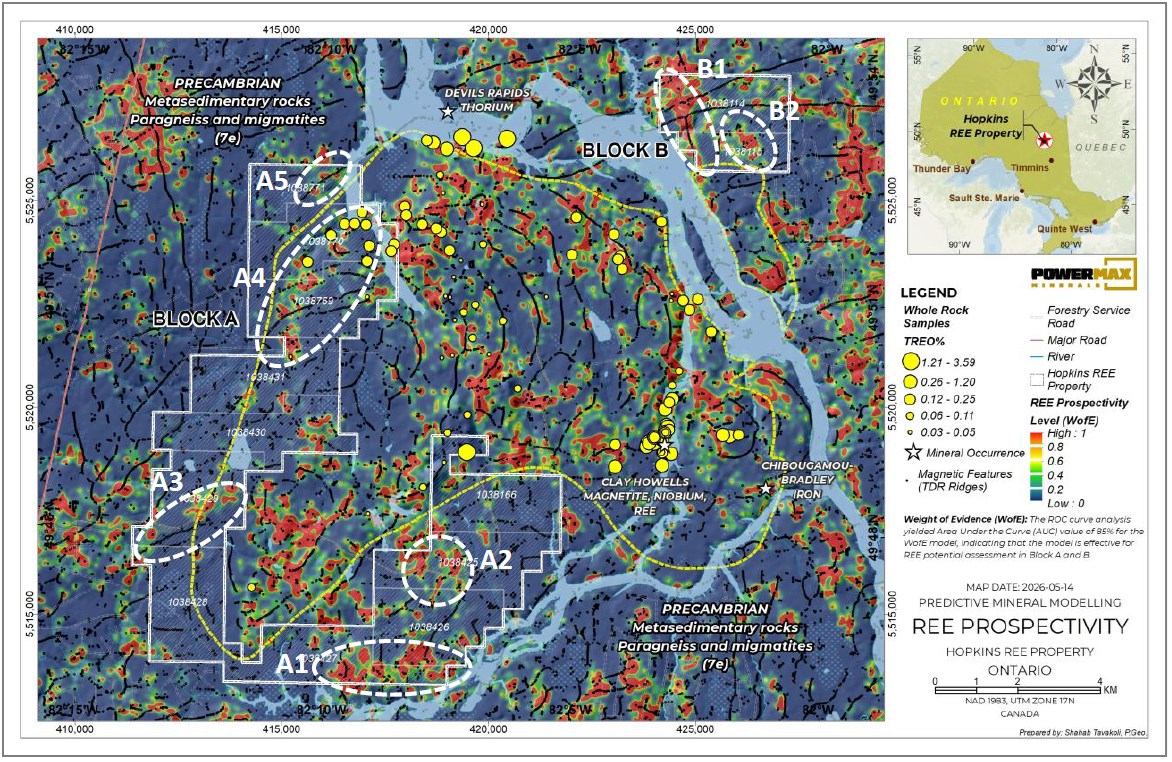
Figure 1: Weight-of-Evidence REE prospectivity map for the Clay-Howells intrusion showing interpreted REE prospectivity levels for Blocks A and B, publicly available whole-rock TREO sample data, and positive extrema of the magnetic tilt derivative, interpreted to reflect possible magnetite- and iron-bearing lithological or structural features.
To view an enhanced version of this graphic, please visit:
https://images.newsfilecorp.com/files/11633/300976_f45d2c50741059be_001full.jpg
Geological Significance
The Clay-Howells complex is interpreted as a structurally emplaced, multi-phase alkaline-carbonatite intrusive centre characterized by LREE-dominant, magnetite-associated and carbonatite-related REE mineralization. The study identifies two principal REE mineralization styles: an intrusion-hosted, magnetite-bearing, K-rich syenite system, and a contact-hosted, Th-rich metasomatic system developed along the intrusive-paragneiss boundary.
The desktop study indicates that Block A lies within a central-to-marginal transition zone where two REE mineralization styles may overlap: an intrusion-internal, Fe-Ca-P-rich magnetite-apatite system along stronger magnetic corridors, and a more evolved, Th-rich monazite ± allanite style developed in silica-rich marginal zones affected by late calcium-rich carbonatitic alteration. Block B is interpreted to contain structurally focused target zones along the intrusive margin. These areas are considered prospective based on the datasets reviewed or Th-rich, LREE-enriched metasomatic fronts and stockwork-style mineralization linked to late-stage alkaline or carbonatitic fluids.
The study further notes that reported REE mineralization at Clay-Howells occurs across several geological settings, including syenite, carbonatite, massive magnetite zones, syenite breccias and fault-alteration breccias. These settings support a hybrid magmatic-hydrothermal REE system with both intrusion-internal magnetite-apatite-syenite LREE mineralization and contact-hosted, Th-rich, carbonatite-related REE-Nb mineralization.
Cautionary Note Regarding Historical Information and Adjacent Mineralization
The desktop study is based on publicly available geological, geophysical, geochemical and historical exploration datasets, including information produced by government agencies and third-party operators. The Company and its Qualified Person have not yet independently verified all underlying historical data through fieldwork, re-sampling, or re-processing of raw geophysical datasets. Accordingly, the interpretations, target rankings and recommendations described in this news release should be considered preliminary and subject to confirmation through future exploration.
The desktop study references reported magnetite-niobium-REE mineralization and other geological features in the broader Clay-Howells intrusive complex as geological context and exploration analogues. Mineralization on nearby, adjacent or geologically similar properties is not necessarily indicative of mineralization on the Hopkins REE Project. The Hopkins REE Project does not currently contain any mineral resource or mineral reserve estimate, and there is no certainty that future exploration will result in the delineation of mineral resources.
Recommended Exploration Program
Based on the desktop study, Powermax intends to evaluate the priority targets through a phased exploration program, subject to funding, access, permitting, seasonal conditions and final program design. Recommended work includes:
- Airborne magnetic, VLF and radiometric surveys covering the property.
- geological mapping and prospecting over targets A1 to A5 and B1 to B2;
- targeted rock sampling of magnetic, radiometric, and structural anomalies;
- soil geochemistry over Area A1 and other selected target corridors;
- ground verification of magnetic and radiometric anomalies and structural lineaments; and
- may include a follow-up trenching or drill testing of priority targets, subject to exploration results and permitting.
Management Comment
Paul Gorman, Chief Executive Officer of Powermax, commented:
"The Hopkins REE desktop study provides Powermax with a clear and technically supported exploration framework. The identification of multiple priority targets, particularly Area A1 within Block A, gives the Company a focused path forward for field validation. The integration of magnetic, radiometric, gravity and geochemical datasets has highlighted structurally controlled zones that we believe warrant systematic follow-up for rare earth element mineralization."
Qualified Person
Afzaal Pirzada, P.Geo., a Director of the Company and a "Qualified Person" as defined by National Instrument 43-101, reviewed and approved the scientific and technical information disclosed in this press release.
About Powermax Minerals Inc.
Powermax Minerals Inc. is a Canadian mineral exploration company focused on advancing rare earth element projects. The Company holds options to acquire the Cameron REE Property in British Columbia and the Atikokan and Pinard REE properties in Ontario, and owns a
On Behalf of the Board of Directors
Paul Gorman, CEO & Director
Email: info@powermaxminerals.com
Website: www.powermaxminerals.com
Forward-Looking Statements
This news release contains forward-looking statements, including statements regarding the Hopkins REE Project, exploration targets, proposed exploration programs, geological interpretations, potential mineralization and future work plans. Forward-looking statements are based on current expectations and assumptions and are subject to risks and uncertainties that may cause actual results to differ materially. These risks include, but are not limited to, exploration risk, geological uncertainty, commodity price fluctuations, permitting and access risks, financing risks and regulatory approvals. The Company undertakes no obligation to update forward-looking statements except as required by applicable securities laws.

To view the source version of this press release, please visit https://www.newsfilecorp.com/release/300976