
NI 43-101 Technical Report Completed on Ecru, Highlighting Robertson, Carlin and North Nevada Rift-Style Gold Potential
Aurbis Resources (QNICF) announced completion of an independent NI 43-101 Technical Report on the Ecru Gold Project in Nevada.
Sentiment and the balance of points
Rhea-AI Sentiment reads the wording of the document, how positive or negative its language is on a 1 to 5 scale. The balance of points shown with the takes weighs what the document actually discloses, so the two can disagree, for example when a trial that missed its main goal is described in upbeat language.
Rhea-AI Summary
Aurbis Resources (QNICF) announced completion of an independent NI 43-101 Technical Report on the Ecru Gold Project in Nevada. The report concludes Ecru is very underexplored and outlines three key target styles: Robertson-style intrusion-related, Carlin-style, and Northern Nevada Rift-related epithermal gold.
The report recommends staged work: geological mapping, rock sampling, detailed magnetic and potential IP surveys, followed by drilling. Aurbis has already started a high-definition magnetic survey and plans integrated geophysics and geochemistry to generate drill targets.
Positive
- Independent NI 43-101 report completed on Ecru Gold Project
- Three distinct gold target styles identified across the property
- Ecru described as very underexplored, indicating untested potential
- Clear, staged exploration plan culminating in drilling
- High-definition magnetic survey already underway to refine targets
Negative
- Ecru Project remains at an early, underexplored stage
- Carlin-type target in the north has not been directly drill-tested
- Northern Nevada Rift epithermal target described as most speculative
- No resource estimate or economic studies disclosed in the report
AI-generated analysis. How Rhea-AI works. Not financial advice.




KEY HIGHLIGHTS
NI43-101 Technical Report completed on the Ecru project in Nevada.
The Report identifies three prospective target types, including Robertson, Carlin, and Epithermal vein-style gold mineralisation.
The findings corroborate the Company's exploration rationale for the Project, and suggest geological mapping, rock sampling, a detailed magnetic survey, a potential IP survey and then drilling.
"Aurbis is building momentum on the Ecru Gold Project. The NI 43-101 Technical Report and the high-definition drone magnetic survey, which will be reported on soon, support our original view of the project. The additional Epithermal style, North Nevada Rift-related mineralisation potential, of which the 'Fire Creek' deposit is only about 30km north of Ecru, is a welcome addition to Ecru, which we plan to explore fully.
Our methodical approach is paying dividends, and we look forward to progressing activities on Ecru,"
- Johan Lambrechts (CEO)
Vancouver, British Columbia--(Newsfile Corp. - June 2, 2026) - Aurbis Resources Corp. (CSE: AURR) (Aurbis, AURR or the Company) is pleased to announce that Mr S. McMillin from Rangefront Mining Services has completed a detailed NI 43-101 Technical Report on the Ecru project, held by Aurbis Resources in Lander County, Nevada.
The report reviewed historical data to produce a detailed assessment of the prospectivity and concluded that "The Ecru Project is very underexplored. ... Gravity and AMT geophysics support a strong network of faults across the Project. Soil anomaly distributions suggest structural and stratigraphic control of potential mineralization."
The report also identifies three prospective target styles, including Robertson-style intrusion-related gold mineralization, Carlin-style gold mineralization, and epithermal-style gold mineralization associated with the Northern Nevada Rift, which bisects the northeastern section of the project.
Aurbis is pleased that the report supports the company's own review of the available data on prospectivity potential, and that the proposed exploration activities also align.
The NI 43-101 report recommends exploration activities, including detailed mapping to identify features common to Robertson, as well as rock chip sampling to better characterise the distribution of metals. It also recommends a detailed magnetic survey to better characterise structures and define the intrusion, and an IP survey to better characterise any sulphide accumulations, before culminating in drilling of the final targets.
NI 43-101 Report Summary
The NI 43-101 Technical report was prepared by Mr. S. McMillin of Rangefront Mining Services for Aurbis Resources in May 2026 and reviewed the existing geological and technical data for the Ecru Gold Project located in the Battle Mountain Eureka trend in Nevada. The Ecru Project consists of 112 unpatented mining claims plus leased ground of approximately 1,316 ha and sits directly northeast of Nevada Gold Mines' Robertson Deposit within the Cortez Gold District - one of Nevada's most productive gold-producing regions.
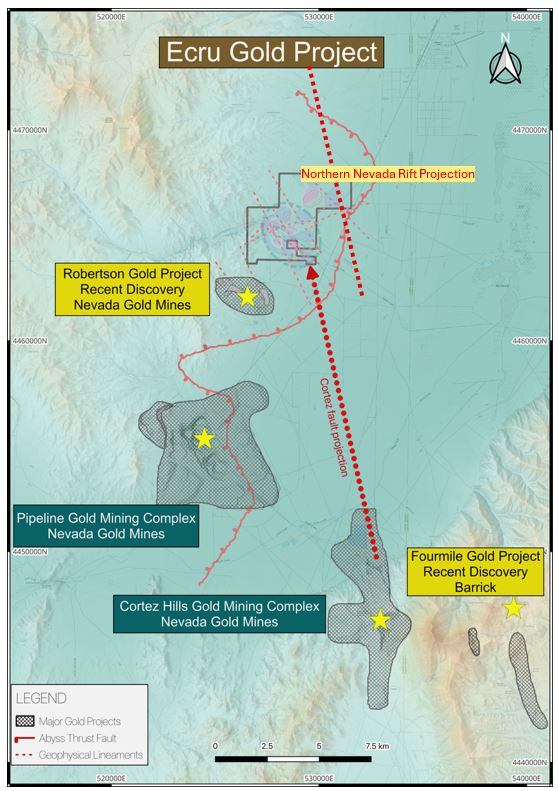
Figure 1: Map showing the location of the Ecru project
To view an enhanced version of this graphic, please visit:
https://images.newsfilecorp.com/files/8152/299766_figure1.jpg
The report states that the Ecru Project is very underexplored. "Owing to its location adjacent to Robinson, there should be common features that mapping has not identified. Gravity and AMT geophysics support a strong network of faults across the Project. Soil anomaly distributions suggest structural and stratigraphic control of potential mineralization."
The report recommends detailed mapping and rock chip sampling to identify Robertson-related characteristics and identify metal distribution. A detailed magnetic survey is also recommended to better identify structures and determine whether a larger mass of intrusive material occurs beneath the northern and southern areas of the project. An IP survey is recommended for consideration to better identify any clay alteration or sulfide accumulations, followed by drilling.
Exploration Targets
The report identifies three prospective target types across different parts of the property:
1. The southern portion, where outcrop is present, is considered the highest-priority near-term target and represents Robertson-Analogous Intrusion-Related Gold potential. Surface alteration includes strong silicification, jasper formation, and multiple generations of breccia. The Ecru and Robertson intrusive bodies appear to be part of a larger northwest-trending granodiorite cluster rather than isolated stocks.
Evidence of the intrusion beneath Ecru was mapped as a small granodiorite outcrop likely correlative with the multi-stage Eocene stock at Robertson. Hornfels, commonly associated with the Robertson deposit, was not observed during the site visit but may have been overprinted by intense silicification around the buried intrusive, as suggested by existing magnetic data.
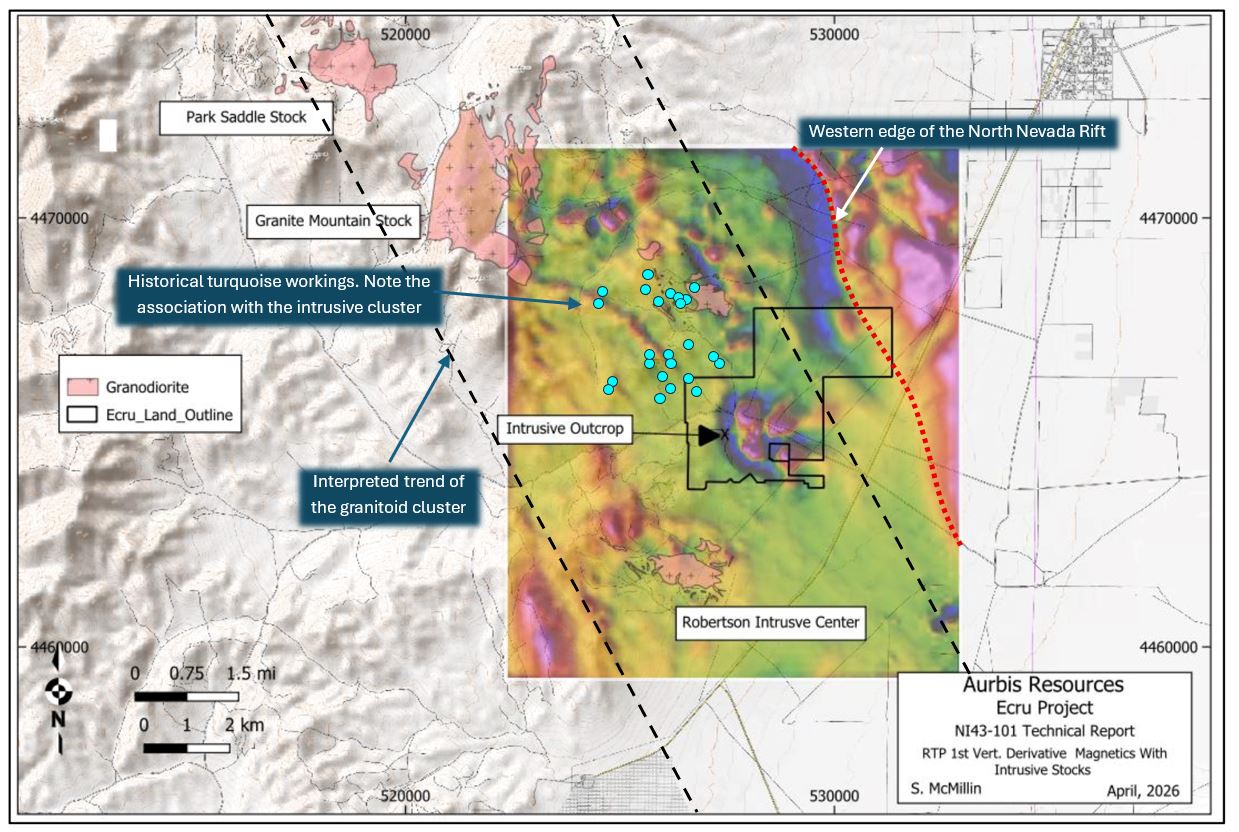
Figure 2: Map showing the Ecru intrusion and mapped outcrop location, along with the projected trend of intrusive bodies and the North Nevada Rift
To view an enhanced version of this graphic, please visit:
https://images.newsfilecorp.com/files/8152/299766_figure2.jpg
2. Gravity data suggest an anomaly in the northern portion of the property that may represent either lower-plate carbonate rocks or an intrusive body at depth. This is considered favourable for Carlin-type mineralisation. This target has not been directly drill-tested, but a nearby hole (BIC-01) encountered upper-plate shales, siltstones, and hornfels at depth.
Turquoise and other phosphate minerals occur in the vicinity of Carlin-type deposits and may provide evidence of hydrothermal activity. Figure 2 shows several turquoise workings on and surrounding Ecru. The report draws an analogy to the Blue Star Mine on the Carlin Trend, which began as a turquoise deposit before gold was identified, and it became a significant Carlin-style gold mine. On the Carlin Trend, turquoise and variscite are likely deposited from the reaction of acidic, copper and phosphate-bearing water with carbonate rocks. At Ecru, the rocks are siliciclastic, and there appears to be a strong spatial correlation between the magnetic signature/intrusive outcrop and the turquoise prospects.
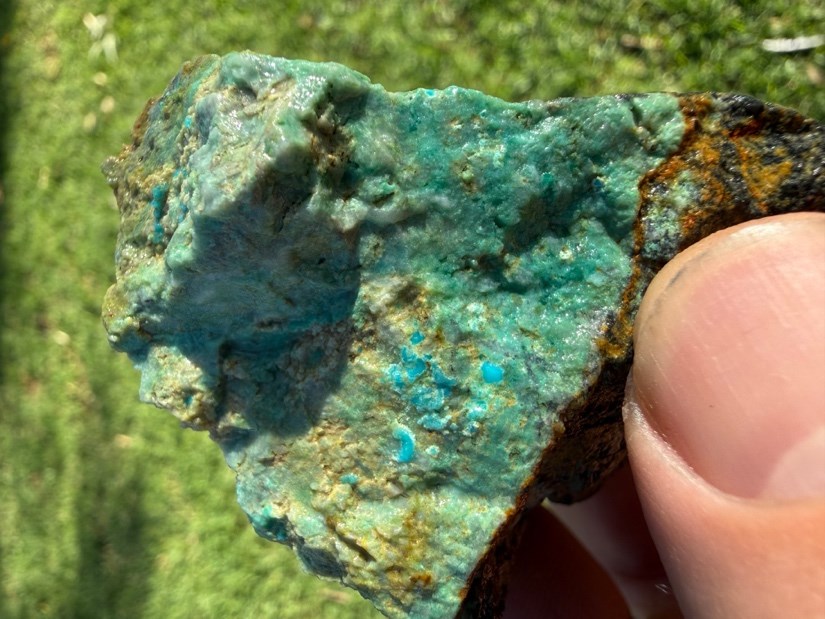
Figure 3: Photograph of a Turquoise sample collected on the western boundary of the Ecru Project
To view an enhanced version of this graphic, please visit:
https://images.newsfilecorp.com/files/8152/299766_ea9f788cf4badb7c_042full.jpg
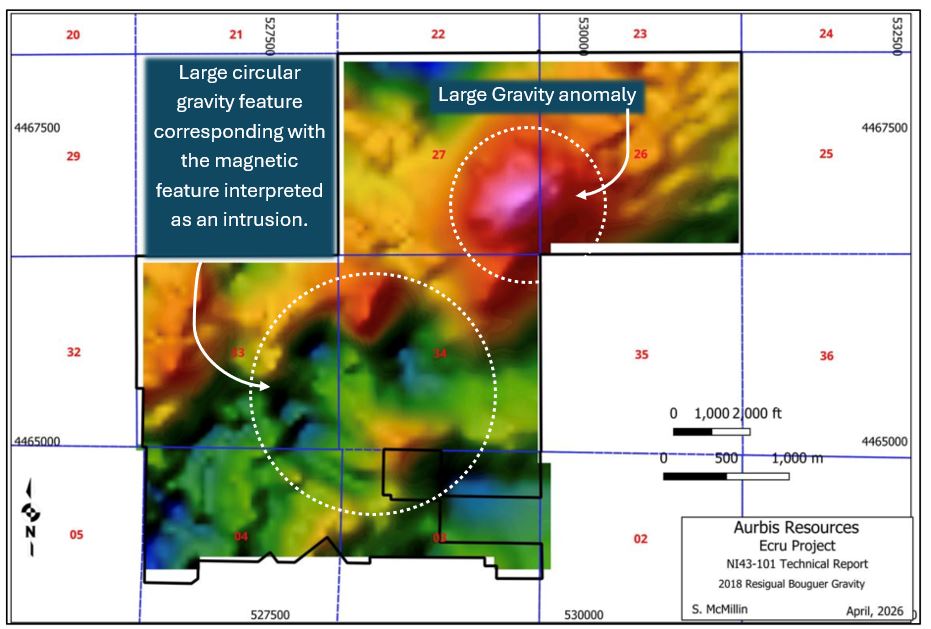
Figure 4: Map showing the residual gravity mode, highlighting the large gravity high anomaly in the north of Ecru
To view an enhanced version of this graphic, please visit:
https://images.newsfilecorp.com/files/8152/299766_figure4.jpg
3. The northeast corner of the property is close to the projected extent of the Northern Nevada Rift (NNR). This raises the possibility of epithermal-style gold mineralisation hosted in NNR volcanic rocks beneath pediment cover. Although this is considered the most speculative of the three target types, gold deposits associated with the northern Nevada Rift are often high-grade.
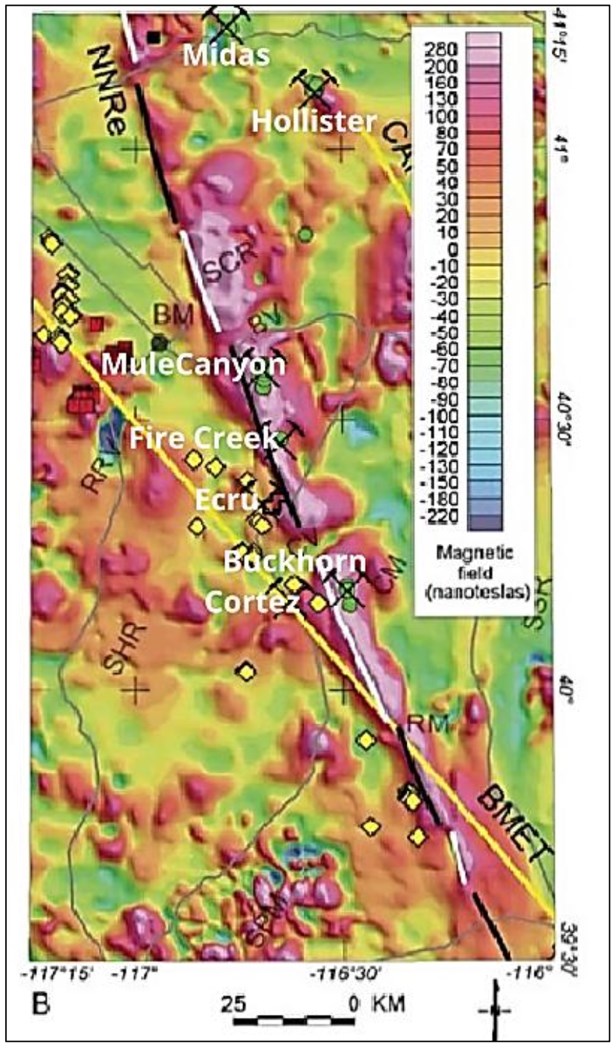
Figure 5: Figure showing the North Nevada Rift (NNRe) in relation to Ecru and the Battle Mountain Eureka trend (BMET)
To view an enhanced version of this graphic, please visit:
https://images.newsfilecorp.com/files/8152/299766_ea9f788cf4badb7c_051full.jpg
Soil and rock geochemical surveys show overlapping anomalies in Carlin-type pathfinder elements - As, Sb, Cu, Ba, Hg, Mo, and Zn - particularly in the southwest area. The report interprets these patterns as reflecting both structural and lithological controls on potential mineralization. A notably strong, isolated barium anomaly (up to 5,570 ppm Ba) is interpreted as possibly hydrothermal in origin rather than simply reflecting sedimentary barite in the Slaven Formation.
Future Activities
Aurbis Resources Corp. (CSE: AURR) is pleased that the technical report identified several target areas and mineralization styles, including the epithermal-style mineralization of the Northern Nevada Rift, which the Company had not previously considered. Aurbis will implement the activities recommended by the report and has already commenced a high-definition magnetic survey, which will be inverted to produce a 3D view of the project's magnetic characteristics and structurally interpreted to better understand potential fluid conduits. A progress report on the magnetic survey and interpretation will be issued in the near future. Field mapping and rock sampling will also commence as soon as possible to better understand local surface geology, alteration, and mineral distribution. Once the magnetic interpretation is complete, that data will be used in conjunction with the 100m x 100m gravity data to model the project's gravity characteristics. The combined data above will be used to generate initial targets, which will, in turn, guide a potential IP survey to identify clay alteration and/or sulfide mineralization. The final step, as envisaged by this exploration program, is drilling the targets identified by the culmination of the data.
We believe this is a robust exploration plan and gives the Company the best likelihood of success for discovery on the Ecru Gold Project.
We look forward to keeping our investors and followers informed of our progress.
On behalf of the Board of Directors
Johan Lambrechts
Chief Executive Officer and Director
1 (855) 764-2535
info@aurbisresources.com
The CSE has neither approved nor disapproved the contents of this news release. Neither the CSE nor its Market Regulator (as that term is defined in the policies of the CSE) accepts responsibility for the adequacy or accuracy of this release.
Qualified Person
Johan Lambrechts, QP, is the Company's qualified person as defined by NI 43-101 and has reviewed the scientific and technical information that forms the basis for portions of this news release. Mr Lambrechts is a member of the Australian Institute of Geoscientists (#5900). He has approved the disclosure herein. Mr Lambrechts is not independent of the Company, as he is a director of the Company.
CAUTIONARY AND FORWARD-LOOKING STATEMENTS
This news release includes certain statements that may be deemed "forward-looking statements". All statements in this news release, other than statements of historical facts that address events or developments that the Company expects to occur, are forward-looking statements.
Forward-looking statements are statements that are not historical facts and are generally, identified by the words "expects," "plans," "anticipates," "believes," "intends," "estimates," "projects," "potential" and similar expressions, or that events or conditions "will," "would," "may," "could" or "should" occur. Although the Company believes the expectations expressed in such forward-looking statements are based on reasonable assumptions, such statements are not guarantees of future performance.
Forward-looking statements are based on the beliefs, estimates, and opinions of the Company's management on the date the statements are made. Except as required by applicable securities laws, the Company undertakes no obligation to update these forward-looking statements if management's beliefs, estimates, opinions, or other factors.

To view the source version of this press release, please visit https://www.newsfilecorp.com/release/299766
FAQ
AI-generated questions and answers. How Rhea-AI works. Not financial advice.