
Quantum Cyber Introduces PHANTOM-950 Long-Range Autonomous UAS Platform in Development
Quantum Cyber (Nasdaq: QUCY) announced development of the PHANTOM-950, a long-range autonomous UAS concept designed for logistics, ISR, communications relay, electronic warfare, and humanitarian missions.
Sentiment and the balance of points
Rhea-AI Sentiment reads the wording of the document, how positive or negative its language is on a 1 to 5 scale. The balance of points shown with the takes weighs what the document actually discloses, so the two can disagree, for example when a trial that missed its main goal is described in upbeat language.
Rhea-AI Summary
Quantum Cyber (Nasdaq: QUCY) announced development of the PHANTOM-950, a long-range autonomous UAS concept designed for logistics, ISR, communications relay, electronic warfare, and humanitarian missions. The modular, blended-wing platform targets up to 950 km range, 18,000 m altitude, and 10 kg payload, with reusable or one-way configurations and autonomous navigation.
Quantum Cyber plans domestic manufacturing after completing its previously announced U.S. facility acquisition and production build-out.
Positive
- New PHANTOM-950 UAS concept targets up to 950 km mission range
- Targeted operating altitude up to 18,000 meters with 10 kg payload capacity
- Modular payload bay designed to support diverse government and commercial missions
- Design supports both reusable and one-way mission configurations
- Planned in-house U.S. manufacturing intended to enhance quality and scalability
- Platform intended to expand and complement existing autonomous systems portfolio
Negative
- PHANTOM-950 remains in development with no deployment or production timeline disclosed
- Domestic manufacturing depends on completion of previously announced facility acquisition and build-out
Details
Market move: QUCY -5.84% in the Jul 2 session. PHANTOM-950 UAS platform introduction
On Jul 2, the day this news came out, QUCY closed 5.84% below the previous close.
Data tracked by StockTitan Argus for the Jul 2 session.
Key Figures
- Maximum mission range
- 950 kilometers
- Targeted mission range for PHANTOM-950 platform
- Operating altitude
- 18,000 meters
- Targeted operating ceiling for PHANTOM-950
- Payload capacity
- 10 kilograms
- Targeted maximum payload for PHANTOM-950
Historical Context
-
Agreed to acquire Bridgeport manufacturing facility and equipment for $3.2M.
-
Board approval to pursue acquisition of an equity stake in SpaceX.
-
Announced alignment with U.S. National Quantum Initiative executive order.
-
Introduced Quantum Station battlefield operating system for autonomous warfare.
-
Outlined strategic developments and financing, including $15M warrant proceeds.
24h Move is the share-price change in the day after each event; other market factors may also have contributed.
Key Terms
unmanned aerial system technical
electronic warfare technical
blended-wing airframe technical
multi-stage propulsion technical
AI-generated analysis. How Rhea-AI works. Not financial advice.




New Platform Concept Would Expand the Company’s Autonomous Systems Portfolio With a Configurable Long-Range Aircraft Designed for Logistics, ISR, Communications Relay and Government Mission Profiles | Platform will be Built Using Stealth Capabilities
WEST PALM BEACH, Florida, July 02, 2026 (GLOBE NEWSWIRE) -- 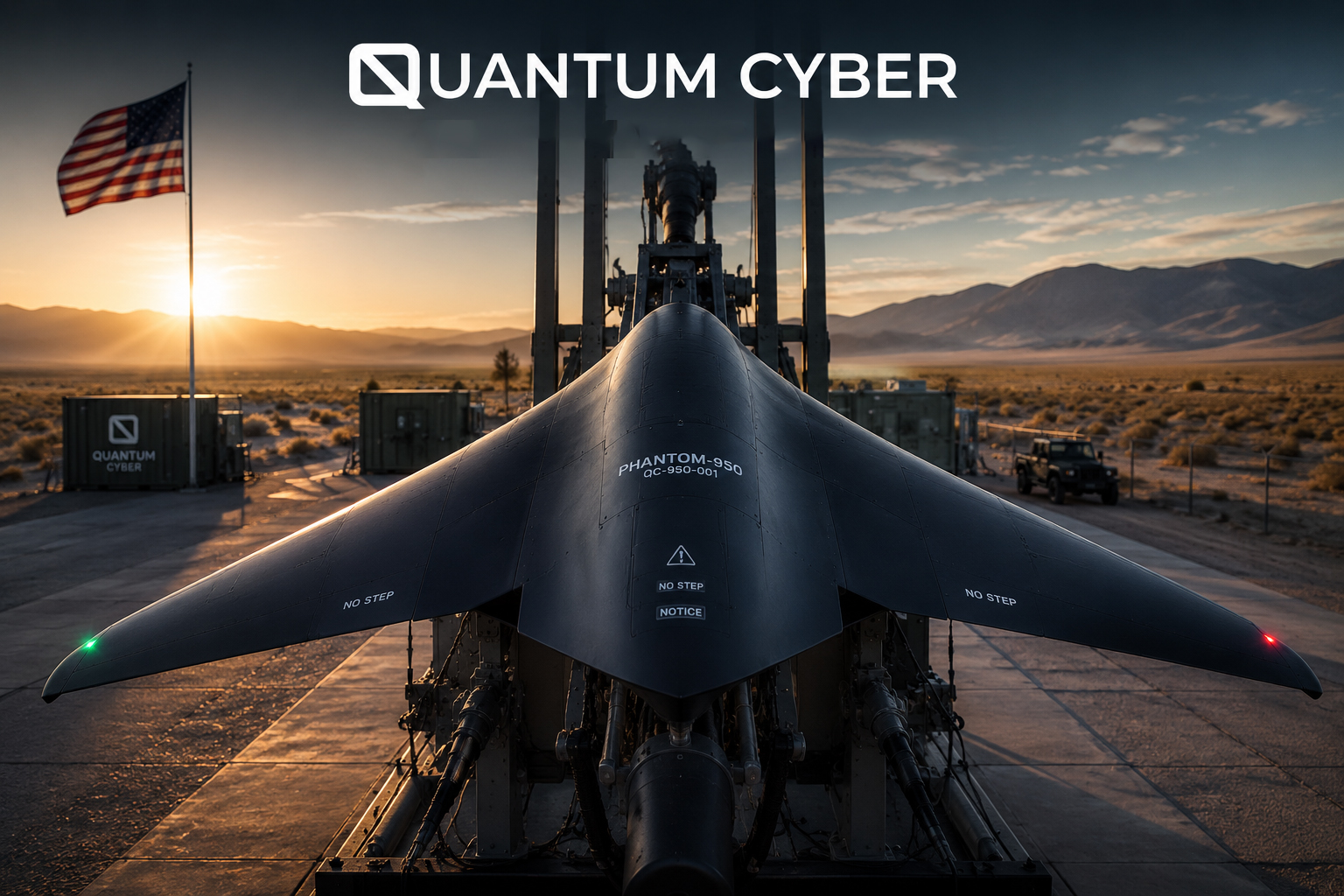
Quantum Cyber N.V. (Nasdaq: QUCY) (“Quantum Cyber” or the “Company”), a Nasdaq-listed autonomous defense technology company assembling an AI-powered System-of-Systems platform for drone warfare, counter-UAS, and border security applications, today introduced the PHANTOM-950, a long-range autonomous unmanned aerial system (“UAS”) platform the Company is developing as a modular design intended to support government and defense customers across logistics, surveillance, communications relay, electronic warfare, humanitarian support, and other mission-specific applications.
The PHANTOM-950 is intended to expand Quantum Cyber’s growing autonomous systems portfolio by introducing a platform designed for extended-range operations, built around a blended-wing airframe, a multi-stage propulsion architecture, and a configurable payload bay. The Company believes the platform, if developed as intended, would complement its broader System-of-Systems strategy by adding an aircraft designed for missions requiring long endurance, autonomous operation, and modular payload flexibility.
Platform Overview
According to internal design specifications, the PHANTOM-950 is being designed for missions of up to 950 kilometers, depending on configuration, with a targeted operating altitude of up to 18,000 meters, a targeted payload capacity of up to 10 kilograms, autonomous navigation and precision landing capability, and support for either reusable or one-way mission configurations. The modular payload architecture is intended to accommodate a broad range of government and commercial mission requirements, including logistics, humanitarian assistance, communications relay, intelligence, surveillance and reconnaissance, environmental monitoring, and other customer-specific payloads.
As designed, the PHANTOM-950 would incorporate a blended-wing airframe together with a multi-stage propulsion system intended to support launch, cruise, and terminal flight operations. The platform is being designed around a modular philosophy intended to allow customers to configure payloads according to operational requirements rather than limiting the aircraft to a single mission profile.
Quantum Cyber intends to manufacture the PHANTOM-950 through its domestic manufacturing operations following completion of its previously announced manufacturing facility acquisition and production build-out. The Company believes that, if established, in-house manufacturing would support quality control, supply chain resilience, and future production scalability.
The introduction of the PHANTOM-950 follows several strategic initiatives announced by the Company in recent months, including expansion of its domestic manufacturing capabilities, development of the Quantum Station command-and-control platform, advancement of proprietary propulsion technologies, and continued growth of its autonomous systems portfolio.
“PHANTOM-950 represents another step in the evolution of our autonomous platform portfolio,” said David Lazar, Chief Executive Officer of Quantum Cyber. “Our objective is to develop modular systems capable of supporting a wide variety of government and commercial missions while leveraging the manufacturing capabilities we are building in the United States.”
About Quantum Cyber N.V.
Quantum Cyber N.V. (Nasdaq: QUCY) is assembling an AI-powered, quantum-accelerated System-of-Systems autonomous defense platform that integrates drone warfare, counter-UAS, autonomous naval mine countermeasures, EMP shielding, anti-drone ammunition, command-and-control, and quantum antenna applications under a single Nasdaq-listed company. The Company acquires, licenses, and develops combat-proven autonomous technologies, deploying them as a coordinated, multi-domain portfolio across air, land, and sea. For more information, visit www.quantum-cyber.ai.
Forward-Looking Statements
Certain statements made in this press release are “forward-looking statements” within the meaning of the “safe harbor” provisions of the Private Securities Litigation Reform Act of 1995. Forward-looking statements may be identified by the use of words such as “anticipate,” “believe,” “expect,” “estimate,” “plan,” “intend,” “outlook,” “project,” “designed to,” and other similar expressions that predict or indicate future events or trends or that are not statements of historical matters. Such forward-looking statements relate to, among other things, the design, capabilities, specifications, and performance of the PHANTOM-950, including its projected range, operating altitude, payload capacity, propulsion architecture, and autonomous navigation and precision landing functionality; the Company’s intention and ability to design, develop, test, and manufacture the PHANTOM-950; the Company’s intention and ability to manufacture the PHANTOM-950 through its domestic manufacturing operations; the completion of the Company’s previously announced manufacturing facility acquisition and production build-out; the suitability of the platform for logistics, ISR, communications relay, electronic warfare, humanitarian, government, commercial, and other mission profiles; the integration of the PHANTOM-950 within the Company’s broader System-of-Systems strategy; and the Company’s ability to pursue and secure government, defense, and commercial customers. The PHANTOM-950 is a platform in development, is a concept in the design stage, no prototype has been built or tested, and the stated specifications in the press release are design objectives which reflect internal design targets that have not been independently validated and may differ materially from the performance of any aircraft ultimately produced, if any. The visual shown in the press release is a computer-generated conceptual rendering prepared for illustrative purposes. It does not depict an existing production aircraft or prototype and should not be interpreted as evidence of completed development, manufacturing status, testing, or commercial availability. Actual product configuration, capabilities, appearance, and specifications may change as development progresses. The Company’s ability to manufacture the platform is dependent on the completion of its previously announced facility acquisition and production build-out, which may not be completed on the expected terms, timeline, or at all. The Company has not entered into any customer contracts for the PHANTOM-950, and there can be no assurance that it will do so.
These forward-looking statements reflect the current analysis of existing information and are subject to various risks and uncertainties. As a result, caution must be exercised in relying on forward-looking statements. Due to known and unknown risks, actual results may differ materially from the Company’s expectations or projections. The following factors, among others, could cause actual results to differ materially from those described in these forward-looking statements: (i) the failure to complete design, development, testing, or manufacturing of the PHANTOM-950 on acceptable terms, on the expected timeline, or at all; (ii) the failure to meet projected performance, development, production, or financial targets; (iii) the failure to complete the previously announced manufacturing facility acquisition and production build-out; (iv) changes in applicable laws or regulations, including export controls and defense procurement requirements; (v) an inability to successfully pursue the Company’s new initiatives or to secure government, defense, or commercial customers; and (vi) other risks and uncertainties discussed from time to time in other reports and public filings with the Securities and Exchange Commission (the “SEC”) by the Company. Additional information concerning these and other factors that may impact the Company’s expectations and projections can be found in its filings with the SEC, including its annual report on Form 10-K filed on March 31, 2026, its first quarter report on Form 10-Q filed on May 15, 2026, and its subsequent filings with the SEC. The Company’s SEC filings are available publicly on the SEC’s website at www.sec.gov. Any forward-looking statement made by the Company in this press release is based only on information currently available to the Company and speaks only as of the date on which it is made. The Company undertakes no obligation to publicly update any forward-looking statement, whether as a result of new information, future developments, or otherwise, except as required by law.
Investor Relations Contact
Arx Investor Relations
North American Equities Desk
qucy@arxhq.com

FAQ
AI-generated questions and answers. How Rhea-AI works. Not financial advice.