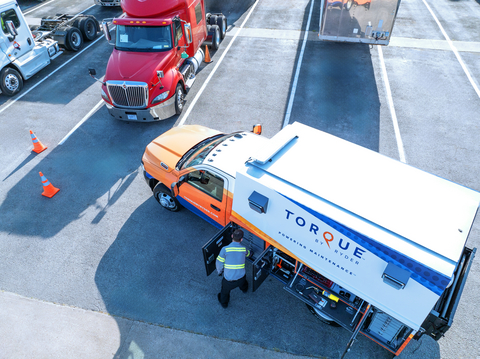
Ryder (NYSE: R) completed the acquisition of Truck Service Depot on January 5, 2026, adding an Atlanta-based mobile maintenance operator to its Torque by Ryder™ retail mobile maintenance network.
Rhea-AI Sentiment reads the wording of the document, how positive or negative its language is on a 1 to 5 scale. The balance of points shown with the takes weighs what the document actually discloses, so the two can disagree, for example when a trial that missed its main goal is described in upbeat language.
Further expands Ryder’s retail mobile maintenance business, Torque by Ryder™, across Georgia
Strengthens Ryder’s ability to support customers in high-velocity freight corridors and aligns with the company’s Southeast expansion strategy
MIAMI--(BUSINESS WIRE)--
Ryder System, Inc. (NYSE: R) has completed the acquisition of Truck Service Depot, an Atlanta-based mobile maintenance business servicing commercial trucks and trailers in Georgia. This acquisition strengthens and expands Ryder’s Torque by Ryder™ retail mobile maintenance business offering, accelerating growth of this product solution.
Ryder acquires Truck Service Depot, expanding its retail mobile maintenance business, Torque by Ryder™, across Georgia.
Truck Service Depot operates with a skilled team including more than 20 technicians and runs two physical locations: a 10 full drive-through maintenance bay facility in Atlanta, GA, and a service center in Savannah, GA. Ryder anticipates the acquisition will create synergies and benefit both Ryder and Truck Service Depot customers. To support a seamless transition and maintain uninterrupted services for customers, Torque by Ryder™ will integrate Truck Service Depot employees, assets, and operations into its network throughout 2026. Scott Marshall, who founded Truck Service Depot in 2018, will work closely with Ryder to help guide the transition.
“With Truck Service Depot’s strong presence in Georgia and complementary mobile maintenance services in a growth market for Ryder, we are enhancing our ability to further offer flexible, rapid maintenance solutions to fleets across this growing freight corridor,” says Tom Havens, president of Fleet Management Solutions at Ryder.
Ryder completed the transaction on January 5, 2026. Financial terms of the deal are not disclosed.
“I chose Ryder to continue the legacy of best-in-class mobile maintenance services because of their commitment to innovation, customer service, and employee growth,” says Scott Marshall, CEO of Truck Service Depot. “I am confident that Ryder is the ideal home for our employees and customers moving forward.”
Strategic Advantage in a High-Growth Logistics Hub
Fulton County, recognized by Georgia as a top priority for logistics investment, benefits from an increasing demand for transportation and fleet services. The area’s multimodal infrastructure—including the world’s busiest airport, major interstate corridors, and extensive freight rail access—provides exceptional connectivity for commercial fleets operating throughout the Southeast. Truck Service Depot’s market presence strengthens Ryder’s ability to support customers moving through this high-velocity freight corridor and aligns with the company’s broader Southeast expansion strategy.
The acquisition builds on Ryder’s broader Southeast expansion strategy, which includes recent investments in new truck rental and maintenance facilities in McDonough, GA, and Lebanon, TN. These recent openings reinforce Ryder’s commitment to serving high-growth logistics corridors with flexible, tech-enabled fleet solutions, while Truck Service Depot’s coverage areas further position Ryder at the center of one of the nation’s most active freight hubs.
With this acquisition, Torque by Ryder™ retail mobile maintenance services are available across 27 states delivering comprehensive support to customers across a wide range of vehicles, including commercial trucks, trailers, delivery vans, refrigerated vehicles, construction and utility vehicles, passenger and shuttle buses, forklifts, and emergency response vehicles.
For more information about Torque by Ryder™, visit torquebyryder.com or call 833-9-TORQUE (986-7783).
Note Regarding Forward-Looking Statements: Certain statements and information included in this news release are “forward-looking statements” within the meaning of the Federal Private Securities Litigation Reform Act of 1995. These forward-looking statements are based on our current plans and expectations and are subject to risks, uncertainties and assumptions. Accordingly, these forward-looking statements should be evaluated with consideration given to the many risks and uncertainties that could cause actual results and events to differ materially from those in the forward-looking statements including those risks set forth in our periodic filings with the Securities and Exchange Commission. New risks emerge from time to time. It is not possible for management to predict all such risk factors or to assess the impact of such risks on our business. Accordingly, we undertake no obligation to publicly update or revise any forward-looking statements, whether as a result of new information, future events, or otherwise.
Mobile maintenance is the ongoing care, repairs and software updates for assets that move or are accessed on the go—such as vehicles, field equipment, mobile clinics, or smartphone apps. For investors it matters because maintenance determines how reliably those assets perform, how often they cost money for fixes or downtime, and whether they meet safety or regulatory standards; think of it like routine car service that keeps an investment running and avoids surprise bills.
freight corridorstechnical
Freight corridors are dedicated routes—such as roads, rail lines, shipping lanes, or combinations of these—optimized for moving large volumes of goods between key production, storage and market hubs. Think of them as highways for cargo that reduce delays and costs by prioritizing freight flow. Investors watch freight corridors because their efficiency and capacity directly affect companies’ delivery times, shipping costs, supply-chain resilience and the value of logistics, port and transport assets.
multimodal infrastructuretechnical
Multimodal infrastructure is the hardware, software and networks that let a system handle different kinds of inputs and outputs — for example text, images, audio, video or different transport modes — in a single, coordinated platform. Investors care because it lets products serve more customers and use cases from the same core system, reducing costs, enabling new revenue streams and concentrating technical or regulatory risk in one place, much like a transport hub that connects buses, trains and taxis.
logistics corridorstechnical
Logistics corridors are the linked routes and facilities—roads, rail lines, ports, warehouses and border procedures—that goods travel through from maker to buyer, like a highway system for freight. Investors care because the speed, cost and reliability of these corridors directly affect companies’ delivery times, operating costs and ability to grow; better corridors can lower risk and boost profit margins, while bottlenecks can shrink revenues and raise uncertainty.