
Fleet Launches Mythos-ready Autonomous Endpoint Management
Rhea-AI Summary
Fleet announced Mythos-ready autonomous endpoint management on May 14, 2026, aiming to shrink patch cycles from 55–94 days to under two weeks, often hours. The platform delivers continuous patching, hourly policy checks, and detailed vulnerability exposure reporting across major operating systems for security-focused enterprises including Fastly (NYSE:FSLY).
AI-generated analysis. Not financial advice.
Positive
- None.
Negative
- None.
News Market Reaction – RDDT
On the day this news was published, RDDT gained 1.42%, reflecting a mild positive market reaction.
Data tracked by StockTitan Argus on the day of publication.
Key Figures
Peers on Argus
Momentum scanner shows 2 peers (e.g., BIDU, BILI) moving down with median move about -4.1%, suggesting broader sector dynamics. No same-day peer news is recorded, so this AI security tooling headline appears more company-specific for RDDT within a weak sector tape.
Historical Context
| Date | Event | Sentiment | Move | Catalyst |
|---|---|---|---|---|
| Apr 30 | Q1 2026 earnings | Positive | +13.1% | Strong Q1 revenue, profitability, and guidance drove a double‑digit price gain. |
| Apr 09 | Earnings date set | Neutral | +1.0% | Announcement of timing and format for upcoming Q1 2026 earnings release. |
| Feb 05 | Q4 2025 + buyback | Positive | -7.4% | Strong Q4 and full‑year results plus $1B buyback authorization met with selloff. |
Earnings fundamentals have been strong, but price reactions have been mixed: one strong rally on Q1 2026 results and one notable selloff on earlier upbeat earnings and buyback news.
Over the last few months, Reddit reported very strong financial performance. Q4 2025 and full-year results included robust growth and a $1 billion repurchase authorization, yet shares fell 7.43% the next day. By contrast, Q1 2026 results on 04/30 delivered $663M revenue and sparked a 13.07% gain. An earnings-date announcement on 04/09 produced only a modest move. Against this backdrop, today’s AI security and infrastructure-focused news fits into a narrative of operational and ecosystem strengthening rather than a core earnings catalyst.
Regulatory & Risk Context
Market Pulse Summary
This announcement highlights Reddit’s role as a reference customer for Fleet’s autonomous endpoint management as enterprises confront AI‑accelerated exploits. Being named alongside companies like Fastly and Uber underscores a focus on hardening employee devices and infrastructure. Historically, Reddit’s major price swings centered on earnings and buybacks, not operational tooling. Investors may watch how such security partnerships support uptime, trust, and long‑term engagement alongside the company’s strong recent growth and profitability metrics.
Key Terms
autonomous endpoint management technical
devops technical
infrastructure as code technical
apis technical
gitops-mode technical
AI-generated analysis. Not financial advice.




Fighting AI with AI, top public companies and the Forbes Cloud 100 choose Fleet to prepare employee devices for new ways of working and bot attacks
Validating this approach, security-conscious companies including Fastly (NYSE: FSLY), Uber (NYSE: UBER), Cursor, Reddit (NYSE: RDDT), and Stripe have chosen Fleet to keep employee devices current and resilient as AI-driven threats accelerate.
"Adopting Fleet has fundamentally shifted how we manage devices, turning it into a streamlined discipline that mirrors our DevOps culture. We've unlocked total, unified visibility across thousands of employee devices, and we get real-time confidence in the health and compliance of our global infrastructure every single day," said Dan Jackson, Senior Manager, Systems Engineering at Fastly. "We operate entirely free of the traditional maintenance and operational overhead that used to slow us down, resulting in a highly secure, efficient, and modern IT environment."
Anthropic Mythos, expected to be publicly released later this year, represents a step-change in AI capability. Security researchers predict that both Mythos and OpenAI's GPT 5.5 will dramatically lower the barrier to automated exploit development. Meanwhile, vulnerabilities are already being exploited 100 times faster on average in 2026 than three years ago. The window between disclosure and weaponization is no longer measured in weeks. It's measured in hours.
According to the 2025 Gartner® Innovation Insight: Autonomous Endpoint Management (AEM), "patching cycles that currently take 55 to 94 days can be reduced to 6 to 13 days with AEM-enabled tools - an
Fleet delivers on that vision today.
By monitoring when a new software update becomes available and when new vulnerabilities are disclosed, Fleet can now automatically mitigate vulnerabilities and keep software up to date, with no ticket or manual intervention required. New capabilities, for every OS, include:
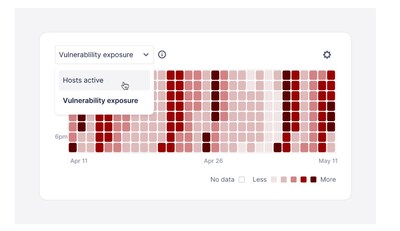
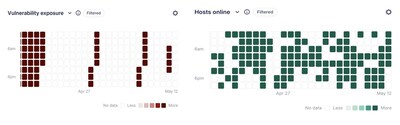
- Out-of-the-box reporting on which devices have (or had) out-of-date software and the length of time they were exposed to risk from critical vulnerabilities over the last 30 days. This provides an easy way to gather metrics like "Mean Time to Patch" (MTTP) and augments Fleet's existing data lake integrations that allow infinite, more in-depth historical analysis.
- Upgraded policy engine that compares installed software, configurations, and system metrics with known vulnerability databases and the latest available releases of software. When a device falls out of compliance, Fleet automatically updates the software or performs a more advanced mitigation such as uninstalling the old version. Policies run every hour (or at custom defined intervals) globally, shrinking exposure windows to hours.
- Highly customizable auto-patch policies designed for IT teams with complex environments, yet who must also roll out updates faster than ever, but with surgical precision to avoid crashing apps and interrupting workflows. Like most of Fleet's capabilities, this is not "all or nothing", and supports ring deployments, complex scoping, exclusions, and variations for particular roles, subsidiaries, and global geographies.
Fleet's customers who have begun taking advantage of the new capabilities are pleased: "Patch policies are already transforming how we operate," said a principal endpoint engineer at a leading consumer electronics company that is currently migrating from a legacy solution. "Apps we'd skip patching due to maintenance overhead are now straightforward to configure, typically taking just five minutes. The ongoing maintenance burden is minimal, and I can set it up to update software automatically while still customizing every aspect of the end user experience for the person on the other end of the device."
The industry is recognizing the need to be resourceful and swift to keep up with the AI evolution. For instance, Salesforce CEO Marc Benioff recently noted the company's strategic shift toward going headless and API-first. His stance adds to the wave of companies racing to position their products as programmatic infrastructure with first-class support for AI, which requires first-class support for modern standards like infrastructure as code, APIs, MCP, and CLIs, alongside traditional user interfaces.
"Fleet has prioritized change control and 'GitOps-mode' from the very beginning, because we knew how important it is for humans to review each other's work and prevent mistakes," said Mike McNeil, cofounder and CEO of Fleet Device Management. "Now that auto-patching is becoming inevitable for every organization, auditability, undo-ability, and special exceptions are even more important, especially for large enterprises where you're managing tens of thousands of devices. You need humans in the loop to prevent costly mistakes and outages, and Fleet's implementation of autonomous endpoint management provides that middle ground."
About Fleet (fleetdm.com):
Fleet is the open device management and vulnerability management platform for Macs, PCs, iPhones, iPads, Android, Chromebooks, desktop Linux, and cloud infrastructure. Organizations in 90 countries use Fleet to manage millions of devices at scale, enhance security, and stay compliant. The company's mission is to bring transparency, efficiency, and control to the world of computing devices through its open and extensible platform. Learn more at fleetdm.com.
For media inquiries, please contact:
Alyssa Pallotti for Fleet
alyssa@apt-pr.com
+447397686566
1 Gartner, Innovation Insight: Autonomous Endpoint Management, Tom Cipolla, Dan Wilson, 15 January 2025.
GARTNER is a trademark of Gartner, Inc. and/or its affiliates.

 View original content to download multimedia:https://www.prnewswire.com/news-releases/fleet-launches-mythos-ready-autonomous-endpoint-management-302771551.html
SOURCE Fleet Device Management