
TransCode Therapeutics Presents Phase 1a Clinical Data for TTX-MC138 at ESMO Congress 2026
The study met its primary safety endpoint, while exploratory findings included treatment-associated antitumor immune activity.
Sentiment and the balance of points
Rhea-AI Sentiment reads the wording of the document, how positive or negative its language is on a 1 to 5 scale. The balance of points shown with the takes weighs what the document actually discloses, so the two can disagree, for example when a trial that missed its main goal is described in upbeat language.
Rhea-AI Summary
TransCode Therapeutics (RNAZ) presented Phase 1a results for TTX-MC138 in previously treated advanced solid tumors at the ESMO Congress 2026. The ongoing multicenter study is open-label, meaning treatment assignments are known, and evaluates increasing doses and expanded patient groups. TTX-MC138 was administered once every 28 days at four dose levels ranging from 0.8 mg/kg to 4.8 mg/kg.
The study met its primary safety endpoint, with no dose-limiting toxicities observed. Drug exposure in plasma increased with dose across the four evaluated levels. The company described disease stabilization in the heavily pretreated, varied patient population and extended progression-free intervals—time without disease worsening—in a subset of patients. The poster also highlighted exploratory evidence of treatment-associated antitumor immune activity.
How this balance works
Rhea-AI gives every point it takes from this document a weight. Minor counts 1, Moderate 3 and Major 9, so one Major point outweighs several Minor ones. The bar adds up the weights on each side, and when neither side holds more than 65% of the total the balance reads Mixed.
It reads the document as published, with the same rules for every company, and it does not look at what the market expected or at how the stock traded, so a point can be objectively good on a day the stock falls.
Rhea-AI Sentiment measures something else, the tone of the wording.
Positive
- Major pointTTX-MC138 met its primary safety endpoint, with no dose-limiting toxicities observed.
- Minor pointTransCode reported disease stabilization, with extended progression-free intervals in a subset of patients.
- Minor pointExploratory findings indicated treatment-associated antitumor immune activity.
Negative
- None.
Key Figures
- Dose range and schedule
- 0.8–4.8 mg/kg; once every 28 days
- TTX-MC138 across four evaluated dose levels
- Dose-limiting toxicities
- 0
- Phase 1a study
Previous Clinical trial Reports
-
Follow-up reported stable disease, extended progression-free intervals and no dose-limiting toxicities.
-
Final Phase 1a report described safety and disease stabilization, including no dose-limiting toxicities.
24h Move is the share-price change in the day after each event; other market factors may also have contributed.
Key Terms
pharmacokinetic medical
open-label medical
dose-escalation medical
dose-limiting toxicities medical
AI-generated analysis. How Rhea-AI works. Not financial advice.


Poster highlights durable disease control, acceptable tolerability and exploratory evidence of treatment-associated antitumor immune activity in patients with advanced solid tumors
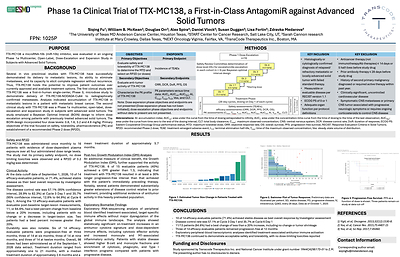
The poster presents findings on safety, tolerability, pharmacokinetic, antitumor activity and exploratory biomarkers from the ongoing multicenter, open-label, dose-escalation and dose-expansion study in patients with previously treated advanced solid tumors.
TTX-MC138 was administered once every 28 days across four evaluated dose levels ranging from 0.8 mg/kg to 4.8 mg/kg. The study met its primary safety endpoint, and no dose-limiting toxicities were observed. Dose-dependent plasma exposure was observed across the four evaluated dose levels.
"These data provide additional insight into the safety, clinical activity and durability findings observed in the Phase 1a study," said Dan Vlock, MD, TransCode consulting Senior Medical Advisor. "The disease stabilization observed across this heavily pretreated and heterogeneous patient population, together with the extended progression-free intervals seen in a subset of patients, supports the continued clinical evaluation of TTX-MC138."
About TransCode Therapeutics
TransCode Therapeutics is an immuno-oncology and targeted cancer therapy company with a focus on treating advanced malignancy. The company's lead therapeutic candidate, TTX-MC138, is focused on treating metastatic tumors that overexpress microRNA-10b, a unique, well-documented biomarker of metastasis, and is currently being evaluated in a Phase 2a trial under the PRE-I-SPY program in collaboration with Quantum Leap Healthcare Collaborative. In addition, TransCode has a portfolio of other first-in-class therapeutic candidates designed to mobilize the immune system to recognize and destroy cancer cells. For more information,visit www.transcodetherapeutics.com
Forward-Looking Statements
This release contains "forward-looking statements" within the meaning of the Private Securities Litigation Reform Act of 1995, including, without limitation, statements concerning the timing, and results of TransCode's clinical trials, including its Phase 1a evaluation and Phase 2a clinical development of TTX-MC138, and statements concerning the therapeutic potential of TransCode's therapeutic candidates. Any forward-looking statements in this press release are based on management's current expectations of future events and are subject to a number of risks and uncertainties that could cause actual results to differ materially and adversely from those set forth in or implied by such forward-looking statements. These risks and uncertainties include, but are not limited to: the risks associated with drug discovery and development; the risk that the results of clinical trials will not be consistent with TransCode's preclinical studies or expectations or with results from previous clinical trials; risks associated with the conduct of clinical trials; risks associated with TransCode's financial condition and its need to obtain additional funding to support its business activities, including TransCode's ability to continue as a going concern; risks associated with the timing and outcome of TransCode's planned regulatory submissions; risks associated with obtaining, maintaining and protecting intellectual property; risks associated with TransCode's ability to enforce its patents against infringers and defend its patent portfolio against challenges from third parties; risks of competition from other companies developing products for similar uses; risks associated with TransCode's dependence on third parties; and risks associated with geopolitical events and pandemics. For a discussion of these and other risks and uncertainties, and other important factors, any of which could cause TransCode's actual results to differ from those contained in or implied by the forward-looking statements, see the section entitled "Risk Factors" in TransCode's Annual Report on Form 10-K for the year ended December 31, 2025, as well as discussions of potential risks, uncertainties and other important factors in any subsequent TransCode filings with the U.S. Securities and Exchange Commission. All information in this press release is as of the date of this release; TransCode undertakes no duty to update this information unless required by law.

 View original content to download multimedia:https://www.prnewswire.com/news-releases/transcode-therapeutics-presents-phase-1a-clinical-data-for-ttx-mc138-at-esmo-congress-2026-302918795.html
SOURCE TransCode Therapeutics, Inc.
FAQ
AI-generated questions and answers. How Rhea-AI works. Not financial advice.
What did TransCode's TTX-MC138 Phase 1a trial show on safety?
The study met its primary safety endpoint, and no dose-limiting toxicities were observed. TTX-MC138 was administered once every 28 days across four evaluated dose levels, ranging from 0.8 mg/kg to 4.8 mg/kg, in patients with previously treated advanced solid tumors.