
Royal Road Minerals Identifies Broad Hydrothermal System and High-Grade Silver-Antimony Veins at the Margaritas Target, GAM Project; Colombia
Rhea-AI Summary
Royal Road Minerals (OTCQB: RRDMF, TSXV: RYR) reported first diamond drilling results from the Margaritas target at its GAM gold-copper-silver project in Colombia.
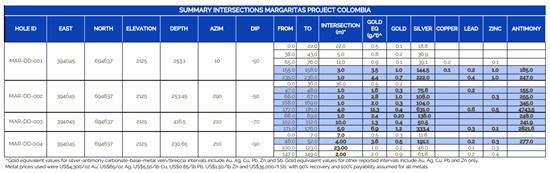
Four holes (1,154m) outlined a broad polymetallic hydrothermal system and intersected high-grade silver-antimony CBM veins over mineable widths.
Positive
- High-grade CBM vein in MAR-DD-002: 4m at 651 g/t silver and 0.47% antimony
- Multiple CBM intercepts including 5m at 377 g/t silver and 0.28% antimony in MAR-DD-003
- Broad mineralized intervals: MAR-DD-003 returned 304m at 0.3 g/t gold equivalent from surface
- Margaritas lies 4km south of the Güíntar porphyry discovery within the GAM project
- Company interprets Margaritas as part of a larger hydrothermal system with porphyry-related potential
Negative
- Company states broad 0.3 g/t gold equivalent intervals are not economically significant at this stage
- True widths of all drill intersections are unknown due to insufficient geological information
- Drill holes MAR-DD-001 and MAR-DD-002 terminated in syn- to late-mineralization granodiorite, limiting depth testing
- Project remains at an early exploration stage and requires further drilling and vectoring studies
News Market Reaction – RRDMF
In the Jun 9 session, RRDMF declined 14.61%, reflecting a significant negative market reaction.
Data tracked by StockTitan Argus on the day of publication.
AI-generated analysis. How Rhea-AI works. Not financial advice.




Toronto, Ontario--(Newsfile Corp. - June 9, 2026) - Royal Road Minerals Limited (TSXV: RYR) (OTCQB: RRDMF) ("Royal Road" or the "Company") is pleased to announce results from its first exploratory diamond drilling program at the Margaritas target, part of the Company's wholly owned Güíntar-Aleman-Margaritas ("GAM") gold-copper-silver project in Antioquia Province, Colombia (see Figure 1).
Initial drilling at Margaritas comprised four scout diamond drill holes for a total of 1,154 meters and has identified a broad polymetallic hydrothermal system developed within altered volcanic and intrusive rocks. Mineralization occurs as hydrothermal breccias, stockwork vein systems, quartz-tourmaline breccias and sulphide-rich alteration zones carrying low-grade gold-silver mineralization with locally elevated copper values. These broader mineralized zones are crosscut and locally upgraded by later silver-antimony carbonate-base-metal ("CBM") veins and breccias, which have returned high-grade silver and significant antimony values over mineable widths (see Figures 2 and 3).
Notable Drill Results
SILVER-ANTIMONY CARBONATE-BASE-METAL (CBM) VEIN AND BRECCIA INTERSECTIONS
| MAR-DD-001 | From 155 to 158 meters: 3m at 204 g/t silver and |
| (3.5 g/t gold equivalent1) | |
| MAR-DD-002 | From 177 to 181 meters: 4m at 651 g/t silver and |
| (11.3 g/t gold equivalent) | |
| MAR-DD-003 | From 102 to 112 meters: 10m at 50 g/t silver and |
| (1.3 g/t gold equivalent) | |
| MAR-DD-003 | From 171 to 176 meters: 5m at 377 g/t silver and |
| (6.9 g/t gold equivalent) | |
| MAR-DD-004 | From 48 to 52 meters: 4m at 191 g/t silver and |
| (3.6 g/t gold equivalent) |
HYDROTHERMAL BRECCIA, STOCKWORK AND TOURMALINE BRECCIA INTERSECTIONS
| MAR-DD-004 | From 100 to 123 meters: 23m at 1.0 g/t gold equivalent |
| MAR-DD-001 | From 65 to 76 meters: 11m at 0.9 g/t gold equivalent |
| MAR-DD-002 | From surface to 36 meters: 36m at 0.5 g/t gold equivalent |
(Not true width and the Company does not have sufficient information to determine true widths of the drill hole intersections)
System Interpretation
Drill holes MAR-DD-003 and MAR-DD-004 returned 304 meters and 231 meters respectively at 0.3 g/t gold equivalent from surface to end-of-hole. While these intervals are not considered economically significant, they highlight the scale of hydrothermal alteration and mineralization encountered at Margaritas.
Drill holes MAR-DD-003 and MAR-DD-004 intersected altered volcanic and intrusive rocks hosting broad zones of hydrothermal breccia, stockwork veining, quartz-tourmaline breccias and sulphide-rich alteration characterized by low-grade gold-silver mineralization with locally elevated copper values. These broader mineralized zones are interpreted to represent the outer expression of a larger hydrothermal system.
Quartz-tourmaline breccias are commonly associated with the broader low-grade hydrothermal system and appear to represent pathways for hydrothermal fluids rather than the principal hosts to high-grade silver-antimony mineralization.
These broader mineralized zones are locally overprinted and upgraded by carbonate-base-metal ("CBM") veins and breccias carrying elevated silver, antimony, lead and zinc values. The highest-grade silver and antimony intersections reported to date are associated with this later mineralizing event.
Drill holes MAR-DD-001 and MAR-DD-002 tested the strike continuity of later silver-antimony carbonate-base-metal veins and breccias. These holes confirmed high-grade silver-antimony mineralization over mineable widths but terminated in a syn- to late-mineralization granodiorite.
District-Scale Implications
Margaritas is located approximately four kilometers south of the Güíntar porphyry discovery and approximately three kilometers south of the Algodona target. Recent drilling at Güíntar, combined with geophysical modelling and geological interpretation, has highlighted the potential for a cluster of mineralized porphyry centers within the GAM project area (see Press Release May 5, 2026).
The geological and geochemical characteristics observed at Margaritas suggest a relatively distal position within this broader mineralized environment. Surface geochemistry, petrography and geological mapping indicate increasing exploration potential toward the south and at depth.
While it remains early in the exploration process, the Company believes Margaritas may represent part of the broader hydrothermal footprint associated with the emerging GAM porphyry cluster. Further drilling and vectoring studies will be required to determine the relationship between Margaritas and nearby porphyry targets.
"We knew from geochemical studies and alteration mapping prior to drilling that near-surface mineralization at Margaritas was located at some distance above or adjacent to a potential porphyry target," said Dr Tim Coughlin, President and CEO of Royal Road Minerals. "The high-grade silver-antimony veins were not obvious on surface and are a pleasant surprise. Together with the broader mineralized zones identified during drilling, they further corroborate the distal model and provide important vectors toward the porphyry target. Now that all drill results are in hand, we will commence detailed geochemical and geophysical vectoring studies designed to locate follow-up drill holes aimed at identifying the primary source of the hydrothermal system while continuing to evaluate the economic potential of the high-grade silver-antimony veins."
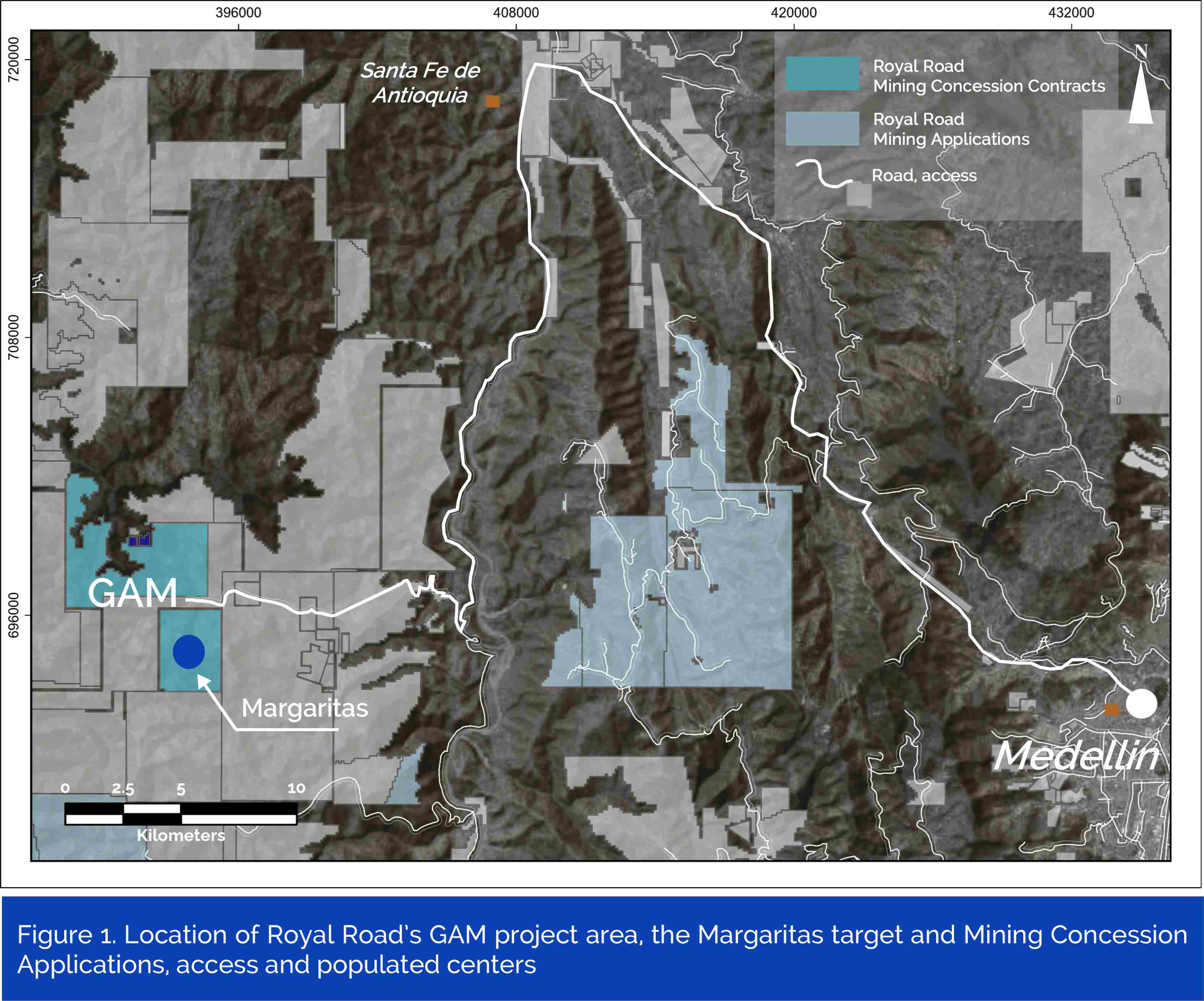
To view an enhanced version of this graphic, please visit:
https://images.newsfilecorp.com/files/4008/300714_fig1.jpg
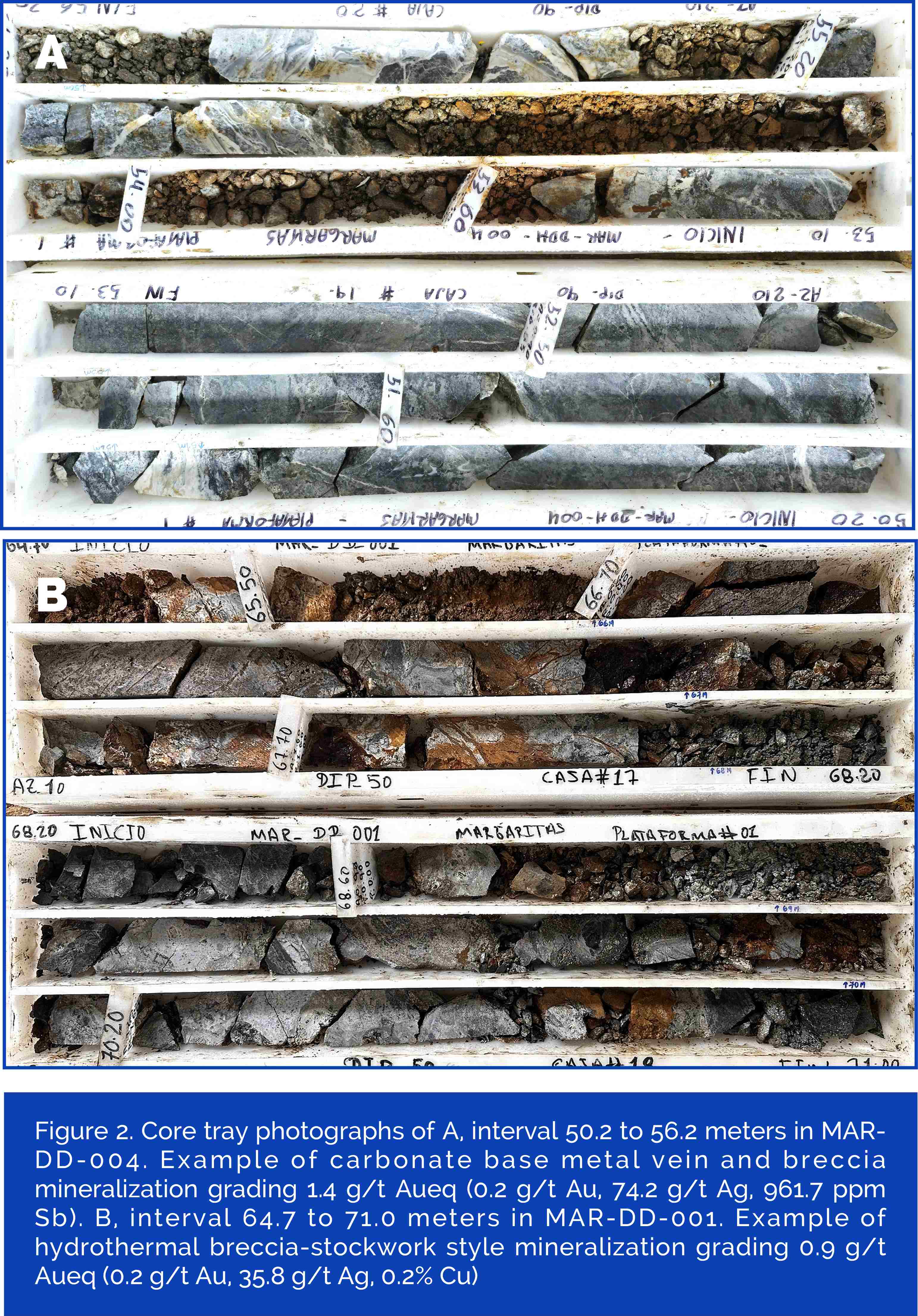
To view an enhanced version of this graphic, please visit:
https://images.newsfilecorp.com/files/4008/300714_fig2.jpg
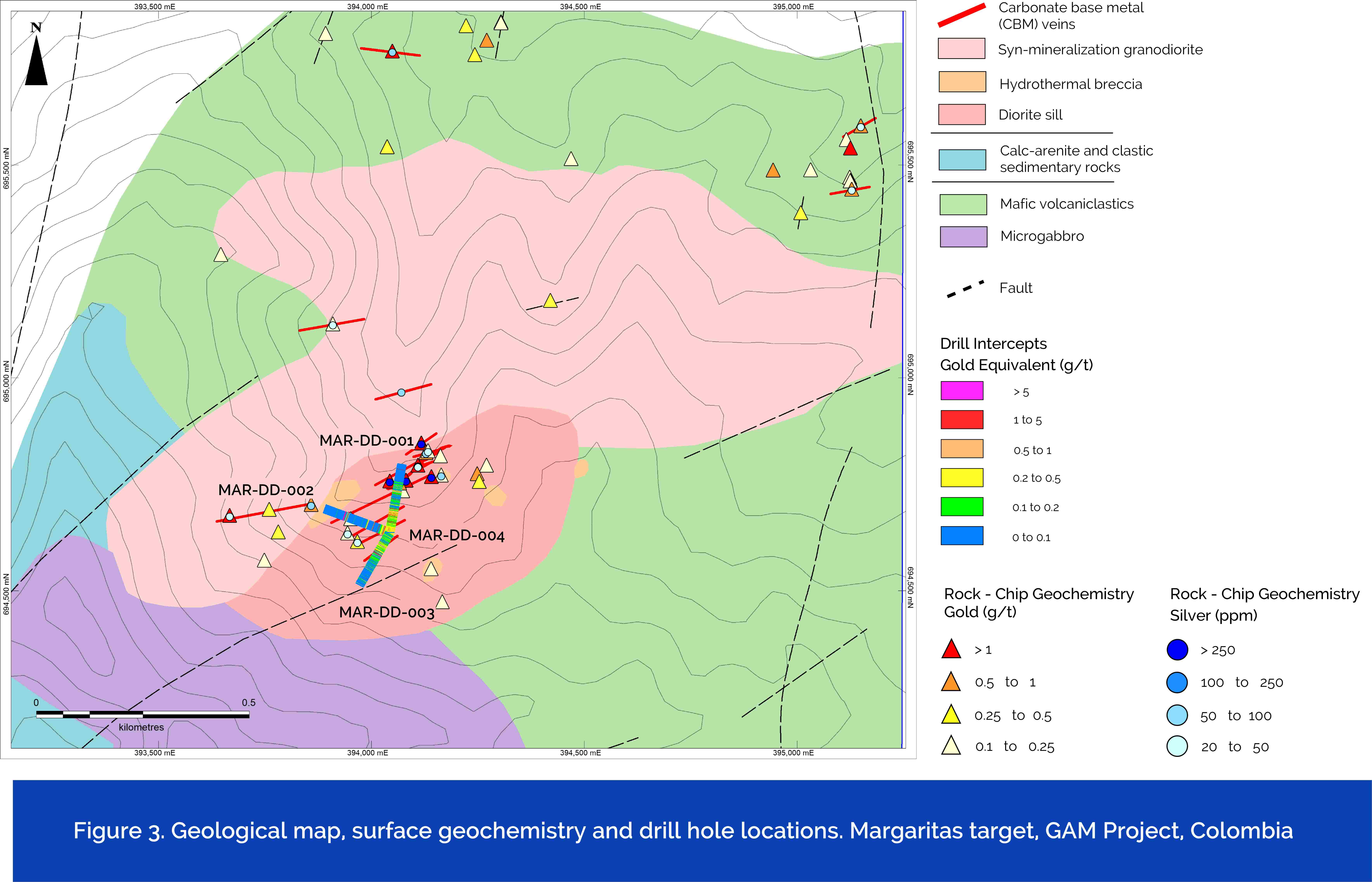
To view an enhanced version of this graphic, please visit:
https://images.newsfilecorp.com/files/4008/300714_fig3.jpg
About the GAM Project
The GAM project is wholly owned by Royal Road and is located approximately 50 kilometers west of Medellín in the Department of Antioquia, Colombia (see Figure 1). The Project comprises the Güíntar and Margaritas Mining Concession Contracts, in addition to the El Aleman Mining and Chuscalita Mining Concession Contracts. The Güíntar and Margaritas Mining Concession Contracts were obtained through Royal Road's acquisition of Northern Colombia Holdings Limited a wholly owned subsidiary of AngloGold Ashanti Limited (see Press Release May 31, 2019). El Aleman and Chuscalita are subject to option agreements pursuant to which Royal Road holds the exclusive right to acquire a
About Royal Road Minerals:
Royal Road Minerals is a mineral exploration and development company with its head office and technical-operations center located in Jersey, Channel Islands. The Company is listed on the TSX Venture Exchange under the ticker RYR, on the OTCQB under the ticker RRDMF and on the Frankfurt Stock Exchange under the ticker RLU. The Company's mission is to apply expert skills and innovative technologies to the process of discovering and developing copper and gold deposits of a scale large enough to benefit future generations and modern enough to ensure minimum impact on the environment and no net loss of biodiversity. The Company currently explores in the Kingdoms of Saudi Arabia, Morocco and in Colombia. More information can be found on the Company's website www.royalroadminerals.com.
Neither the TSX Venture Exchange nor its Regulation Services Provider (as that term is defined in the policies of the TSX Venture Exchange) accepts responsibility for the adequacy or accuracy of this release.
The scientific and technical information contained in this news release has been prepared, reviewed and approved by Dr. Tim Coughlin, BSc (Geology), MSc (Exploration and Mining Geology), PhD, FAusIMM, President and Chief Executive Officer of Royal Road Minerals Limited and a Qualified Person as defined under National Instrument 43-101.
Cautionary statement:
This news release contains certain statements that constitute forward-looking information and forward-looking statements within the meaning of applicable securities laws (collectively, "forward-looking statements") describing the Company's future plans and the expectations of its management that a stated result or condition will occur. Such forward-looking statements involve known and unknown risks, uncertainties and other factors that may cause the actual results, performance or achievements of the Company, or developments in the Company's business or in the mineral resources industry, to differ materially from the anticipated results, performance, achievements or developments expressed or implied by such forward-looking statements. Forward-looking statements include all disclosure regarding possible events, conditions or results of operations that is based on assumptions about, among other things, future economic conditions and courses of action, and assumptions related to government approvals, and anticipated costs and expenditures. The words "plans", "prospective", "expect", "intend", "intends to" and similar expressions identify forward looking statements, which may also include, without limitation, any statement relating to future events, conditions or circumstances. Forward-looking statements of the Company contained in this news release, which may prove to be incorrect, include, but are not limited to the Company's exploration plans.
The Company cautions you not to place undue reliance upon any such forward-looking statements, which speak only on the date they are made. There is no guarantee that the anticipated benefits of the Company's business plans or operations will be achieved. The risks and uncertainties that may affect forward-looking statements include, among others: economic market conditions, anticipated costs and expenditures, government approvals, and other risks detailed from time to time in the Company's filings with Canadian provincial securities regulators or other applicable regulatory authorities. Forward-looking statements included herein are based on the current plans, estimates, projections, beliefs and opinions of the Company management and the Company does not undertake any obligation to update forward-looking statements should assumptions related to these plans, estimates, projections, beliefs and opinions change.
Quality Assurance and Quality Control
Sample preparation and analyses are conducted according to standard industry procedures. Drill core and saw-cut channel samples are crushed, split and pulverized prior to analysis of Gold by fire assay and Atomic Absorption and multi-elements by ICP-AES and ICP-MS after four acid digestion. Soil samples are sieved to -200 mesh and analyzed for Gold by fire assay and ICP AES and multi-elements by ICP-AES and ICP-MS after aqua regia digestion. Analytical performance is monitored by means of certified reference materials (CRMs), coarse blanks, coarse and pulp duplicate samples. Surface samples have been prepared in ALS Chemex preparation lab in Colombia and analyses have been completed in ALS Chemex Lima.
Contact
Ben Butlin
Royal Road Minerals Limited
info@royalroadminerals.com
+44 1534 887166
1 Gold equivalent values for silver-antimony carbonate-base-metal vein/breccia intervals include Au, Ag, Cu, Pb, Zn and Sb. Gold equivalent values for other reported intervals include Au, Ag, Cu, Pb and Zn only. Metal prices used were US
To view the source version of this press release, please visit https://www.newsfilecorp.com/release/300714