
Silver One Intersects 472 g/t Silver, 0.6 g/t Gold, plus 0.87% Lead - 1.10% Zinc, Extending Down-Dip Mineralization 400 Metres Beyond Open-Pit Resource
High‑grade down‑dip intercepts and prior metallurgical recoveries support Silver One’s ongoing 25 km Candelaria drill program and pre‑feasibility work.
Rhea-AI Summary
Silver One (SLVRF) reported initial 2026 reverse‑circulation drilling results from its 25,000‑metre program at the Candelaria Project in Nevada.
Hole SOC26‑196A extends sulfide mineralization about 400 m down‑dip from the nearest hole in the 2025 resource model, intersecting 25.91 m grading 215 g/t silver, 0.33 g/t gold, 0.43% lead and 0.55% zinc (250 g/t silver equivalent), including 9.14 m of 472 g/t silver, 0.60 g/t gold, 0.87% lead and 1.10% zinc (540 g/t silver equivalent) from 542.55 m. Hole SOC26‑197 cut 3.05 m of 454 g/t silver and 0.68 g/t gold (539 g/t silver equivalent) plus 4.58 m of 112 g/t silver (131 g/t silver equivalent).
Earlier metallurgical tests on similar sulphides returned average flotation recoveries of 62% silver and 72% gold, rising to about 77.5% silver and 82% gold with cyanidation of flotation tails. A pre‑feasibility study is advancing using conventional cyanide extraction, which the company expects to complete by year end.
Positive
- SOC26‑196A 25.91 m at 215 g/t Ag, incl. 9.14 m at 472 g/t Ag, 0.60 g/t Au, 0.87% Pb, 1.10% Zn
- SOC26‑197 3.05 m at 454 g/t Ag, 0.68 g/t Au plus 4.58 m at 112 g/t Ag
- Down‑dip extension mineralization pushed ~400 m beyond 2025 open‑pit resource drilling
- Metallurgy flotation + cyanidation averaged ~77.5% Ag and 82% Au recoveries on sulphides
- Drill program scale 25,000 m RC campaign with four holes drilled and two more assays pending
- Pre‑feasibility study advancing with conventional cyanide extraction and expected completion by year end
Negative
- Extrakt process needs further testing and will not be included in the current pre‑feasibility study
News Explained
Candelaria remains pre-production, with two completed holes awaiting assays and permitting deferred until after the planned pre-feasibility study.
Candelaria remains in exploration and pre-feasibility work: the 2026 campaign has drilled
The company has chosen conventional cyanide extraction as the current study basis for both fresh open-pit material and heap-leach material; Extrakt solutions are not included at this stage.
Assays for holes SO-C-26-198 and SO-C-26-199 and drilling resumption by month-end are the next milestones; after the planned year-end study, the company says it will update and renew permits before making a production decision.
AI-generated analysis. How Rhea-AI works. Not financial advice.




Candelaria Project, Nevada
Vancouver, British Columbia--(Newsfile Corp. - September 17, 2026) - Silver One Resources Inc. (TSXV: SVE) (OTCQX: SLVRF) (FSE: BRK1) ("Silver One" or the "Company") is pleased to report assay results from the first two drill holes of its 25,000-metre reverse-circulation "RC" 2026 drilling campaign at the Candelaria Project, Nevada, as outlined in the Company's May 27, 2026 news release. A total of 2,077 metres has been drilled in four holes, with assays received for two of the completed holes. Results to date reinforce the continuity, thickness and grade of the mineralized system, and demonstrate meaningful down-dip extension of the mineralization. The mineralization remains open along strike (See Figures 1 and 2 and Table 1).
National Drilling is preparing to mobilize by month-end, with drilling scheduled to resume immediately thereafter as the program continues through the fall and winter.
Highlights
Strong silver-gold-lead-zinc grades in sulfides in both SOC26-196A and SOC26-197.
Drill hole SOC26-196A extends the mineralization ~400 m down-dip north from the nearest drill hole used in the 2025 resource estimate (see Company "Technical Report Updated Mineral Resource Estimate: Heap Leach Pads on the Candelaria Property" completed in accordance with NI 43-101, filed on Sedar+ on Aug 27, 2026, and Company news releases of Aug 26, 2026 and May 6, 2025).
This hole intersected 9.14 m averaging 472 g/t silver ("Ag"), 0.60 g/t gold ("Au"),
0.87% lead ("Pb"),1.10% zinc ("Zn"), (540 g/t silver equivalent ("AgEq")) within a broader 25.91-m zone averaging 215 g/t Ag, 0.33 g/t Au,0.43% Pb,0.55% Zn (250 g/t AgEq). Mineralization begins at 542.55 m depth. True-widths are approximately94% of drill intercepts.Drill hole SOC26-197 intersected 3.05 m averaging 454 g/t Ag, 0.68 g/t Au,
1.45% Pb,1.77% Zn (539 g/t AgEq) from 391.67 m.An additional 4.58 m intercept averaging 112 g/t Ag, 0.16 g/t Au,
0.24% Pb,0.42% Zn (131 g/t AgEq) from 403.86 m (See Table 1 and 2).These results continue to demonstrate the robustness and upside potential of the Candelaria mineralized system.
Metallurgical testing (2023) confirms sulphides, consisting mainly of galena, sphalerite, and argentiferous galena, respond well to flotation, with silver and gold recoveries significantly enhanced by cyanidation of flotation tails. Average flotation recoveries were
62% silver,72% gold,50% lead and37% zinc (See company news release of June 14, 2023).
Greg Crowe, President & CEO of Silver One, stated: "These initial 2026 drill results continue to demonstrate the strength and scale of the Candelaria mineralized system. The grades, thicknesses, and the 400-metre down-dip extension achieved in SOC26-196A, highlight the remarkable continuity of the mineralization and reinforce our view that Candelaria hosts a robust and expanding silver-gold-base-metal system. The sulphide material intersected is similar to that found in deep holes drilled in previous campaigns. Our 2023 metallurgical program showed that sulphides respond well to flotation, providing valuable context and enhancing the opportunities to add value by recovering base metals, in addition to the gold and silver. With two additional holes pending assays, we are encouraged by the momentum of this extensive 25,000 metre program and look forward to updating shareholders as results continue to come in."
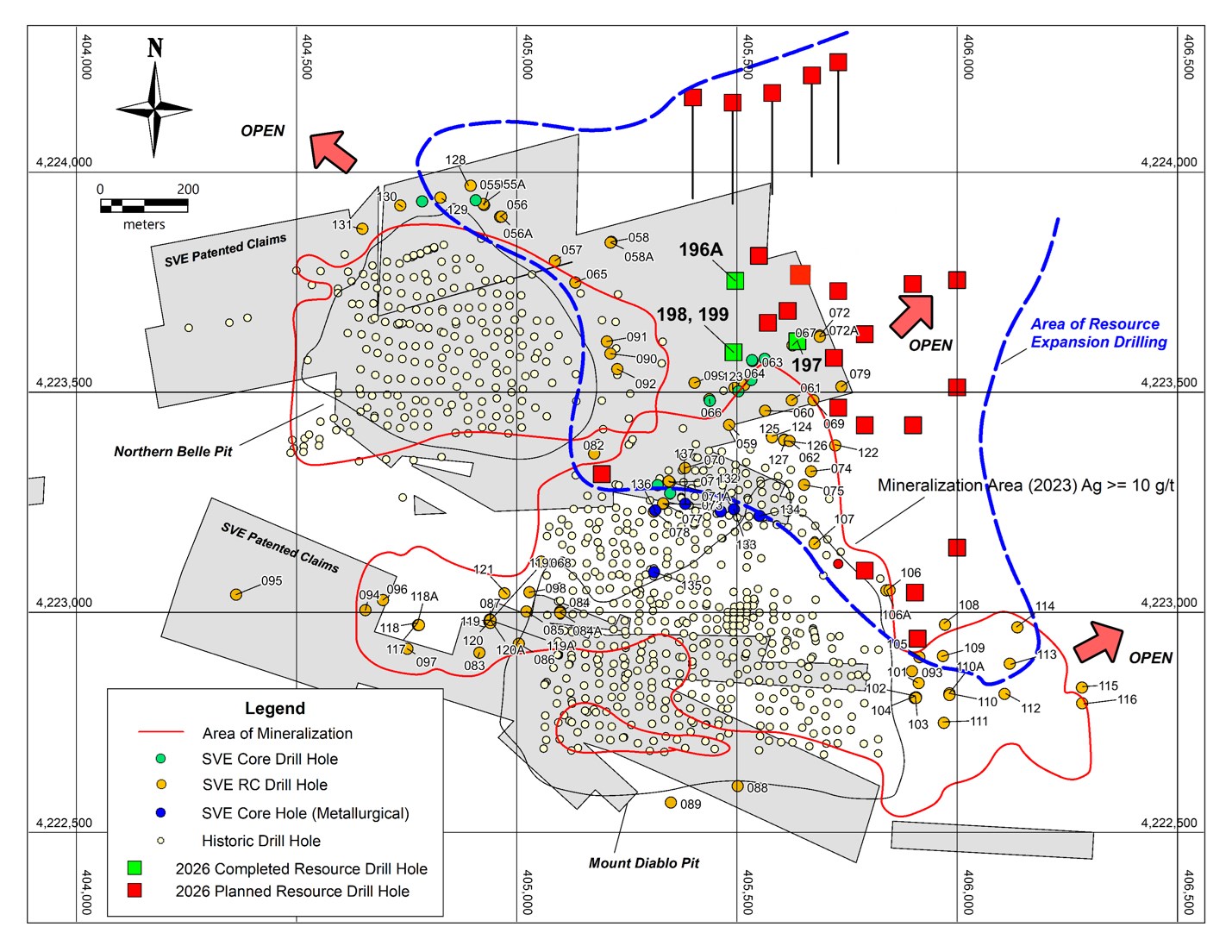
Figure 1. Candelaria resource area map showing completed holes (green squares) and selected planned holes from the 2026 drill program (red squares).
To view an enhanced version of this graphic, please visit:
https://images.newsfilecorp.com/files/4730/314700_89430645046df894_001full.jpg
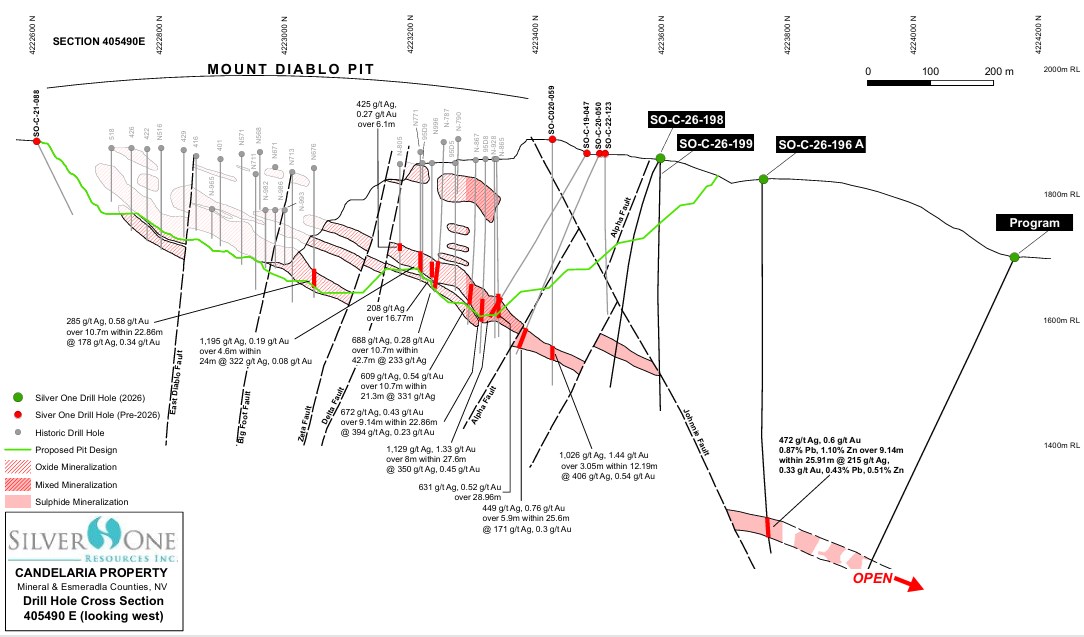
Figure 2. North-South section 405490E looking west.
To view an enhanced version of this graphic, please visit:
https://images.newsfilecorp.com/files/4730/314700_89430645046df894_002full.jpg
Table 1. Summary of relevant assays received to date from the 2026 RC drilling campaign. Widths reported are near-true widths approximately
| HOLE ID | From (m) | To (m) | Interval (m) | Au g/t | Ag g/t | Cu % | Pb % | Zn % | AgEq g/t |
| SO-C-26-196A | 542.55 | 568.46 | 25.91 | 0.33 | 215 | 0.02 | 0.43 | 0.51 | 250 |
| Includes | 542.55 | 551.69 | 9.14 | 0.6 | 472 | 0.04 | 0.87 | 1.10 | 540 |
| SO-C-26-197 | 391.67 | 394.72 | 3.05 | 0.68 | 454 | 0.04 | 1.45 | 1.77 | 539 |
| and | 403.86 | 408.44 | 4.58 | 0.16 | 112 | 0.01 | 0.24 | 0.42 | 131 |
| SO-C-26-198 | Assays Pending | ||||||||
| SO-C-26-199 | Assays Pending | ||||||||
AgEq calculated using the following recoveries and metal prices: Ag
Table 2. Location and downhole data for holes completed to date from the 2026 RC drilling campaign.
| Hole | Easting UTM NAD83 | Northing UTM NAD83 | Elevation meters | Azimuth | Incl | Depth meters |
| SO-C-26-196 | 405497 | 4223761 | 1827.7 | 0 | -90 | 222.51 |
| SO-C-26-196A | 405496 | 4223753 | 1827.82 | 0 | -90 | 608.08 |
| SO-C-26-197 | 405637 | 4223616 | 1864 | 0 | -90 | 484.03 |
| SO-C-26-198 | 405492 | 4223591 | 1867.6 | 180 | -75 | 365.76 |
| SO-C-26-199 | 405493 | 4223591 | 1867.6 | 0 | -90 | 396.24 |
Metallurgical Context
Preliminary metallurgical testing completed in 2023 on sulphide samples from two drill holes drilled in 2022 demonstrate that flotation effectively recovers silver, gold, lead, and zinc. Average flotation recoveries were
Importantly, cyanidation of flotation tails significantly improved precious-metal extraction, increasing silver recovery to
These results support that the sulphide mineralization so far encountered in the 2026 drilling is amenable to conventional processing flowsheets, providing a sound basis for future economic studies.
Technical Significance
The grades and thicknesses reported from SOC26-196A and SOC26-197 underscore the continuity, strength, and scale of the mineralized system at Candelaria. The 400-metre down-dip extension achieved by SOC26-196A is particularly encouraging, demonstrating that the system remains open and robust at depth, down-dip and along strike.
Combined with the metallurgical performance of similar sulphide material, these results highlight the significant upside potential of the project as drilling continues.
Next Steps
Assays for the remaining two holes are pending and will be released upon receipt. National Drilling is preparing to mobilize by the end of the month with drilling scheduled to resume shortly thereafter.
The program will continue to focus on expanding known mineralization and evaluating deeper targets identified through geophysics and structural interpretation.
Analytical and QA/QC Procedures
All samples were assayed by American Assay Laboratories ("AAL") in Sparks, NV, USA (ISO accredited Laboratory, ISO/IEC 17025:2017). Samples were analyzed for fifty elements by ICP-MS. Gold was analyzed by FA with ICP finish (IO-FAAu30), samples over 100 g/t Ag were analyzed by FA/gravimetric methods (G-FAAuAg). Over limit Cu, Pb and Zn were analyzed by ore-grade volumetric analysis (IO-4AOR). The QA/QC program included the submission of Certified Standards, blanks, core duplicates, as well as the insertion of crushed duplicates and pulp duplicates at random intervals. Certified Standards were inserted at a rate of one standard for every 20 samples (
Extrakt Proprietary Solution Update
Silver One is advancing towards completing its formerly announced pre-feasibility study at Candelaria. Extrakt proprietary solutions (promoted by the Extrakt Bechtel Alliance) have shown promise for increasing silver recoveries from previously processed leach pads. However, the Company believes further testing will be required for inclusion into the pre-feasibility study. As such, the Company has made the decision to proceed with a pre-feasibility study using conventional cyanide ("CN") extraction on both the fresh open-pit material and the heap leach material. Based on current metal prices, as well as three-year trailing average silver and gold prices, the Project is expected to generate robust economic returns, even under the more conservative recovery assumptions associated with cyanide extraction of the heap leach material.
Silver One is aiming to complete the pre-feasibility study by year end. The Company will then move forward with updating and renewing existing permits with the aim of making a production decision.
Qualified Person
The technical content of this news release has been reviewed and approved by Robert M. Cann, P. Geo, a Qualified Person as defined by National Instrument 43-101 and an independent consultant to the Company.
About Silver One
Silver One is focused on the exploration and development of quality silver projects. The Company holds a
The Company owns 636 lode claims and five patented claims on its Cherokee project located in Lincoln County, Nevada, host to multiple silver-copper-gold vein systems, traced to date for over 11 km along-strike.
Silver One also owns a
For more information, please contact:
Silver One Resources Inc.
Gary Lindsey - VP, Investor Relations
Phone: 604-974‐5274
Mobile: (720) 273-6224
Email: gary@strata-star.com
Forward-Looking Statements
Information set forth in this news release contains forward-looking statements that are based on assumptions as of the date of this news release. These statements reflect management's current estimates, beliefs, intentions and expectations. They are not guarantees of future performance. Silver One cautions that all forward-looking statements are inherently uncertain, and that actual performance may be affected by a number of material factors, many of which are beyond Silver One's control. Such factors include, among other things: risks and uncertainties relating to Silver One's limited operating history, ability to obtain sufficient financing to carry out its exploration and development objectives on the Candelaria Project, obtaining the necessary permits to carry out its activities and the need to comply with environmental and governmental regulations. Accordingly, actual and future events, conditions and results may differ materially from the estimates, beliefs, intentions and expectations expressed or implied in the forward-looking information. Except as required under applicable securities legislation, Silver One undertakes no obligation to publicly update or revise forward-looking information.
NEITHER TSX VENTURE EXCHANGE NOR ITS REGULATION SERVICES PROVIDER (AS THAT TERM IS DEFINED IN THE POLICIES OF THE TSX VENTURE EXCHANGE) ACCEPTS RESPONSIBILITY FOR THE ADEQUACY OR ACCURACY OF THIS RELEASE.

To view the source version of this press release, please visit https://www.newsfilecorp.com/release/314700
FAQ
AI-generated questions and answers. How Rhea-AI works. Not financial advice.
What are the key assay details from hole SOC26‑196A at Candelaria?
Hole SOC26‑196A intersected 25.91 m from 542.55 m depth averaging 0.33 g/t gold, 215 g/t silver, 0.02% copper, 0.43% lead and 0.51% zinc (250 g/t silver equivalent). This includes 9.14 m from 542.55 m averaging 0.60 g/t gold, 472 g/t silver, 0.04% copper, 0.87% lead and 1.10% zinc (540 g/t silver equivalent). Widths are near‑true, about 94% of drilled intercepts.
What did hole SOC26‑197 intersect in the 2026 drill campaign?
Hole SOC26‑197 cut 3.05 m from 391.67 m averaging 0.68 g/t gold, 454 g/t silver, 0.04% copper, 1.45% lead and 1.77% zinc (539 g/t silver equivalent). It also intersected 4.58 m from 403.86 m averaging 0.16 g/t gold, 112 g/t silver, 0.01% copper, 0.24% lead and 0.42% zinc (131 g/t silver equivalent).
How extensive is the 2026 drilling program at Silver One’s Candelaria Project?
The 2026 program is planned for 25,000 m of reverse‑circulation drilling. To date, 2,077 m have been drilled in four holes (SOC26‑196, 196A, 197, 198), with assays received for SOC26‑196A and SOC26‑197. Assays for SOC26‑198 and SOC26‑199 are pending, and National Drilling is preparing to remobilize by month‑end.
What metallurgical recoveries have been achieved on Candelaria sulphide mineralization?
Preliminary 2023 tests on sulphide samples showed average flotation recoveries of 62% silver, 72% gold, 50% lead and 37% zinc. Cyanidation of flotation tails increased silver recovery to 71%–84% (average 77.5%) and gold recovery to 75%–89% (average 82%), indicating the sulphides are amenable to conventional flowsheets.
Why is Silver One using conventional cyanide extraction in the pre‑feasibility study?
The company states that Extrakt proprietary solutions have shown promise for increasing silver recoveries from historic leach pads but require further testing before inclusion in the pre‑feasibility study. It has therefore decided to proceed using conventional cyanide extraction on fresh open‑pit and heap‑leach material.
What is the timeline and objective of the Candelaria pre‑feasibility study?
Silver One is aiming to complete the pre‑feasibility study by year end. After completion, the company plans to update and renew existing permits with the aim of making a production decision for the Candelaria Project.