
Silexion Therapeutics Reports New Positive Preclinical Findings Demonstrating Multi-Mechanism Immune Sensitization by SIL204 in KRAS-Driven Cancers
Silexion Therapeutics (NASDAQ: SLXN) reported new positive preclinical data showing that its KRAS-targeting siRNA SIL204 exerts multi-mechanism immune sensitization in human KRAS-mutant pancreatic and non-small cell lung cancer cell lines.
Rhea-AI Summary
Silexion Therapeutics (NASDAQ: SLXN) reported new positive preclinical data showing that its KRAS-targeting siRNA SIL204 exerts multi-mechanism immune sensitization in human KRAS-mutant pancreatic and non-small cell lung cancer cell lines. SIL204 significantly upregulated the FAS (CD95) immune death receptor and downregulated HLA-G, an immune checkpoint, across KRAS G12D, G12V and G12C models.
Combined with previously reported MHC-I (HLA-ABC) upregulation in KRAS G12R-mutant pancreatic cells, the data support a coordinated signature involving increased antigen presentation, restored susceptibility to immune-mediated apoptosis, and reduced immune checkpoint activity across four KRAS mutations. According to Silexion, these findings reinforce the rationale for combining SIL204 with anti-PD-(L)1 therapies and provide additional translational support as SIL204 advances into Phase 2/3 clinical evaluation, following initiation of the first trial site at Tel Aviv Sourasky Medical Center in July 2026.
Positive
- FAS upregulation in KRAS-mutant cells up to ~2-fold at 72 hours (P<0.0001) in KRAS G12D pancreatic cells and significant increase in KRAS G12V NSCLC cells
- HLA-G checkpoint downregulation with statistically significant, dose-dependent reductions in KRAS G12C NSCLC cells (P<0.001 at 24h; P<0.01 at 72h at 200 nM) and reductions in additional KRAS-mutant lines
- Coordinated immune-sensitization signature demonstrated across three pathways (MHC-I, FAS, HLA-G) and four KRAS mutations (G12D, G12V, G12C, G12R) in pancreatic and NSCLC models
- SIL204 advancing to Phase 2/3 clinical evaluation, with the first clinical trial site initiated at Tel Aviv Sourasky Medical Center in late July 2026
- Addresses large KRAS-driven populations where KRAS mutations occur in ~90% of pancreatic cancers and 30–35% of lung adenocarcinomas, supporting broad potential applicability of SIL204’s mechanism
Negative
- New SIL204 results are limited to preclinical cell-line studies, with no new clinical efficacy or safety data disclosed alongside these mechanistic findings
Details
News Market Reaction – SLXN
In the Aug 4 session, SLXN declined 2.56%, reflecting a moderate negative market reaction. Argus tracked a peak move of +8.4% during that session. Argus tracked a trough of -30.2% from its starting point during tracking. Our momentum scanner triggered 10 alerts that day, indicating notable trading interest and price volatility. Trading volume was exceptionally heavy at 7.6x the daily average, suggesting significant selling pressure.
Data tracked by StockTitan Argus on the day of publication.
Key Figures
- FAS upregulation
- up to approximately 2-fold
- 72 hours in KRAS G12D-mutant pancreatic cancer cells
- FAS p-value
- P<0.0001
- PK59 KRAS G12D-mutant pancreatic cancer cells vs. control
- FAS p-value
- P<0.05
- CORL23 KRAS G12V-mutant NSCLC cells vs. control
- HLA-G p-value
- P<0.001
- NCI-H358 KRAS G12C-mutant NSCLC cells at 24 hours
- HLA-G p-value
- P<0.01
- NCI-H358 KRAS G12C-mutant NSCLC cells at 72 hours
- KRAS mutations
- 4 distinct KRAS mutations
- Immune-modulatory effects across pancreatic and NSCLC models
- KRAS prevalence
- approximately 90%
- Pancreatic cancers
- KRAS prevalence
- 30–35%
- Lung adenocarcinomas
Historical Context
-
Germany's BfArM approved initiation of the SIL204 Phase 2/3 trial.
-
Silexion announced attendance and investor meetings at BIO International Convention.
-
The company announced a 1-for-10 reverse share split.
-
Results included higher R&D spending, a larger net loss, and lower cash.
-
Warrant exercises targeted approximately $1 million in gross proceeds.
24h Move is the share-price change in the day after each event; other market factors may also have contributed.
Key Terms
hla-g medical
mhc-i medical
qPCR technical
anti-pd-(l)1 medical
AI-generated analysis. How Rhea-AI works. Not financial advice.




Silexion to present SIL-204 data at leading Cancer Symposium designed to feature the latest science in the field of GI cancers
New preclinical data demonstrate that SIL204 treatment produced statistically significant upregulation of FAS (CD95), the immune “death receptor,” and statistically significant downregulation of HLA-G, an established immune checkpoint, in human KRAS-mutant pancreatic and non-small cell lung cancer cell lines representing three distinct KRAS mutations (G12D, G12V, and G12C)
Combined with previously reported MHC-I upregulation, findings support a coordinated immune-sensitization signature across three key immune pathways - increased antigen presentation, restored susceptibility to immune-mediated apoptosis, and reduced immune checkpoint activity - and reinforce the scientific rationale for combining SIL204 with anti-PD-(L)1 immune checkpoint inhibitor therapies
Findings emerge as Silexion advances SIL204 into Phase 2/3 clinical evaluation, following successful initiation of the Company’s first clinical trial site at Tel Aviv Sourasky Medical Center at the end of July 2026
Grand Cayman, Cayman Islands, Aug. 04, 2026 (GLOBE NEWSWIRE) -- Silexion Therapeutics Corp. (NASDAQ: SLXN) (“Silexion” or the “Company”), a clinical-stage biotechnology company pioneering RNA interference (RNAi) therapies for KRAS-driven cancers, today announced additional positive preclinical findings from its ongoing translational immuno-oncology program evaluating SIL204 in human KRAS-mutant cancer cells. The new findings further expand SIL204’s therapeutic profile by demonstrating a coordinated immune-sensitizing effect on tumor cells, reinforcing the scientific rationale for combining SIL204 with anti-PD-(L)1 checkpoint inhibitor therapies. In newly reported studies performed across three human cancer cell lines representing three different KRAS mutations, SIL204 treatment produced statistically significant increases in expression of FAS, a well-established immune “death receptor,” and statistically significant reductions in expression of HLA-G, an immune checkpoint that tumors use to evade immune surveillance. The findings, generated in human pancreatic (KRAS G12D) and non-small cell lung cancer (NSCLC; KRAS G12V and G12C) cell lines, build on the Company’s previously reported MHC-I upregulation data announced in May 2026, and further support SIL204’s potential to act as a multi-mechanism immune sensitizer in KRAS-driven tumors.
“These new findings meaningfully extend and reinforce the immuno-oncology profile of SIL204 that we first reported in May,” said Ilan Hadar, Chairman and Chief Executive Officer of Silexion Therapeutics. “In one integrated dataset, we are now seeing that SIL204 modulates three of the most important mechanisms by which KRAS-driven tumors evade the immune system - upregulating antigen presentation via MHC-I, upregulating FAS to restore sensitivity to immune-mediated cell death, and downregulating the HLA-G immune checkpoint to remove a key inhibitory signal to immune cells. SIL204 is producing this coordinated immune-sensitizing effect across multiple KRAS mutations and both of the largest KRAS-driven tumor types. We believe this profile supports the rationale for further evaluation of SIL204 in combination with anti-PD-(L)1 checkpoint inhibitor therapies, particularly in indications like pancreatic cancer where these agents have historically shown limited single-agent efficacy.”
FAS (also known as CD95) is a cell surface death receptor whose engagement by Fas ligand (FasL) - which is expressed on activated CD8+ T cells and natural killer (NK) cells - triggers programmed cell death of the target cell. Cancer cells, and KRAS-driven tumors in particular, commonly downregulate FAS to evade immune-mediated killing. Recent research published in Developmental Cell (Cell Press) has demonstrated that elimination of oncogenic KRAS in genetic mouse models of pancreatic ductal adenocarcinoma restores FAS expression and enables FasL-expressing CD8+ T cells to eradicate KRAS-driven tumors.¹ In the newly reported Silexion study, SIL204 treatment produced statistically significant, dose-dependent increases in FAS expression at 72 hours in human KRAS G12D-mutant pancreatic cancer cells (PK59; up to approximately 2-fold, P<0.0001 vs. control) and in KRAS G12V-mutant NSCLC cells (CORL23; P<0.05 vs. control).
HLA-G is a non-classical HLA class I molecule that functions as a potent immune checkpoint. When expressed on tumor cells, HLA-G binds inhibitory receptors - including ILT-2 (LILRB1), ILT-4 (LILRB2), and KIR2DL4 - on CD8+ T cells, NK cells, and myeloid immune cells, suppressing their anti-tumor activity and enabling immune escape.² HLA-G is a recognized and increasingly prominent drug target in oncology, with multiple HLA-G-directed programs currently in clinical development in advanced solid tumors. In the newly reported study, SIL204 treatment produced statistically significant, dose-dependent reductions in HLA-G expression in human KRAS G12C-mutant NSCLC cells (NCI-H358; P<0.001 at 24 hours and P<0.01 at 72 hours vs. control at the 200 nM dose), with additional reductions observed in KRAS G12D-mutant pancreatic and KRAS G12V-mutant NSCLC cells.
Taken together with the Company’s previously reported May 2026 findings demonstrating statistically significant upregulation of MHC-I (HLA-ABC) in KRAS G12R-mutant pancreatic cancer cells, these new data support a coordinated immune-sensitization signature across three key immune pathways. The immune-modulatory effects have now been observed across four distinct KRAS mutations (G12D, G12V, G12C, and G12R) in both pancreatic and non-small cell lung cancer models, reinforcing the potential applicability of SIL204’s mechanism across the largest KRAS-driven cancer patient populations.
The findings arrive at a moment when the oncology field is actively exploring combinations of KRAS-directed therapies with immune checkpoint inhibitors, with recent academic and industry work demonstrating that combining KRAS inhibition with anti-PD-1 or anti-PD-L1 agents can produce sustained tumor regression and reprogramming of the tumor microenvironment in KRAS-driven cancers.³ Pancreatic ductal adenocarcinoma and KRAS-mutant NSCLC together represent the largest KRAS-driven patient populations, with KRAS mutations present in approximately
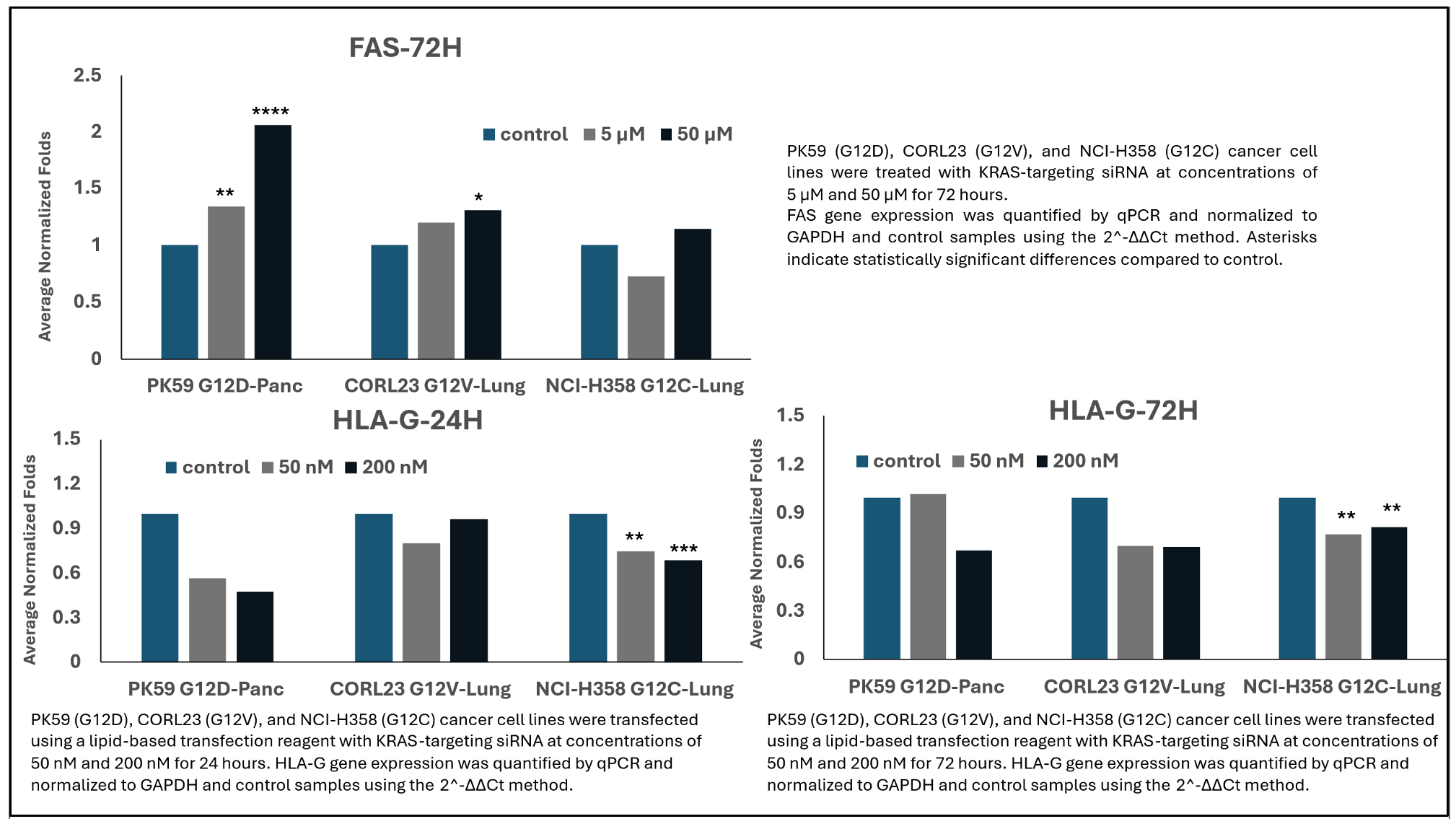
Image Caption: SIL204 treatment upregulates FAS and downregulates HLA-G expression in human KRAS-mutant cancer cells. FAS expression at 72 hours (upper panel) in pancreatic (PK59, G12D) and NSCLC (CORL23, G12V; NCI-H358, G12C)cells treated with SIL204, the Company's clinical KRAS-targeting siRNA. HLA-G expression at 24 hours (lower left) and 72 hours (lower right) in the same cell lines. Gene expression quantified by qPCR, normalized to GAPDH and control samples using the 2^-ΔΔCt method. *P<0.05, **P<0.01, ***P<0.001, ****P<0.0001 vs. control.
About Silexion Therapeutics
Silexion Therapeutics is a pioneering clinical-stage, oncology-focused biotechnology company dedicated to the development of innovative treatments for unsatisfactorily treated solid tumor cancers that have the mutated KRAS oncogene, generally considered to be the most common oncogenic gene driver in human cancers. The Company conducted a Phase 2a clinical trial in its first-generation product candidate, which showed a positive trend in comparison to the control of chemotherapy alone, and is now advancing its lead, second-generation, product candidate, SIL204, a small interfering RNA (siRNA), through Phase 2/3 clinical evaluation. Silexion is committed to pushing the boundaries of therapeutic advancements in the field of oncology and further developing its lead product candidate for locally advanced pancreatic cancer. For more information, please visit: https://silexion.com
Notice Regarding Forward-Looking Statements
This press release contains forward-looking statements within the meaning of the federal securities laws. All statements other than statements of historical fact contained in this communication, including statements regarding the therapeutic potential, immune-modulating activity, mechanism of action, translational significance including its potential role in modulating antigen presentation, restoring immune recognition, reducing immune checkpoint activity, enhancing responsiveness to checkpoint inhibitor therapies, and future immuno-oncology or combination applications, are forward-looking statements. These forward-looking statements are generally identified by terminology such as “may”, “should”, “could”, “might”, “plan”, “possible”, “expect”, “intend”, “will”, “estimate”, “anticipate”, “believe”, “predict”, or “potential”, or the negatives of these terms or variations of them or similar terminology. Forward-looking statements involve a number of risks, uncertainties, and assumptions, and actual results or events may differ materially from those projected or implied in those statements. Important factors that could cause such differences include, but are not limited to: (i) the inherent uncertainties associated with preclinical research and drug development, including the risk that preclinical findings may not translate to clinical outcomes; (ii) Silexion’s ability to successfully complete additional preclinical studies and initiate and conduct clinical trials, including the Phase 2/3 trial of SIL204 in locally advanced pancreatic cancer; (iii) Silexion’s strategy, future operations, financial position, projected costs, prospects, and plans; (iv) the impact of the regulatory environment and compliance complexities, including site-level approvals, conditions and clearances required prior to study commencement at each clinical site in Israel and Germany, and the timing and outcome of additional regulatory submissions and reviews in further EU member states, the United States, and other jurisdictions; (v) expectations regarding future partnerships or other relationships with third parties; (vi) Silexion’s future capital requirements and sources and uses of cash, including its ability to obtain additional capital; (vii) Silexion’s ability to maintain its Nasdaq listing; and (viii) other risks and uncertainties set forth in the documents filed by the Company with the SEC, including the Company’s Annual Report on Form 10-K for the year ended December 31, 2025, filed with the SEC on March 17, 2026, and the Company’s Quarterly Report on Form 10-Q for the quarter ended March 31, 2026, filed with the SEC on May 15, 2026. Silexion cautions you against placing undue reliance on forward-looking statements, which reflect current beliefs and are based on information currently available as of the date a forward-looking statement is made. Forward-looking statements set forth herein speak only as of the date they are made. Silexion undertakes no obligation to revise forward-looking statements to reflect future events, changes in circumstances, or changes in beliefs, except as otherwise required by law.
Company Contact
Silexion Therapeutics Corp
Ms. Mirit Horenshtein Hadar, CFO
mirit@silexion.com
Investor Relations Contact
Arx Investor Relations
North American Equities Desk
silexion@arxhq.com
____________________
¹ Mahadevan KK et al., Elimination of oncogenic KRAS in genetic mouse models eradicates pancreatic cancer by inducing FAS-dependent apoptosis by CD8+ T cells, Developmental Cell (2023).
² See Loustau M et al., HLA-G Neo-Expression on Tumors, Frontiers in Immunology (2020); Lin A and Yan WH, Heterogeneity of HLA-G Expression in Cancers: Facing the Challenges, Frontiers in Immunology (2018).
³ See Mahadevan KK et al., KRASG12D inhibition reprograms the microenvironment of early and advanced pancreatic cancer to promote FAS-mediated killing by CD8+ T cells, Cancer Cell (2023); Kemp SB et al., Efficacy of a Small-Molecule Inhibitor of KrasG12D in Immunocompetent Models of Pancreatic Cancer, Cancer Discovery (2023); MD Anderson Cancer Center research on combination of KRAS G12D inhibition with checkpoint inhibitors in pancreatic cancer models.

FAQ
AI-generated questions and answers. How Rhea-AI works. Not financial advice.