
Supermicro Introduces Industry's Highest Density AMD EPYC™ 4005 Series MicroBlade® for Cloud, Edge, and SaaS Workloads
Supermicro (NASDAQ: SMCI) launched a high-density MicroBlade platform powered by AMD EPYC 4005 series processors on Feb 26, 2026.
Rhea-AI Summary
Supermicro (NASDAQ: SMCI) launched a high-density MicroBlade platform powered by AMD EPYC 4005 series processors on Feb 26, 2026. The 6U chassis supports up to 40 server nodes (up to 320 nodes per 48U rack) and emphasizes energy efficiency, flexible mix-and-match node types, integrated networking with dual 25GbE and 100G uplinks, and comprehensive remote management including TPM 2.0, signed firmware, IPMI 2.0, KVM over IP, and Redfish API support.
The platform targets cloud, edge, SaaS, storage gateways, and specialized compute workloads, offering single-socket nodes with DDR5 ECC UDIMM memory, PCIe Gen5 SSDs, and chassis power-capping via the controller-managed CMM.
Positive
- Compute density: up to 40 nodes per 6U chassis
- Rack scalability: supports up to 320 nodes in a standard 48U rack
- Integrated networking: dual 25GbE ports with 100G uplinks reduce cabling and TCO
Negative
- Single-socket node design: one AMD EPYC 4005 processor per node
- Limited memory per node: two DDR5 ECC UDIMM slots per node
Details
News Market Reaction – SMCI
On Feb 26, the day this news came out, SMCI closed 3.93% below the previous close.
Data tracked by StockTitan Argus for the Feb 26 session.
Key Figures
- Nodes per 6U enclosure
- 40 server nodes
- New MicroBlade 6U system capacity
- Nodes per rack
- 320 server nodes
- Maximum nodes in standard 48U rack
- Memory slots per node
- 2 DDR5 ECC UDIMM slots
- Per-node memory configuration
- Memory speed
- 5600 MT/s
- DDR5 ECC UDIMM operating speed
- PCIe Gen5 SSDs per node
- 2 PCIe Gen5 E1.S SSDs
- Local storage configuration
- Additional SSD per node
- 1 M.2 SSD
- Per-node additional storage
- Network ports
- Dual-port 25GbE
- Integrated networking via Broadcom BCM57414
- Integrated switches
- Two 25G switches with 100G uplinks
- Enclosure networking and uplink capacity
Historical Context
-
Launched CNode-X AI data platform with NVIDIA and VAST Data.
-
Demonstrated AI GPU clusters providing fast grid demand response.
-
Announced March investor conference participation and 1x1 meetings.
-
Reported Q2 FY2026 results and provided FY2026 revenue and EPS guidance.
-
Scheduled Q2 FY2026 earnings release and webcast details.
24h Move is the share-price change in the day after each event; other market factors may also have contributed.
Key Terms
ddr5 technical
ecc technical
pcie gen5 technical
tpm 2.0 technical
kvm over ip technical
redfish api technical
serial over lan technical
AI-generated analysis. How Rhea-AI works. Not financial advice.




- Delivers Unmatched Scalability, Flexibility, Energy Efficiency
- Optimized for specialized compute including e-commerce and cybersecurity
- Up to 40 server nodes in a 6U enclosure
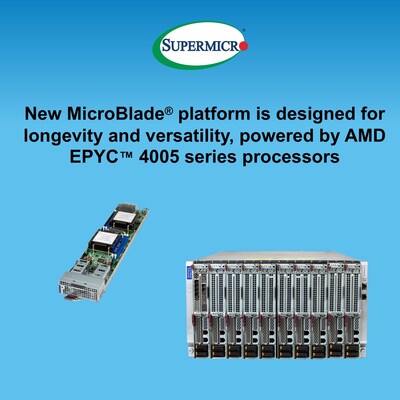
"Our flexible blade architecture enables customers to mix different node types with different CPUs within a single enclosure and can incorporate up to 320 server nodes in a standard 48U rack," said Charles Liang, president and CEO of Supermicro. "Supermicro continues to lead the industry in delivering advanced, energy-efficient platforms to market that maximize scalability, lower total cost of ownership, and protecting data center investments for the long term."
For more information, please visit: https://www.supermicro.com/en/Aplus/MicroBlade/module/MBA-315R-1DE12.php
The new 6U system supports up to 40 nodes in a single enclosure, delivering unparalleled compute density, energy efficiency, and cost effectiveness for scale-out and multi-tenant environments. The platform is optimized for a wide range of efficient and high-density workloads, including:
- Cloud & Virtualization: Ideal for multi-tenant web hosting and small Virtual Private Server (VPS) instances.
- Modern Infrastructure: Kubernetes and microservices platforms, including API services and web front ends.
- Enterprise & Edge: Departmental private clouds and edge deployments requiring high density in constrained spaces.
- Data Services: Object storage gateways and high-efficiency data processing.
- Specialized Compute: Job-splitting simulations, e-commerce platforms, and cybersecurity applications.
Each node supports a single AMD EPYC 4005 series processor with two DDR5 ECC UDIMM slots operating at up to 5600 MT/s, along with two PCIe Gen5 E1.S SSDs and one M.2 SSD per node. Integrated networking features dual-port 25GbE via Broadcom BCM57414, with advanced security and manageability including TPM 2.0, signed firmware, hardware root of trust, IPMI 2.0, KVM over IP, and Redfish API support. The new MicroBlade system uniquely enables flexible mix-and-match configurations across single-wide and double-wide nodes further showcasing the versatility of the all-in-one Supermicro blade system. Connectivity further elevates its capabilities, with two integrated 25G Ethernet switches with 100G uplinks in the back of the enclosure, ensuring reliable, high-speed networking while lowering the TCO through cable reduction.
The MicroBlade chassis management module (CMM) provides total remote control of individual server blades, power supplies, cooling fans, and networking switches remotely. System administrators can control the maximum power consumption per server through power capping and manage the power allocation in the MicroBlade CMM for each blade server. Remote power control capabilities to reboot and/or reset the server are available as well as remote access to the BIOS configuration and operating system console information via SOL (Serial over LAN) or embedded KVM capabilities. Because the controller is a separate processor, all monitoring and control functions operate flawlessly regardless of CPU operation or system power-on status.
About Super Micro Computer, Inc.
Supermicro (NASDAQ: SMCI) is a global leader in Application-Optimized Total IT Solutions. Founded and operating in
Supermicro, Server Building Block Solutions, and We Keep IT Green are trademarks and/or registered trademarks of Super Micro Computer, Inc.
All other brands, names, and trademarks are the property of their respective owners.
 View original content to download multimedia:https://www.prnewswire.com/news-releases/supermicro-introduces-industrys-highest-density-amd-epyc-4005-series-microblade-for-cloud-edge-and-saas-workloads-302698031.html
SOURCE Super Micro Computer, Inc.
FAQ
AI-generated questions and answers. How Rhea-AI works. Not financial advice.