
New Survey by Stagwell's (STGW) The Harris Poll Finds America's Doctors and Scientists Worry About the Future of U.S. Scientific Innovation
Despite their concerns, 94% of doctors, 89% of scientists and 90% of graduate students expected U.S. scientific leadership in 10 years.
Sentiment and the balance of points
Rhea-AI Sentiment reads the wording of the document, how positive or negative its language is on a 1 to 5 scale. The balance of points shown with the takes weighs what the document actually discloses, so the two can disagree, for example when a trial that missed its main goal is described in upbeat language.
Rhea-AI Summary
Stagwell (NASDAQ:STGW) agency The Harris Poll released a Bayer-commissioned survey examining U.S. doctors’ and scientists’ concerns about scientific innovation. Among respondents, 89% of doctors and 91% of scientists were concerned about online science and health misinformation; 89% and 93%, respectively, said the problem had worsened over five years.
Americans’ cynicism toward their fields had prompted 69% of doctors, 71% of scientists and 72% of graduate students to rethink their career choices. Concern about political interference in scientific research priorities reached 90%, 91% and 89%, respectively. The online U.S. survey, conducted September 23–October 14, 2026, included 202 primary care physicians, 250 scientists or engineers and 254 graduate students in science, technology, engineering and mathematics.
AI-generated analysis. How Rhea-AI works. Not financial advice.


NEW YORK CITY, NY / ACCESS Newswire / November 10, 2026 / The Harris Poll, a Stagwell (NASDAQ:STGW) agency, announced today the results from a new survey, "Warning Signs: Scientists and Doctors Worry About the Future of American Innovation," commissioned by Bayer. The survey of primary care physicians, scientists, engineers and graduate students in science, technology, engineering, and math (STEM) fields revealed a scientific community that is increasingly alarmed over misinformation, public cynicism, funding shortfalls and political interference, risking future scientific breakthroughs.
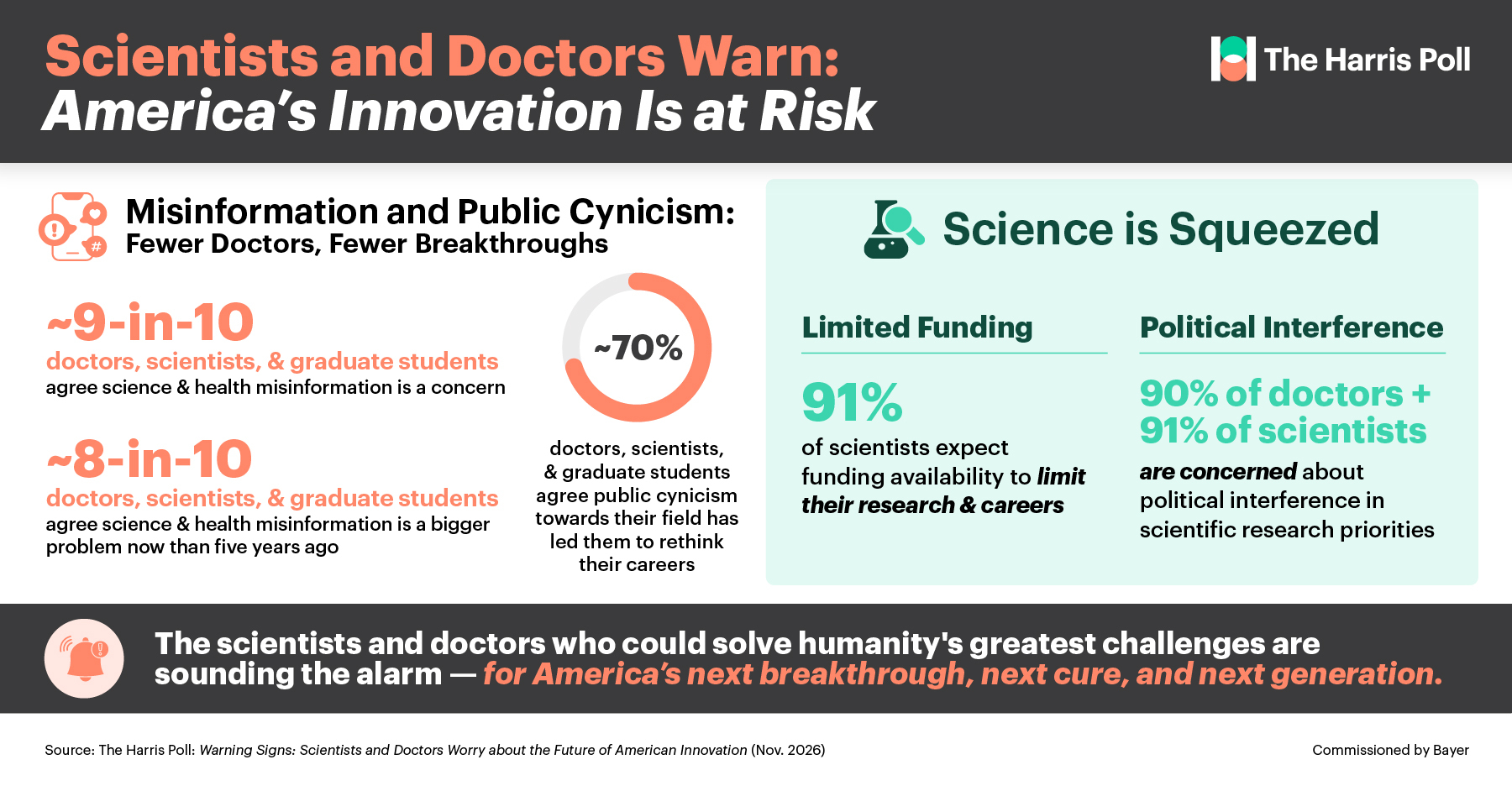
Nearly nine-in-10 doctors (
This cynicism could mean fewer U.S. doctors and researchers available to care for patients and advance breakthroughs. Roughly seven-in-10 say Americans' cynicism toward their field has led them to rethink their career choices (
Amidst the alarm was a note of optimism: doctors, scientists and graduate students are significantly more confident in U.S. scientific leadership than the general public. Roughly nine-in-10 believe the U.S. will be a world leader in scientific research in 10 years (
"The scientists and doctors working on tomorrow's breakthroughs are sending a clear signal today: innovation cannot thrive without public trust," said John Gerzema, CEO of The Harris Poll. "Their message is not one of pessimism, but of urgency. If we want the next generation of discoveries that improve lives, we must support the people, institutions, and scientific process that make those discoveries possible."
Key findings from the report, Warning Signs, include:
- Breakthroughs on the Horizon: 9-in-10 doctors (
91% ), scientists (90% ) and graduate students (87% ) agree that with enough funding and investment in R&D, we're only a few years away from solving some of humanity's most urgent health challenges. - The Threat of Misinformation and Public Cynicism: 9-in-10 doctors (
89% ), scientists (91% ), and graduate students (95% ) are concerned about science and health misinformation spreading online, and feel this is a bigger problem than it was five years ago (89% doctors;93% scientists;85% graduate students). - Limited Funding, Political Interference Hold Us Back: Regardless of how they identify politically,
90% of doctors,91% of scientists and89% of graduate students are concerned about political interference in scientific research priorities.
The cost of inaction is measured in lives, economic growth, and a generation of researchers who may yet choose a different path. Protecting America's scientific future and the breakthroughs on the horizon require attention and action.
Read the full report here: https://theharrispoll.com/articles/future-of-american-innovation/.
Methodology
The research was conducted online in the United States by The Harris Poll on behalf of Bayer among 202 doctors (primary care physicians), 250 scientists or engineers, and 254 graduate students in STEM. The survey was conducted September 23 through October 14, 2026.
For complete research methodology, including weighting variables and subgroup sample sizes, please reach out to Kathy Steinberg at The Harris Poll: kathy.steinberg@harrispoll.com.
About The Harris Poll
The Harris Poll is one of the longest-running and most respected surveys in American history, tracking public opinion, corporate reputation, and brand health since 1956. As part of Stagwell (NASDAQ:STGW), The Harris Poll delivers research, analytics, and measurement solutions to the world's leading brands. With a global reach of more than ninety countries, The Harris Poll offers advisory services across sectors to world leaders, CEOs, and business decision-makers with state-of-the-art analytics, real-time software services, and practitioners in marketing, reputation, customer experience, trends, futures, and thought leadership/research-for-public release. The Harris Poll translates shifting social sentiment into a competitive marketplace advantage. www.theharrispoll.com
About Stagwell
Stagwell is the global challenger network transforming marketing through AI. We deliver scaled creative performance for the world's most ambitious brands, connecting culture-moving creativity with leading-edge technology to harmonize the art and science of marketing. Led by entrepreneurs, our specialists in 40+ countries are unified under a single purpose: to drive effectiveness and improve business results for our clients. Join us at www.stagwellglobal.com.
Media Contacts:
The Harris Poll
Melinda Jones
Melinda.jones@harrispoll.com
Bayer:
Brian Leake
brian.leake@bayer.com
SOURCE: Stagwell
View the original press release on ACCESS Newswire
FAQ
AI-generated questions and answers. How Rhea-AI works. Not financial advice.
What did Stagwell’s Harris Poll survey find about science misinformation?
89% of doctors, 91% of scientists and 95% of graduate students surveyed were concerned about science and health misinformation spreading online. The problem was viewed as worse than five years earlier by 89% of doctors, 93% of scientists and 85% of graduate students.
What did Stagwell’s Harris Poll survey find about funding and future health breakthroughs?
91% of doctors, 90% of scientists and 87% of graduate students agreed that, with enough funding and investment in research and development, solving some of humanity’s most urgent health challenges was only a few years away. These figures reflect respondents’ opinions, not demonstrated research outcomes.