
Standard Uranium Intersects Significant Structure, Alteration, and Anomalous Radioactivity in Multiple Drill Holes at the Davidson River Project; Concludes Summer Drill Program
Radioactive intervals provide follow-up targets, but pending laboratory assays are needed to establish uranium concentrations.
Sentiment and the balance of points
Rhea-AI Sentiment reads the wording of the document, how positive or negative its language is on a 1 to 5 scale. The balance of points shown with the takes weighs what the document actually discloses, so the two can disagree, for example when a trial that missed its main goal is described in upbeat language.
Rhea-AI Summary
Standard Uranium (STTDF) completed 6,734 metres of summer drilling at its Davidson River uranium project in Saskatchewan’s southwest Athabasca Basin. The program covered twelve diamond drill holes across the Warrior, Bronco and Thunderbird corridors. Three holes intersected anomalous radioactivity across 5.0 metres of combined intervals, with a maximum handheld reading of 1,650 counts per second in hole DR-26-040.
Drilling more than doubled the known widths of the Thunderbird and Bronco structural corridors to greater than 300 metres across strike. It also encountered graphitic faults, shear zones and hydrothermal alteration; initial clay analysis confirmed dravitic-clay alteration in DR-26-040. Geochemical assays remain pending, and radioactivity readings do not directly establish uranium grades. One hole required restarting because of difficult ground conditions. The company plans follow-up exploration, with more than 60 km of untested strike length remaining.
Positive
- Minor point6,734 metres across twelve drill holes completed at Davidson River’s Warrior, Bronco and Thunderbird corridors.
- Minor point5.0 metres of combined radioactive intervals intersected in three holes; DR-26-040 readings peaked at 1,650 cps.
- Minor pointThunderbird and Bronco corridor widths more than doubled to greater than 300 metres across strike.
- Minor pointGraphitic faults, shear zones and hydrothermal alteration intersected in multiple drill holes.
- Minor pointDravitic-clay alteration confirmed by initial clay analysis in Bronco drill hole DR-26-040.
- Minor point. Forward-looking: it has not happened yet and may not happen.Follow-up exploration is being planned for radioactive intervals and regional targets; all structural corridors remain open along strike.
Negative
- Minor pointGeochemical assays remain pending; handheld radioactivity readings are preliminary indications, not direct measures of uranium grade.
- Minor pointDR-26-051A required restarting because of difficult ground conditions.
AI-generated analysis. How Rhea-AI works. Not financial advice.




Vancouver, British Columbia--(Newsfile Corp. - October 1, 2026) - Standard Uranium Ltd. (TSXV: STND) (OTCQB: STTDF) (FSE: 9SU0) ("Standard Uranium" or the "Company") is pleased to announce that drilling activities have been completed at its flagship Davidson River Uranium Project ("Davidson River", or the "Project") located in the southwest Athabasca Basin, Saskatchewan, Canada (Figure 1). Drilling began on June 1, 2026, and a total of 6,734 metres have been completed across the Warrior, Bronco, and Thunderbird structural corridors. The summer drill campaign was designed to target basement-hosted, high-grade* uranium mineralization on the same regional structural trends that host significant uranium deposits including NexGen Energy's Arrow deposit and Paladin Energy's Triple R deposit (Figure 1).
"This program has returned the highest radioactivity recorded to date on the Project and more than doubled the known width of the Thunderbird and Bronco structural corridors. We have intersected our most prospective rocks yet, with strong hydrothermal alteration including sericite and dravitic clays, linked to widespread structural disturbance - The perfect geological environment for basement-hosted uranium mineralization," said Sean Hillacre, P.Geo., President & VP Exploration of Standard Uranium. "Completing our largest drill program ever and seeing prospective results from our integrated targeting thesis on Davidson River is a significant milestone for the Company. The striking similarities we see between these rocks and the structural settings of known deposits in the area give us increased confidence in where we will focus our next phase of exploration."
Highlights
A total of 6,734 metres were completed across twelve diamond drill holes across target areas along the Warrior, Bronco, and Thunderbird conductor corridors (Figure 2).
Multiple intervals of anomalous** radioactivity >300 counts per second ("cps") were intersected in three drill holes, totalling 5.0 metres of composite radioactivity across all intervals. All structural corridors remain open along strike.
Anomalous** radioactivity is hosted within paragneiss, pegmatite, and granitoid orthogneiss units. Structural settings include hydrothermally altered graphitic fault zones and quartz-carbonate veining - all consistent with known uranium mineralization in the region.
Initial results from samples containing clay alteration analyzed by Short Wavelength Infrared Reflectance ("SWIR") via a Portable Infrared Mineral Analyzer ("PIMA") to verify clay species have confirmed dravitic-clay alteration in drill hole DR-26-040 along the Bronco corridor.
- Whole-rock geochemical assays of drill core samples are pending. Several priority uranium targets remain along >60 km of untested strike length, and additional exploration programs are being planned to follow up on radioactive intervals and continue developing and testing regional drill targets across the Project.
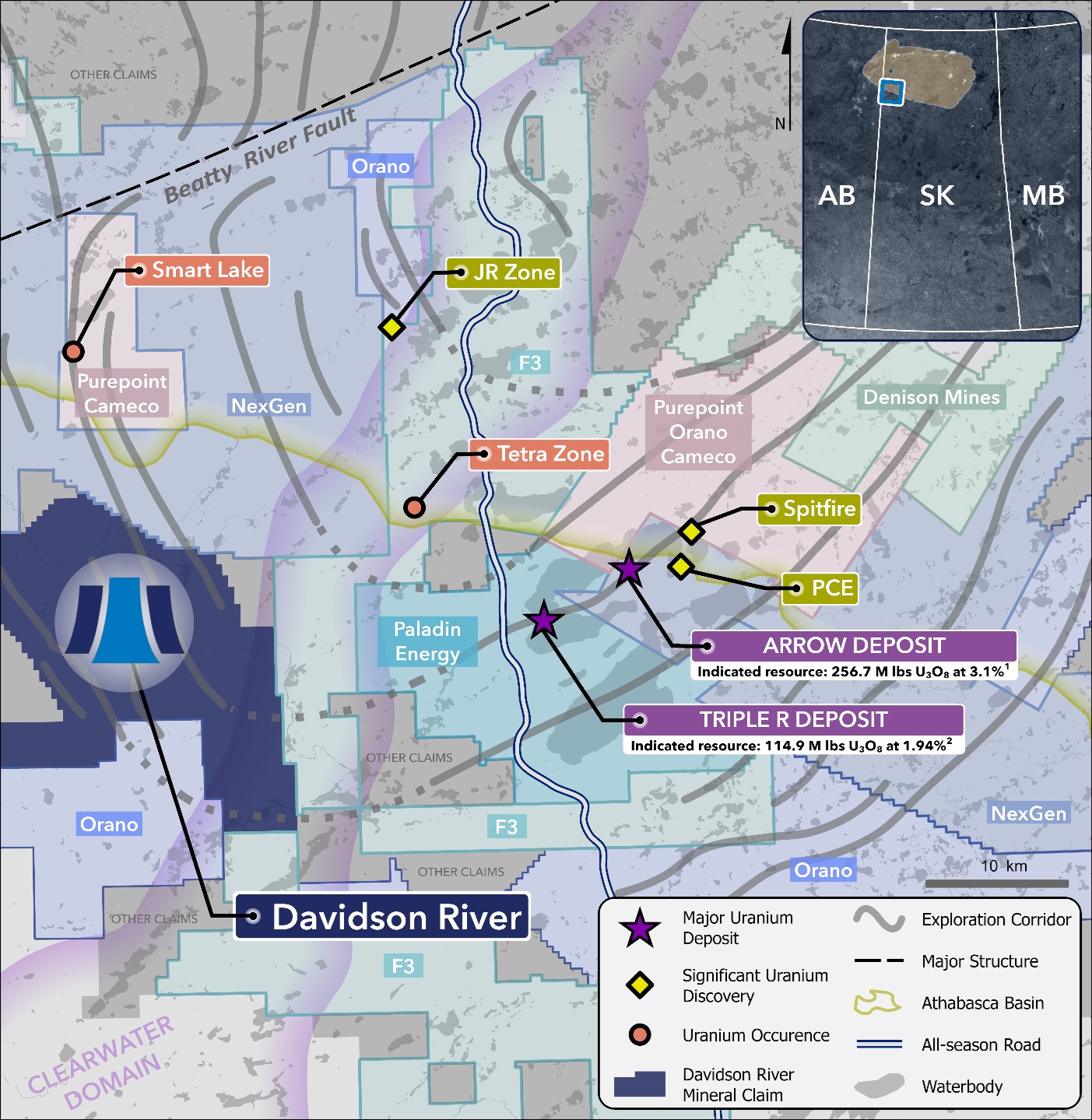
Figure 1. Overview of Standard Uranium's Flagship Davidson River Project in the southwest Athabasca Basin uranium district along trend from significant uranium discoveries and resources1,2.
To view an enhanced version of this graphic, please visit:
https://images.newsfilecorp.com/files/10633/316802_13e0cbfc84d6fb00_001full.jpg
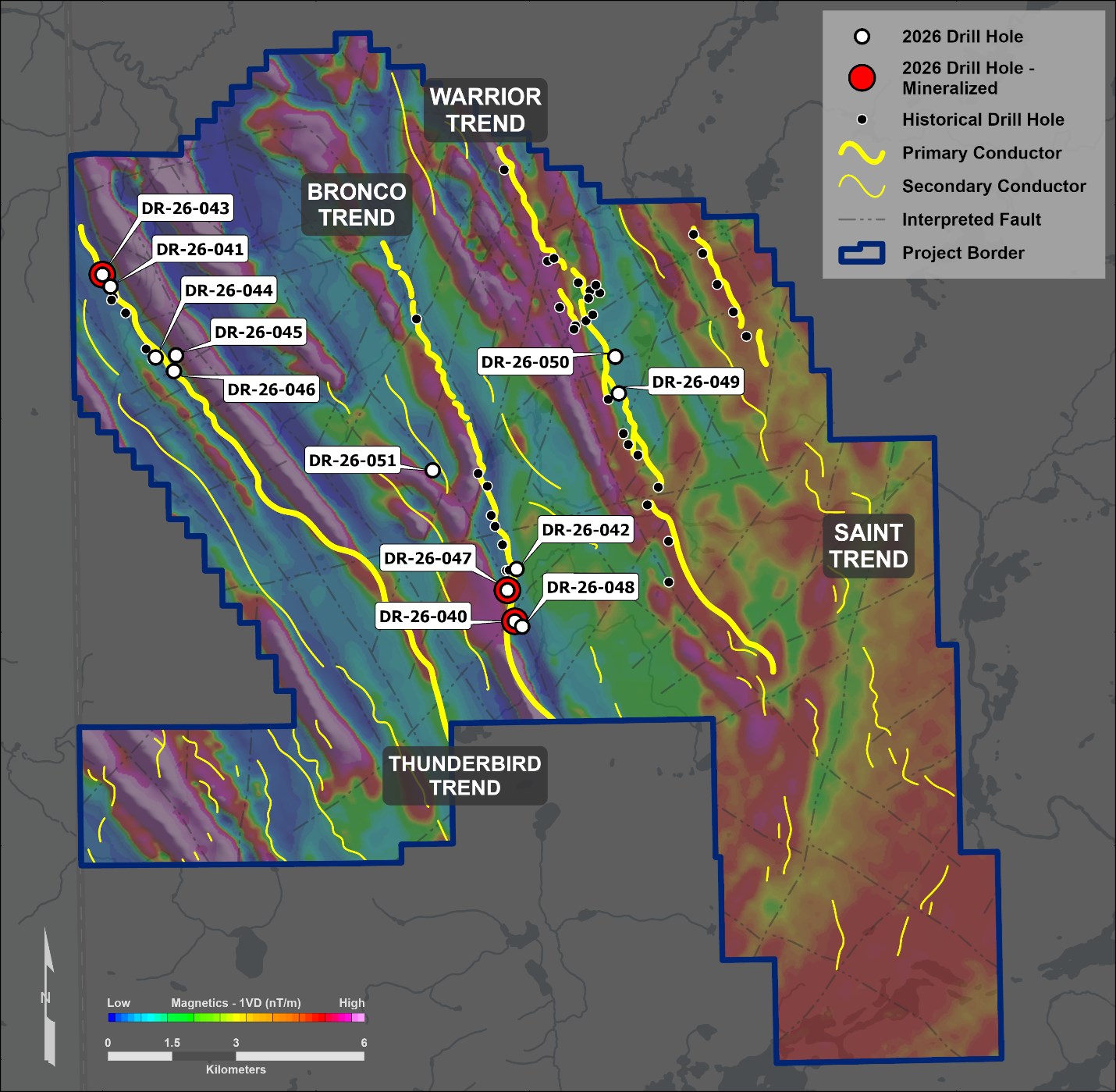
Figure 2. Davidson River project overview highlighting summer 2026 drilling.
To view an enhanced version of this graphic, please visit:
https://images.newsfilecorp.com/files/10633/316802_13e0cbfc84d6fb00_002full.jpg
2026 Drill Program - Preliminary Results
The summer drill program comprised 6,734 metres across twelve drill holes, three of which intersected anomalous** radioactivity within multiple intervals (Table 1). One drill hole was restarted due to difficult ground conditions.
The summer program began testing high-priority target areas defined by data integration and modeling of the Project's existing datasets and a Multiphysics survey, comprising combined real-time 3D Ambient Noise Tomography ("ANT"), Horizontal-to-Vertical Spectral Ratio ("HVSR"), and ground gravity surveys completed on select areas of the Warrior, Bronco, and Thunderbird conductor trends. Initial radiometric*** results and drill hole information from the program is provided in Table 1.
Targets were selected and prioritized through an iterative approach working in collaboration with Fleet Space and Convolutions Geoscience Corporation, targeting compelling geophysical signatures and favorable geological/structural settings.
The twelve completed drill holes encountered highly favorable geological settings for basement-hosted uranium deposits, including:
Five metres of anomalous** radioactivity (>300 cps) intersected across multiple intervals in three drill holes.
Significant graphitic faults and shear zones were intersected in multiple drill holes, more than doubling the known width of the Thunderbird and Bronco structural corridors to greater than 300 metres across strike. The modeled structural geometry at Davidson River from new drill results matches the stacked shear zone geometry of the neighbouring Patterson Lake Corridor.
Drilling intersected prominent brittle reactivation features including breccias, cataclasites, fault gouge, strong fracturing and local shearing all of which are consistent with environments hosting uranium mineralization in the region.
Multiple intervals of moderate to strong hydrothermal alteration including sericite and dravitic clays, hematite, and quartz-carbonate veining.
Table 1. Summer 2026 Davidson River Drill Hole Information
| DDH | Orientation Azimuth/Dip (°) | Target Area | Handheld Spectrometer Results (RS-125) | |||||
| From (m) | To (m) | Width (m) | Min cps | Max cps | ||||
| DR-26-040 | 080/-65 | Bronco | 279.5 | 280 | 0.5 | <300 | 300 | |
| 397 | 397.5 | 0.5 | <300 | 300 | ||||
| 398 | 398.5 | 0.5 | <300 | 300 | ||||
| 464 | 464.5 | 0.5 | <300 | 1,650 | ||||
| 464.5 | 465 | 0.5 | <300 | 540 | ||||
| 465.5 | 466 | 0.5 | <300 | 780 | ||||
| DR-26-041 | 050/-70 | Thunderbird | <300 | |||||
| DR-26-042 | 085/-70 | Bronco | <300 | |||||
| DR-26-043 | 050/-70 | Thunderbird | 356 | 356.5 | 0.5 | <300 | 320 | |
| DR-26-044 | 049/-65 | Thunderbird | <300 | |||||
| DR-26-045 | 045/-70 | Thunderbird | <300 | |||||
| DR-26-046 | 045/-70 | Thunderbird | <300 | |||||
| DR-26-047 | 080/-65 | Bronco | 493 | 493.5 | 0.5 | <300 | 570 | |
| 522 | 522.5 | 0.5 | <300 | 550 | ||||
| 543 | 543.5 | 0.5 | <300 | 390 | ||||
| DR-26-048 | 080/-70 | Bronco | <300 | |||||
| DR-26-049 | 065/-70 | Warrior | <300 | |||||
| DR-26-050 | 060/-65 | Warrior | <300 | |||||
| DR-26-051A | 075/-65 | Bronco | Incomplete; Difficult ground conditions | |||||
| DR-26-051 | 075/-65 | Bronco | DR-26-051A restart; <300 | |||||
All depths and intervals are meters downhole, true thicknesses cannot yet be determined.
"Anomalous" means >300 cps, this refers to local radioactivity within the overall interval.
Next Steps & Follow Up
Drill core samples have been collected systematically throughout all drill holes for whole-rock multi-element geochemical analysis and samples from zones of anomalous** radioactivity have been submitted to SRC Geoanalytical Laboratories in Saskatoon for U3O8 assay. These analytical results will be integrated with the detailed logging information and geophysical datasets to prioritize follow-up target areas for future drill testing, in addition to testing of numerous other priority regional targets.
About the Davidson River Project
Davidson River includes 10 contiguous mineral dispositions totaling 30,737 hectares and lies approximately 25 km west of the Arrow and Triple R uranium deposits and 75 km south of the past-producing Cluff Lake uranium mine. The Company has now completed 23,295 metres of diamond drilling in 51 drill holes on the Davidson River property since 2020, which has further refined the exploration strategy for high-grade basement hosted uranium mineralization on the property. The flagship property hosts more than 70 km of conductive trends across four main structural corridors - the Warrior, Bronco, Thunderbird, and Saint trends. All four geophysical corridors contain multiple target areas favorable for high-grade basement hosted uranium mineralization.
Qualified Person Statement
The scientific and technical information contained in this news release has been reviewed and approved by Sean Hillacre, P.Geo., President and VP Exploration of the Company and a "qualified person" as defined in NI 43-101 - Standards of Disclosure for Mineral Projects.
Geochemical assays are pending. Samples collected for analysis were sent to SRC Geoanalytical Laboratories in Saskatoon, Saskatchewan for preparation, processing, and ICP-MS or ICP-OES multi-element analysis using total and partial digestion and boron by fusion. SRC is an ISO/IEC 17025:2005 and Standards Council of Canada certified analytical laboratory. Blanks, standard reference materials, and repeats were inserted into the sample stream at regular intervals in accordance with Standard Uranium's quality assurance/quality control ("QA/QC") protocols. All sample results will be subject to internal QA/QC protocols prior to subsequent release.
Samples containing clay alteration were sent to Rekasa Rocks Inc. in Saskatoon, Saskatchewan to be analyzed by Short Wavelength Infrared Reflectance ("SWIR") via a Portable Infrared Mineral Analyzer ("PIMA") to verify clay species.
Historical data disclosed in this news release relating to sampling results from previous operators are historical in nature. Neither the Company nor a qualified person has yet verified this data and therefore investors should not place undue reliance on such data. The Company's future exploration work may include verification of the data. The Company considers historical results to be relevant as an exploration guide and to assess the mineralization as well as economic potential of exploration projects. Any historical grab samples disclosed are selected samples and may not represent true underlying mineralization.
Natural gamma radiation from rocks reported in this news release was measured in counts per second ("cps") using a handheld RS-125 super-spectrometer and RS-120 super-scintillometer. Readers are cautioned that scintillometer readings are not uniformly or directly related to uranium grades of the rock sample measured and should be treated only as a preliminary indication of the presence of radioactive minerals. Because the orientation of mineralization is unknown, true widths are unknown and reported intervals represent core lengths. The RS-125 and RS-120 units supplied by Radiation Solutions Inc. ("RSI") have been calibrated on specially designed Test Pads by RSI. Standard Uranium maintains an internal QA/QC procedure for calibration and calculation of drift in radioactivity readings through three test pads containing known concentrations of radioactive minerals. Internal test pad radioactivity readings are known and regularly compared to readings measured by the handheld scintillometers for QA/QC purposes.
References
1 Arrow deposit, Rook I Project, Saskatchewan, NI 43-101 Technical Report on Feasibility Study, Prepared for NexGen Energy Ltd., Effective date: February 22, 2021
2 Feasibility Study, NI 43-101 Technical Report, for PLS Property, Prepared for Fission Uranium Corp., Effective date: January 17, 2023
* The Company defines uranium concentrations greater than 1.0 wt.% as "high-grade."
** Using a handheld RS-125 Super-Spectrometer, readings exceeding 300 counts per second (cps) are considered "anomalous," while those exceeding 65,535 cps are considered "off-scale."
*** Natural gamma radiation reported in this news release was measured in counts per second (cps) using a handheld RS-125 super-spectrometer. Readers are cautioned that handheld scintillometer/spectrometer and/or gamma probe readings are not uniformly or directly related to uranium grades of the rock sample measured and should be treated only as a preliminary indication of the presence of radioactive minerals.
**** The Company cautions that results or discoveries on properties in proximity to the Company's properties may not necessarily be indicative of the presence of mineralization on the Company's properties.
About Standard Uranium (TSXV: STND)
We find the fuel to power a clean energy future
Standard Uranium is a uranium exploration company and emerging project generator poised for discovery in the world's richest uranium district. The Company holds interest in over 272,035 acres (110,089 hectares) in the world-class Athabasca Basin in Saskatchewan, Canada. Since its establishment, Standard Uranium has focused on the identification, acquisition, and exploration of Athabasca-style uranium targets with a view to discovery and future development.
Standard Uranium's Davidson River Project, in the southwest part of the Athabasca Basin, Saskatchewan, comprises ten mineral claims over 30,737 hectares. Davidson River is highly prospective for basement-hosted uranium deposits due to its location along trend from recent high-grade uranium discoveries. However, owing to the large project size with multiple targets, it remains broadly under-tested by drilling. Recent intersections of wide, structurally deformed and strongly altered shear zones provide significant confidence in the exploration model and future success is expected.
Standard Uranium's eastern Athabasca projects comprise over 59,748 hectares of prospective land holdings. The eastern basin projects are highly prospective for unconformity related and/or basement hosted uranium deposits based on historical uranium occurrences, recently identified geophysical anomalies, and location along trend from several high-grade uranium discoveries.
Standard Uranium's Sun Dog project, in the northwest part of the Athabasca Basin, Saskatchewan, is comprised of nine mineral claims over 19,603 hectares. The Sun Dog project is highly prospective for basement and unconformity hosted uranium deposits yet remains largely untested by sufficient drilling despite its location proximal to uranium discoveries in the area.
For further information contact:
Jon Bey, Chief Executive Officer, and Chairman
Suite 3123, 595 Burrard Street
Vancouver, British Columbia, V7X 1J1
Tel: 1 (306) 850-6699
E-mail: info@standarduranium.ca
Cautionary Statement Regarding Forward-Looking Statements
This news release contains "forward-looking statements" or "forward-looking information" (collectively, "forward-looking statements") within the meaning of applicable securities legislation. All statements, other than statements of historical fact, are forward-looking statements and are based on expectations, estimates and projections as of the date of this news release. Forward-looking statements include, but are not limited to, statements regarding: the timing and content of upcoming work programs; timing of results of assays; geological interpretations including the Company's beliefs with respect to the Project and similarities to nearby deposits; timing of the Company's exploration programs; and estimates of market conditions.
Forward-looking statements are subject to a variety of known and unknown risks, uncertainties and other factors that could cause actual events or results to differ from those expressed or implied by forward-looking statements contained herein. There can be no assurance that such statements will prove to be accurate, as actual results and future events could differ materially from those anticipated in such statements. Certain important factors that could cause actual results, performance or achievements to differ materially from those in the forward-looking statements are highlighted in the "Risks and Uncertainties" in the Company's management discussion and analysis for the fiscal year ended April 30, 2026.
Forward-looking statements are based upon a number of estimates and assumptions that, while considered reasonable by the Company at this time, are inherently subject to significant business, economic and competitive uncertainties and contingencies that may cause the Company's actual financial results, performance, or achievements to be materially different from those expressed or implied herein. Some of the material factors or assumptions used to develop forward-looking statements include, without limitation: that the transaction with Aventis will proceed as planned; the future price of uranium; anticipated costs and the Company's ability to raise additional capital if and when necessary; volatility in the market price of the Company's securities; future sales of the Company's securities; the Company's ability to carry on exploration and development activities; the success of exploration, development and operations activities; the timing and results of drilling programs; the discovery of mineral resources on the Company's mineral properties; the costs of operating and exploration expenditures; the presence of laws and regulations that may impose restrictions on mining; employee relations; relationships with and claims by local communities and indigenous populations; availability of increasing costs associated with mining inputs and labour; the speculative nature of mineral exploration and development (including the risks of obtaining necessary licenses, permits and approvals from government authorities); uncertainties related to title to mineral properties; assessments by taxation authorities; fluctuations in general macroeconomic conditions.
The forward-looking statements contained in this news release are expressly qualified by this cautionary statement. Any forward-looking statements and the assumptions made with respect thereto are made as of the date of this news release and, accordingly, are subject to change after such date. The Company disclaims any obligation to update any forward-looking statements, whether as a result of new information, future events or otherwise, except as may be required by applicable securities laws. There can be no assurance that forward-looking statements will prove to be accurate, as actual results and future events could differ materially from those anticipated in such statements. Accordingly, readers should not place undue reliance on forward-looking statements.
Neither the TSX-V nor its Regulation Services Provider (as that term is defined in the policies of the TSX-V) accepts responsibility for the adequacy or accuracy of this release.

To view the source version of this press release, please visit https://www.newsfilecorp.com/release/316802
FAQ
AI-generated questions and answers. How Rhea-AI works. Not financial advice.
What did Standard Uranium find in its Davidson River summer 2026 drilling?
Three drill holes intersected anomalous radioactivity across 5.0 metres of combined intervals, with a maximum handheld reading of 1,650 counts per second in DR-26-040. Drilling also encountered graphitic faults, shear zones and hydrothermal alteration. These preliminary readings do not directly establish uranium grades.
How will Standard Uranium test and follow up Davidson River’s radioactive drill intervals?
Samples from radioactive zones have been submitted to SRC Geoanalytical Laboratories in Saskatoon for U3O8 assay, a laboratory measurement of uranium oxide content. The company plans to combine analytical results with detailed drill logging and geophysical data to prioritize future drill targets, alongside other regional targets.