
Sun Peak Drills 39.0 Metres of 1.38% Copper and 0.84% Zinc and 19.42 Metres of 1.17% Copper, 2.59% Zinc and 22.35 G/T Silver at Safra Vms Project, Saudi Arabia
Sun Peak’s first Safra drill program outlines open copper‑zinc VMS mineralization and defines multiple gravity‑supported follow‑up targets in Saudi Arabia.
Sentiment and the balance of points
Rhea-AI Sentiment reads the wording of the document, how positive or negative its language is on a 1 to 5 scale. The balance of points shown with the takes weighs what the document actually discloses, so the two can disagree, for example when a trial that missed its main goal is described in upbeat language.
Rhea-AI Summary
Sun Peak Metals (SUNPF) reported maiden drill results from its Safra VMS Project in Saudi Arabia, including 39.0 metres of 1.38% copper.
The 10-hole, 1,242-metre diamond program at the 100%-owned project tested Safra Main and Safra South. All seven Safra Main holes intersected disseminated to massive sulphide, with highlights of 39.0 metres grading 1.38% copper and 0.84% zinc in SAF26DD008, and 19.42 metres grading 1.17% copper, 2.59% zinc and 22.35 g/t silver, plus a separate 13.0-metre polymetallic interval, in SAF26DD005. Additional intercepts included 8.85 metres of 1.32% copper and 6.51% zinc in SAF26DD001 and 6.0 metres of 2.86% copper and 5.70% zinc in SAF26DD010.
The Safra Main system remains open along strike and at depth, while untested gravity anomalies at Safra North and Safra East, where surface samples returned up to 1.38% copper, are prioritized for follow-up drilling. Sun Peak also completed 13 holes at the Halahila VMS Project, with 402 core samples submitted for assay, and reports extensive QA/QC procedures with SGS laboratories.
Positive
- 39.0 m at 1.38% Cu and 0.84% Zn in hole SAF26DD008 at Safra Main
- 19.42 m at 1.17% Cu, 2.59% Zn and 22.35 g/t Ag, plus separate 13.0 m polymetallic interval in SAF26DD005
- High-grade lenses including 8.85 m at 1.32% Cu and 6.51% Zn (SAF26DD001) and 6.0 m at 2.86% Cu and 5.70% Zn (SAF26DD010)
- Seven of seven holes at Safra Main intersected sulphide mineralization, and the system remains open along strike and at depth
- Additional upside from untested gravity anomalies at Safra North and Safra East, where surface samples returned up to 1.38% Cu
- 13 more holes drilled at Halahila VMS Project with 402 samples submitted for assays, expanding project pipeline
Negative
- Three holes at Safra South (SAF26DD004, SAF26DD007, SAF26DD009) returned no significant mineralized intervals
Details
News Market Reaction – SUNPF
On Sep 8, the day this news came out, SUNPF closed 12.50% above the previous close.
Data tracked by StockTitan Argus for the Sep 8 session.
AI-generated analysis. How Rhea-AI works. Not financial advice.




VANCOUVER, BC / ACCESS Newswire / September 8, 2026 / Sun Peak Metals Corp. (TSXV:PEAK)(OTCQB:SUNPF) ("Sun Peak" or the "Company") today announced assay results from its maiden diamond drill program at the Company's
All seven holes drilled at Safra Main returned mineralized intervals of disseminated to massive sulphide, confirming that the mineralized system identified at surface continues below surface and remains open at depth and along strike for follow-up testing.
The results demonstrate that Sun Peak's integrated approach of combining geological mapping and interpretation with ground gravity and ground Time Domain Electromagnetics (TDEM) surveys can successfully develop geological models and generate drill targets, providing increased confidence as the Company advances numerous additional targets across its Saudi Arabian portfolio.
Highlights
39.0 metres averaging
1.38% copper and0.84% zinc, including 17.75 metres averaging1.60% copper and1.58% zinc in Hole SAF26DD008;19.42 metres averaging
1.17% copper,2.59% zinc and 22.35 g/t silver, including 3.0 metres averaging3.08% copper,11.72% zinc and 57.25 g/t silver. A second interval in the same hole returned 13.0 metres averaging0.49% copper,1.77% zinc,1.64% lead, 69.17 g/t silver, and 0.61 g/t gold, including 6.0 metres averaging0.96% copper,3.35% zinc,3.15% lead, 127.43 g/t silver, and 1.02 g/t gold in Hole SAF26DD005;Additional high-grade intersections include 8.85 metres averaging
1.32% copper and6.51% zinc in SAF26DD001; 6.80 metres averaging0.48% copper,3.19% zinc, 34.81 g/t silver and 1.33 g/t gold in SAF26DD003; and 6.0 metres averaging2.86% copper and5.70% zinc in SAF26DD010.
"Our team is thrilled with the results of our first drill project in the Kingdom. We drilled exceptional intercepts of copper, zinc, gold and silver that remain open for further expansion," said Greg Davis, President and CEO of Sun Peak. "The results are very encouraging, and we see clear opportunities to extend the mineralized zones through follow-up drilling. The results validate the exploration process our team applied at Safra and confirms the geological model."
"We are applying this same disciplined methodology to numerous other targets across our Saudi Arabian portfolio," continued Mr. Davis. "In addition, we have numerous high-priority VMS and gold targets across our Saudi licenses, including Al Miyah, Washaq and targets generated across the Round 9 licenses. Our objective is to systematically drill-test this pipeline and pursue the potential for multiple discoveries across the portfolio."
"The initial drilling intersected broad zones of copper and zinc-rich VMS mineralization with associated gold and silver, confirming the significance of the Safra Main system. These encouraging results, combined with previous geophysics and surface work, provide a strong foundation for the next program," said Arron Albano, Exploration Manager of Sun Peak. "Importantly, the presence of significant mineralization has strengthened our interpretation of the untested gravity anomalies at Safra North and Safra East. Including Safra Main, these will be the next high-priority targets for follow-up exploration programs. The geological and geophysical signatures and style of mineralization observed at Safra share important characteristics with other significant VMS deposits of the Arabian-Nubian Shield."
Safra Drill Results
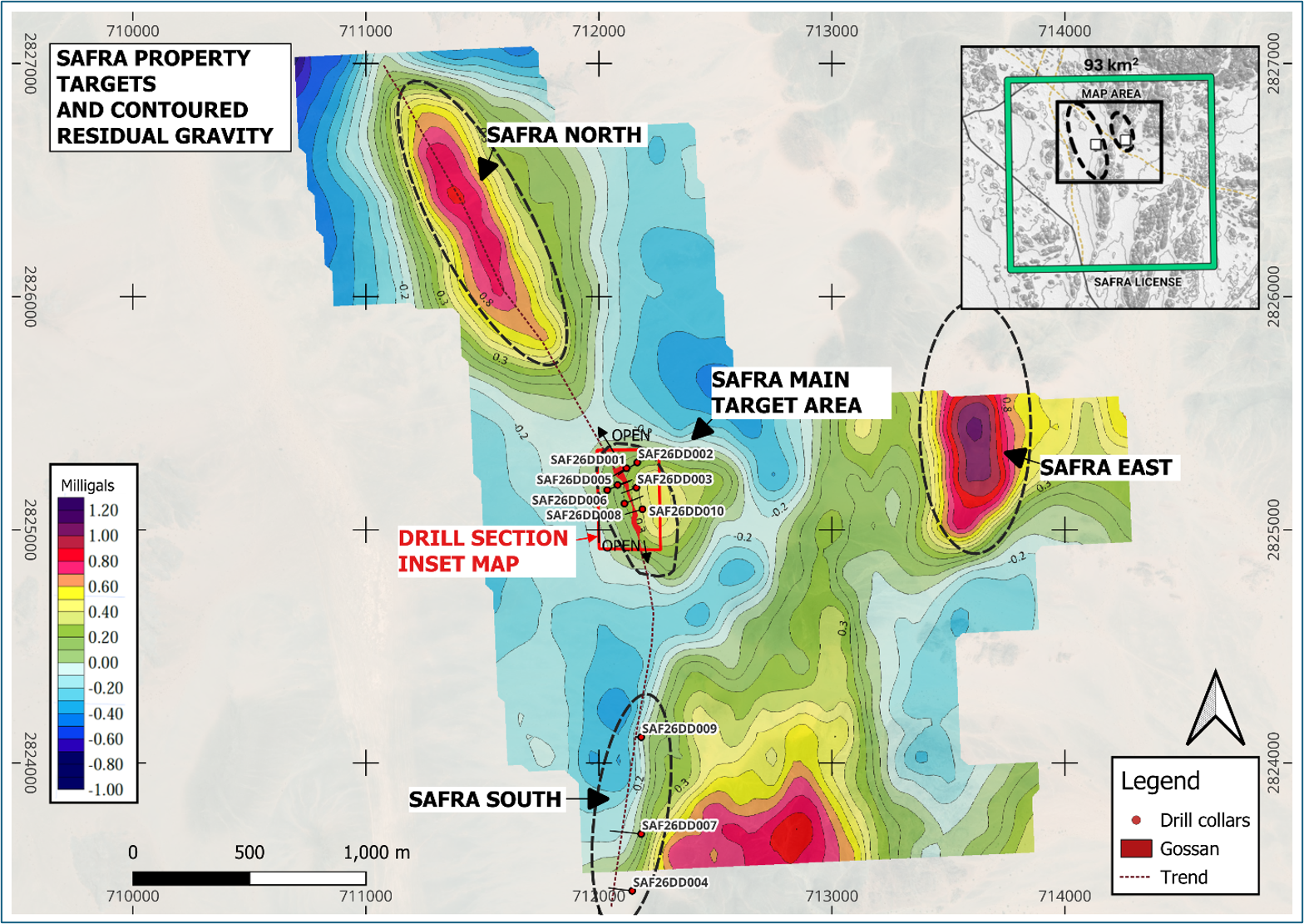
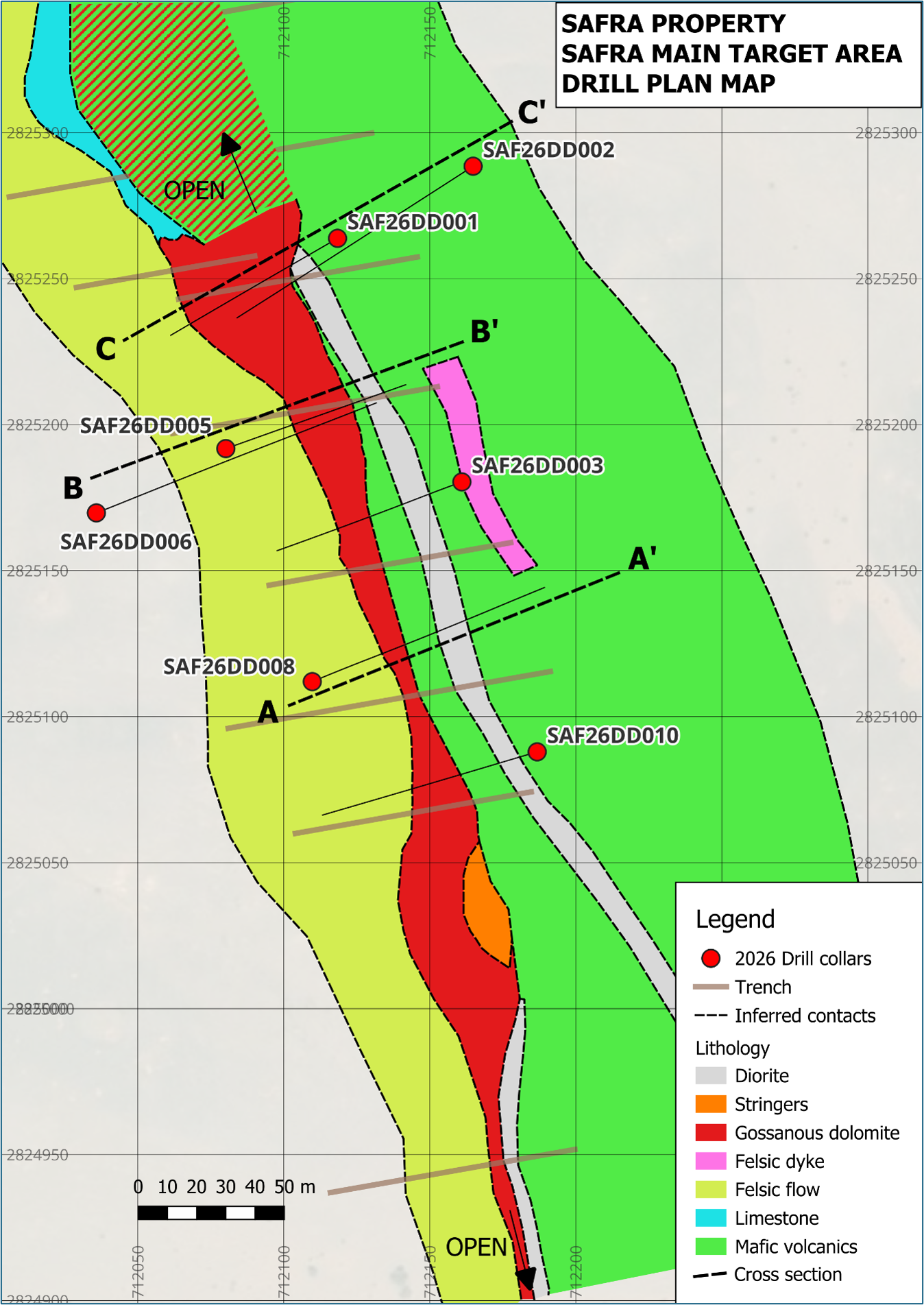
The maiden drill program comprised 10 diamond drill holes totaling 1,242 metres (Figures 1 and 2). At Safra Main seven holes tested coincident geological, geochemical and geophysical targets developed through surface mapping and sampling, trenching, gravity and TDEM surveys. Three holes tested conductive TDEM targets at Safra South, located approximately 1.5 kilometres south of Safra Main (Figure 1). Substantial portions of the mineralized trends, geophysical targets and their depth extent remain untested.
The Safra Main Zone remains open for expansion both to the north toward the Safra North target and south along strike, as well as at depth (Figures 3, 4, and 5). Importantly, additional strong and currently untested gravity anomalies, including Safra North, occur along the projected strike of the mineralized system providing compelling targets for follow-up exploration and drilling (Figure 1). These anomalies highlight the potential for the Safra Main mineralized system to extend beyond the limits tested by drilling to date and/or for additional zones of sulphide mineralization to occur along the broader prospective trend.
The Safra East Zone, a parallel VMS trend located approximately 1.5 km east of Safra Main, remains untested by diamond drilling. VMS-related, gossanous exhalite grab samples collected from the zone have returned up to
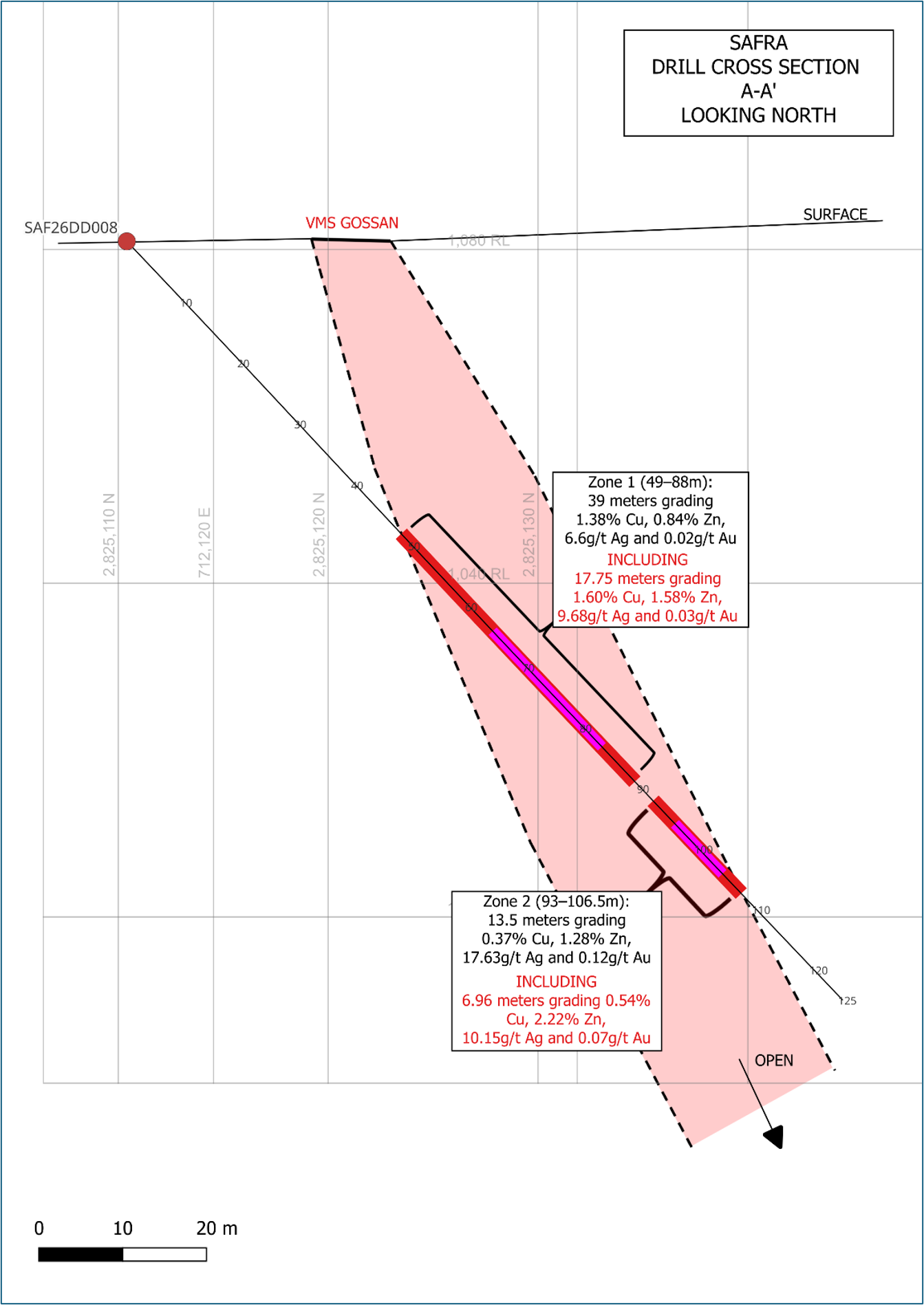
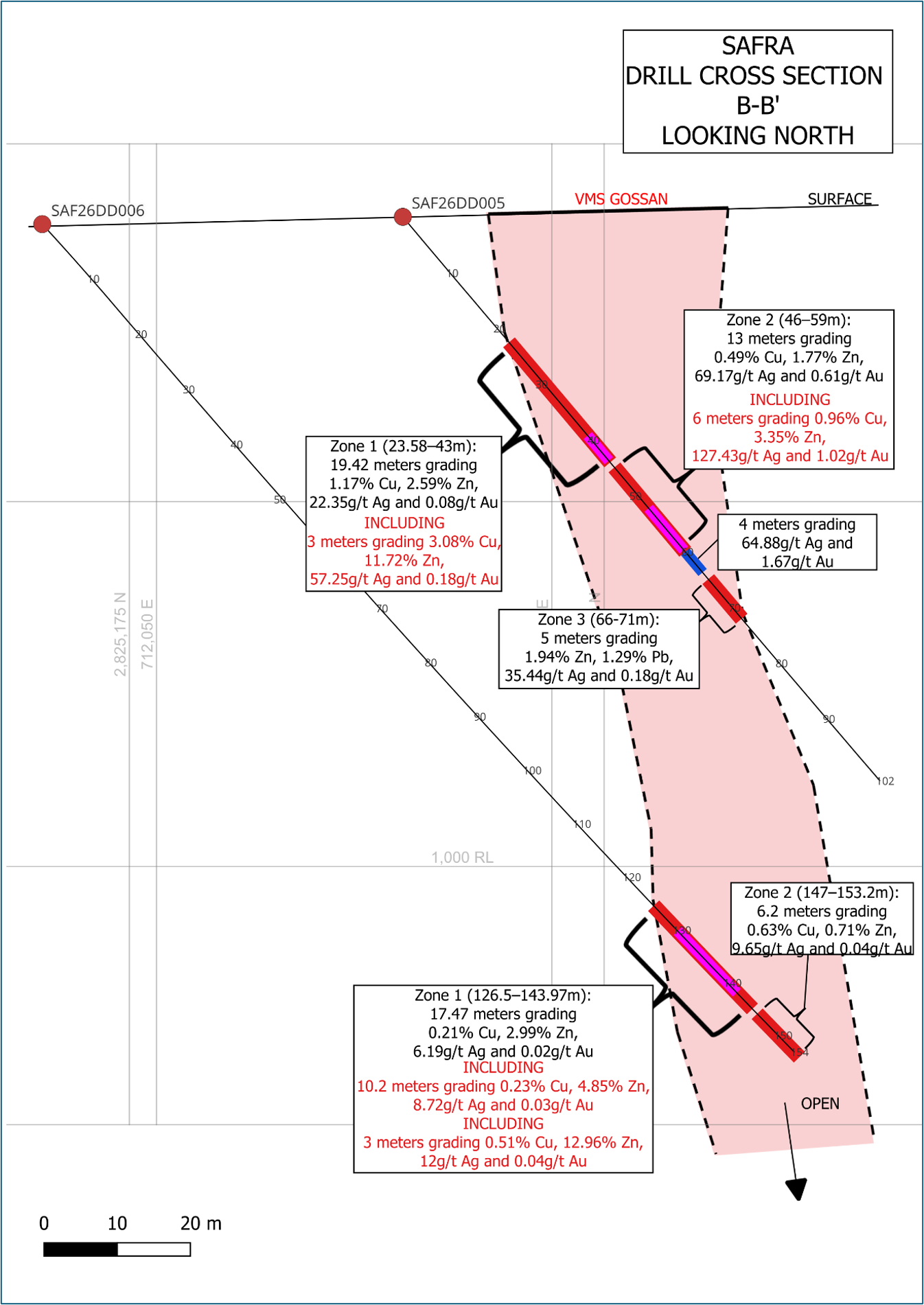
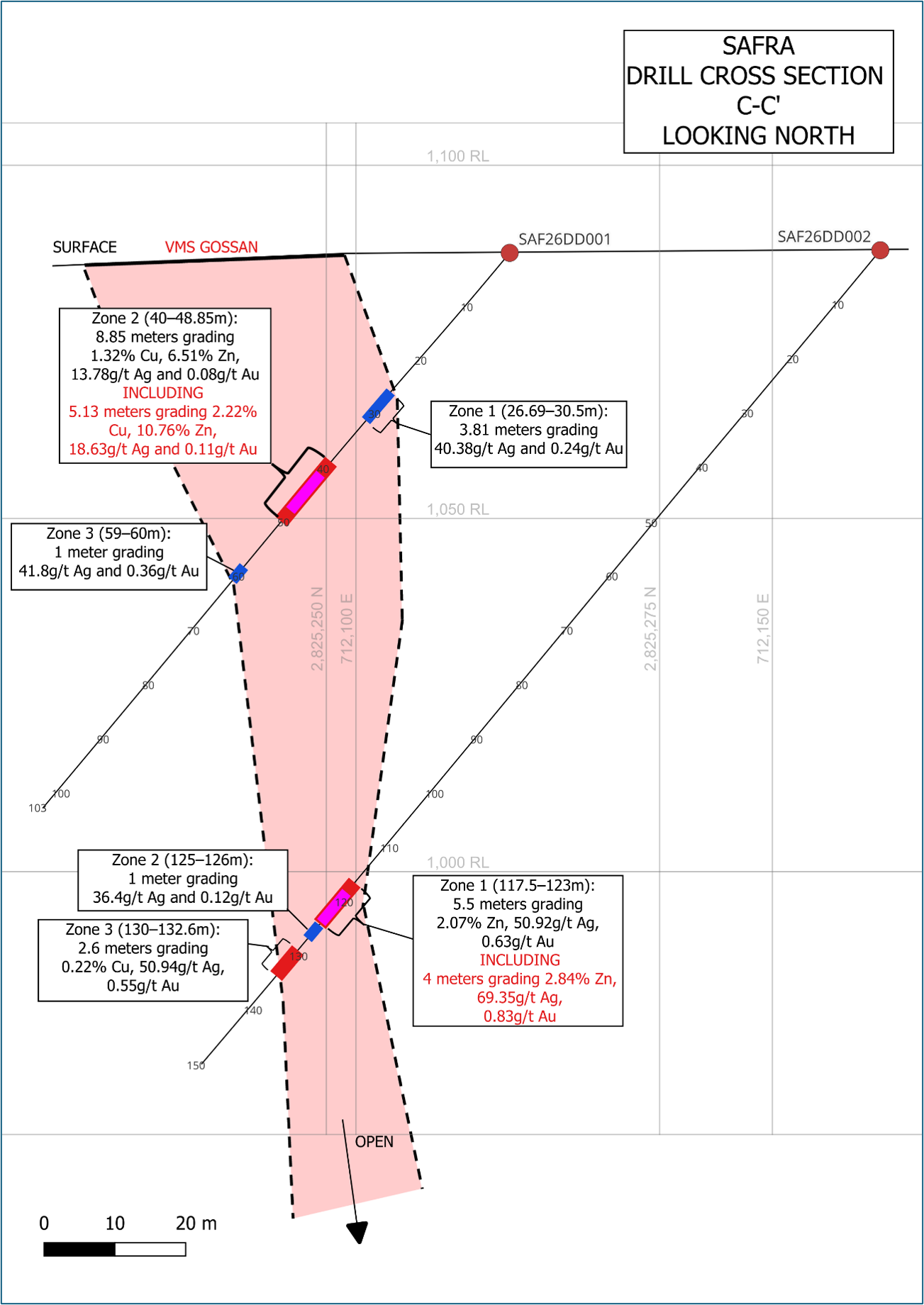
The principal mineralized intervals with assays are summarized in Table 1 and shown on Figures 3 to 5. Reported intervals are core lengths unless otherwise indicated.
Table 1. Summary of results
Hole | Interval | From (m) | To (m) | Length (m) | Cu (%) | Zn (%) | Pb (%) | Au (g/t) | Ag (g/t) |
SAF26DD001 | Safra Main | 40.00 | 48.85 | 8.85 | 1.32 | 6.51 | 0.26 | 0.08 | 13.78 |
SAF26DD001 | Including | 42.00 | 47.13 | 5.13 | 2.22 | 10.76 | 0.17 | 0.11 | 18.63 |
SAF26DD001 | Precious Metals | 26.69 | 30.50 | 3.81 | 0.15 | 0.21 | 0.32 | 0.24 | 40.38 |
SAF26DD001 | Precious Metals | 59.00 | 60.00 | 1.00 | 0.06 | 0.02 | 0.03 | 0.36 | 41.80 |
SAF26DD002 | Safra Main | 117.50 | 123.00 | 5.50 | 0.37 | 2.07 | 0.45 | 0.63 | 50.92 |
SAF26DD002 | Including | 119.00 | 123.00 | 4.00 | 0.50 | 2.84 | 0.62 | 0.83 | 69.35 |
SAF26DD002 | Secondary | 130.00 | 132.60 | 2.60 | 0.22 | 0.02 | 0.15 | 0.55 | 50.94 |
SAF26DD002 | Precious Metals | 125.00 | 126.00 | 1.00 | 0.09 | 0.15 | 0.36 | 0.12 | 36.40 |
SAF26DD003 | Safra Main | 47.20 | 54.00 | 6.80 | 0.48 | 3.19 | 0.15 | 1.33 | 34.81 |
SAF26DD003 | Including | 47.20 | 51.00 | 3.80 | 0.81 | 5.66 | 0.18 | 2.10 | 51.81 |
SAF26DD003 | Secondary | 57.20 | 62.00 | 4.80 | 0.49 | 0.53 | 0.23 | 0.11 | 23.31 |
SAF26DD004 | Safra South | 86.60 | 88.90 | 2.30 | 0.20 | 0.02 | 0.00 | 0.01 | 0.28 |
SAF26DD005 | Safra Main 1 | 23.58 | 43.00 | 19.42 | 1.17 | 2.59 | 0.33 | 0.08 | 22.35 |
SAF26DD005 | Including | 40.00 | 43.00 | 3.00 | 3.08 | 11.72 | 0.15 | 0.18 | 57.25 |
SAF26DD005 | Safra Main 2 | 46.00 | 59.00 | 13.00 | 0.49 | 1.77 | 1.64 | 0.61 | 69.17 |
SAF26DD005 | Including | 53.00 | 59.00 | 6.00 | 0.96 | 3.35 | 3.15 | 1.02 | 127.43 |
SAF26DD005 | Precious Metals | 59.00 | 63.00 | 4.00 | 0.13 | 0.04 | 0.29 | 1.67 | 64.88 |
SAF26DD005 | Secondary | 66.00 | 71.00 | 5.00 | 0.14 | 1.94 | 1.29 | 0.18 | 35.44 |
SAF26DD006 | Safra Main | 126.50 | 143.97 | 17.47 | 0.21 | 2.99 | 1.61 | 0.02 | 6.19 |
SAF26DD006 | Including 1 | 131.00 | 141.20 | 10.20 | 0.23 | 4.85 | 2.60 | 0.03 | 8.72 |
SAF26DD006 | Including 2 | 131.00 | 134.00 | 3.00 | 0.51 | 12.96 | 5.73 | 0.04 | 12.00 |
SAF26DD006 | Secondary | 147.00 | 153.20 | 6.20 | 0.63 | 0.71 | 0.31 | 0.04 | 9.65 |
SAF26DD007 | Safra South - No Significant Interval | ||||||||
SAF26DD008 | Safra Main | 49.00 | 88.00 | 39.00 | 1.38 | 0.84 | 0.08 | 0.02 | 6.60 |
SAF26DD008 | Including | 64.75 | 82.50 | 17.75 | 1.60 | 1.58 | 0.13 | 0.03 | 9.68 |
SAF26DD008 | Secondary | 93.00 | 106.50 | 13.50 | 0.37 | 1.28 | 0.12 | 0.12 | 17.63 |
SAF26DD008 | Including | 96.54 | 103.50 | 6.96 | 0.54 | 2.22 | 0.06 | 0.07 | 10.15 |
SAF26DD009 | Safra South - No Significant Interval | ||||||||
SAF26DD010 | Safra Main | 43.00 | 49.00 | 6.00 | 2.86 | 5.70 | 0.02 | 0.02 | 9.53 |
SAF26DD010 | Including | 44.23 | 47.25 | 3.02 | 4.98 | 10.60 | 0.02 | 0.03 | 14.10 |
SAF26DD010 | Secondary | 54.00 | 60.00 | 6.00 | 0.59 | 0.38 | 0.01 | 0.02 | 2.94 |
Safra Project
The Safra Project is 185 kilometres northeast of Medina and covers approximately 93 km² within the prospective Nuqrah VMS Belt of the Arabian-Nubian Shield (Figure 6). Mapping, sampling and trenching at Safra Main identified multiple subparallel VMS-related mineralized zones, including two gossan and alteration trends measuring approximately 600 metres by 40 metres and 200 metres by 20 metres.
Previously reported surface sampling returned values of up to
The maiden drilling program has provided a strong geological framework for follow-up work while opening up substantial portions of the mineralized trends, geophysical targets and the depth extent of mineralized zones for additional testing.
Drilling intersected a complex package of felsic and mafic volcanic rocks and intrusions, including diorite dykes and repeated dolomite intervals. Alteration is characterized by variable silicification and carbonate alteration, with chlorite, epidote and hematite developed locally. The association of dolomite, altered diorite and volcanic rocks with sulphide mineralization, connects features recognized in surface trenching with the mineralized system encountered in drilling.
Sulphide mineralization ranges from disseminated and fracture-controlled sulphides, to more strongly developed zones and locally semi-massive sulphide. Mineralization consists primarily of chalcopyrite, sphalerite and pyrite with common magnetite and local pyrrhotite. Several holes also encountered broader zones of disseminated and fracture-controlled chalcopyrite-pyrite-magnetite mineralization.
Next Steps
Sun Peak is integrating the assay results with geological logging, structural interpretation, surface geochemistry, gravity and TDEM data to further refine the Safra geological model and prioritize follow-up drilling. Planned work will evaluate extensions of the mineralized zones along strike and at depth at Safra Main, together with North, South, and East Targets.
After the maiden drill program at Safra, Sun Peak completed an initial drill program at Halahila VMS Project comprised of 13 diamond drill holes totaling 2,521 metres. A total of 402 drill core samples have been submitted to ALS Global in Jeddah for laboratory analysis, with initial assay results expected shortly.
QA/QC and Sampling Protocol
Sampling at Safra followed Sun Peak's internal sampling and QA/QC protocols. Diamond drill core was halved, with half-core samples submitted to SGS Inspection Services Saudi Arabia Ltd. in Jeddah, Saudi Arabia, and subsequently shipped to SGS Ankara Maden ve Jeokimya Laboratuvarı in Ankara, Türkiye, for sample preparation and analysis. Samples were prepared using SGS method PRP89, whereby samples were dried and crushed to a minimum of
Gold was analyzed by 30 g fire assay with an Atomic Absorption Spectroscopy (AAS) finish (FAA313). Silver, copper, zinc and a suite of other major and trace elements were analyzed using a four-acid digestion followed by ICP-AES and ICP-MS analysis (ICM40B). Samples exceeding the upper analytical limits of the multi-element method were re-analyzed using applicable single-element over-range four-acid digestion with AAS methods (AAS42S and AAS43B).
Sun Peak's internal QA/QC program included the regular insertion of certified reference materials, blanks and duplicate samples into the drill core sample stream. Approximately
Qualified Person
The scientific and technical information contained in this news release has been reviewed and approved by Arron Albano, P.Geo., Exploration Manager for Sun Peak Metals Corp., who is a Qualified Person as defined by National Instrument 43-101 - Standards of Disclosure for Mineral Projects.
ABOUT SUN PEAK METALS CORP.
Sun Peak Metals Corp's portfolio is located within the Arabian-Nubian Shield, a highly prospective Precambrian mineral belt that hosts numerous VMS, intrusion-related and orogenic gold systems, including Jabal Sayid and Mansourah in Saudi Arabia and the Bisha Mine and Asmara Projects in Eritrea. The Company's exploration strategy is focused on systematically advancing a pipeline of projects from regional target identification through drill testing.
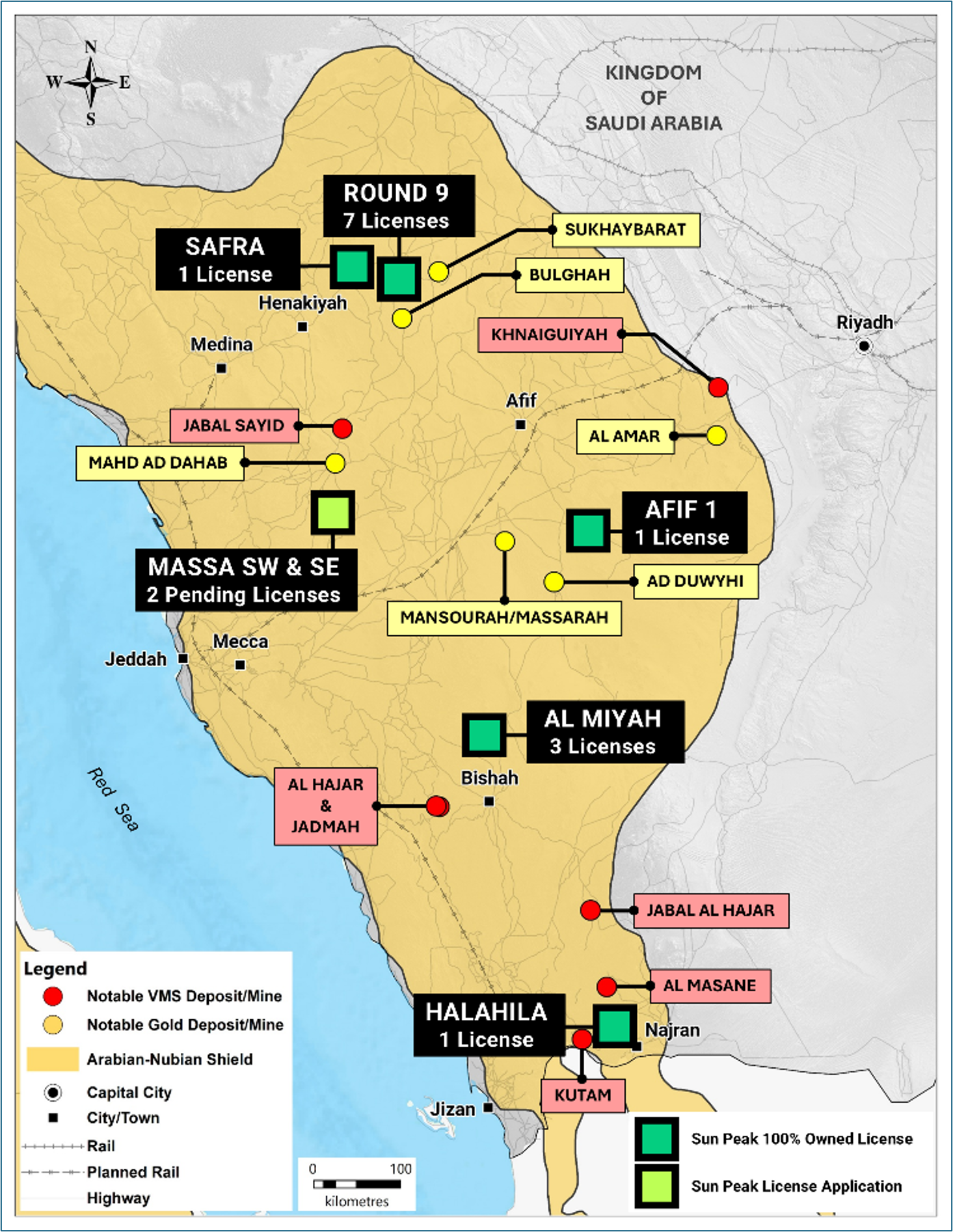
In the Kingdom of Saudi Arabia, the Company holds 13 exploration licenses totaling 1,072 km² along established VMS and gold trends, with applications pending for two additional exploration licenses covering approximately 200 km² (Figure 6).
In Ethiopia, the Company's Shire Project comprises six exploration licenses covering approximately 1,450 km².
Sun Peak's team has an unparalleled track record of multiple mine discoveries within the Arabian-Nubian Shield, supported by significant capital-markets strength and experience.
ON BEHALF OF THE BOARD OF DIRECTORS OF SUN PEAK METALS CORP.
Greg Davis,
President, CEO & Director
FOR FURTHER INFORMATION, PLEASE CONTACT:
Greg Davis
(T): +1 (604) 999 1099
(E): info@sunpeakmetals.com
Neither TSX Venture Exchange nor its Regulation Services Provider (as that term is defined in policies of the TSX Venture Exchange) accepts responsibility for the adequacy or accuracy of this release.
Disclaimer for Forward-Looking Information
Certain information and statements in this news release may be considered forward-looking information or forward-looking statements for purposes of applicable securities laws (collectively, "forward-looking statements"), which reflect the expectations of management regarding its disclosure and amendments thereto. Forward-looking statements consist of information or statements that are not purely historical, including any information or statements regarding beliefs, plans, expectations or intentions regarding the future. Such information or statements in this news release include, but are not limited to, statements with respect to the anticipated benefits of the potential for exploration potential in Saudia Arabia; the untapped mineral wealth of Saudi Arabia; Sun Peak being successful in acquiring additional licenses; the goal of making a significant discovery and the development of a large-scale project in Saudi Arabia or Ethiopia and identifying other potential properties and opportunities both in Ethiopia, Saudi Arabia and globally. Such statements are subject to risks and uncertainties that may cause actual results, performance or developments to differ materially from those contained in the statements. No assurance can be given that any of the events anticipated by the forward-looking statements will occur or, if they do occur, what benefits Sun Peak will obtain from them. These forward-looking statements reflect management's current views and are based on certain expectations, estimates and assumptions, which may prove to be incorrect. A number of risks and uncertainties could cause actual results to differ materially from those expressed or implied by the forward-looking statements, including without limitation: These assumptions and risks include, but are not limited to, assumptions and risks associated with the state of the political stability of Ethiopia and the Middle Eastern region, equity financing markets and results of future exploration activities by Sun Peak.
These forward-looking statements are made as of the date of this news release and, except as required by applicable securities laws, Sun Peak assumes no obligation to update these forward-looking statements, or to update the reasons why actual results differed from those projected in the forward-looking statements. Additional information about these and other assumptions, risks and uncertainties are set out in the "Risks Factors" section in the Company's Prospectus dated August 10, 2020 and the "Risks Associated with the SDC Acquisition" section in the Company's Information Circular dated November 3, 2025, both filed on SEDAR+.
SOURCE: Sun Peak Metals Corp.
View the original press release on ACCESS Newswire
FAQ
AI-generated questions and answers. How Rhea-AI works. Not financial advice.
How large was the maiden drill program at Safra and which targets were tested?
The maiden Safra program comprised 10 diamond drill holes totaling 1,242 metres. Seven holes targeted coincident geological, geochemical and geophysical anomalies at Safra Main, while three holes tested conductive TDEM targets at Safra South, located about 1.5 kilometres south of Safra Main.
What follow-up exploration is planned at the Safra Project?
Sun Peak is integrating assay results with geological logging, structural interpretation, surface geochemistry, gravity and TDEM data to refine the Safra model. Planned work includes follow-up drilling to test extensions of the Safra Main mineralized zones along strike and at depth, as well as further evaluation of the Safra North, South and East targets, focusing on strong untested gravity anomalies.
What is the scale and setting of the Safra Project in Saudi Arabia?
The Safra Project lies about 185 kilometres northeast of Medina and covers approximately 93 km² within the Nuqrah VMS Belt of the Arabian-Nubian Shield. Mapping and trenching at Safra Main have defined multiple subparallel VMS-related zones, including gossan and alteration trends measuring roughly 600 m by 40 m and 200 m by 20 m.
What QA/QC procedures were used for the Safra drilling assays?
Diamond drill core was halved and half-core samples sent to SGS in Jeddah and then SGS Ankara for preparation and analysis. Samples were dried, crushed to at least 75% passing 2 mm, and a 250 g split was pulverized to at least 85% passing 75 microns. Gold was analyzed by 30 g fire assay with AAS finish, and silver, copper, zinc and other elements by four-acid digestion with ICP-AES/ICP-MS. Sun Peak inserted certified reference materials, blanks and duplicates in about 10–15% of samples, while SGS applied its own internal controls.
What exploration work has Sun Peak completed at the Halahila VMS Project?
Following the Safra program, Sun Peak completed an initial drill campaign at the Halahila VMS Project, consisting of 13 diamond drill holes totaling 2,521 metres. A total of 402 drill core samples from Halahila have been submitted to ALS Global in Jeddah for laboratory analysis, with initial assay results expected to be received in the near term.