
Lodestar Metals Reports Bulk-Tonnage Gold-Silver Potential at the Gold Run Project in Nevada
Lodestar Metals (OTCQB: SVTNF, TSXV: LSTR) reported first assay results from six reverse-circulation holes (1,143 m) of its 2,680 m maiden drill program at the Gold Run project in Nevada’s Robbers Knob target.
Sentiment and the balance of points
Rhea-AI Sentiment reads the wording of the document, how positive or negative its language is on a 1 to 5 scale. The balance of points shown with the takes weighs what the document actually discloses, so the two can disagree, for example when a trial that missed its main goal is described in upbeat language.
Rhea-AI Summary
Lodestar Metals (OTCQB: SVTNF, TSXV: LSTR) reported first assay results from six reverse-circulation holes (1,143 m) of its 2,680 m maiden drill program at the Gold Run project in Nevada’s Robbers Knob target. Drilling outlined three mineralisation styles: broad near-surface oxide gold-silver, high‑grade shoots/veins, and a deeper polymetallic zone.
Key intercepts include 70.1 m grading 0.54 g/t Au and 6.7 g/t Ag in LSRC03, 36.6 m grading 0.27 g/t Au and 6.0 g/t Ag in LSRC02, and 30.5 m grading 0.33 g/t Au and 6.8 g/t Ag in LSRC01. Infill hole LSRC04 cut 16.8 m grading 6.07 g/t Au and 41.1 g/t Ag, including 3.0 m of 31.9 g/t Au and 181.6 g/t Ag. LSRC02 also intersected a deeper 15.2 m polymetallic interval grading 0.37 g/t Au, 16 g/t Ag, 0.40% Zn and 0.27% Pb. Geophysical (magnetics, IP) surveys define untested chargeability anomalies and northwest-trending structures, while assays remain pending for 12 additional holes (1,537 m) at the Gomes, Black Diamond and Crown North targets.
Positive
- Broad oxide intercepts up to 70.1 m at 0.54 g/t Au and 6.7 g/t Ag at Robbers Knob
- High-grade shoot of 16.8 m at 6.07 g/t Au and 41.1 g/t Ag, including 3.0 m at 31.9 g/t Au
- New polymetallic horizon intersected over 15.2 m grading 0.37 g/t Au, 16 g/t Ag, 0.40% Zn, 0.27% Pb
- Three mineralisation styles (oxide, high-grade structural, deeper polymetallic) enhance target diversity at Gold Run
- 12 additional RC holes totaling 1,537 m pending across three priority targets, providing near-term news flow
Negative
- None.
Details
News Market Reaction – SVTNF
On Aug 5, the day this news came out, SVTNF closed 0.91% below the previous close.
Data tracked by StockTitan Argus for the Aug 5 session.
AI-generated analysis. How Rhea-AI works. Not financial advice.




Vancouver, British Columbia--(Newsfile Corp. - August 5, 2026) - Lodestar Metals Corp. (TSXV: LSTR) (OTCQB: SVTNF) (FSE: PR90) ("Lodestar" or the "Company"), an exploration company focused on unlocking world-class gold potential, reports assay results from the first six reverse-circulation ("RC") holes of its maiden 2,680m drill program at the flagship Gold Run project in Nevada. The initial 1,143 m of drilling at the Robbers Knob target identified multiple gold-silver mineralisation styles and strong bulk-tonnage potential.
Highlights:
| Hole ID | From (m) | To (m) | Interval (m) | Au (g/t) | Ag (g/t) | Pb (%) | Zn (%) | Style |
| LSRC04 | 132.6 | 149.4 | 16.8 | 6.07 | 41.1 | - | - | vein/shoot |
| including | 132.6 | 135.6 | 3.0 | 31.90 | 181.6 | - | - | |
| LSRC03 | 89.9 | 160.0 | 70.1 | 0.54 | 6.7 | oxide Au-Ag | ||
| LSRC02 | 161.5 | 176.8 | 15.2 | 0.37 | 16.0 | 0.27 | 0.40 | Au-Ag polymetallic |
Note: Assay intervals presented above are hole lengths; true widths are estimated to be 85
- Three mineralisation styles demonstrated at Robbers Knob: broad, near-surface oxide gold-silver intercepts over 30-70 m, comparable to grades exploited in large open-pit, heap-leach operations in northern Nevada; high-grade gold-silver shoots/veins; and a deeper gold-silver polymetallic zone.
- Detailed magnetics and IP data defined untested chargeability anomalies and northwest-trending structures that provide clear vectors for follow-up drilling.
- Assays pending for 12 additional RC holes (1,537 m) across three priority targets: Gomes, Black Diamond and Crown North.
"These initial results from Robbers Knob validate our geological model and confirm a robust gold-silver system with both bulk-tonnage oxide mineralisation and structurally controlled higher-grade zones," said Lowell Kamin, President & CEO of Lodestar Metals. "We are particularly encouraged by the consistency across multiple holes and the clear vectors for potential expansion highlighted by our geophysical data. With additional assays pending across several targets, we believe this program marks an important step in defining the broader scale potential of the Gold Run project."
5mm
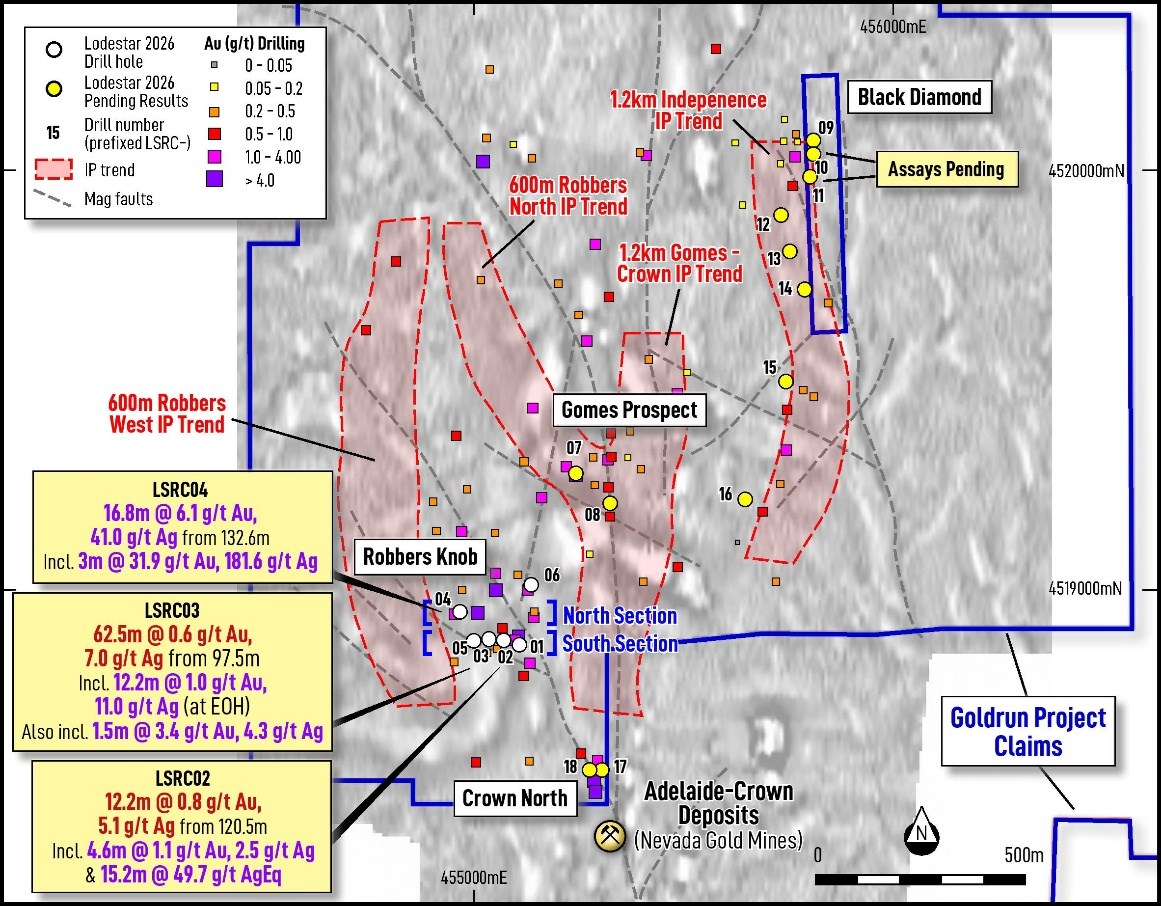
Figure 1. UAV Magnetics map (TMIRTP) showing structural interpretation, maximum gold assays from previous drilling and highlighting assay results from the 2026 drilling at Robbers Knob
To view an enhanced version of this graphic, please visit:
https://images.newsfilecorp.com/files/3029/307930_681bee36248c0803_003full.jpg
The maiden RC drill program tested four high-priority gold-silver targets across Gold Run and comprised 18 holes totaling 2,680 m. Final assays have now been received for the first six holes at Robbers Knob, while results are pending for the remaining 12 holes testing Gomes, Black Diamond and Crown North.
Robbers Knob Drill Results
Drilling at Robbers Knob has confirmed three mineralisation styles with clear expansion potential: a shallow bulk-tonnage oxide gold-silver system, a higher-grade structurally controlled gold-silver zone, and a deeper gold-silver polymetallic zone. Figure 1 highlights the structural setting and shows how current drilling aligns with interpreted northwest-trending faults and nearby geophysical targets.
Bulk-Tonnage Gold-Silver Oxide
Broad oxide gold-silver mineralisation was intersected in four holes across the main southern section of Robbers Knob, primarily within a weathered zone at depths of approximately 40 m to 150 m. Key intercepts include 62.5 m grading 0.6 g/t Au and 7.0 g/t Ag from 97.5 m in LSRC03, 36.6 m grading 0.3 g/t Au and 6.0 g/t Ag from 50.3 m in LSRC02, 30.5 m grading 0.3 g/t Au and 6.8 g/t Ag from 51.8 m in LSRC01, and 36.6 m grading 0.2 g/t Au and 3.7 g/t Ag from 137.2 m in LSRC05.
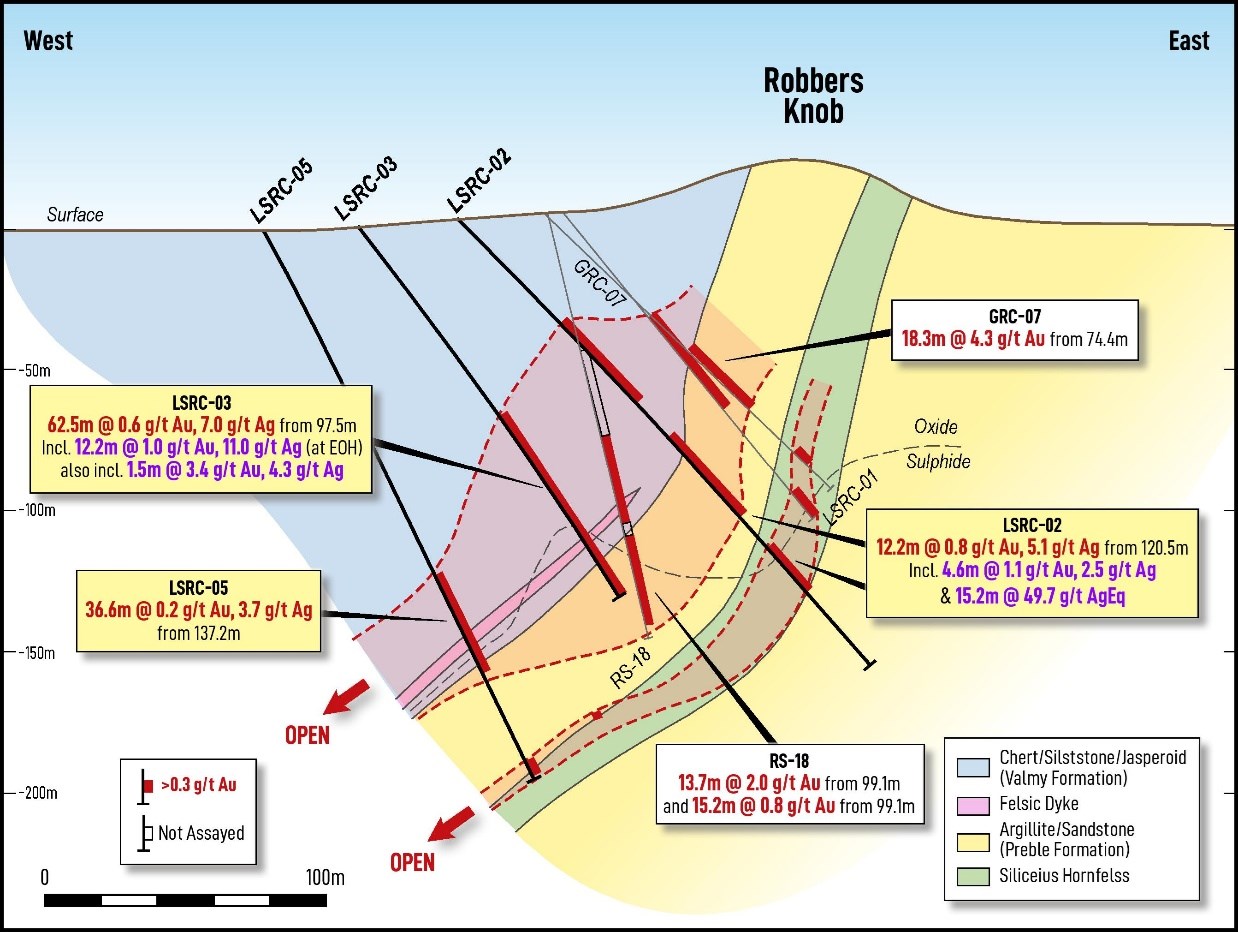
Figure 2. Southern cross section at Robbers Knob showing the geology, oxidation and significant intercepts from LSRC-01, 2, 3 and 5.
To view an enhanced version of this graphic, please visit:
https://images.newsfilecorp.com/files/3029/307930_681bee36248c0803_004full.jpg
Figure 2 illustrates the continuity of the shallow oxide system across the southern section of Robbers Knob. These results support the interpretation of a broad oxide gold-silver target with characteristics comparable to bulk-tonnage, heap-leach style mineralisation seen elsewhere in northern Nevada held by adjacent mining companies Nevada Gold Mines and SSR Mining.
High Grade Gold-Silver Shoots/Veins
Infill hole LSRC04 confirmed the presence of higher-grade gold-silver mineralisation within the broader Robbers Knob system. The hole returned 16.8 m grading 6.1 g/t Au and 41.1 g/t Ag from 132.6 m, including 3.0 m grading 31.9 g/t Au and 181.6 g/t Ag. These results support the interpretation of structurally controlled higher-grade zones that could be repeated along northwest-oriented faults identified in magnetics and mapping (Figure 1).
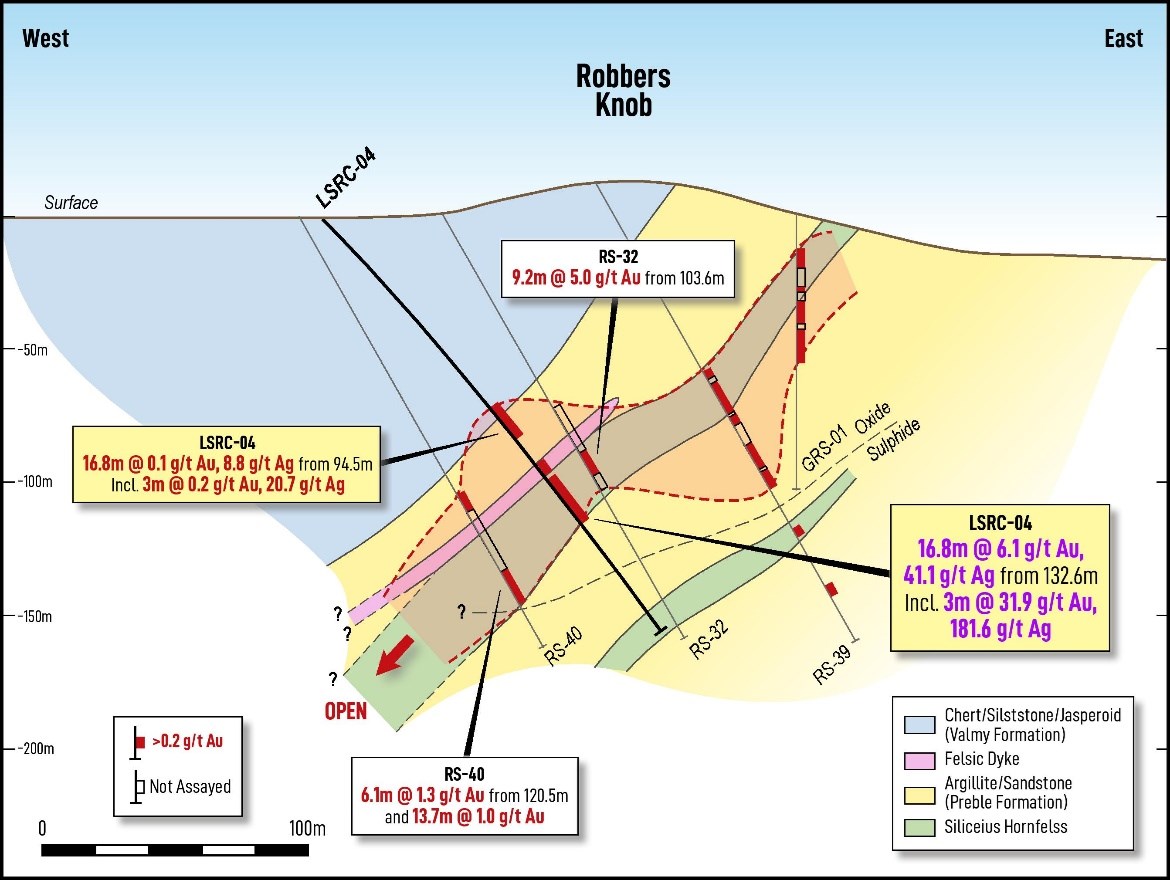
Figure 3. Northern cross section at Robbers Knob showing the geology, oxidation and significant intercepts from LSRC-04.
To view an enhanced version of this graphic, please visit:
https://images.newsfilecorp.com/files/3029/307930_681bee36248c0803_005full.jpg
Figure 3 highlights the higher-grade zone intersected in LSRC04 and supports the interpretation that structurally controlled shoots or veins occur within the broader mineralised system. Future exploration may prove that these higher-grade zones provide an important complementary upside to the shallow bulk-tonnage oxide mineralisation.
Deeper Gold-Silver Polymetallic Zone
Deeper drilling also intersected a style of mineralisation not previously recognized in historical drilling at Robbers Knob. Beginning at 161.5 m in LSRC02, the Company intersected 15.2 m of polymetallic mineralisation grading 0.37 g/t Au, 16 g/t Ag,
This deeper polymetallic zone represents an additional target horizon beneath the shallow oxide system. Follow-up drilling is expected to test the scale and continuity of this deeper mineralisation.
Expansion Targets
Recent DDIP and drone-supported magnetic surveys have strengthened the Company's targeting model at Robbers Knob. The geophysical data define chargeability anomalies immediately west and north of the current drilling (Figure 4), while magnetics indicate northwest-trending structures that may control higher-grade mineralisation (Figure 1).
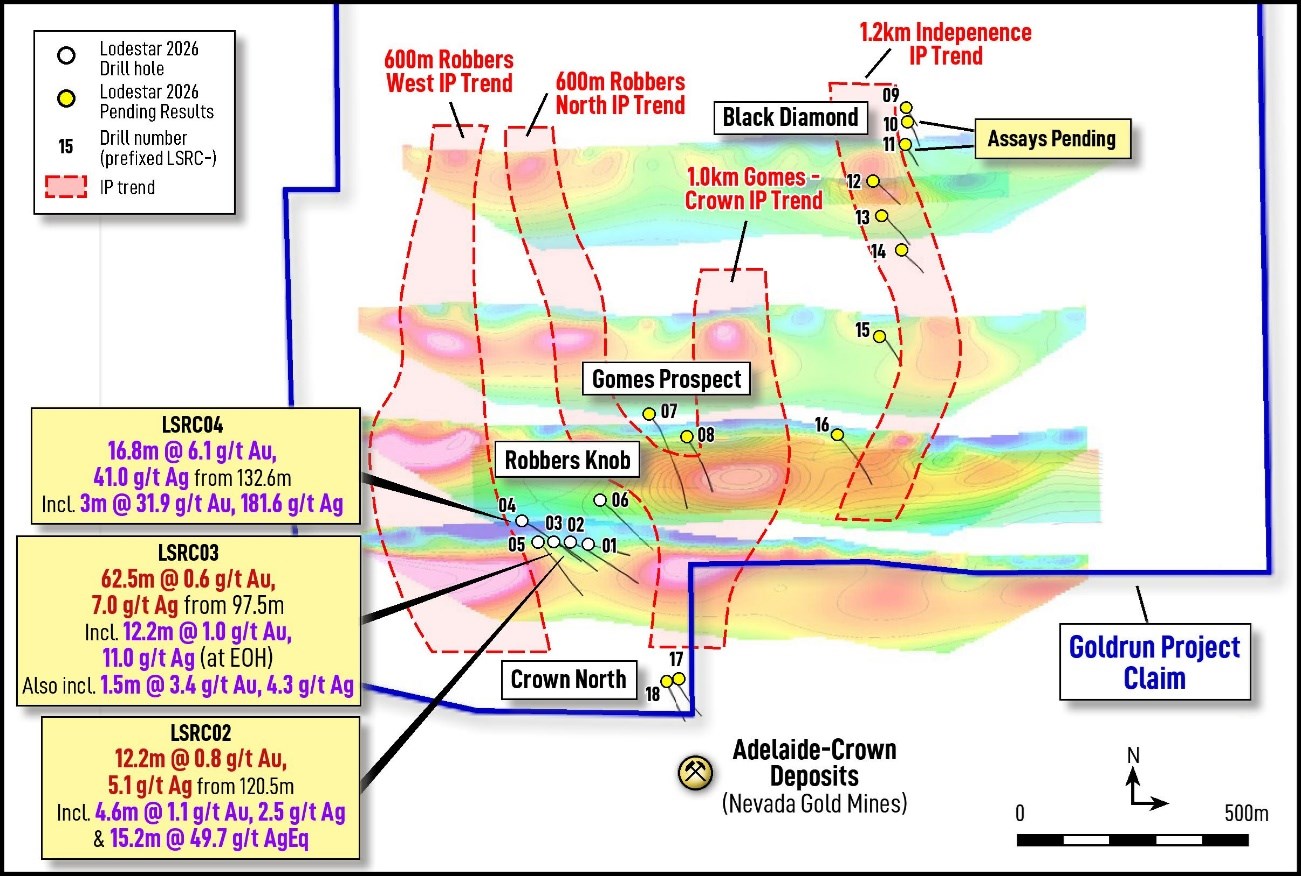
Figure 4. 3D view looking north and down of the DDIP showing the new drill results and other Lodestar holes with outstanding assays
To view an enhanced version of this graphic, please visit:
https://images.newsfilecorp.com/files/3029/307930_681bee36248c0803_006full.jpg
Figure 4 shows the Robbers West and Robbers North anomalies, which extend beyond the current drill footprint and may represent deeper sulphide mineralisation underlying the shallow oxide system. These anomalies, together with the structural interpretation shown in Figure 1, provide clear targets for follow-up drilling.
Pending Assays
Assays are pending for 12 additional holes totaling 1,537 m from three priority targets across Gold Run. These include Gomes, where drilling targeted historical gold-silver mineralisation and an IP anomaly; Black Diamond, where drilling tested high-grade silver-gold mineralisation and two chargeability IP anomalies; and Crown North, where drilling tested the projected northern extension of the Adelaide Crown epithermal gold deposit held by Nevada Gold Mines.
Sampling Procedures and QA/QC
RC holes were drilled by HD Drilling using a 5.5″ hammer with a 5¼″ M40CC hammer bit and reverse circulation methods to minimize contamination and maximise sample size. In some deeper sections of certain RC holes, a 5″ hammer was used to achieve greater depth penetration.
Reverse circulation (RC) drilling was used to obtain representative drill cuttings for geological logging and laboratory assaying. Samples were collected at 5 ft (1.52 m) intervals. Drill cuttings from each interval passed through the cyclone and were split using a rig-mounted rotary splitter. A representative split of approximately 4-9 kg was collected into cloth sample bags for assay. RC drilling was conducted dry where practicable. Where wet RC drilling was required to maintain drilling performance in some deeper or more difficult sections, samples were collected at the same 5 ft intervals using a rotary wet splitter, and recorded by the project manager on the sampling cut sheet for later reference. The drilling contractor cleaned the rig-mounted rotary cone splitter at regular intervals and as required to minimize contamination between samples. RC samples were collected from 5 ft bulk samples using the A-chute of the splitter attached directly to the cyclone. Overall, the drilling and sampling procedures were designed to maximise sample recovery, reduce fines loss, and maintain representative RC samples for geological logging and assay. Cloth bags were marked by the program manager with the drill hole ID and sample interval/footage to maintain sample identification and traceability. All 5 ft split samples were submitted to the laboratory for analysis. All samples are transported in large bags sealed with numbered security tags. The sample bags are picked up by a service contracted by Bureau Veritas to transport the samples directly from site to their facility in Reno, Nevada. The sampling approach is considered appropriate for RC drilling and for the style of mineralisation being tested.
The QA/QC procedure adopted is approximately 3 blank samples per 100 samples, 2 standard samples of known gold and silver grades per 100 samples and 3 field duplicates per 100 samples. All QA/QC samples were within expected tolerances.
RC samples were prepared by Bureau Veritas located in Sparks, Nevada USA using preparation code WGHT. This procedure involved crushing samples to
Additional Information
1 A summary of drill targets and intercepts and supporting technical data was provided in the Company's December 2, 2025 news release.
2 The Company has identified historical drill intercepts interpreted from the Property's historical database, which was acquired. The Company has not previously verified the intercepts, and limited information is available regarding sampling methodologies, analytical procedures, and associated QA/QC protocols. The historical intercepts are considered relevant for the purposes of exploration targeting, which is intended to validate and assess the continuity and reliability of the reported mineralisation. Readers are cautioned that the historical information should not be relied upon until it has been independently verified.
Qualified Person
The scientific and technical information contained in this news release has been reviewed and approved by Mr. Leo Horn, who is the Qualified Person for the purposes of National Instrument 43-101 - Standards of Disclosure for Mineral Projects ("NI 43-101"). Mr. Horn is a consulting director to the Company and is a member of the Australasian Institute of Geoscientists (MAIG). Mr. Horn has sufficient experience relevant to the style of mineralisation and type of deposit under consideration, and to the activities being undertaken, to qualify as a Qualified Person as defined by NI 43-101. Mr. Horn has reviewed and verified the technical information contained in this news release and consents to the disclosure of such information in the form and context in which it appears. The Company is not aware of any new information or data that materially affects the scientific or technical information disclosed in this news release.
ABOUT LODESTAR METALS
Lodestar Metals Corp. is a Canadian gold exploration company focused on advancing the Gold Run Project in Nevada, strategically located on a major Carlin-type gold trend and adjacent to some of the largest gold deposits in North America. With decades of combined geological and capital markets expertise, Lodestar follows a disciplined, step-by-step approach to discovery. The Company's strategy is clear: focus capital on high-value targets, move quickly on known mineralisation, and build a compliant gold resource that delivers lasting shareholder value. For more information, please visit www.lodestarmetals.ca.
Contact:
Lowell Kamin
President & CEO
Lodestar Metals Corp
(416) 272-1241
lkamin@integritycapitalgrp.com
Forward-Looking Statements
The information set forth in this news release contains forward-looking statements based on assumptions as of the date of this news release. These statements reflect management's current estimates, beliefs, intentions, and expectations. They are not guarantees of future performance. Lodestar cautions that all forward-looking statements are inherently uncertain and that actual performance may be affected by several material factors, many of which are beyond Lodestar's control. Such factors include, among other things, risks and uncertainties relating to Lodestar's limited operating history and the need to comply with environmental and governmental regulations. Accordingly, actual and future events, conditions and results may differ materially from the estimates.
NEITHER TSX VENTURE EXCHANGE NOR ITS REGULATION SERVICES PROVIDER (AS THAT TERM IS DEFINED IN THE POLICIES OF THE TSX VENTURE EXCHANGE) ACCEPTS RESPONSIBILITY FOR THE ADEQUACY OR ACCURACY OF THIS RELEASE.
Table 1: Drilling details for the first 6 holes of Lodestar's recent RC Drill Program at Robbers Knob
| Hole_ID | X(NAD83) | Y (NAD 83) | Elevation (m) | Final Depth (m) | Azimuth | Dip |
| LSRC-01 | 455109 | 4518870 | 1894.8 | 147.8 | 64.7 | -44.5 |
| LSRC-02 | 455074 | 4518880 | 1891.8 | 213.4 | 89.8 | -44.7 |
| LSRC-03 | 455037 | 4518884 | 1889.8 | 160 | 85.9 | -49.4 |
| LSRC-04 | 454968 | 4518947 | 1872.8 | 201.2 | 88.0 | -44.8 |
| LSRC-05 | 455002 | 4518880 | 1889.0 | 217.9 | 91.2 | -59.8 |
| LSRC-06 | 455135 | 4519010 | 1861.7 | 202.7 | 102.1 | -49.3 |
Table 2: Composite assay results for the first 6 holes of Lodestar's recent RC Drill Program at Robbers Knob
| HoleID | From | To | Interval(m) | Au g/t | Ag g/t | Pb % | Zn % | Cut-off Au g/t |
| LSRC01 | 51.8 | 82.3 | 30.5 | 0.33 | 6.8 | 0.1 | ||
| including | 61.1 | 76.2 | 15.1 | 0.51 | 11.1 | 0.3 | ||
| including | 65.5 | 73.2 | 7.6 | 0.79 | 15.2 | 0.5 | ||
| 135.6 | 147.8 | 12.2 | 0.17 | 7.0 | 0.1 | |||
| including | 141.7 | 147.8 | 6.1 | 0.21 | 7.0 | 0.2 | ||
| LSRC02 | 50.3 | 86.9 | 36.6 | 0.27 | 6.0 | 0.1 | ||
| including | 85.3 | 88.4 | 3.0 | 0.53 | 2.9 | 1.0 | ||
| 117.3 | 135.6 | 18.3 | 0.60 | 5.4 | 0.1 | |||
| including | 120.4 | 132.6 | 12.2 | 0.75 | 5.1 | 0.5 | ||
| including | 125.0 | 129.5 | 4.6 | 1.08 | 2.5 | 1.0 | ||
| 160.0 | 178.3 | 18.3 | 0.33 | 13.9 | 0.23 | 0.35 | 0.1 | |
| including | 161.5 | 176.8 | 15.2 | 0.37 | 16.0 | 0.27 | 0.4 | 0.3 |
| LSRC03 | 89.9 | 160.0 | 70.1 | 0.54 | 6.7 | 0.1 | ||
| including | 97.5 | 160.0 | 62.5 | 0.58 | 7.0 | 0.3 | ||
| including | 97.5 | 99.1 | 1.5 | 3.39 | 4.3 | 1.0 | ||
| also including | 111.3 | 115.8 | 4.6 | 1.05 | 5.7 | 1.0 | ||
| including | 123.4 | 160.0 | 36.6 | 0.60 | 9.1 | 0.3 | ||
| including | 147.8 | 160.0 | 12.2 | 1.03 | 11.0 | 0.5 | ||
| LSRC04 | 94.5 | 111.3 | 16.8 | 0.11 | 8.8 | 0.1 | ||
| 96.0 | 99.1 | 3.0 | 0.23 | 20.7 | 0.2 | |||
| including | 132.6 | 149.4 | 16.8 | 6.07 | 41.1 | 0.5 | ||
| including | 132.6 | 135.6 | 3.0 | 31.90 | 181.6 | 1.0 | ||
| LSRC05 | 137.2 | 173.7 | 36.6 | 0.24 | 3.7 | 0.1 | ||
| including | 158.5 | 160.0 | 1.5 | 0.62 | 9.0 | 0.5 | ||
| also including | 169.2 | 172.2 | 3.0 | 0.54 | 8.4 | 0.5 | ||
| LSRC06 | 45.7 | 53.3 | 7.6 | 0.10 | 5.0 | 0.1 | ||
| 80.8 | 83.8 | 3.0 | 0.13 | 4.9 | 0.1 | |||
| 108.2 | 109.7 | 1.5 | 0.10 | 4.2 | 0.1 | |||
| 155.4 | 158.5 | 3.0 | 0.14 | 5.6 | 0.1 |
Note: Assay intervals presented above are hole lengths; true widths are estimated to be 85

To view the source version of this press release, please visit https://www.newsfilecorp.com/release/307930
FAQ
AI-generated questions and answers. How Rhea-AI works. Not financial advice.