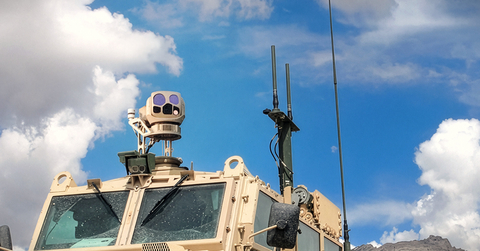
Teledyne FLIR Defense Wins $35+ Million Surveillance System Contract for Reconnaissance Vehicles
Teledyne FLIR Defense Wins $35+ Million Surveillance System Contract for Reconnaissance Vehicles
Teledyne (NYSE:TDY) said Teledyne FLIR Defense won a contract worth more than $35 million from WB Electronics to equip reconnaissance vehicles with TacFLIR 280-HDEP medium-range multi-spectral surveillance systems.
Delivery of TacFLIR 280-HDEP systems will provide advanced situational awareness, target identification, and other recon capabilities
Third award this year for technology integration on armored vehicles in Europe
Agreement with WB Group in Poland builds on years of collaboration to improve warfighter mission success and safety
THOUSAND OAKS, Calif.--(BUSINESS WIRE)--
Teledyne Technologies Incorporated (NYSE:TDY) announced today that Teledyne FLIR Defense has been awarded a contract worth more than $35 million by WB Electronics S.A. (part of the WB Group) to equip reconnaissance vehicles with TacFLIR® 280-HDEP medium range multi-spectral surveillance systems.
Teledyne FLIR Defense has been awarded a contract worth more than $35 million by WB Electronics S.A. (part of the WB Group) to equip reconnaissance vehicles with TacFLIR® 280-HDEP medium range multi-spectral surveillance systems. Designed for a wide range of land missions, TacFLIR 280-HDEP delivers best-in-class daylight and thermal imagery, along with powerful video processing and Aided Target Recognition (AiTR) capability. The advanced sensor system has been field-tested in Europe for nearly a decade, proving its effectiveness and reliability in harsh environments.
Designed for a wide range of land missions, TacFLIR 280-HDEP delivers best-in-class daylight and thermal imagery, along with powerful video processing and Aided Target Recognition (AiTR) capability. The advanced sensor system has been field-tested in Europe for nearly a decade, proving its effectiveness and reliability in harsh environments.
“The integration of TacFLIR 280-HDEP into the reconnaissance vehicles is a testament to our years-long collaboration with WB Electronics,” said Dr. JihFen Lei, president of Teledyne Defense and Aerospace. “By providing warfighters the clearest picture of the battlefield through superior EO/IR imagery and intelligent tracking, TacFLIR technology will enhance situational awareness for military forces while reducing operator risk.”
The contract win is Teledyne FLIR Defense’s third announcement this year involving an armored vehicle program in Europe. In February, the company reported that its Black Hornet 4 nano-drone would be digitally integrated on Switzerland’s Piranha 8x8 vehicles to stream live video and target data to commanders and crew. In January, FLIR Defense said it would provide long-range thermal imaging sights and radars for Bulgaria’s new Stryker vehicles. In total, the three contracts are valued at more than $85 million.
TacFLIR 280-HDEP is designed and built by Teledyne FLIR Defense in Billerica, Massachusetts.
About Teledyne FLIR Defense
Teledyne FLIR Defense has been providing advanced, mission-critical technology and systems for more than 45 years. Our products are on the frontlines of the world’s most pressing military, security and public safety challenges. As a global leader in thermal imaging, we design and build sophisticated surveillance sensors for air, land and maritime use. We develop the most rugged, trusted unmanned air and ground platforms, as well as intelligent sensing devices used to detect chemicals, biological agents, radiation and explosives. At Teledyne FLIR Defense we bring together this expertise to deliver solutions that enable critical decisions and keep our world safe – from any threat, anywhere. To learn more, visit us online or follow @flir and @flir_defense.
About Teledyne Technologies
Teledyne Technologies is a leading provider of sophisticated digital imaging products and software, instrumentation, aerospace and defense electronics, and engineered systems. Teledyne's operations are primarily located in the United States, the United Kingdom, Canada, and Western and Northern Europe. For more information, visit Teledyne's website at www.teledyne.com.
Multi-spectral describes tools or sensors that collect information across several different bands of light or electromagnetic wavelengths, not just the colors we see with our eyes. For investors, multi-spectral capability signals richer, more precise data—like a camera that sees temperature and material qualities as well as color—which can create competitive advantages, expand product uses, improve decision-making, and affect regulatory scrutiny or market demand for technologies and services that rely on advanced sensing.
aided target recognitiontechnical
Aided target recognition is a system or feature that helps a human user find, identify or prioritize objects of interest—such as lesions on a scan, components on an assembly line, or targets in sensor data—by using algorithms and sensor inputs to highlight likely matches. For investors, it matters because it can boost a product’s accuracy, speed and safety, lower operating costs and regulatory risk, and therefore influence customer adoption and a company’s competitive position and revenue potential.
thermal imagerytechnical
Thermal imagery is imaging that records heat patterns instead of visible light, producing pictures where temperature differences appear as colors or shades. Investors care because it reveals hidden problems or performance signals — for example detecting equipment overheating, energy leaks in buildings, or stressed crops — which can indicate higher costs, production risks or safety issues; it’s like a fever thermometer for assets that helps spot trouble before it becomes costly.
eo/ir imagerytechnical
EO/IR imagery is data captured by cameras that see both visible light (electro-optical) and heat (infrared), combining a normal photographic view with a thermal view—like pairing a regular camera with a heat-sensing camera. Investors care because this dual imaging is used across defense, surveillance, drones, maritime and industrial inspection markets; improvements or contracts in EO/IR technology can drive sales, recurring service revenues, and influence regulatory or fleet-replacement decisions.
nano-dronetechnical
A nano-drone is an extremely small unmanned flying device, often about the size of a large insect or small bird, equipped with cameras or sensors and controlled remotely or autonomously. Investors care because these tiny flying robots open new commercial and defense markets—everything from close-up inspections, delivery of tiny payloads, and medical sensing to surveillance—while also raising regulatory, privacy and safety risks that can affect revenue, costs and legal exposure for companies involved.
thermal imaging sightstechnical
Thermal imaging sights are devices that detect the heat given off by people, animals or equipment and turn those heat differences into a visible image, allowing operators to “see” in total darkness, smoke or bad weather. For investors, they matter because demand and pricing affect revenues and margins in sectors like defense, security, firefighting and industrial inspection—think of them as a company’s ability to sell night-vision that works by sensing heat rather than light.