Teledyne FLIR OEM Launches Prism Counter-UAS Software to Extend Drone Threat Detection Range and Speed Response
Teledyne FLIR OEM Launches Prism Counter-UAS Software to Extend Drone Threat Detection Range and Speed Response
Teledyne FLIR OEM (NYSE:TDY) released Prism C-UAS, a counter‑UAS software stack that combines patented thermal image processing and AI to extend small‑drone detection and tracking range.
Patented image processing and advanced AI extend detection range and give operators more time to respond to drone threats
GOLETA, Calif.--(BUSINESS WIRE)--
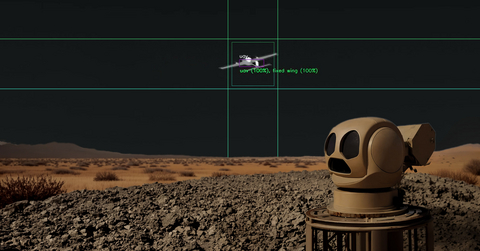
Teledyne FLIR OEM today announced the release of Prism® C‑UAS, a high‑performance counter‑unmanned aircraft system (C‑UAS) detection and tracking software stack. Designed to address the escalating global threat of unauthorized drone activity, Prism C‑UAS extends detection and tracking range for small, hard‑to‑detect drones. By combining patented thermal infrared (IR) image signal processing with artificial intelligence (AI)‑driven perception, the software enables small‑drone detection with fewer than four pixels on target, maximizing time to respond with counter‑drone measures.
Prism C-UAS enables scalable deployment across a wide range of global C-UAS architectures.
The Critical Role of Software in C-UAS
The Federal Aviation Administration (FAA) reports more than 100 drone incursions per month near U.S. airports, while the U.S. Department of Homeland Security testified that more than 60,000 drone flights were detected near the U.S.–Mexico border in the final six months of 2024. Cheap, expendable, and increasingly autonomous drones have shifted unauthorized drone activity from a regulatory challenge into a significant security threat affecting military theaters, national borders, civilian airports, critical infrastructure, and special events like the World Cup and Olympics. To meet this growing global threat, the defense and security industries are rapidly expanding C‑UAS capabilities.
“Software has become a defining performance differentiator in today’s C‑UAS environment,” said Jared Faraudo, Vice President of Product Management, Teledyne FLIR OEM. “Prism C‑UAS enables sub 2x2‑pixel drone detection and tracking, providing a significant increase in drone detection range over conventional systems. It reflects our vertical integration and domain expertise, transforming raw thermal data into actionable intelligence for modern, multi‑layered defense architectures.”
Unmatched Prism Software Performance
Leveraging patented denoise, local contrast enhancement, and upsampling algorithms to enhance target signal‑to‑noise ratio (SNR), Prism C‑UAS increases moving target indicator (MTI) detection range. Once detected, targets are processed by an AI-based object detector and tracked by an efficient multi‑object tracker software to reduce false positives and maintain persistent tracks. The system is optimized specifically for small, fast, and maneuvering drone targets.
Designed for streamlined integration, Prism C‑UAS natively supports data from Teledyne FLIR OEM’s market‑leading Boson®+ and Neutrino® IR camera families, as well as select commercial off‑the‑shelf visible cameras to enable multispectral sensor configurations. Prism C‑UAS lowers integration risk through Teledyne FLIR OEM’s proven technology, robust developer tools, and expert technical support, enabling scalable deployment across a wide range of global C‑UAS architectures.
To see the new Prism C-UAS software and other exciting products, visit the Teledyne FLIR OEM demonstration suite at the Gaylord National Resort and Convention Center, Monument Suite #5221 at SPIE DCS 2026, April 28 to April 30, 2026. For more information on Prism C-UAS and the full suite of Teledyne FLIR OEM solutions, visit www.oem.flir.com.
About Teledyne FLIR OEM
Teledyne FLIR OEM, part of Teledyne Technologies Incorporated (NYSE:TDY), is the world's largest volume manufacturer of ITAR-free and NDAA-compliant infrared (IR) sensor and camera modules. As a vertically integrated supplier, Teledyne FLIR OEM delivers thousands of thermal imaging modules and related software tools daily for defense, automotive, uncrewed, professional, and artificial intelligence applications designed to improve decision support and situational awareness. Teledyne FLIR OEM enables life-changing thermal sensing so the world can do and see more. For more information, please visit https://oem.flir.com/ or follow @flir.
A counter‑unmanned aircraft system (C‑UAS) is a set of tools and tactics used to detect, track, and disable or redirect unmanned aircraft (drones) that pose a safety or security threat. For investors, C‑UAS matters because it represents a growing market driven by regulations and the need to protect airports, critical infrastructure, public events and businesses — similar to buying a security system to guard a building against intruders.
thermal infraredtechnical
Thermal infrared is the band of light you can’t see but can feel as heat; objects emit it based on their temperature, and special cameras convert that heat into images. Investors care because thermal-infrared technology powers products and services—like night-vision cameras, building energy audits, industrial equipment monitoring, and satellite sensors—that can reduce costs, improve safety, enable new markets, and signal growth or risk for companies in hardware, software, utilities, and defense.
artificial intelligencetechnical
Artificial intelligence is the ability of computers and machines to perform tasks that typically require human thinking, such as understanding language, recognizing patterns, or making decisions. For investors, it matters because AI can enhance efficiency, uncover new insights, and enable smarter strategies, potentially impacting the value and performance of companies that develop or utilize this technology.
signal‑to‑noise ratiotechnical
Signal-to-noise ratio measures how much useful information (the signal) stands out from irrelevant or random fluctuations (the noise). For investors it indicates how reliably data, price moves or reports reflect real trends rather than short-term randomness—think of trying to hear a conversation in a noisy room: a high ratio makes the message clear, a low ratio makes it hard to tell what’s important, raising uncertainty in decisions.
multi‑object trackertechnical
A multi-object tracker is a computer program that follows and keeps identity of several moving items at once—like assigning and maintaining name tags for people in a busy crowd as they walk in and out of view. For investors it matters because this capability is a core enabling technology in areas such as autonomous vehicles, robotics, security systems and some medical imaging tools, and improvements can drive product performance, market adoption and competitive advantage.
multispectraltechnical
Multispectral describes systems that capture or analyze information in several specific parts of the light spectrum — not just ordinary color — such as visible, infrared, or ultraviolet bands. For investors it signals a technology that can reveal details ordinary cameras miss (like crop stress, material differences, or tissue properties), creating potential competitive advantages, new product uses and revenue opportunities across markets such as agriculture, defense, medical imaging and remote sensing.
moving target indicator (mti)technical
A moving target indicator (MTI) is a dynamic guidance tool that updates a security’s desired price level or trading objective as new market data arrives, rather than keeping a fixed goal. Think of it like a GPS that reroutes your arrival time based on traffic: for investors it helps adjust expectations, manage risk, and decide when to trim or add positions as conditions change, so plans stay aligned with current reality.