Teledyne Gas and Flame Detection Helps Maritime Operators Address New IMO Safety Recommendations
Teledyne Gas and Flame Detection Helps Maritime Operators Address New IMO Safety Recommendations
Teledyne Technologies (NYSE:TDY), through Teledyne Gas and Flame Detection, is helping maritime operators align with updated IMO Resolution MSC.581(110) on entering enclosed ship spaces.
RENFREW, Scotland--(BUSINESS WIRE)--
Teledyne Gas and Flame Detection (Teledyne GFD), part of Teledyne Technologies Incorporated (NYSE:TDY), is responding to updated International Maritime Organization (IMO) recommendations for entering enclosed spaces aboard ships with gas detection solutions that help operators strengthen atmospheric monitoring and address evolving safety expectations.
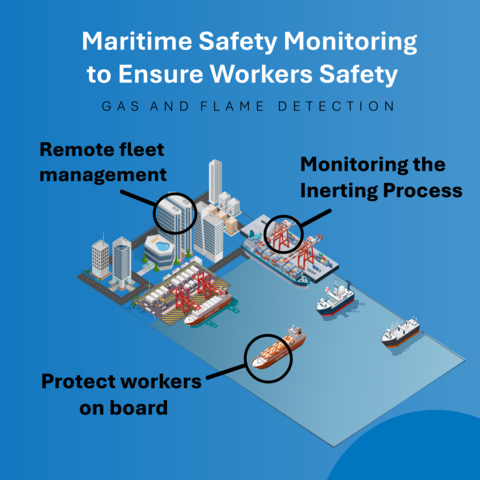
Teledyne Gas and Flame Detection's Maritime Safety Monitoring
IMO Resolution MSC.581(110) broadens recommended gas testing protocols to include carbon dioxide alongside other key atmospheric hazards. Growing demand for these solutions has contributed to multiple related awards year-to-date, reflecting increased focus across the maritime sector on safety readiness and compliance.
“The IMO’s revised recommendations represent an important advancement for maritime safety,” said Thibault Fourlegnie, Vice President and General Manager, Teledyne GFD. “We provide practical gas detection solutions that help customers improve enclosed-space safety and meet evolving compliance expectations.”
Manufactured at Teledyne GFD’s facility in Renfrew, Scotland, the company’s gas detection solutions draw upon more than 75 years of engineering and manufacturing expertise in industrial safety technologies. Investment at the plant is ongoing in line with growing global demand.
About Teledyne Gas and Flame Detection
Teledyne GFD equips ship operators, partners, and stakeholders with technologies that help protect personnel, strengthen compliance, and promote safer working practices across the industry. With marine-approved gas detection solutions manufactured in Renfrew, Scotland, the company helps customers address evolving enclosed-space safety expectations. For more information, visit Teledyne Gas and Flame Detection.
About Teledyne
Teledyne is a leading provider of sophisticated digital imaging products and software, instrumentation, aerospace and defense electronics, and engineered systems. Teledyne's operations are primarily located in the United States, Canada, the United Kingdom, and Western and Northern Europe. For more information, visit Teledyne's website at teledyne.com.
Media Contact:
Nathalie Dewisme
Senior Global Marketing & Communication Manager
Teledyne Gas and Flame Detection
nathalie.dewisme@teledyne.com
Source: Teledyne Gas and Flame Detection
Key Terms
international maritime organizationregulatory
An international maritime organization is a global body that sets rules and standards for shipping safety, environmental protection, and crew welfare across national borders—think of it as the referee and rulebook for the world’s oceans. Investors care because its regulations influence operating costs, required ship upgrades, legal risks, and the pace of trade and technology adoption, all of which can materially affect shipping companies’ profits and related industries’ valuations.
gas detectiontechnical
Gas detection is the use of sensors and monitoring systems to find harmful or flammable gases in air before they reach dangerous levels. For investors, it signals a company’s ability to manage safety, comply with rules, and avoid costly accidents or shutdowns—similar to a smoke alarm protecting a home; reliable detection lowers operational risk, potential liabilities, and can be a competitive advantage in industries where gas hazards matter.
atmospheric monitoringtechnical
Atmospheric monitoring is the regular measurement and tracking of air conditions—such as gases, particles and weather-related data—around a facility or region to detect pollution, emissions or changing climate patterns. Investors care because those measurements reveal regulatory compliance, operational risks, cleanup costs and reputational exposure; think of it like a company’s smoke and weather sensors that signal when air-related problems could lead to fines, shutdowns or long-term liability.