Teledyne Introduces Kaleido SWIR Hyperspectral Camera for High‑Speed Industrial Inspection
Teledyne Introduces Kaleido SWIR Hyperspectral Camera for High‑Speed Industrial Inspection
Teledyne (NYSE:TDY) introduced Kaleido, a short-wave infrared (SWIR) hyperspectral camera for high-speed industrial inspection in recycling, food safety, pharmaceuticals, and waste management.
Rhea-AI Sentiment reads the wording of the document, how positive or negative its language is on a 1 to 5 scale. The balance of points shown with the takes weighs what the document actually discloses, so the two can disagree, for example when a trial that missed its main goal is described in upbeat language.
WATERLOO, Ontario--(BUSINESS WIRE)--
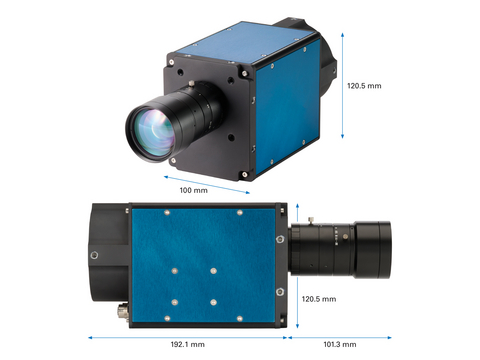
Teledyne DALSA, a global leader in machine vision, today announced Kaleido™, a groundbreaking short‑wave infrared (SWIR) hyperspectral camera. Engineered to overcome the integration and performance barriers of industrial sorting, Kaleido targets critical applications in recycling, food safety, pharmaceuticals, and waste management. By significantly advancing material discrimination and increasing throughput, Kaleido redefines the cost-to-performance ratio for hyperspectral inspection.
Teledyne’s Kaleido SWIR Hyperspectral Camera
Fully designed and vertically manufactured by Teledyne and encompassing the sensor, spectrograph, and interface, Kaleido delivers up to 1,280 pixel spatial resolution with line rates exceeding 2.3 kHz. This high-speed capability allows for the inspection of higher volumes in less time without sacrificing spectral precision.
“Kaleido is an example of how we leverage the collective power of Teledyne’s global technologies and capabilities. It combines deep sensor physics, advanced optical design, and world-class system engineering to reduce the complexity and cost of hyperspectral deployment,” said Sadiq Panjwani, Senior Executive Vice President and General Manager of the Machine Vision Cameras Group. “Kaleido is a scalable solution that improves global outcomes by ensuring food safety, driving cleaner manufacturing, and enabling more responsible resource management. This is the future of industrial intelligence.”
Kaleido simplifies the user experience with built‑in spectral band selection and spectrograph‑based aberration correction, ensuring consistent calibration across units throughout the full operating temperature range. These innovations reduce system complexity and accelerate time-to-market for machine builders. Additionally, Teledyne has integrated proven features from its award‑winning line scan families, such as metadata tagging and multiple regions of interest (ROI), ensuring that only the most relevant data is delivered to the processing engine for maximum efficiency.
The camera utilizes a 10 GigE interface fully compliant with GigE Vision® and GenICam® standards. Optimized for high responsivity, the Kaleido sensor maintains strong signal integrity even in low‑light conditions, allowing for the effective use of modern, energy-efficient SWIR LED lighting. With flexible lens options and a robust global partner network, Kaleido is built for rapid scaling.
Teledyne Vision Solutions offers the world’s most comprehensive, vertically integrated portfolio of industrial and scientific imaging technology. Aligned under one umbrella, Teledyne DALSA, e2v CMOS image sensors, FLIR IIS, Lumenera, Photometrics, Princeton Instruments, Judson Technologies, Acton Optics, and Adimec form an unrivaled collective of expertise across the spectrum with decades of experience and best-in-class solutions. Together, they combine and leverage each other’s strengths to provide the deepest, widest sensing and related technology portfolio in the world. Teledyne offers worldwide customer support and the technical expertise to handle the toughest tasks. Their tools, technologies, and vision solutions are built to deliver to their customers a unique and competitive advantage.
About Teledyne
Teledyne (NYSE:TDY) is a leading provider of sophisticated digital imaging products and software, instrumentation, aerospace and defense electronics, and engineered systems. Teledyne's operations are primarily located in the United States, Canada, the United Kingdom, and Western and Northern Europe. For more information, visit Teledyne's website at www.teledyne.com.
Short-wave infrared (SWIR) is the band of light just beyond visible red, roughly in the 0.9–1.7 micrometer range, picked up by specialized sensors rather than ordinary cameras. Think of it like a night-vision tool for materials: it reveals moisture, chemical signatures, hidden defects and details through haze or low light. For investors, SWIR-enabled products can create higher-margin equipment and new service opportunities across industrial inspection, telecom, defense and medical imaging.
hyperspectraltechnical
Hyperspectral describes imaging or sensing that captures light across hundreds of very narrow color bands, producing detailed “spectral fingerprints” that reveal material composition or subtle conditions ordinary cameras miss—like seeing many more colors than the human eye to tell apart similar objects. For investors, hyperspectral technology can signal companies with advanced analytics or unique data products used in agriculture, mining, defense, environmental monitoring and manufacturing, potentially enabling higher-value services, new revenue streams and competitive differentiation.
spectrographtechnical
A spectrograph is an instrument that splits light or other electromagnetic signals into a rainbow-like pattern so you can read the unique “fingerprint” of a material or substance. For investors, it matters because companies use spectrographs in product development, quality control and regulatory testing to verify composition, purity or performance—activities that affect production costs, product approvals and the credibility of scientific claims, all of which can influence revenue and risk.
metadata taggingtechnical
Metadata tagging is the practice of attaching short, descriptive labels to a document or data item—such as a press release’s company name, ticker, sector, event type or regulatory category—so computers and people can find, sort and analyze it quickly. For investors, these tags act like a library catalog or folder labels: they speed research, enable automated screening and alerts, and help ensure important announcements are not missed or misclassified during trading and due diligence.
regions of interesttechnical
Regions of interest are specific parts of a medical image, scan or dataset that researchers select for focused measurement or analysis—like circling the most important area in a photograph to study. For investors, how those areas are chosen and measured can affect reported trial results, safety signals and regulatory conclusions, so they influence perceptions of a therapy’s effectiveness and the value of companies developing diagnostics or treatments.
10 GigEtechnical
10 GigE, short for 10 Gigabit Ethernet, is a networking standard that moves data at about 10 billion bits per second—roughly ten times faster than common 1 Gigabit connections. For investors it signals a company’s ability to handle heavy data loads, support faster services, and scale infrastructure; think of it as upgrading from a two-lane road to a ten-lane highway, which can reduce bottlenecks and enable new business opportunities.
GigE Visiontechnical
GigE Vision is an industry standard that lets high-performance cameras send large amounts of image and video data over ordinary Ethernet (network) cables. Think of it as a wide, reliable highway that moves camera pictures quickly and in a consistent format so different devices and software can work together. Investors care because it lowers integration costs, speeds deployment of automation and imaging systems, and can expand markets for companies that make industrial cameras, medical scanners, and machine-vision software.
GenICamtechnical
GenICam is an industry standard that defines how industrial and scientific cameras describe their features and how software talks to them, so cameras from different makers can work with the same programs. For investors, widespread GenICam support means a company’s imaging products are easier to integrate, sell, and scale across customers and systems, lowering adoption friction and commercial risk much like a universal plug that fits many devices.