
U.S. Army Selects Teledyne FLIR Defense Rogue 1 Loitering Munition System for LASSO Program
Teledyne FLIR Defense (NYSE:TDY) announced that its Rogue 1 loitering munition system was selected by the U.S. Army for the LASSO (Low Altitude Stalking and Strike Ordnance) program.




Rogue™ 1 drone platform will enable Brigade Combat Teams to deliver precision strikes against tanks and other armored vehicles
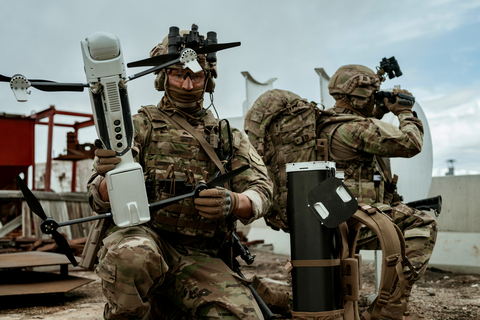
Teledyne FLIR Defense announced that its Rogue™ 1 loitering munition system has been selected by the
Teledyne FLIR will deliver a variant of its Rogue 1 lethal UAS for LASSO. Launched in spring 2024, the
As described in Army solicitation statements, the LASSO system is a man-portable, ground launched, lethal payload munition and uncrewed aerial system (UAS) with anti-armor capability for use by Infantry Brigade Combat Teams. LASSO is designed to deliver long-range precision strike fire with minimal collateral damage in complex environments.
“The precision and autonomy of the Rogue 1 platform make it ideally suited to achieve the Army’s goals for LASSO,” said Dr. JihFen Lei, President of Teledyne FLIR Defense and Senior Vice President of Teledyne’s Defense and Aerospace Group. “Rogue 1 leverages our expertise delivering battle-proven UAS technology, including the widely deployed Black Hornet® nano-drone, which we believe can be used with Rogue 1 in an unrivaled ‘hunter-killer’ combination.
“We’ll continue to work closely with the Army to help combat teams improve their mobility and lethality and achieve tactical overmatch against our adversaries,” Lei added.
Rogue 1 is a next-generation, optionally recoverable vertical takeoff and landing (VTOL) UAS that enables warfighters to conduct precision strikes against moving and stationary armored targets, soft-skinned vehicles, and dismounted threats. The Rogue 1 system is light enough to be carried by a single Soldier in a single tube and does not require vehicle transport, nor a launcher, key features for Infantry forces.
Other features include advanced electro-optical and FLIR Boson® 640+ thermal cameras to deliver day/night long-range reconnaissance and surveillance. A novel coupling between sensors and warhead in its gimballed payload enables extremely precise targeting. With a greater than 30-minute flight time, burst speeds of more than 70 mph (113 kph), and range in excess of 12 miles (20 km), Rogue 1 was designed for today’s harsh battlefield conditions, including communication- and GPS-denied environments.
Teledyne FLIR will deliver up to 130 Rogue 1 components/systems to the Army for test and evaluation next summer. The contract has a two-year performance period.
Visit us online to learn more about the wide range of FLIR Defense unmanned aerial systems and advanced payload options.
About Teledyne FLIR Defense
Teledyne FLIR Defense has been providing advanced, mission-critical technology and systems for more than 45 years. Our products are on the frontlines of the world’s most pressing military, security and public safety challenges. As a global leader in thermal imaging, we design and build sophisticated surveillance sensors for air, land and maritime use. We develop the most rugged, trusted unmanned air and ground platforms, as well as intelligent sensing devices used to detect chemicals, biological agents, radiation and explosives. At Teledyne FLIR Defense we bring together this expertise to deliver solutions that enable critical decisions and keep our world safe – from any threat, anywhere. To learn more, visit us online or follow @flir and @flir_defense.
About Teledyne Technologies
Teledyne Technologies is a leading provider of sophisticated digital imaging products and software, instrumentation, aerospace and defense electronics, and engineered systems. Teledyne's operations are primarily located in
View source version on businesswire.com: https://www.businesswire.com/news/home/20260513911725/en/
Media Contact:
Joe Ailinger, Jr.
Teledyne FLIR Defense
joe.ailinger@teledyne.com
Source: Teledyne FLIR Defense