
Thomson Reuters Reminds Non-Canadian Taxable Shareholders of "Opt-Out" Alternative for Return of Capital
Thomson Reuters (TSX/Nasdaq: TRI) reminded non-Canadian taxable shareholders they can opt out of a proposed return of capital tied to a share consolidation.
Sentiment and the balance of points
Rhea-AI Sentiment reads the wording of the document, how positive or negative its language is on a 1 to 5 scale. The balance of points shown with the takes weighs what the document actually discloses, so the two can disagree, for example when a trial that missed its main goal is described in upbeat language.
Rhea-AI Summary
Thomson Reuters (TSX/Nasdaq: TRI) reminded non-Canadian taxable shareholders they can opt out of a proposed return of capital tied to a share consolidation. The plan includes a US$605 million special cash distribution (about US$1.36 per share estimate) and a proportional reverse stock split.
Opt-out eligibility is limited to certain non-Canadian taxpayers; registered opt-out elections must be received by 5:00 p.m. EDT on April 27, 2026. The company warned tax consequences are complex and urged consultation with advisors.
Positive
- US$605 million special cash distribution announced
- Approx. US$1.36 cash per common share (estimate)
- Canadian tax treatment expected to be generally tax-free for residents
- Opt-out preserves current share count and voting interest for eligible shareholders
Negative
- Complex cross-border tax consequences for non-Canadian taxable shareholders
- Opt-out action required and deadlines may be earlier via intermediaries
- Share consolidation will reduce participating shareholders’ post-transaction share count
Details
News Market Reaction – TRI
On Apr 15, the first trading day after this news, TRI closed 5.06% above the previous close.
Data tracked by StockTitan Argus for the Apr 15 session.
Key Figures
- Special cash distribution
- US$605 million
- Aggregate proposed return of capital
- Cash per share
- US$1.36 per common share
- Estimated distribution based on shares as of March 6, 2026
- Opt-out deadline
- 5:00 p.m. EDT on April 27, 2026
- Registered shareholders’ opt-out election deadline with Computershare
- Share price
- $87.98
- Pre-news current price for TRI
- 52-week high
- $218.42
- 52-week trading range high
- 52-week low
- $79.71
- 52-week trading range low
- Market cap
- $36,959,660,294
- Pre-news market capitalization
- Short interest
- 8.16%
- Reported short position as percent of float
Historical Context
-
Announced timing and access details for Q1 2026 earnings release and call.
-
Announced integration partnership with Smokeball to enhance legal tech ecosystem.
-
Filed circular for US$605M special distribution and proportional share consolidation.
-
Announced participation in Bank of America 2026 Information and Business Services Conference.
-
Filed 2025 annual report with audited financials and MD&A on regulatory platforms.
24h Move is the share-price change in the day after each event; other market factors may also have contributed.
Key Terms
return of capital financial
reverse stock split financial
volume weighted average trading price technical
plan of arrangement regulatory
AI-generated analysis. How Rhea-AI works. Not financial advice.




Action is required to opt out
Opt-out deadlines vary by intermediary and may be earlier than April 27, 2026
As described in the company's management proxy circular dated March 13, 2026 (the "Circular"), the proposed return of capital and share consolidation transactions consist of a special cash distribution of
The return of capital is intended to distribute cash on a basis that is generally expected to be tax-free for Canadian tax purposes. As a result, Canadian resident shareholders are generally not eligible to opt out of the return of capital. Eligibility criteria for opting out of the return of capital is set out below.
Opting out
- What happens if you opt out: If you're eligible to opt out of the return of capital and choose to do so, you will not receive the special cash distribution. Each opting-out shareholder will still participate in the proposed transactions through a share exchange and the share consolidation but will continue to hold the same number of shares that it currently holds. Such opting-out shareholders will realize a proportionate increase in their equity and voting interests in the company by virtue of the consolidation of the participating shares under the share consolidation.
- Process: If you're a non-registered holder (i.e., you hold shares through a bank or broker), follow your bank or broker's instructions if you'd like to opt out of the return of capital. You should contact your bank or broker if you have not received information regarding how to opt out of the return of capital. Registered shareholders should follow instructions sent to them by Computershare Trust Company of
Canada , including depositing with Computershare a duly completed opt-out election and certification form prior to 5:00 p.m. EDT on April 27, 2026.
- Deadline: Any opt-out elections should be completed by the deadline set by your bank/broker or Computershare (depending on whether you're a non-registered or registered holder).
If you're not eligible to opt out of the return of capital or are eligible to opt out but decide not to, no action is required to participate in the return of capital.
Tax Consequences
The Canadian and
Conversion and Share Consolidation Ratios
Pursuant to the terms of the plan of arrangement to implement the return of capital and share consolidation transactions, each issued and outstanding non-participating share will be exchanged for one New Common Share and, after the return of capital to participating shareholders, each issued and outstanding New Common Share will be exchanged for a number of common shares equal to the Conversion Ratio and each issued and outstanding common share will then be consolidated into a number of post-consolidation shares equal to the Share Consolidation Ratio. Accordingly, non-participants in the return of capital will still participate in the share consolidation but will ultimately hold the same number of common shares as prior to the transactions, and participating shareholders will hold a fewer number of common shares to reflect the return of capital received.
Below is a description of the Conversion and Share Consolidation Ratios, as well as a numerical example:
The "Conversion Ratio" will be calculated as follows:
|
1 |
where X is the volume weighted average trading price of Thomson Reuters shares on the Nasdaq for the five trading days on which Thomson Reuters shares trade on the Nasdaq immediately preceding the effective date of the transactions. |
The "Share Consolidation Ratio" will be calculated as follows:
|
$X-Cash Distribution Per Share |
where X is the volume weighted average trading price of Thomson Reuters shares on the Nasdaq for the five trading days on which Thomson Reuters shares trade on the Nasdaq immediately preceding the effective date of the transactions. |
The Conversion and Share Consolidation Ratios will be fixed after close of business on the last trading day preceding the effective date of the transactions in order to allow Thomson Reuters to consolidate the common shares on a basis that is proportional to the return of capital distribution.
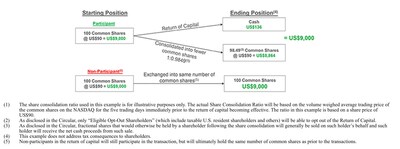
The foregoing discussion of the Conversion and Share Consolidation Ratios is intended to provide a general summary only. Shareholders are encouraged to read the Circular in its entirety.
Additional information and assistance
To be eligible to opt out of the return of capital, a shareholder must be an "Eligible Opt-Out Shareholder," which means a shareholder (whether registered or non-registered) who is (a) not a resident of
Details of the return of capital and share consolidation transactions (including information regarding the opt-out right and tax considerations) are described in the Circular and related materials, which are available on www.thomsonreuters.com in the "Investor Relations" section. The documents were filed with the Canadian securities regulatory authorities on SEDAR+ and are available at www.sedarplus.com. The documents were also furnished to the
Registered shareholders who have questions or need assistance may contact Computershare Investor Services Inc. at 1.800.564.6253 (toll-free in
Non-registered shareholders who hold their shares indirectly through an intermediary (such as an investment dealer, stock broker, bank, trust company or other nominee) should contact their intermediary if they have questions or need assistance.
Shareholders who have questions or need assistance may also contact D.F. King & Co., Inc., who is acting as Information Agent for the transactions at 1.800.967.5068 (toll-free in
About Thomson Reuters
Thomson Reuters (TSX/Nasdaq: TRI) informs the way forward by bringing together the trusted content and technology that people and organizations need to make the right decisions. The company serves professionals across legal, tax, audit, accounting, compliance, government, and media. Its products combine highly specialized software and insights to empower professionals with the data, intelligence, and solutions needed to make informed decisions, and to help institutions in their pursuit of justice, truth and transparency. Reuters, part of Thomson Reuters, is the world's leading provider of trusted journalism and news. For more information, visit thomsonreuters.com.
SPECIAL NOTE REGARDING FORWARD-LOOKING STATEMENTS
Certain statements in this news release are forward-looking within the meaning of applicable Canadian and
CONTACTS
MEDIA
Zoe Zanettos
Director, Corporate Affairs
+1 647 202 8948
zoe.zanettos@thomsonreuters.com
INVESTORS
Gary E. Bisbee, CFA
Head of Investor Relations
+1 646 540 3249
gary.bisbee@thomsonreuters.com

 View original content to download multimedia:https://www.prnewswire.com/news-releases/thomson-reuters-reminds-non-canadian-taxable-shareholders-of-opt-out-alternative-for-return-of-capital-302742301.html
SOURCE Thomson Reuters
FAQ
AI-generated questions and answers. How Rhea-AI works. Not financial advice.