
T2 Metals Expands Gold-in-Soil Anomaly Footprint at Target Area 2 at Its District-Scale Aurora Project, Yukon, Canada
Sentiment and the balance of points
Rhea-AI Sentiment reads the wording of the document, how positive or negative its language is on a 1 to 5 scale. The balance of points shown with the takes weighs what the document actually discloses, so the two can disagree, for example when a trial that missed its main goal is described in upbeat language.
Rhea-AI Summary
T2 Metals (TWOSF) reported that 2026 soil sampling extended the gold-in-soil trend to 2.4 km at its Aurora Gold-Copper Project in Yukon.
Expanded Target Area 2 defines a 2,400 m by 800 m footprint between the AJ and Toby prospects. Together, the expanded target and the two prospects form the East Zone. The new soil anomalies remain undrilled, and the broader Aurora gold-copper mineralized trend now extends more than 12 km.
Assays are in for 1,929 of 3,705 soil samples collected at Aurora. Of those, 133 samples (6.9%) exceeded 100 parts per billion gold, including 14 at or above 1.0 gram per tonne. T2 Metals plans to rank targets in 2027 and use the results to guide planning for its first diamond drilling program at Aurora.
Positive
- Minor pointExpanded Target Area 2 outlines a 2,400 m by 800 m footprint between AJ and Toby.
- Minor pointAurora's gold-copper mineralized trend now extends more than 12 km, farther than previously recognized.
- Minor pointSoil gold assays exceeded 100 ppb in 133 of 1,929 samples (6.9%), including 28 at or above 0.5 g/t and 14 at or above 1.0 g/t.
- Minor pointEast Zone soil assays recorded a maximum of 10,078.1 ppb gold.
- Minor pointEast Zone soil assays recorded maxima of 7,395.3 ppm copper and 85.6 ppm silver.
2 minor points
- Minor pointMultiple new gold-in-soil anomalies lie along the trend of the AJ and Toby prospects.
- Minor point. Forward-looking: it has not happened yet and may not happen.2027 exploration plans include ranking targets to guide T2 Metals' first diamond drilling program at Aurora.
Negative
- Minor point. Forward-looking: it has not happened yet and may not happen.New gold-in-soil anomalies remain undrilled, with follow-up planned to identify potential bedrock sources.
- Minor pointSoil assays outside the East Zone are still pending after results were received for 1,929 of 3,705 project samples.
AI-generated analysis. How Rhea-AI works. Not financial advice.




Additional Results from 2026 Soil Geochemistry Program Extend Gold Anomalism Across a 2.4 km Area
Vancouver, British Columbia--(Newsfile Corp. - November 24, 2026) - T2 Metals Corp. (TSXV: TWO) (OTCQB: TWOSF) (FSE: WJ6) ("T2 Metals" or the "Company") is pleased to report additional results from its 2026 auger/soil sampling program at the Company's Aurora Gold-Copper Project ("Aurora" or the "Project") within the prolific Tombstone Gold Belt in northwestern Yukon, Canada. Aurora is located 8 km from Prospector Metals' ML Project (see Figure 1), a recent gold-copper-silver discovery that highlights the untested mineral potential of the region.
These additional auger/soil results have significantly expanded the footprint of gold anomalism, previously known as Target Area 2 (see news release dated September 2, 2026), in the eastern part of Aurora, defining a broad 2.4 km trend now referred to as the East Zone. The results outline multiple areas of elevated gold, accompanied by anomalous copper, silver, arsenic and antimony, in an area northwest of the AJ prospect. Individual soil samples returned gold values of up to 5.89 g/t Au1, while the broader multi-element signature provides support for the prospectivity of an underlying mineralizing system (see Table 1). Together, these results establish the East Zone as a substantial new area of gold-copper exploration potential within the Project. The Aurora gold-copper mineralized system now covers a trend of more than 12 km, substantially larger than previously recognized. Further assay results from the 2026 auger/soil sampling program for the rest of the Project will be released as they become available.
Program Highlights
New results from the 2026 auger/soil sampling program delineate an expanded Target Area 2, now known as the East Zone:
Expanded Gold-in-Soil Anomaly Footprint: Sampling has extended the previously identified anomaly in the east of the claim area, which begins 250 metres north of the previously drilled AJ prospect, and now covers a 2.4 km strike;
Strong Gold-in-Soil Values: Individual samples returned gold grades up to 5.89 g/t Au1, highlighting the strength of gold anomalism within the expanded Target Area 2 (see Table 1);
Multiple areas of gold anomalism: New results identify additional discrete gold-in-soil anomalous zones on trend with the AJ and Toby prospects, where previous sampling has been very limited;
Undrilled targets near known gold mineralization: These new gold-in-soil anomalies are undrilled, but begin 250 metres from AJ where 2010 drilling intersected high-grade gold including 4.9 m of 12.45 g/t Au, 3.4 m of 7.61 g/t Au and 3.2 m of 25.06 g/t Au in massive quartz-tourmaline-sulphide veins;
Expansive Gold-Copper System: The Aurora gold-copper mineralized system extends along a trend of more than 12 km, substantially larger than previously recognized.
1 In a set of 1,929 surface soil samples Au values ranged from 10,078 ppb to 0.25 ppb averaging 56 ppb; Ag ranged from 85.6 ppm to 0.05 ppm averaging 0.8 ppm; Cu ranged from 7,395 ppm to 10.8 ppm averaging 102 ppm.
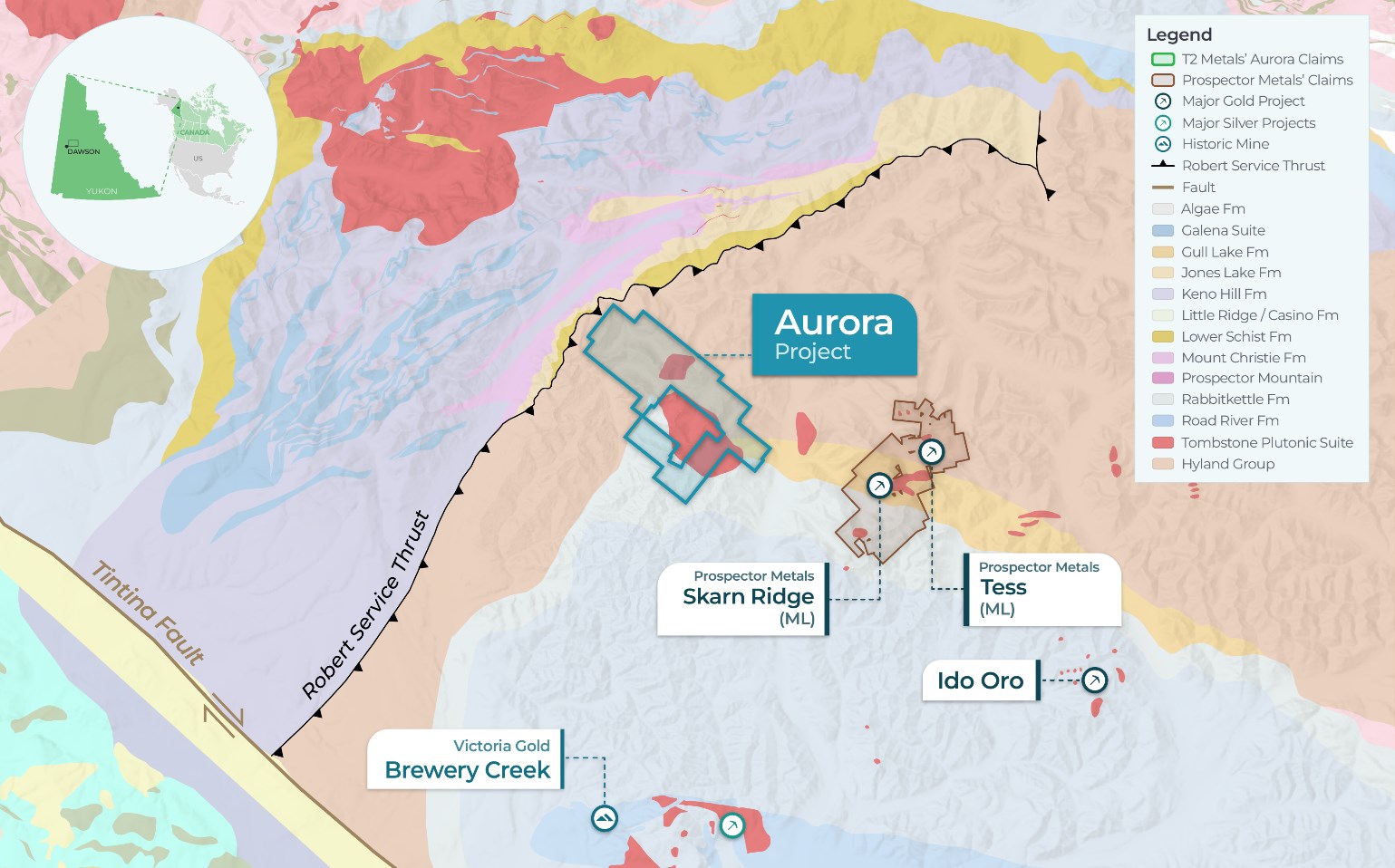
Figure 1: Location of T2 Metals' Aurora Project in relation to Prospector Metals' ML Project and the Brewery Creek Mine, Dawson Mining District, Yukon.
To view an enhanced version of this graphic, please visit:
https://images.newsfilecorp.com/files/7326/325473_2d97850344eacbba_002full.jpg
High-Grade Gold Target Area Expanded
As announced in September, Target Area 2, centred approximately 900 metres northwest of the AJ prospect, returned some of the highest gold and arsenic values, plus elevated levels of copper and silver, within the initial dataset of 1,619 auger/soil samples.
The current assay dataset comprises 1,929 samples and shows Target Area 2 to be significantly larger in area with a broad (2,400 m x 800 m) highly prospective gold-bismuth-copper-silver-antimony footprint between the previously identified Toby and AJ prospects (see Figure 2) where no consistent sampling had been previously completed. Collectively, the expanded Target Area 2 and these prospects are now referred to as the East Zone, located in the east-central part of Aurora (see Figure 3 and Figure 5).
The East Zone is characterized by multiple discrete gold-in-soil anomalies, overlying mixed sedimentary rocks, skarn and gossan. The East Zone sits immediately east of the Antimony Mountain Stock, a monzonite intrusion that forms part of the Tombstone Plutonic Suite, a geological setting associated with gold mineralization elsewhere in the Tombstone Gold Belt (see Figure 1 and Figure 2). Intrusive bodies control the formation and distribution of gold mineralization, including within the surrounding rocks and geological structures, making this an important target at Aurora for further evaluation. Individual auger/soil results include 5.89 g/t, 5.71 g/t, 2.80 g/t and 2.64 g/t Au (See Table 1 for full assay results).
The 2026 auger/soil dataset is now complete for the East Zone and confirms this is the most arsenic- and copper-silver-rich area of the Project sampled to date. East Zone is a broad highly prospective target area that extends across more than 2.4 km of strike, encompassing the original Toby and AJ prospects. The AJ prospect lies on the southern boundary of the East Zone where high-grade gold was intersected in previous drilling, including 3.15 m at 25.1 g/t Au. This high-grade gold at AJ is believed to be part of the broader East Zone mineralizing system, which is now better defined by the recent auger/soil results.
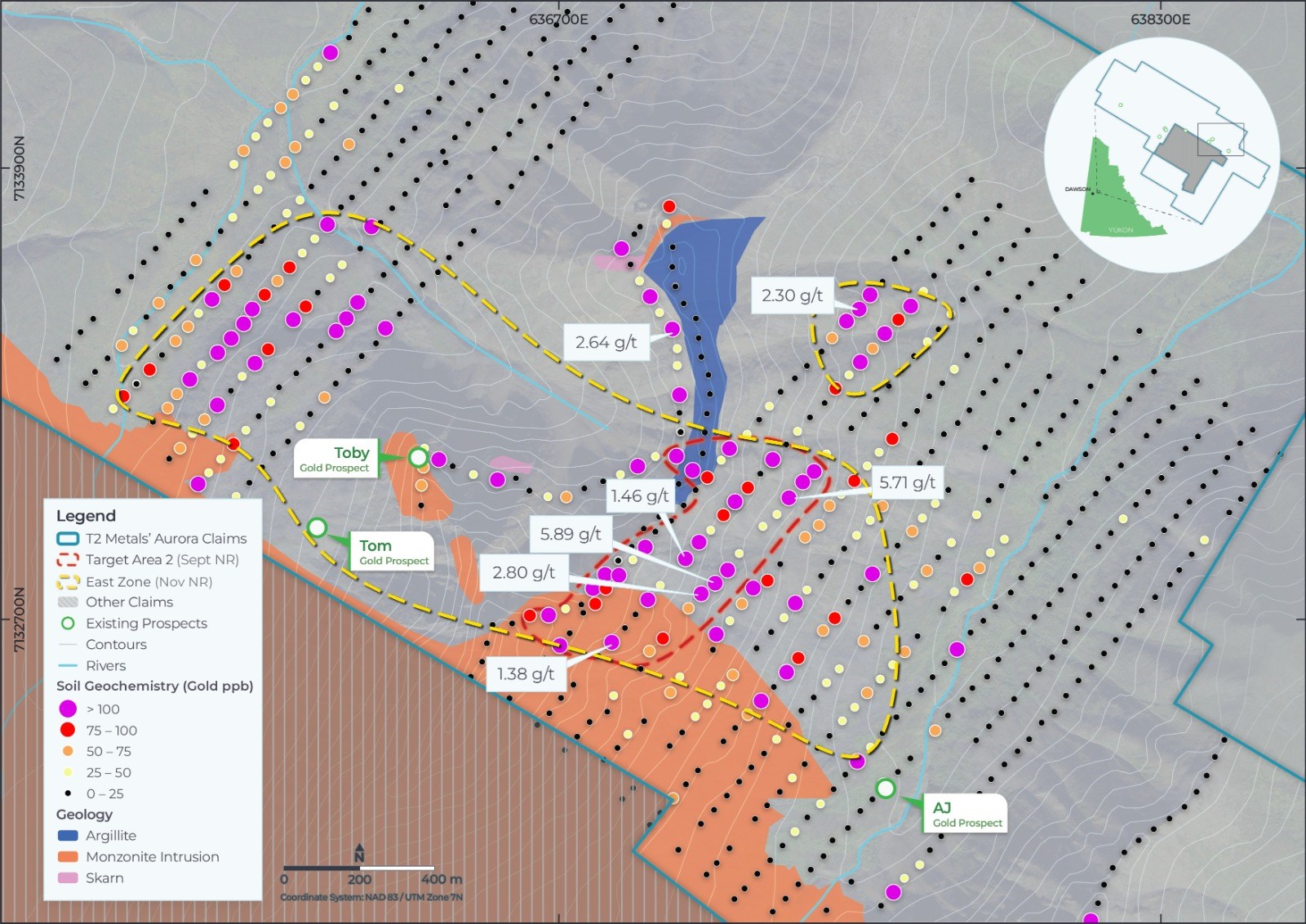
Figure 2: East Zone (expanded Target Area 2) gold-in-soil results, Aurora Project, Yukon. Peak Gold Value of 5.89 g/t Au.
To view an enhanced version of this graphic, please visit:
https://images.newsfilecorp.com/files/7326/325473_2d97850344eacbba_003full.jpg
2026 Soil Geochemistry Results: East Zone
During T2 Metals' 2026 summer exploration program, the Company's field team collected a total of 3,705 auger/soil samples at Aurora. Most of these samples were taken from areas with very limited previous exploration. Assay results for 1,929 of the Company's auger/soil samples have now been received (see Table 1).
Of the 1,929 samples, 133 (
Gold is accompanied by elevated pathfinder elements, including arsenic, bismuth and antimony. These geochemical signatures are associated with reduced intrusion-related gold systems ("RIRGS") and skarn-style gold-copper mineralization, two geological settings known to host significant gold deposits within the Tombstone Gold Belt.
The field sampling protocols applied by T2 Metals are modeled on the systematic auger/soil geochemistry techniques applied by explorer and prospector Shawn Ryan, whose methods have led to multiple discoveries across the Yukon including the multi-million-ounce White Gold and Coffee Gold deposits.
| n= 1929 | Cu (ppm) | Pb (ppm) | Zn (ppm) | Ag (ppm) | As (ppm) | Au (ppb) | Sb (ppm) | Bi (ppm) | Se (ppm) | Te (ppm) |
| MAX | 7395.3 | 10000 | 2405 | 85.6 | 10000 | 10078.1 | 2000 | 977.7 | 41.5 | 12.6 |
| MIN | 10.8 | 6.1 | 14 | 0.05 | 3.7 | 0.25 | 0.5 | 0.05 | 0.25 | 0. 1 |
| AVG | 102.02 | 125.07 | 125.20 | 0.81 | 458.38 | 56.25 | 18.58 | 6.13 | 1.02 | 0.24 |
Table 1: Assay statistics for the final 2026 auger/soil samples from the East Zone, Aurora Project, Yukon (n = 1,929).
Mark Saxon, President & CEO of T2 Metals, said:
"Aurora is a large, highly prospective and underexplored project in one of North America's largest mineral belts and most underexplored gold regions. The recent investment by AngloGold Ashanti, one of the world's premier gold mining companies, into Sitka Gold reinforces the region's discovery and development pedigree.
"Results from our systematic 2026 exploration program continue to advance our understanding of Aurora's scale and significant gold, copper and silver potential. The high grades returned from the East Zone are a particularly exciting development. New auger/soil results have extended the gold-copper mineralized footprint at Aurora, defining a broader area of untested gold anomalism. This is substantially larger than previously recognized and highlights the gold potential in this part of the Project.
"The gold values are encouraging, but equally important is the broader geochemical signature, including highly anomalous copper, silver and antimony, and what this indicates about the underlying mineralizing system. The East Zone has emerged as a large, well-defined, multi-element target for follow-up in 2027.
"I would like to thank our field team for the pace and quality of their work, and their ongoing dedication to advancing Aurora and helping unlock its significant discovery potential."
2027 Exploration Plans
T2 Metals' 2027 exploration and drill plans at Aurora will focus on systematically evaluating and prioritizing gold target areas identified through the completed 2026 auger/soil sampling program. By integrating the final set of auger/soil results, as they become available, with airborne magnetic, radiometric and LiDAR surveys, structural mapping and RAB drilling data, will help rank priority targets and guide planning for T2 Metals' first diamond drill program at Aurora.
At the East Zone, follow-up work will focus on identifying the potential bedrock sources of the gold-in-soil anomalies, evaluating geological relationships between the respective anomalies, and refining priority areas for further exploration to help determine drill-ready targets. This work will incorporate the auger/soil sampling results with geological mapping and geophysical data to guide follow-up exploration.
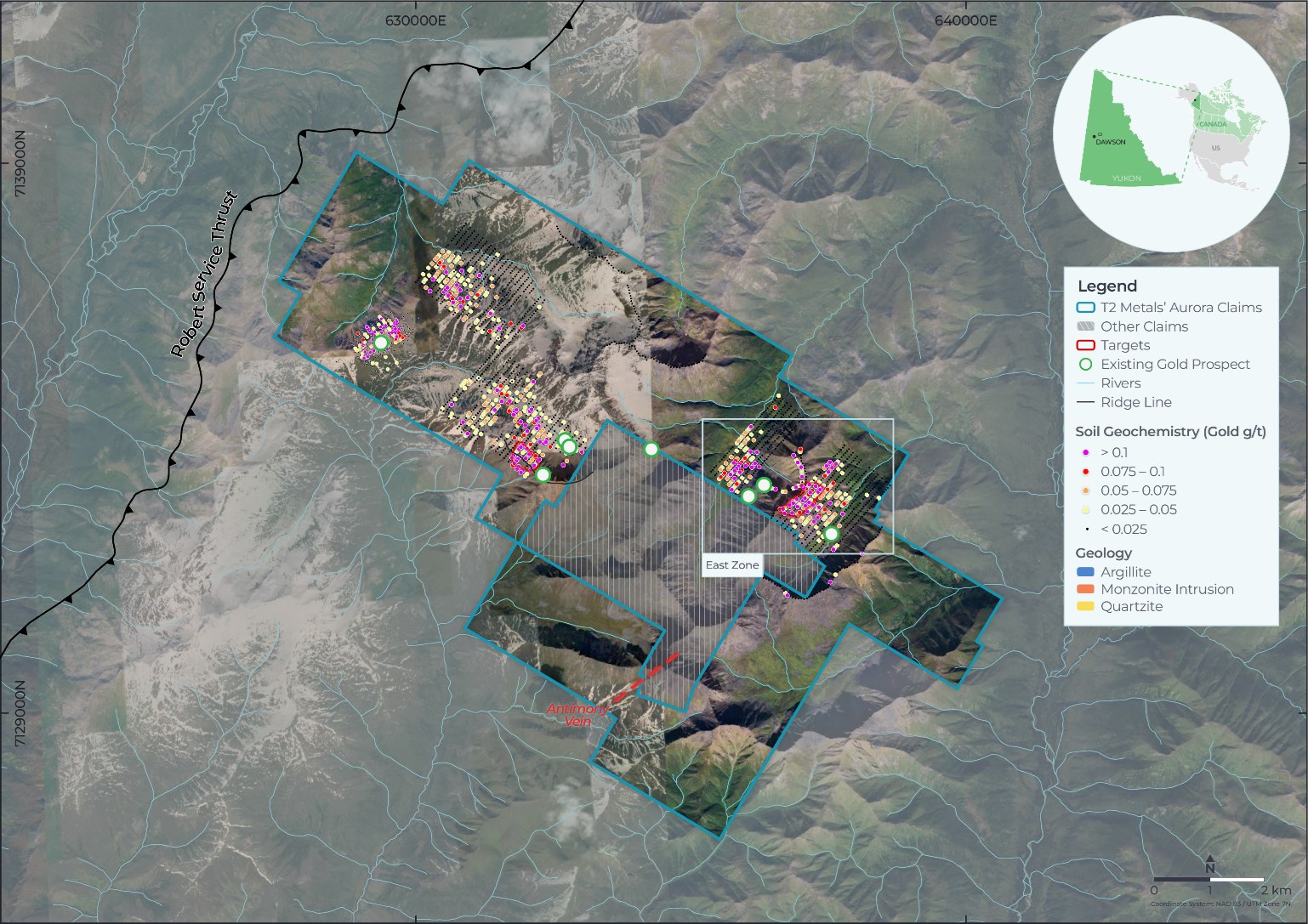
Figure 3: Gold-in-soil results from 2026 auger/soil sampling highlighting the East Zone at the Aurora Project, Yukon.
To view an enhanced version of this graphic, please visit:
https://images.newsfilecorp.com/files/7326/325473_2d97850344eacbba_004full.jpg
Project Location
Aurora is a large, underexplored project covering 76 km², located in the historic Dawson Mining District. The district is known for high-grade gold-silver-copper systems and significant recent discoveries, attracting renewed hard-rock exploration interest and strategic investment from senior gold producers.
The Project shares significant geological similarities with Prospector Metals' nearby ML Project, where recent exploration success highlights the discovery potential of this geological setting. Aurora remains comparatively underexplored with less than 3,000 m of historical drilling prior to T2 Metals' 2026 RAB drill program. This limited exploration history, combined with the geological similarities to ML, points to considerable scope for further exploration and new discoveries. Aurora also lies 30 km north of the Brewery Creek Mine (see Figure 1), a past-producing open-pit, heap-leach gold mine that was one of the most northerly sub-Arctic operations of its kind in the world.
Regional Geological Setting: Tombstone Gold Belt
Aurora is situated within the western portion of the Tombstone Gold Belt in Yukon, Canada — a core component of the broader, highly endowed Tintina Gold Province that stretches from southwestern Alaska, USA, to the border of the Northwest Territories, Canada (see Figure 4).
The belt hosts numerous multi-million-ounce gold deposits such as Snowline Gold's Rogue Project, Banyan Gold's AurMac Project and the Eagle Gold Mine (see Figure 4). Aurora shares the same geological signature as these deposits, offering significant discovery potential. In particular, the Project hosts the Antimony Mountain Stock, the same style of intrusion that is associated with gold mineralization at the Brewery Creek Mine and, more regionally, Snowline Gold's Rogue Project and Sitka Gold's RC Project (see Figure 4).
Although the belt is primarily known for being prolific in gold, it also hosts localized copper mineralization and major silver deposits, including the Keno Hill Silver District, one of the world's highest-grade silver districts and home to Hecla Mining's Keno Hill operations.
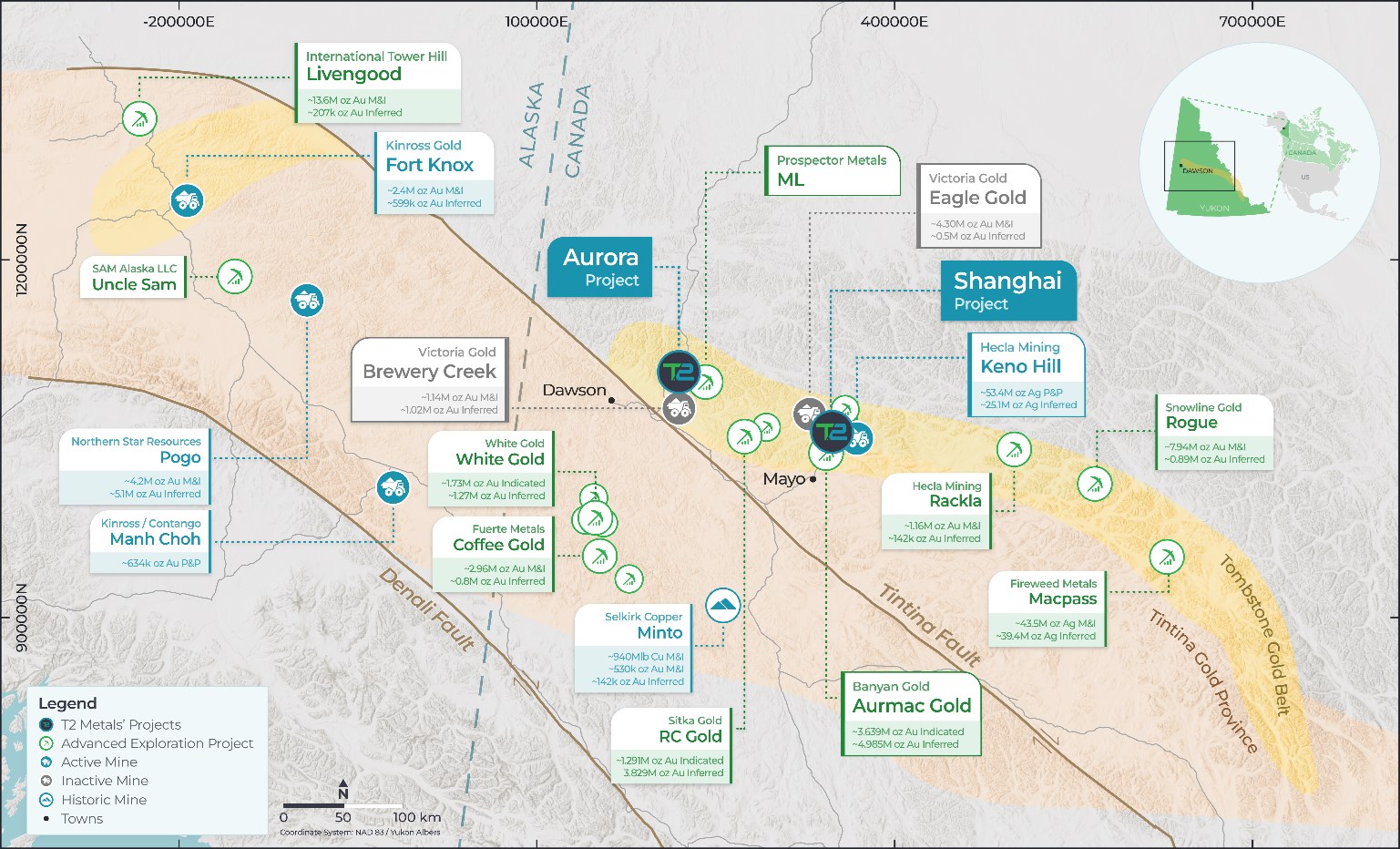
Figure 4: Location of T2 Metals' Shanghai and Aurora projects in the Tombstone Gold Belt and broader Tintina Gold Province, Alaska, USA, and Yukon, Canada.
To view an enhanced version of this graphic, please visit:
https://images.newsfilecorp.com/files/7326/325473_2d97850344eacbba_005full.jpg
Geological Signature: RIRGS
The Tombstone Gold Belt is globally recognized for hosting RIRGS associated with mid-Cretaceous granitic intrusions. As these intrusions cooled, gold-bearing fluids migrated into surrounding fractures, depositing gold in sheeted quartz veins and as disseminated mineralization across both the intrusions and adjacent host rocks. This unique geological setting created high-grade structurally controlled veins and large-scale, bulk-tonnage gold deposits associated with major discoveries in the belt.
RIRGS deposits are typically characterized by gold-dominant, low-sulphide mineralization (generally less than
Project Historical Results & Timeline
In 1916, Aurora was originally named Antimony Mountain after the discovery of high-grade antimony veins in the area. Exploration resumed in the mid-1960s, with intermittent surface sampling, geological mapping and some drilling (less than 3,000 metres) over several decades. In 2004, Yukon explorers and prospectors Shawn Ryan and Cathy Wood staked the Project. Their systematic soil and rock chip sampling, together with the integration of fragmented historical datasets, helped unlock the scale and mineral potential of the area.
Exploration between the mid-1960s and late 2000s identified six gold-bearing prospects across a 10 km trend at Aurora. Historical results from 2009 and 2010 include 4.9 m of 12.45 g/t Au, 3.4 m of 7.61 g/t Au and 3.2 m of 25.06 g/t Au in drilling at the AJ prospect, and up to 61 g/t Au in outcrop grab samples and 2 m of 3.2 g/t Au in drilling at the Golden Wall prospect. Although surface sampling and drilling returned high-grade gold results, only a small portion of the Project has been tested, leaving much of Aurora underexplored.
In February 2026, T2 Metals acquired Aurora, its second Yukon project sourced from Ryan and Wood, following the Company's previous acquisition of their Shanghai Project in September 2025.
2026 Summer Exploration Program: Overview
T2 Metals commenced its first summer exploration program at Aurora on June 30, 2026 (see news release), focusing on a multi-disciplinary approach to systematically advance and evaluate priority targets at Aurora through LiDAR surveying, geological mapping, prospecting, and soil and rock sampling.
Fieldwork progressed through June and July, with an airborne LiDAR survey and auger/rock sampling completed across the Project. Geological mapping and prospecting identified new outcropping semi-massive stibnite mineralization approximately 300 metres west of the Antimony Mountain prospect and identified new semi-massive chalcopyrite mineralization in rock float 300 metres northeast of the Rainbow prospect. These results were significant as they physically extend known mineralized zones, providing surface evidence of both antimony, which is an important pathfinder element associated with gold, and copper.
The Company subsequently commenced its RAB drilling program on July 30, 2026 (see news release) at the TK, JC and Rainbow prospects (collectively referred to as the Anaconda prospect), marking the first drill program in 17 years at Aurora.
T2 Metals reported its first set of results from 1,619 auger/soil samples at Aurora on September 2, 2026, identifying two untested high-priority gold-copper targets, Target Area 1 and Target Area 2. This news release (dated November 24, 2026) reports assay results from the second set of results of 1,929 from the 2026 auger/soil sampling program at the expanded Target Area 2, now called the East Zone.
Further assay results, including from the 2026 auger/soil sampling program and RAB drill program, from the Company's complete summer exploration activities will be released as they become available.
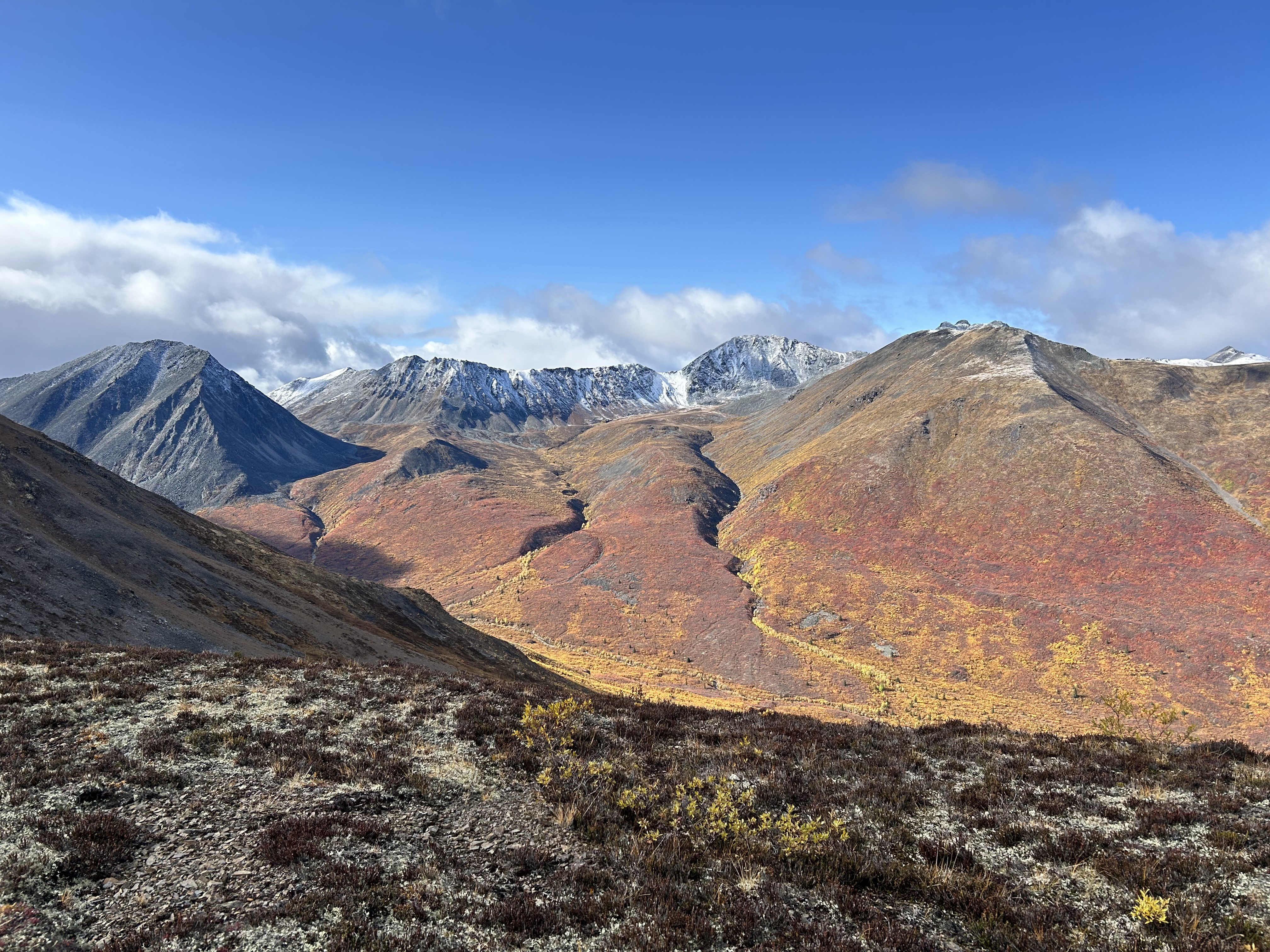
Figure 5: Looking west towards the historical Tom and Toby prospects at the East Zone, Aurora Project, Yukon.
To view an enhanced version of this graphic, please visit:
https://images.newsfilecorp.com/files/7326/325473_2d97850344eacbba_006full.jpg
Aurora Project Midpoint: Google Earth Link
2026 Soil Geochemistry: QA/QC Protocol
The auger/soil samples were submitted to Bureau Veritas Commodities Canada Ltd. in Vancouver for 37-element aqua regia digestion with ICP-MS/ICP-ES finish (method AQ201), with gold reported to a 0.5 ppb detection limit. Field duplicates were inserted at a rate of approximately
The auger/soil geochemical anomalies described in this news release have not previously been drill-tested; individual soil assays do not establish bedrock grades, mineralized widths or continuity. The peak assay values cited herein include results previously announced on September 2, 2026, and should not be interpreted as newly reported peak assays. See Table 1 for more information.
Qualified Person
The Qualified Person (as defined under National Instrument 43-101 – Standards of Disclosure for Mineral Projects) for the Company's projects, Mark Saxon, the Company's President & CEO, a Fellow of the Australasian Institute of Mining and Metallurgy, and a Member of the Australian Institute of Geoscientists, has reviewed and approved the contents of this news release.
About T2 Metals Corp. (TSXV: TWO) (OTCQB: TWOSF) (FSE: WJ6)
T2 Metals Corp. is an emerging precious and critical strategic metals company enhancing shareholder value through exploration and discovery. T2 Metals is committed to engaging with rights holders and stakeholders with the highest level of respect, ensuring that our exploration activities contribute positively to the communities in which we operate.
ON BEHALF OF THE BOARD
| "Mark Saxon" Mark Saxon President & CEO | For further information, please contact: www.t2metals.com 1305 – 1090 West Georgia Street, Vancouver, BC, V6E 3V7 info@t2metals.com |
Neither the TSX Venture Exchange nor its Regulation Services Provider (as that term is defined in the policies of the TSX Venture Exchange) accepts responsibility for the adequacy or accuracy of this news release.
Cautionary Note Regarding Forward-Looking Statements
Certain information set out in this news release constitutes forward-looking information. Forward-looking statements are often, but not always, identified by the use of words such as "seek", "anticipate", "plan", "continue", "estimate", "expect", "may", "will", "intend", "could", "might", "should", "believe" and similar expressions. Forward-looking statements are based upon the opinions and expectations of management of the Company as at the effective date of such statements and, in certain cases, information provided or disseminated by third parties. Although the Company believes that the expectations reflected in forward-looking statements are based upon reasonable assumptions, and that information obtained from third party sources is reliable, they can give no assurance that those expectations will prove to have been correct. Readers are cautioned not to place undue reliance on forward-looking statements.
These forward-looking statements are subject to a number of risks and uncertainties. Actual results may differ materially from results contemplated by the forward-looking statements. Accordingly, the actual events may differ materially from those projected in the forward-looking statements. Such risks include uncertainties relating to exploration activities. When relying on forward-looking statements to make decisions, investors and others should carefully consider the foregoing factors and other uncertainties and should not place undue reliance on such forward-looking statements. The Company does not undertake to update any forward-looking statements, except as may be required by applicable securities laws.
To view the source version of this press release, please visit https://www.newsfilecorp.com/release/325473
FAQ
AI-generated questions and answers. How Rhea-AI works. Not financial advice.