
Merion Road Capital Management and Blue Hill Advisors urge United Bancorporation of Alabama to return excess capital, improve profitability, and strengthen corporate governance
Merion Road Capital Management and Blue Hill Advisors, owning about 2% of United Bancorporation of Alabama (OTC: UBAB), sent a July 7, 2026 letter urging a sizable capital return, cost discipline, and stronger board-level capital allocation expertise.
Sentiment and the balance of points
Rhea-AI Sentiment reads the wording of the document, how positive or negative its language is on a 1 to 5 scale. The balance of points shown with the takes weighs what the document actually discloses, so the two can disagree, for example when a trial that missed its main goal is described in upbeat language.
Rhea-AI Summary
Merion Road Capital Management and Blue Hill Advisors, owning about 2% of United Bancorporation of Alabama (OTC: UBAB), sent a July 7, 2026 letter urging a sizable capital return, cost discipline, and stronger board-level capital allocation expertise.
They propose a $40M modified Dutch auction tender (about 25% of UBAB’s ~$170M market cap), citing high capital ratios following the $123.75M ECIP preferred issuance, a 46% expense increase since 2022 with largely flat deposits, and stock underperformance of 41% versus peers. At $55.36, they note UBAB trades at 9.4x LTM earnings, 1.18x TBV and 0.71x adjusted TBV, and outline potential EPS and adjusted TBV per-share accretion if such a tender is executed.
Positive
- High capital levels after $123.75M ECIP preferred investment in 2022
- Strong regulatory capital ratios well above ECIP and regional peer medians
- Investors highlight valuation of 9.4x LTM earnings and 0.71x adjusted TBV
- Illustrative $40M tender equals about 25% of current ~$170M market cap
- Illustrated tender scenario shows 22% EPS and 6% adjusted TBV/share accretion
Negative
- Operating expenses up 46% from 12/31/2022 to 3/31/2026
- Operating expenses-to-assets ratio has risen back above 3.0%
- Deposits contracting at 0.9% CAGR since 2022 versus 1.4% national growth
- Stock underperformance of 41% versus peer set over the past year
- Quarterly expense guidance raised from $8.5M to about $12M in two years
- Capital ratios expanding as excess capital not fully deployed, pressuring ROE
Details
News Market Reaction – UBAB
On Jul 7, the day this news came out, UBAB closed 3.11% above the previous close.
Data tracked by StockTitan Argus for the Jul 7 session.
AI-generated analysis. How Rhea-AI works. Not financial advice.




A full copy of the letter is provided below:
July 7, 2026
The Board of Directors
United Bancorporation of Alabama, Inc.
200 East Nashville Avenue
Attention: Michael Vincent, President and CEO, and the Board of Directors
Merion Road Capital Management and Blue Hill Advisors (together, "we") have been investors in United Bancorporation of Alabama, Inc. ("UBAB" or the "Company") since 2022 and currently own approximately
Notwithstanding these benefits, recent results have been underwhelming. Deposit and loan growth have stalled, expenses have ballooned, and excess capital continues to weigh on the Company's return on equity ("ROE"). Consequently, shareholders have suffered lagging market returns leaving the stock at a deeply discounted valuation relative to similarly situated banks. At
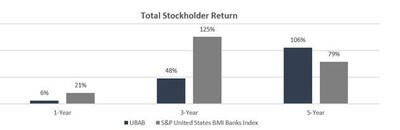
We have had numerous calls and in-person meetings with UBAB's management team expressing our concerns and offering tangible recommendations (detailed below). While we appreciate management's availability and openness, we are disappointed by the lack of concrete steps taken to address these issues. We are writing this letter to memorialize our views and urge the Board to take immediate, decisive action.
Our primary areas of focus are as follows:
- Capital allocation: UBAB possesses some of the highest capital ratios in the industry, in large part due to the US Department of Treasury's July 2022 preferred investment via the Emergency Capital Investment Program ("ECIP"). While the Company has taken incremental steps to leverage its balance sheet – notably raising the dividend and repurchasing stock in the open market – capital continues to accrete and weigh on both UBAB's ROE and market performance. We believe it is time for the Company to take more aggressive steps.
What are UBAB's capital ratio targets and when will the Company hit them?
- Efficiency: Historically, UBAB's expense growth has tracked balance sheet and earnings growth. In recent years, however, expenses have soared by
46% for the twelve months ending 12/31/2022 to the twelve months ending 3/31/2026 while balance sheet growth has lagged. Expense growth in itself is not a bad thing, but UBAB must either articulate a plan to grow into this elevated expense base or take measures to reduce costs.
Does UBAB have a plan to grow into this expense base or has it identified areas to cut costs?
- Governance: While we appreciate that UBAB's board comprises professionals with ties to the local community, we believe the board lacks much-needed capital allocation expertise. Because this skillset is so central to the Company's prospective return profile, we believe it is critical that UBAB have the right person(s) in the boardroom to ensure no missteps.
Which current directors, if any, possess the requisite expertise to help leverage/deploy UBAB's excess capital?
As previously discussed with management, we believe the following steps need to be taken and are calling on the Board to take decisive action:
- Repurchase
$40M $40M 25% of UBAB's current~ market capitalization, would be highly accretive, well-received by shareholders, and leave sufficient capital to fund organic growth or actionable M&A.$170 million - Improve operating efficiency: UBAB's expenses have risen nearly
50% over the last few years despite stagnant top-line growth. While management may have previously been granted latitude to invest in the business, a prolonged period of negative operating leverage is unacceptable. Management must either clearly articulate a credible plan to grow into its elevated expense base or immediately identify areas to reduce costs. Returning to a level of operational efficiency that aligns with historical and peer benchmarks is critical to maximizing returns. - Bolster boardroom capital allocation expertise: We believe UBAB urgently requires enhanced capital allocation oversight at the Board level. Appointing one or two independent directors with deep M&A and capital markets expertise would provide the strategic discipline currently lacking and serve as a powerful catalyst to restore investor confidence.
Our detailed analysis and observations are provided below.
Capital Allocation Concerns
UBAB possesses some of the highest capital ratios in the banking sector following its receipt of
While meeting these repurchase conditions will take several years, the Company can and should utilize this capital today. Unfortunately, instead of utilizing it, UBAB's capital ratios have expanded since receiving the ECIP funds as its modest efforts have been insufficient to offset the combined effects of the Company's earnings generation and slowing growth.
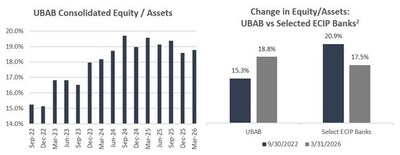
Management has repeatedly held out the carrot of leveraging its balance sheet via M&A. Yet for all its efforts, UBAB has completed only one M&A transaction in its entire history. Management's justifications have been numerous, including AOCI marks, competition from credit unions, and overall sluggishness in its target market. We appreciate that the Company has opted to be disciplined on price, but maintaining excessive levels of capital as an indefinite holding strategy for an elusive transaction is an unacceptable drag on returns.
Operational Concerns
UBAB has a long history of strong fundamental operations characterized by an attractive and growing deposit base, participation in high return incentive programs, and cost discipline. Over the last several years, however, the Company's performance has deteriorated as stagnating deposit levels have coincided with unbridled expense growth. While we believe the fundamentals are still in place, the Company needs to refocus its efforts on getting back to its roots.
Deposits
From 2004 to 2022 UBAB deposits grew organically at an
A similar trend emerges when comparing UBAB's deposit growth to its direct peers: UBAB operated in the upper echelon of its direct competitors for the 18 years leading up to 2022 but has been one of the worst growers since then.
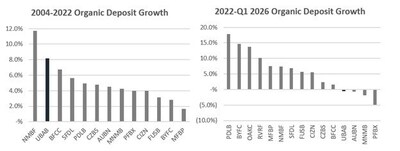
Understanding that UBAB must balance growth objectives against customer acquisition costs, we remain concerned that the Company is sacrificing market share and long-term customer growth to defend a net interest margin that is already amongst the highest of its peer group. Given that UBAB's cost of deposits remains well below peer averages, the Company possesses a distinct competitive advantage that can be leveraged to capture market share in this current interest rate environment.3
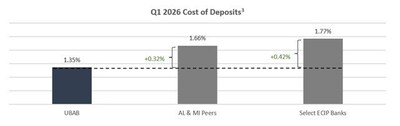
Non-Interest Expense:
Until recently, UBAB consistently generated positive operating. Impressively, from 2004 to 2022, UBAB's operating expenses-to-assets ratio declined from
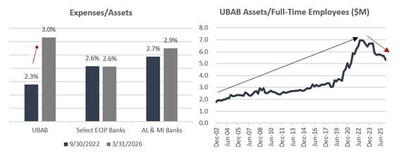
With annualized expenses having increased by
- Q4 2023 Earnings Call: "So, other than that [onetime expenses], I think, a good a good run rates probably
$8.5 million
- Q3 2024 Earnings Call: "Non-interest expense. I think a good quarterly run rate is about
$9.5 million
- Q4 2025 Earnings Call: "So, you know, when you look at a kind of our go-forward run rate, I would say the expectation is to probably model about
$12 million
- Q1 2026 Earnings Release: "We recognize that IT and people expenses are higher and do not expect this trend to continue. We need to grow into what we have. We also recognized that to grow our balance sheet we needed efficient and more robust technology. We invested heavily in a new partnership culminating in our core conversion in 2025."
Recent statements regarding expense discipline are encouraging, but meaningless without action.
The Path Forward
UBAB stock has underperformed its peer-set by
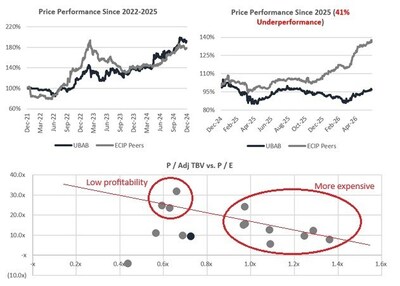
This drastic underperformance has left UBAB trading at a steeply discounted valuation despite its attractive deposit base, excess capital, and stable earnings profile.
All of our interactions with the Company to date have indicated that the Board and management care about doing well for its constituents. We call on the Company to take the following steps.
1. Capital Return
The Company should immediately take steps to execute a modified Dutch auction reverse tender offer to repurchase a significant percentage of its outstanding shares at today's attractive valuation levels. Based on our analysis, UBAB could execute a
UBAB Current | UBAB PF | ECIP Peer | AL & MI Peer | |
Bank Tier 1 Leverage | 15.5 % | 15.5 % | 13.6 % | 9.8 % |
Bank CET1 | 20.9 % | 20.9 % | 20.2 % | 12.5 % |
Bank Tier 1 | 20.9 % | 20.9 % | 20.2 % | 12.5 % |
Bank Total | 22.1 % | 22.1 % | 21.4 % | 13.6 % |
Consolidated E/A | 18.8 % | 16.5 % | 17.5 % | 9.0 % |
A distribution of this magnitude could be accomplished via a tender offer, special dividend or some combination of the two. If the company executes a
$M | Current | Tender | Pro Forma |
Shares Outstanding | 3.055 | (0.667) | 2.388 |
Price | |||
Market Cap. | 169.1 | 132.2 | |
P/E | 9.44x | 7.75x | |
P/TBV | 1.18x | 1.28x | |
P/Adj TBV | 0.71x | 0.67x | |
Earnings / Share | + | ||
TBV / Share | |||
Adj TBV / Share | + (0.9) | ||
LTM Earnings | 17.9 | 16.8 | |
TBV | 143.2 | (40.0) | 93.2 |
ECIP Preferred | 123.8 | 123.8 | |
Adj TBV | 238.0 | (40.0) | 188.0 |
2. Operational Improvement
We are calling on management to:
A. Re-examine its growth strategy. Identify what has caused the Company to lose deposits over the last several years while national and peer deposits have continued to grow, and what has changed versus the prior two decades. The earnings accretion from deposit growth is quite compelling, even assuming incremental rates above current levels.
Deposits ($M)[4] | Current | ||
Assets | 1,458 | 1,658 | 1,858 |
Non-Int Bearing | 457 | 457 | 457 |
Int Bearing | 689 | 889 | 1,089 |
Deposits | 1,146 | 1,346 | 1,546 |
Total Liabilities | 1,184 | 1,384 | 1,584 |
Equity | 274 | 274 | 274 |
Equity / Assets | 18.8 % | 16.5 % | 14.7 % |
Interest Income | 9.2 | 18.3 | |
Interest Expense | 6.0 | 12.0 | |
NII | 3.2 | 6.3 | |
EPS Impact | |||
Accretion to LTM | 17 % | 33 % |
B. Take a fine comb to run-rate costs and justify exactly how they are helping to grow or improve the business.
C. Establish clear targets that management is working towards including target deposits, loans as a percentage of deposits, and expenses. Justify any incremental costs with a return on investment analysis.
3. Corporate Governance
For many years the Company had a relatively small balance sheet with less than
In Conclusion
Management has repeatedly stated that they believe the stock is undervalued. It is time to prove it. Leverage your capital and operational infrastructure through shareholder returns, organic growth, and cost discipline. We trust that you will take the steps to right the ship and will be monitoring our investment closely.
Sincerely,
Aaron Sallen Jason Blumberg
Manager Managing Member
Merion Road Capital Management Blue Hill Advisors
1 Adjusted TBV assumes a repurchase of the ECIP preferred at
2 Select ECIP Banks are limited to public banks with a market capitalization greater than
3 AL & MI Peers are limited to public banks with between
4 Assumes deposits raised at a cost of
 View original content to download multimedia:https://www.prnewswire.com/news-releases/merion-road-capital-management-and-blue-hill-advisors-urge-united-bancorporation-of-alabama-to-return-excess-capital-improve-profitability-and-strengthen-corporate-governance-302818936.html
SOURCE Merion Road Capital Management
FAQ
AI-generated questions and answers. How Rhea-AI works. Not financial advice.