
VIAVI Launches Cesium-less ePRTC360+ Enhanced Primary Reference Time Clock as Alternative to Cesium-Accuracy Holdover Clock
VIAVI (NASDAQ: VIAV) launched the patent-pending Cesium-less ePRTC360+, an enhanced primary reference time clock that meets ITU-T G.8272.1 drift standards previously achieved only by Cesium clocks.
Sentiment and the balance of points
Rhea-AI Sentiment reads the wording of the document, how positive or negative its language is on a 1 to 5 scale. The balance of points shown with the takes weighs what the document actually discloses, so the two can disagree, for example when a trial that missed its main goal is described in upbeat language.
Rhea-AI Summary
VIAVI (NASDAQ: VIAV) launched the patent-pending Cesium-less ePRTC360+, an enhanced primary reference time clock that meets ITU-T G.8272.1 drift standards previously achieved only by Cesium clocks. The device maintains <100 ns long-term drift over 14 days and preserves timing during GNSS-denied threats via VIAVI's altGNSS GEO-L service.
The ePRTC360+ integrates with SecurePNT 6200, uses augmented anti-jam and anti-spoof antennas, avoids Cesium handling/export constraints, and will be demonstrated at MWC Barcelona 2026, March 2-5.
Positive
- Meets ITU-T G.8272.1 Cesium-level ePRTC drift performance
- Maintains 100 ns accuracy during GNSS-denied threats via altGNSS GEO-L
- Lower cost enables deployment at edge sites previously cost-prohibitive with Cesium
- Eliminates Cesium constraints: no tubes, export ECCN, long startup, or hazardous disposal
Negative
- ePRTC360+ performance depends on VIAVI's proprietary altGNSS GEO-L service and SecureTime GEO antenna
Details
News Market Reaction – VIAV
On Feb 17, the day this news came out, VIAV closed 0.04% above the previous close.
Data tracked by StockTitan Argus for the Feb 17 session.
Key Figures
- Short-term drift limit
- < 30 ns
- ITU‑T G.8272.1 ePRTC holdover requirement when entering holdover
- Long-term drift limit
- < 100 ns over 14 days
- ITU‑T G.8272.1 ePRTC holdover requirement traceable to UTC
- Holdover accuracy
- 100 ns
- Maintained during GNSS-denied threats via altGNSS GEO-L service
- Cesium tube replacement
- ≈7 years
- Typical replacement interval for Cesium tubes in Cesium clocks
- MWC Barcelona 2026 dates
- March 2–5, 2026
- First public demonstration of ePRTC360+ at Mobile World Congress
- Standard reference
- ITU‑T G.8272.1
- Enhanced Primary Reference Time Clock drift standard met by ePRTC360+
- GNSS learning period
- up to 40 days
- Long learning period cited as a constraint for Cesium clocks
- Cesium tube lifecycle
- ≈7 years
- Replacement cycle contributing to higher Cesium clock ownership costs
Historical Context
-
Launch of IRINS LEO‑aided inertial navigation system for D3SOE environments.
-
Fiscal Q2 2026 results with revenue growth and positive non-GAAP income.
-
Announcement of date and logistics for fiscal Q2 2026 earnings release.
-
Expansion of XEdge edge monitoring platform with new sensor options.
-
Correction detailing enhancements to the XEdge monitoring platform release.
24h Move is the share-price change in the day after each event; other market factors may also have contributed.
Key Terms
itu-t g.8272.1 technical
gnss technical
rubidium holdover oscillator technical
eccn 3a001.i regulatory
grandmaster clock system technical
AI-generated analysis. How Rhea-AI works. Not financial advice.




Only alternative to Cesium clocks to meet ITU-T G.8272.1 drift standard, with no time limit and at a fraction of the cost
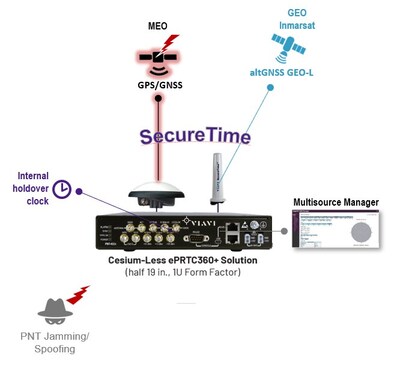
The international ITU-T G.8272.1 standard stipulates that Enhanced Primary Reference Time Clock (ePRTC) holdover must have short-term drift of less than 30 ns when entering into holdover and a long-term drift of less than 100 ns over 14 days, all traceable to UTC. Previously achieved only by Cesium atomic clocks, VIAVI's ePRTC360+ now also meets this standard.
"The Cesium-less ePRTC360+ exceeds leading-edge Cesium-level holdover performance and does this for significantly lower price. This enables deployment across the sync network, particularly at edge sites which were previously cost-prohibitive with Cesium holdover clocks," said Doug Russell, Senior Vice President and General Manager, Aerospace and Defense, VIAVI.
The ePRTC360+ has been successfully tested across a range of live-sky defense and commercial jamming/spoofing environments, and has been integrated into VIAVI's SecurePNT™ 6200 product series. The technology can maintain 100 ns accuracy during GNSS-denied threats through the resilient altGNSS GEO-L service with no time limit. It also combines an augmented VIAVI SecureTimeSM GEO anti-jamming antenna and an enhanced GNSS anti-spoofing antenna that also receive eGNSS GEO service with GPS/GNSS-NMA authentication for spoofing detection and mitigation.
Unlike conventional GNSS omni-directional signals, which can be drowned out by low-power interference, VIAVI's exclusive and GNSS-independent GEO-L service leverages encrypted and highly directional L-band signals transmitted from geostationary satellites. Coupled with the augmented VIAVI SecureTime GEO antenna, the altGNSS GEO-L service provides enhanced anti-jamming protection and a resilient timing reference for the ePRTC360+'s internal Rubidium holdover oscillator and enables smooth multi-orbit source switchover, even when primary GNSS frequencies are jammed, spoofed or subject to sophisticated meaconing attacks.
The affordability of ePRTC360+ clocks compared to Cesium clocks enable operators to deploy them beyond the core and across the network. They also complement non-RF Cesium clocks at the core. This boosts end-to-end sync network robustness and holdover reliability through meshed network PTP feeds as backup between the clocks, especially in case of local or regional jamming and/or spoofing threats.
In addition, the ePRTC360+ addresses constraints posed by the use of Cesium clocks for holdover timing. These include sensitivity to shock, delicate and multi-stage startup procedures that take days to complete, the need for ECCN 3A001.i licenses for export, long GNSS learning period of up to 40 days, as well as strict shipping and storage protocols. In addition, Cesium tubes need to be replaced approximately every seven years, and the dismantling and disposal of Cesium clocks are classified as a hazard due to their material content.
The ePRTC360+ eliminates these hurdles and has been designed for rapid and easy integration into any vendor's grandmaster clock system. It enables operators to meet stringent ePRTC requirements while reducing total cost of ownership.
The ePRTC360+ will be demonstrated for the first time at VIAVI's Stand 5B18 at Mobile World Congress (MWC)
About VIAVI
VIAVI (NASDAQ: VIAV) is a global leader in test and measurement and optical technologies. Our test, monitoring, assurance, and resilient position, navigation and timing solutions enable and secure critical infrastructure ranging from data center ecosystems and communication networks to military, aerospace, railway and first responder communications. In addition, we develop and advance technologies used in high-volume optical applications across anti-counterfeiting, consumer electronics, aerospace, industrial and automotive end markets.
Learn more about VIAVI at www.viavisolutions.com. Follow us on VIAVI Perspectives, LinkedIn and YouTube.
Media Inquiries:
Grand Bridges
Emma Jenkins
emma@grandbridges.com
+1 415 800 4529

 View original content to download multimedia:https://www.prnewswire.com/news-releases/viavi-launches-cesium-less-eprtc360-enhanced-primary-reference-time-clock-as-alternative-to-cesium-accuracy-holdover-clock-302688316.html
SOURCE VIAVI Solutions
FAQ
AI-generated questions and answers. How Rhea-AI works. Not financial advice.