
New Vontier Research: Payment Friction Is Costing Convenience Retailers
Vontier (NYSE: VNT) released national research on May 19, 2026, surveying 600+ U.S. convenience and fuel retailers about payment systems.




New national research shows unified payment environments drive faster feature rollouts, smoother upgrades and stronger customer engagement across the forecourt
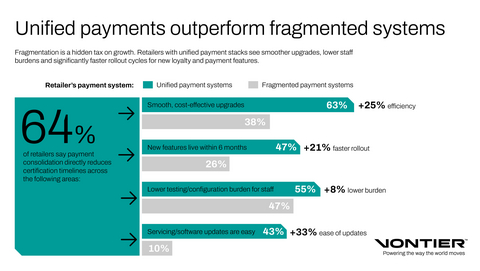
Fragmentation is a hidden tax, Vontier research finds. Retailers with unified payment stacks see smoother upgrades, lower staff burdens and significantly faster rollout cycles for new loyalty and payment features.
As the forecourt becomes a critical battleground for customer loyalty, Vontier's research reveals that payment architecture is now a direct lever for speed of new feature deployment and growth – not just a back-office concern.
Unified Operators Are Pulling Ahead
The data is clear. Operators running more unified payment ecosystems are:
-
More likely to describe upgrades as smooth and cost-effective (
63% vs.38% ) -
More likely to execute on new payment and loyalty initiatives within six months of a decision being made (
47% vs.26% ) -
Less likely to cite staff time for testing and configuration as a cost of certification and compliance (
47% vs.55% ) -
More likely to say servicing and software updates are easy (
43% vs.10% )
Improving the customer experience was the most common motivation for investing in a unified payment architecture – cited by almost half (
The Opportunity Is Significant
Today,
The result:
For operators running loyalty programs – one of the most powerful drivers of repeat visits and basket size – the cost of delay is especially high. Retailers with loyalty schemes are nearly three times more likely to report certification-related launch delays (
"Convenience retail is built on delivering elevated consumer experiences and unified payment systems can support these expectations by driving faster feature rollouts, smoother upgrades and stronger customer engagement," said Mark Morelli, President and CEO of Vontier. "When certification cycles stretch into months, operators aren't just delayed – they're missing opportunities to capture visits, build loyalty and grow revenue. Reducing fragmentation in the environment is how retailers get back to moving at the pace their customers expect."
Vontier: Built to Eliminate Complexity at Every Touchpoint
Vontier's convenience retail and mobility technologies, notably Invenco’s payment and forecourt solutions, are purpose-built to solve these challenges. By unifying payments, streamlining certification pathways and connecting loyalty across consumer touchpoints, operators are able to:
- Launch new payment and loyalty features faster with fewer certification hurdles
- Reduce multi-vendor coordination and downtime risk
- Deliver the contactless, mobile-first and loyalty-integrated experiences consumers increasingly expect
- Free up internal teams and site staff from configuration and testing burdens
With
About Vontier
Vontier (NYSE: VNT) is a global industrial technology company uniting productivity, automation and multi-energy technologies to meet the needs of a rapidly evolving, more connected mobility ecosystem. Leveraging leading market positions, decades of domain expertise and unparalleled portfolio breadth, Vontier powers the way the world moves – delivering smart, safe and sustainable solutions to our customers and the planet. Vontier has a culture of continuous improvement and innovation worldwide. Additional information about Vontier is available on the Company’s website at www.vontier.com.
View source version on businesswire.com: https://www.businesswire.com/news/home/20260519876276/en/
Media Contact:
Antenna Group for Vontier
vontier@antennagroup.com
Investor Contact:
Ryan Edelman, VP of Investor Relations
ryan.edelman@vontier.com
Source: Vontier Corporation