Starlab Space Announces LambdaVision as Latest Customer for its On-Orbit Science Park
Starlab Space Announces LambdaVision as Latest Customer for its On-Orbit Science Park
Starlab Space (OTC:VOYG) announced a reservation agreement with LambdaVision to support long-term, scalable microgravity production of protein-based artificial retinas.
Rhea-AI Sentiment reads the wording of the document, how positive or negative its language is on a 1 to 5 scale. The balance of points shown with the takes weighs what the document actually discloses, so the two can disagree, for example when a trial that missed its main goal is described in upbeat language.
LambdaVision will extend its research and production activities to Starlab as they advance toward space-based commercial manufacturing of protein-based artificial retinas.
HOUSTON--(BUSINESS WIRE)--
Starlab Space LLC, the commercial space station developer expanding access to low Earth orbit research, today announced a reservation agreement with LambdaVision, a biotechnology company developing a protein-based artificial retina designed to restore vision for patients with retinal degenerative diseases. The reservation agreement supports LambdaVision’s transition from research to long-term, scalable biomedical production in space and ensures its continued access to microgravity as the International Space Station approaches retirement.
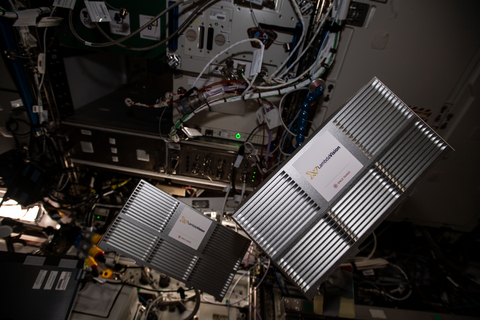
Space Tango and LambdaVision CubeLabs on the International Space Station, containing optimized and automated hardware for layer-by-layer deposition development of LambdaVision’s artificial retina in microgravity. LambdaVision will extend its research and production activities to Starlab as they advance toward space-based commercial manufacturing of protein-based artificial retinas.
LambdaVision’s layer-by-layer assembly process is improved in the low Earth orbit environment, where reduced gravity improves homogeneity, stability and performance of thin films like the protein-based artificial retina. The company has successfully validated its microgravity manufacturing method and plans to improve the quality and functionality of its protein-based artificial retina, while paving the way for novel innovations in other fields.
“Our agreement with Starlab is a critical step in ensuring continued access to low Earth orbit as we advance toward commercial manufacturing,” said Nicole Wagner, Ph.D., CEO of LambdaVision. “We are positioning our protein-based artificial retina and our layer-by-layer technology more broadly for long-term growth beyond the ISS. This approach not only supports our mission to help restore vision on Earth but also opens the door to new research and commercial opportunities by demonstrating that therapies can be produced in low Earth orbit at a commercial scale.”
While LambdaVision’s first application is restoring vision, its layer-by-layer protein manufacturing platform has broader potential. By producing highly uniform, stable protein films in microgravity, the company is advancing a new approach to precision biological manufacturing that could enable improved materials for sensitive biosensors, optical systems, drug delivery applications and tissue engineering.
“LambdaVision has demonstrated the maturity of the science, engineering, and in-space manufacturing processes required to produce retinal implants in microgravity,” said Luis Zea, Ph.D., chief scientist at Starlab. “Their reservation with Starlab enables the transition from demonstration to scalable, sustainable manufacturing, unlocking exponential growth while delivering meaningful benefits to patients on Earth. We are proud to work with LambdaVision to harness the unique advantages of microgravity to do good in the world.”
The announcement builds on Starlab’s growing capabilities in biopharmaceutical and life sciences research in orbit. Microgravity offers conditions that cannot be replicated on Earth, allowing for reduced sedimentation and improved material uniformity, which support higher consistency in protein-based structures and directly impact therapeutic quality, reproducibility and regulatory readiness.
Starlab’s market-driven business model is designed to reduce cost, complexity and risk for researchers and commercial partners. Its single-launch, no-assembly-required architecture enables full certification and operational readiness within weeks from launch, minimizing delays and maximizing efficiency for payload customers. Through its joint venture partners, customers can conduct research aboard the International Space Station today, ensuring a seamless transition to Starlab as its next-generation capabilities come online.
About Starlab
Starlab Space is a U.S.-led, global joint venture among Voyager Technologies (NYSE: VOYG), Airbus, Mitsubishi Corporation, MDA Space, Palantir Technologies, and Space Applications Services, with strategic partners including Hilton, Journey, Northrop Grumman, and The Ohio State University. Starlab is developing a next-generation, AI-enabled commercial space station, aiming to ensure continued human presence in low-Earth orbit and a seamless transition of microgravity science and research alongside the retirement of the International Space Station. Starlab's advanced, user-driven design and robust capabilities make it a premier platform for scientific discovery and technological advancement in space. For more information, visit starlab-space.com.
About LambdaVision
LambdaVision is leveraging space to develop a protein-based artificial retina to restore meaningful vision for the millions of patients blinded by retinal degenerative diseases, including retinitis pigmentosa (RP) and age-related macular degeneration (AMD). The patent-protected artificial retina technology developed by LambdaVision uses photoactive proteins to naturally mimic the light-absorbing properties of human photoreceptor cells and activate neuroreceptors still present in degenerated retinas of blind patients. LambdaVision’s artificial retina is one of the first technologies being evaluated on the International Space Station that has potential for clinical use, and the established microgravity manufacturing processes, quality control methods, and laboratory techniques provide a foundation for future clinical research in space. To learn more, visit lambdavision.com.
Microgravity is a condition where objects experience almost no net weight because they are in continuous free-fall, such as aboard orbiting spacecraft; think of passengers feeling weightless in a smoothly falling elevator. For investors, microgravity matters because it enables scientific experiments and manufacturing processes that behave very differently than on Earth, potentially creating novel drugs, materials, or technologies, changing development timelines, costs, market opportunities and regulatory considerations.
low Earth orbittechnical
Low Earth orbit (LEO) is the region of space close to Earth, roughly from about 160 to 2,000 kilometers above the surface, where satellites and spacecraft circle the planet quickly—think of it as a busy highway just overhead. It matters to investors because many communications, imaging and data services rely on satellites in LEO; their shorter lifespans, lower launch costs, crowded lanes and debris risks directly affect the cost, revenue potential and operational risks of companies that build, launch or use these satellites.
retinal degenerative diseasesmedical
Retinal degenerative diseases are a group of conditions in which the light-sensing cells at the back of the eye progressively break down, causing worsening vision or blindness; think of it like gradual wear-and-tear on a camera sensor. They matter to investors because they represent a large unmet medical need with clear patient populations, long development cycles, and the potential for transformative treatments or diagnostic tools that can significantly affect a company’s market value and regulatory risk.
biopharmaceuticalmedical
A biopharmaceutical is a medicine made from living organisms or their components—such as proteins, cells or genetic material—rather than chemically synthesized compounds. For investors, these products can command high prices and long patent protection but also carry bigger development, manufacturing and regulatory risks; think of them like handcrafted, high-tech products that can generate strong returns if they work, but are costly and complex to produce.
biosensorstechnical
Biosensors are devices that use a biological element (like an enzyme or antibody) combined with a detector to identify and measure molecules such as glucose, pathogens or biomarkers. Think of them as a smoke detector for specific chemicals or biological signals; they turn a biological reaction into a readable signal. Investors care because biosensors can drive recurring revenue from diagnostics, monitoring and wearable health devices, and their commercial value depends on accuracy, manufacturing scale and regulatory approval.
drug deliverymedical
Drug delivery is how a medicine is packaged, moved and released inside the body so it reaches the right place at the right time and dose. Think of it like a shipping and packaging system that affects a product’s effectiveness, side effects and convenience; better delivery can make a drug work longer, be safer, or be easier to use. Investors care because delivery methods influence a therapy’s market value, regulatory approval, manufacturing costs and competitive advantage.
tissue engineeringmedical
Tissue engineering is the lab-based process of growing or assembling living cells on supportive frameworks and using biochemical cues to create or repair body tissues, like building replacement parts from living materials. For investors, it matters because successful products can create entirely new markets for treating injuries and chronic diseases, but they also carry long development timelines, high manufacturing costs, and regulatory risk that affect potential returns.
protein-based artificial retinamedical
A protein-based artificial retina is a bioengineered implant or therapy that uses light-sensitive proteins to mimic the eye’s photoreceptor cells and send visual signals to the brain. Think of it as swapping a damaged camera sensor with a living, protein-powered one; for investors it matters because it targets a large market for vision restoration but carries technical, manufacturing and regulatory risks that affect development time, costs and commercial potential.