
Independent University of South Florida study shows Verra Mobility school zone speed safety programs reduced speeding violations by 97%
Verra Mobility (NASDAQ: VRRM) reported findings from an independent University of South Florida CUTR study, funded by the Florida Department of Transportation, on its school zone speed safety programs in St.
Sentiment and the balance of points
Rhea-AI Sentiment reads the wording of the document, how positive or negative its language is on a 1 to 5 scale. The balance of points shown with the takes weighs what the document actually discloses, so the two can disagree, for example when a trial that missed its main goal is described in upbeat language.
Rhea-AI Summary
Verra Mobility (NASDAQ: VRRM) reported findings from an independent University of South Florida CUTR study, funded by the Florida Department of Transportation, on its school zone speed safety programs in St. Cloud and Osceola County, Florida.
Across 18 school zone cameras, speeding violations fell from 3.47% of passing vehicles to 0.09%, a 97% reduction. During the 30‑day warning period, violations declined by 93%, showing awareness alone strongly influenced driver behavior. The study also found severe speeding (16+ mph over the limit) decreased from 74% to 45%, with some locations exceeding 95% reductions and one site dropping from 80% high-speeding to zero.
Details
News Market Reaction – VRRM
On Aug 18, the day this news came out, VRRM closed 3.15% below the previous close. Our momentum scanner recorded 9 alerts in the available session data.
Data tracked by StockTitan Argus for the Aug 18 session.
Key Figures
- Speeding violations reduction
- 97%
- Participating Florida school zones
- School zone speed cameras
- 18 cameras
- Study sample
- Violation rate
- 3.47% to 0.09%
- Before camera activation versus citation enforcement
- Warning-period reduction
- 93%
- Violations reduced before citations were issued
- Severe speeding threshold
- 16+ mph
- Over the speed limit
- Severe speeding rate
- 74% to 45%
- Before the program versus citation period
- BridgePrep high-speeding rate
- 80%
- Before the program began
- BridgePrep high-speeding rate
- zero
- During warning and citation periods
Historical Context
-
Earnings included a net loss, less favorable contracts, and revised full-year guidance.
-
National safety campaign cited reductions in red-light violations and traffic fatalities.
-
Seven-year agreement extended the relationship but carried materially less favorable financial terms.
-
The company scheduled second-quarter results and an investor conference call for August 5.
-
Leadership appointments and organizational changes targeted execution and customer focus improvements.
24h Move is the share-price change in the day after each event; other market factors may also have contributed.
Key Terms
automated enforcement technical
speed detection systems regulatory
AI-generated analysis. How Rhea-AI works. Not financial advice.




Research demonstrates automated enforcement changes driver behavior and significantly improves school zone safety
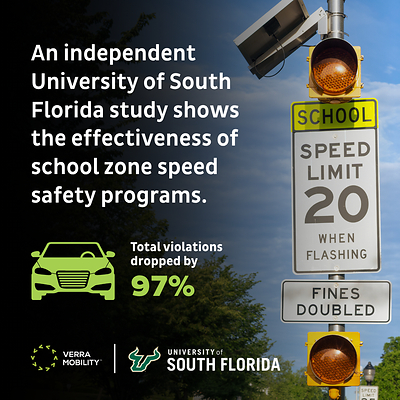
The research was funded by the Florida Department of Transportation (FDOT) and evaluated Verra Mobility-operated school zone speed safety programs in the
The study analyzed vehicle speeds before camera activation, during
The study further found that severe speeding (16+ mph or more over the speed limit) declined from
"Independent research continues to validate what communities across the country are experiencing firsthand. Automated school zone speed enforcement changes driver behavior and helps create safer environments for children," said Stacey Moser, chief customer officer, Verra Mobility. "A
The research was conducted by the University of
"By conducting before-and-after studies and documenting implementation experiences, researchers provided objective evidence of how this technology influences driver behavior and safety outcomes," said Dr. Pei-Sung Lin, director of the Intelligent Transportation Systems, Traffic Operations, and Safety Program at the University of South Florida CUTR. ". This allows municipalities to move beyond theoretical discussions and generate practical, evidence-based insights that help communities make informed decisions about technology investments."
The study also found that the greatest changes occurred during the warning period, reinforcing the importance of public education and awareness alongside enforcement. Researchers concluded that drivers consistently slowed when enforcement was present and suggested that these behavioral changes could contribute to safer driving beyond camera locations.
To download the complete Florida School Zone Speed Safety case study and learn more about Verra Mobility's automated school zone safety solutions, visit www.verramobility.com/government.
About Verra Mobility
Verra Mobility Corporation (NASDAQ: VRRM) is a leading provider of smart mobility technology solutions that make transportation safer, smarter and more connected. The company sits at the center of the mobility ecosystem, bringing together vehicles, hardware, software, data and people to enable safe, efficient solutions for customers globally. Verra Mobility's transportation safety systems and parking management solutions protect lives, improve urban and motorway mobility and support healthier communities. The company also solves complex payment, utilization and compliance challenges for fleet owners and rental car companies. Headquartered in
Forward Looking Statements
We describe many of the trends and other factors that drive our business and future results in this press release. Such discussions contain forward-looking statements within the meaning of Section 21E of the Securities Exchange Act of 1934, as amended (the "Exchange Act"). Forward-looking statements are those that address activities, events, or developments that management intends, expects, projects, believes or anticipates will or may occur in the future. They are based on management's assumptions and assessments in light of past experience and trends, current economic and industry conditions, expected future developments and other relevant factors. They are not guarantees of future performance, and actual results, developments and business decisions may differ significantly from those envisaged by our forward-looking statements. We do not undertake to update or revise any of our forward-looking statements, except as required by applicable securities law. Our forward-looking statements are also subject to material risks and uncertainties that can affect our performance in both the near-and long-term. In addition, no assurance can be given that any plan, initiative, projection, goal, commitment, expectation, or prospect set forth in this press release can or will be achieved. These forward-looking statements should be considered in light of the information included in this press release, our Form 10-K and other filings with the Securities and Exchange Commission. Any forward-looking plans described herein are not final and may be modified or abandoned at any time.
Additional Information
We periodically provide information for investors on our corporate website, www.verramobility.com, and our investor relations website, ir.verramobility.com.
We intend to use our website as a means of disclosing material non-public information and for complying with disclosure obligations under Regulation FD. Accordingly, investors should monitor our website, in addition to following the Company's press releases, SEC filings and public conference calls and webcasts.
Media Relations: | Investor Relations: |
Valerie Schneider | Mark Zindler |

 View original content to download multimedia:https://www.prnewswire.com/news-releases/independent-university-of-south-florida-study-shows-verra-mobility-school-zone-speed-safety-programs-reduced-speeding-violations-by-97-302853631.html
SOURCE Verra Mobility
FAQ
AI-generated questions and answers. How Rhea-AI works. Not financial advice.