
Eco Wave Power Reports Increased Power Output During Stronger Wave Conditions at Jaffa Port, Israel
Eco Wave Power (NASDAQ: WAVE) reported April and May 2026 production results from its grid-connected EWP-EDF One wave energy station at Jaffa Port, Israel, showing higher electricity generation and peak power during stronger wave conditions.
Sentiment and the balance of points
Rhea-AI Sentiment reads the wording of the document, how positive or negative its language is on a 1 to 5 scale. The balance of points shown with the takes weighs what the document actually discloses, so the two can disagree, for example when a trial that missed its main goal is described in upbeat language.
Rhea-AI Summary
Eco Wave Power (NASDAQ: WAVE) reported April and May 2026 production results from its grid-connected EWP-EDF One wave energy station at Jaffa Port, Israel, showing higher electricity generation and peak power during stronger wave conditions. In April, waves of approximately 1–1.5 meters produced about 461 kWh, with 26.2 kW peak power. In May, waves of roughly 1–2 meters generated about 1,004 kWh, with peak power of 39.1 kW and average power of 10.45 kW during relevant periods. Earlier, in February 2026, waves around 3 meters enabled peak power of about 54 kW. The station exports most output to Israel’s grid under a PPA with Israel Electric Corporation and has recorded zero downtime attributable to the Eco Wave Power system since early 2025. The pilot-scale project provides operational data to support larger, AI-enabled commercial deployments.
Positive
- May 2026 wave conditions: about 1,004 kWh generated, peak power 39.1 kW, average 10.45 kW
- April vs. May 2026: electricity generation during relevant wave conditions more than doubled from about 461 kWh to 1,004 kWh
- High-energy waves in February 2026: peak power approximately 54 kW at around 3-meter waves
- Zero system-attributable downtime at Jaffa Port since the beginning of 2025
- Grid revenue pathway: most electricity sold under a Power Purchase Agreement with Israel Electric Corporation
- Pilot delivers operational dataset supporting AI, predictive analytics and digital twin development for future projects
Negative
- The EWP-EDF One installation is a pilot-scale array with a limited number of small floaters, not yet a full commercial-scale project
Details
News Market Reaction – WAVE
On Aug 17, the day this news came out, WAVE closed 2.52% below the previous close.
Data tracked by StockTitan Argus for the Aug 17 session.
Key Figures
- May peak power
- 39.1 kW
- May 2026 Jaffa Port operating periods
- April electricity generated
- 461 kWh
- April 2026 during 1-1.5 meter wave conditions
- April peak power
- 26.2 kW
- April 2026 Jaffa Port operating periods
- May electricity generated
- 1,004 kWh
- May 2026 during 1-2 meter wave conditions
- May average power
- 10.45 kW
- May 2026 relevant operating periods
- February average power
- 20 kW
- February 2026 when wave heights reached approximately 3 meters
- February peak power
- 54 kW
- February 2026 Jaffa Port system
- System downtime
- Zero downtime
- Since the beginning of 2025 attributable to the Eco Wave Power system
Historical Context
-
Breakwater rehabilitation began for planned 1 MW Portugal installation.
-
Loss and expenses declined while cash increased and financing closed.
-
Israeli agencies launched NIS 6 million marine energy investment initiative.
-
California report highlighted WAVE's Port of Los Angeles pilot.
-
Company closed $4.0 million financing priced above prior market close.
24h Move is the share-price change in the day after each event; other market factors may also have contributed.
Key Terms
grid-connected technical
power purchase agreement regulatory
digital twin technical
predictive maintenance technical
AI-generated analysis. How Rhea-AI works. Not financial advice.




May Peak Power Reaches 39.1 kW as Grid-Connected Wave Energy Station Continues to Demonstrate Strong Reliability
Tel Aviv, Israel--(Newsfile Corp. - August 17, 2026) - Eco Wave Power Global AB (publ) (NASDAQ: WAVE) ("Eco Wave Power" or the "Company"), a leading onshore wave energy technology company, today announced April and May 2026 production results from its grid-connected EWP-EDF One wave energy power station at Jaffa Port, Israel, demonstrating increased electricity generation and higher peak power output during stronger wave conditions.
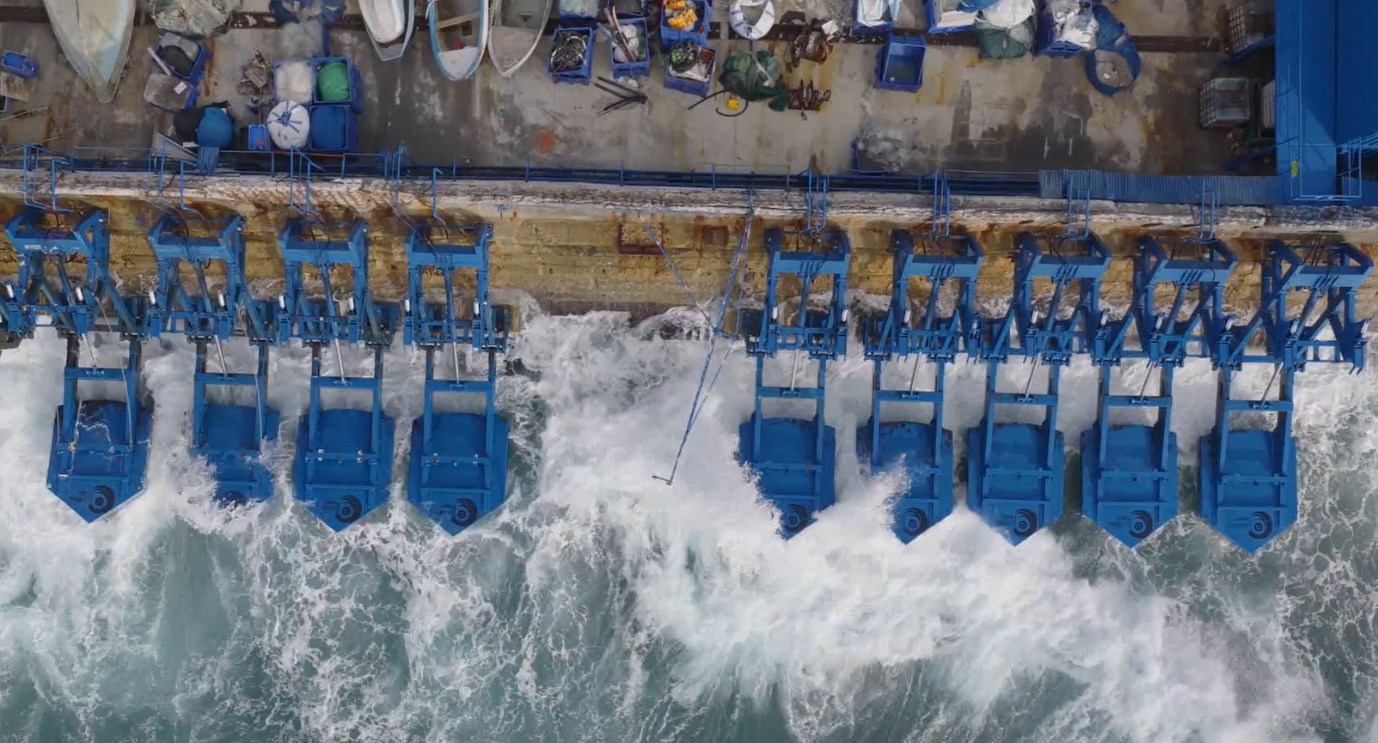
Eco Wave Power Jaffa Port Pilot Power Station
To view an enhanced version of this graphic, please visit:
https://images.newsfilecorp.com/files/11247/309879_387a074dc4599a7b_001full.jpg
For its monthly production reporting, Eco Wave Power focuses on periods in which wave heights exceed approximately 1 meter, as these conditions are considered particularly relevant to the performance parameters expected at the Company's planned commercial-scale projects.
During April 2026, Jaffa Port experienced three days with wave heights ranging between approximately 1 and 1.5 meters. During these wave conditions, the power station generated approximately 461 kWh of clean electricity, with peak power production reaching 26.2 kW.
During May 2026, the site experienced four days with wave heights ranging between approximately 1 and 2 meters. During these conditions, the power station generated approximately 1,004 kWh of clean electricity-more than double the electricity generated during the comparable wave conditions reported for April. Peak power production reached 39.1 kW, while the station achieved an average power output of approximately 10.45 kW during the relevant operating periods.
Most of the electricity generated by the project is exported directly into Israel's national electricity grid under a Power Purchase Agreement with the Israel Electric Corporation ("IEC"), while a portion is used for on-site self-consumption.
Higher Wave Conditions Demonstrate Increased Power Potential
The April and May results add to the growing body of real-world operational data generated by Eco Wave Power's grid-connected technology under different sea conditions.
In February 2026, when wave heights reached approximately 3 meters, the Jaffa Port system achieved an average power output of approximately 20 kW, with peak power production reaching approximately 54 kW.
The results recorded to date demonstrate a progression in peak power output during increasingly energetic wave conditions:
April: waves of approximately 1-1.5 meters - peak power of 26.2 kW
May: waves of approximately 1-2 meters - peak power of 39.1 kW
February: waves reaching approximately 3 meters - peak power of approximately 54 kW
The Company believes this growing dataset provides valuable insight into the relationship between wave conditions and electricity production and supports continued optimization of the technology ahead of larger commercial deployments.
Continued Operational Reliability
Since the beginning of 2025, the Jaffa Port power station has maintained zero downtime attributable to the Eco Wave Power system, continuing to demonstrate the reliability of the Company's onshore wave energy technology.
Eco Wave Power's technology is designed so that the majority of the energy conversion equipment is installed on existing coastal infrastructure, while only the floaters interact directly with the waves. The Company believes this approach can provide advantages in accessibility, maintenance and scalability compared with technologies that locate the majority of their equipment offshore.
Pilot-Scale Validation Supporting Commercial Deployment
The EWP-EDF One project at Jaffa Port is a pilot-scale demonstration array, consisting of a limited number of small-scale floaters. The project is designed primarily to validate continuous operation, system durability and real-world energy production performance, while generating high-quality operational data to support future commercial-scale deployments.
The performance data collected to date further supports the Company's ongoing evaluation of the scalability of Eco Wave Power's proprietary technology. Future commercial projects are expected to utilize significantly larger floaters and a substantially greater number of units, configurations designed to increase energy capture and deliver a more powerful and stable production profile compared with the current pilot-scale installation.
Using Real-World Data to Advance AI-Enabled Wave Energy
Eco Wave Power is utilizing the growing operational dataset generated at Jaffa Port to further optimize its technology and support the development of larger commercial installations.
The Company is working on the integration of artificial intelligence, predictive analytics and digital twin technologies into its wave energy platform, with the goal of optimizing electricity production, improving predictive maintenance and enabling increasingly intelligent management of future commercial wave energy installations.
The Company believes the combination of real-world operating data and AI-driven optimization can become particularly valuable as Eco Wave Power advances from pilot-scale installations toward projects with significantly larger installed capacities.
Inna Braverman, Founder and Chief Executive Officer of Eco Wave Power, commented:
"We specifically analyze wave conditions above approximately one meter because these are particularly relevant to the commercial projects we are pursuing around the world. Every month of operation gives us additional real-world information that can be incorporated into our AI models, digital twins and predictive maintenance systems as we optimize the technology for larger commercial installations."
About Eco Wave Power Global AB (publ)
Eco Wave Power Global (NASDAQ: WAVE) is a pioneering onshore wave energy company that converts ocean and sea waves into clean, reliable and cost-efficient electricity using its patented technology.
By generating renewable power from existing coastal infrastructure such as breakwaters, jetties and piers, Eco Wave Power enables sustainable electricity production in close proximity to coastal cities, ports and energy-intensive infrastructure.
As global electricity demand continues to increase, driven in part by the rapid expansion of artificial intelligence, data centers and digital infrastructure, Eco Wave Power is positioning its technology as a scalable coastal renewable energy solution capable of contributing to next-generation power requirements.
Eco Wave Power developed and operates Israel's first grid-connected wave energy power station, recognized as a "Pioneering Technology" by the Israeli Ministry of Energy and co-funded by EDF Renewables IL.
In the United States, the Company has deployed its wave energy technology at the Port of Los Angeles, in collaboration with Shell Marine Renewable Energy.
Eco Wave Power is advancing additional projects internationally, including in Portugal, Taiwan and India.
The Company has received international recognition and support from organizations including the European Union Regional Development Fund, Innovate UK and the EU Horizon 2020 program, and was honored with the United Nations Global Climate Action Award.
Eco Wave Power's American Depositary Shares (ADSs) are traded on the Nasdaq Capital Market under the ticker symbol "WAVE."
Note: Information available on or through the websites mentioned herein does not form part of this press release.
Forward-Looking Statements
This press release contains forward-looking statements within the meaning of the "safe harbor" provisions of the U.S. Private Securities Litigation Reform Act of 1995 and other Federal securities laws. For example, the Company (NASDAQ: WAVE) is using forward-looking statements in this press release when it discusses the belief that the growing dataset provides insight into the relationship between wave conditions and electricity production and supports continued optimization of the technology ahead of larger commercial deployments; the view that its onshore technology can provide advantages in accessibility, maintenance and scalability compared with technologies that locate the majority of their equipment offshore; expectations that future commercial projects will utilize significantly larger floaters and a substantially greater number of units designed to increase energy capture and deliver a more powerful and stable production profile compared with the current pilot-scale installation; the Company's work on integrating artificial intelligence, predictive analytics and digital twin technologies into its wave energy platform with the goal of optimizing electricity production, improving predictive maintenance and enabling increasingly intelligent management of future commercial installations; and the belief that the combination of real-world operating data and AI-driven optimization can become particularly valuable as the Company advances from pilot-scale installations toward projects with significantly larger installed capacities. Forward-looking statements can be identified by words such as: "anticipate," "intend," "plan," "goal," "seek," "believe," "project," "estimate," "expect," "strategy," "future," "likely," "may," "should," "will", or variations of such words, and similar references to future periods. These forward-looking statements and their implications are neither historical facts nor assurances of future performance and are based on the current expectations of the management of Eco Wave Power and are subject to a number of factors, uncertainties and changes in circumstances that are difficult to predict and may be outside of Eco Wave Power's control that could cause actual results to differ materially from those described in the forward-looking statements. Therefore, you should not rely on any of these forward-looking statements. Except as otherwise required by law, Eco Wave Power undertakes no obligation to publicly release any revisions to these forward-looking statements to reflect events or circumstances after the date hereof or to reflect the occurrence of unanticipated events. More detailed information about the risks and uncertainties affecting Eco Wave Power is contained under the heading "Risk Factors" in Eco Wave Power's Annual Report on Form 20-F for the fiscal year ended December 31, 2025 filed with the SEC on March 12, 2026, which is available on the SEC's website, www.sec.gov, and other documents filed or furnished to the SEC. Any forward-looking statement made in this press release speaks only as of the date hereof. References and links to websites have been provided as a convenience and the information contained on such websites is not incorporated by reference into this press release.
To view the source version of this press release, please visit https://www.newsfilecorp.com/release/309879
FAQ
AI-generated questions and answers. How Rhea-AI works. Not financial advice.