
Western Gold Completes Drilling at First Target and Reports High Grade Surface Sampling Results for Caledonian Gold Project
Western Gold completes first drilling at Coire a'Ghabhalach and reports multiple high-grade surface polymetallic gold intervals ahead of October assay results.
Sentiment and the balance of points
Rhea-AI Sentiment reads the wording of the document, how positive or negative its language is on a 1 to 5 scale. The balance of points shown with the takes weighs what the document actually discloses, so the two can disagree, for example when a trial that missed its main goal is described in upbeat language.
Rhea-AI Summary
Western Gold Exploration (WGELF) has completed drilling of four diamond drill holes totalling 667 m at the Coire a'Ghabhalach (CaG) vein, the first target in its maiden drilling campaign at the Caledonian Gold Project in Scotland.
CaG was defined through systematic channel, backpack drill and soil sampling, which returned multiple high-grade polymetallic gold intervals, including 1.4 m at 9.94 g/t Au with 1.25% Zn and 1.61% Pb, 1.8 m at 7.53 g/t Au with 1.50% Zn and 1.03% Pb, and 1.0 m at 12.95 g/t Au with associated zinc and lead. Channel sampling included 2.5 m at 5.18 g/t Au, with a 0.6 m sub-interval grading 16.70 g/t Au. Veining and alteration have been traced over at least 180 m of strike, with all intercepts remaining open at depth and along strike. Assay results from the completed drilling are expected in October 2026, and drilling has now commenced at the second target, Creag Sheileach, within the Glen Lyon joint venture (90% Western Gold, 10% Acrux Gold).
Positive
- 4 diamond drill holes completed for a total of 667 m at CaG
- Backpack drilling intercept of 1.0 m at 12.95 g/t Au (CGSD7)
- Backpack drilling intercept of 1.4 m at 9.94 g/t Au with zinc and lead (CGSD6)
- Channel sample of 2.5 m at 5.18 g/t Au, including 0.6 m at 16.70 g/t Au (CGCS1)
- Veining and alteration traced over at least 180 m of strike, open along strike and at depth
- Assay results from drilling expected in October 2026, providing a near-term catalyst
Negative
- All reported sampling intervals may not represent true vein widths where vein orientation is unconstrained
- Assay results for the completed CaG drill holes are not yet available, limiting current resource visibility
- Historical assay results cited for comparison have incomplete QA/QC and have not been consistently checked against certificates
- Mineralisation on adjacent properties is stated as not necessarily indicative of what may be found on the Caledonian Gold Project
News Explained
Western Gold reports that the CaG surface and backpack-drill intervals are length-weighted samples rather than reported diamond-drill results, and says true widths have not been determined in all cases; the completed holes therefore still await the subsurface assay evidence expected in
AI-generated analysis. How Rhea-AI works. Not financial advice.




North Berwick, Scotland--(Newsfile Corp. - September 9, 2026) - WESTERN GOLD EXPLORATION LTD. (TSXV: WGLD) (the "Company") is pleased to announce that drilling has been completed at Coire a'Ghabhalach vein ("CaG"), the first target of its maiden drilling campaign at the Caledonian Gold Project (see Press Release dated 29 June 2026). CaG was defined as a strong drill target through a programme of channel sampling, backpack drilling, and soil sampling, the results of which are disclosed below.
The Caledonian Gold Project ("CGP") is held through the Glen Lyon Joint Venture (the "JV") between the Company, which holds a
"The high-grade gold intervals emerging from surface sampling are exactly what we had hoped to see and give us real confidence in the targeting work that's gone into this programme," commented Harry Dobson, Chairman. "We look forward to reporting drill results as they become available."
Highlights:
Drilling of 4 holes for a total of 667m has been completed at CaG, targeting gold anomalies identified from channel, backpack drill and soil sampling (Figure 1 below).
Veining at CaG exhibit characteristics analogous to mineralisation at the nearby Cononish mine*
Assay results for CaG are expected in October 2026. Drilling is now underway at the second target, Creag Sheileach.
Polymetallic mineralisation identified in channel and backpack drill sampling*1:
1.4m @ 9.94 g/t Au,
1.25% Zn,1.61% Pb (backpack drill hole CGSD-6)1.8m @ 7.53 g/t Au,
1.50% Zn,1.03% Pb (backpack drill hole CGSD-9)1m @ 12.95 g/t Au,
0.78% Zn,0.43% Pb (backpack drill hole CGSD-7)2.5m @ 5.18 g/t Au,
0.34% Pb (channel CGCS-1)1.1m @ 7.01 g/t Au,
0.20% Zn,1.19% Pb (backpack drill hole CGSD-8)
Sample locations and full assay results are disclosed in Figure 1 and Table 1 below.
- Systematic channel, backpack drill and soil sampling de-risked drill targeting by constraining vein width, grade continuity, and structural orientation.
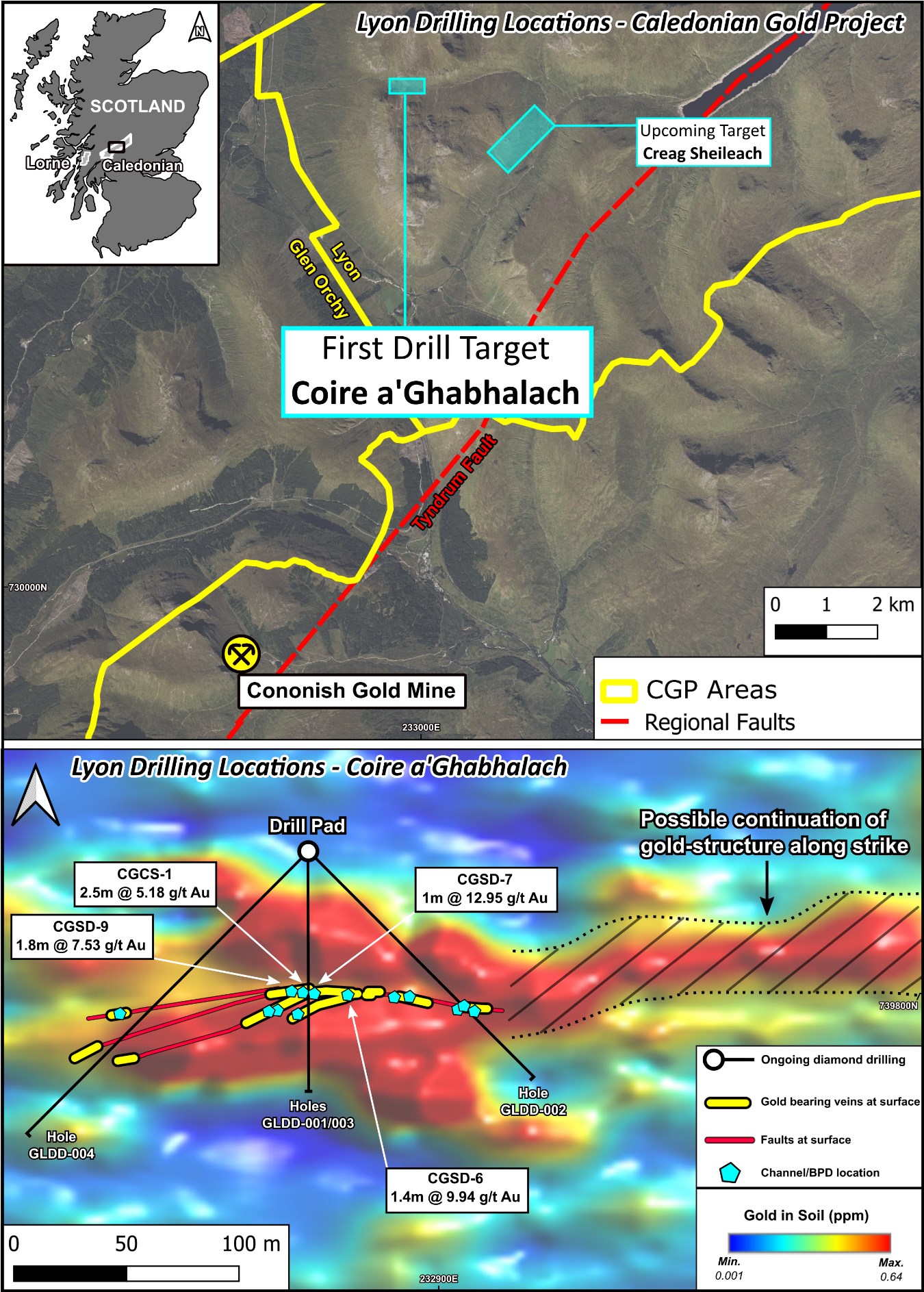
Figure 1. Top – Aerial imagery of the Lyon and Glen Orchy areas, showing planned drill collar locations within the Lyon Option application relative to the Cononish gold and silver mine. Bottom – Gold-in-soil heat map (Inverse Distance Weighted) at CaG, overlain with recently completed diamond drill hole locations (GLDD-01/02/03/04, 'Glen Lyon Diamond Drillhole') and newly reported channel and backpack drill sample locations. Soil data indicate a possible continuation of the CaG gold structure along strike.
To view an enhanced version of this graphic, please visit:
https://images.newsfilecorp.com/files/9801/313558_9f9fc420343728d5_002full.jpg
Geological Overview
The Caledonian Gold Project is situated within the highly prospective Grampian Terrane, a key segment of the Caledonian mineral belt that stretches from Northern Britain and Ireland to Scandinavia and North America. This district is already proven for gold, hosting deposits such as Cononish, which sits directly along strike to the Lyon area as well as Cavanacaw and the significant Curraghinalt deposit (Dalradian Resources; Measured, Indicated and Inferred Resources > 6 Moz Au – 43-101 Technical Report for the Curraghinalt Gold Project, Northern Ireland dated June 22, 2018 by SRK Consulting (Canada) Inc.).
The reader is cautioned that mineralisation on adjacent properties is not necessarily indicative of what can or will be found within any projects upon which the JV may be granted exploration options.
Coire a'Ghabhalach
Coire a'Ghabhalach hosts a structurally complex zone of polymetallic gold mineralisation characterised by multi-generational grey to blue-grey quartz-sulphide veins, sericite-chlorite alteration of adjacent wallrocks, and semi-massive pyrite, galena and sphalerite. Several intervals returned %-level lead and zinc alongside significant gold and silver values, including 1.40m @ 9.94 g/t Au,
Appendix
Table 1. Full Assay Results - Channel Sampling and Backpack Drilling.
| Type | Prospect | Sample ID | Easting | Northing | From (m) | To (m) | Interval (m) | Au (g/t) | Au g·m | Ag (g/t) |
| DH | Coire a'Ghabhalach | CGSD6 | 232857 | 739799 | 0.00 | 1.40 | 1.40 | 9.94 | 13.92 | 37.6 |
| DH | Coire a'Ghabhalach | CGSD9 | 232835 | 739801 | 0.00 | 1.80 | 1.80 | 7.53 | 13.55 | 28.1 |
| CS | Coire a'Ghabhalach | CGCS1 | 232838 | 739800 | 0.50 | 3.00 | 2.50 | 5.18 | 12.95 | 31.9 |
| DH | Coire a'Ghabhalach | CGSD7 | 232840 | 739799 | 0.60 | 1.60 | 1.00 | 12.95 | 12.95 | 23.1 |
| DH | Coire a'Ghabhalach | CGSD8 | 232838 | 739800 | 0.00 | 1.10 | 1.10 | 7.01 | 7.71 | 31.8 |
| CS | Coire a'Ghabhalach | CGCS2 | 232835 | 739790 | 0.00 | 2.10 | 2.10 | 3.60 | 7.56 | 7.7 |
| DH | Coire a'Ghabhalach | CGSD4 | 232885 | 739799 | 0.00 | 1.10 | 1.10 | 1.96 | 2.16 | 1.6 |
| CS | Coire a'Ghabhalach | CGCS3 | 232825 | 739800 | 0.00 | 1.20 | 1.20 | 1.49 | 1.78 | 3.4 |
| DH | Coire a'Ghabhalach | CGSD5 | 232876 | 739798 | 0.00 | 1.00 | 1.00 | 1.68 | 1.68 | 27.9 |
| DH | Coire a'Ghabhalach | CGSD2 | 232905 | 739793 | 0.00 | 0.80 | 0.80 | 1.15 | 0.92 | 8.4 |
| CS | Coire a'Ghabhalach | CGCS4 | 232824 | 739792 | 0.00 | 0.80 | 0.80 | 1.05 | 0.84 | 3.8 |
| DH | Coire a'Ghabhalach | CGSD1 | 232912 | 739792 | 0.60 | 1.60 | 1.00 | 0.59 | 0.59 | 1.7 |
| CS | Coire a'Ghabhalach | CGCS5 | 232823 | 739792 | 0.00 | 0.50 | 0.50 | 1.08 | 0.54 | 5.1 |
CS = saw channel sample; DH = backpack drill hole (short orientation hole). Coordinates given in British National Grid (OSGB36), representing channel/collar location. All intervals represent length-weighted averages calculated using a 0.5 g/t Au cut-off and minimum internal dilution threshold of 0.01 g/t Au. Au g·m = gram-metres (Au grade × interval length).
About Western Gold Exploration
The Company is a mineral exploration company that is listed on the TSX Venture Exchange under the symbol "WGLD". The Company is focused on the exploration of gold, silver and critical minerals in Scotland.
In November 2025, WGLD formed the Glen Lyon Joint Venture (the "JV") with Acrux Gold Limited to explore for gold, silver, and critical minerals as part of the Caledonian Gold Project in central Scotland. The JV has applied for two Crown Estates Mines Royal Option Agreements (i.e., exploration licences) across the Tyndrum Mineral District, specifically the Glen Orchy and Lyon areas, which form the Caledonian Gold Project. The Company also operates at the Lorne Project, which includes both Lagalochan and Ardlochan prospects, and are located in the highly prospective Lorne Porphyry District of the wider Caledonian belt.
For further information, please contact:
Ross McLellan, CEO
Phone: +44 7779 161441
Email: info@westerngoldexploration.com
Website: www.westerngoldexploration.com
Review by Qualified Person, Quality Control and Reports
David Pym (CGeol), a consultant of the Company, is the Qualified Person (as defined by National Instrument 43-101) who supervised, verified and approved the scientific and technical disclosure in this press release on behalf of the Company. The results presented in this press release are from the Company's own sampling and provide an important validation of historical assays quoted in previous press releases. Historical assay results have not been checked consistently against assay certificates, nor is there significant QAQC information available.
Sampling Methods*1: Channel samples were collected by cutting a continuous channel of uniform width and depth across the exposed vein face and are considered broadly representative of true vein width over the sampled interval. Diamond backpack drill samples are considered analogous to channel samples in terms of representativeness. All intervals represent length-weighted averages calculated using a 0.5 g/t Au cut-off and a minimum internal dilution threshold of 0.01 g/t Au over 1 metre. True widths have not been determined in all cases and reported intervals may not represent true vein widths where vein orientation relative to sample orientation has not been fully constrained.
Each sample was crushed, split, and pulverised prior to analysis. Multi-element geochemistry (48 elements, including silver and base metals) was determined using a four-acid digestion followed by ICP-MS analysis (method ME-MS61L). Gold was assayed using a 30 g fire assay with an ICP-MS finish, providing a detection limit of 0.005 ppm (Au-AA23).
All analytical work was undertaken by ALS Global, Ireland. ALS Geochemistry laboratories operate under a unified Global Geochemistry Quality Manual in accordance with ISO/IEC 17025:2017 and use a global laboratory information management system (LIMS) to ensure consistent, high-quality, and reproducible analytical results.
CAUTIONARY STATEMENT REGARDING FORWARD-LOOKING STATEMENTS: This news release includes certain "forward-looking statements" under applicable Canadian securities legislation. Forward-looking statements include, but are not limited to, statements with respect to timing and receipt of the Crown Estates Mines Royal Option Agreements (i.e., exploration licences) applied for by the JV, timing and completion of any drilling and work programs on the properties of the Company and the proposed properties of the JV, estimates of mineralisation from drilling and sampling, geological information projected from drilling and sample results, potential for minerals and/or mineral resources, and statements regarding the plans, intentions, beliefs, and current expectations of the Company and the JV with respect to the future business activities and operating performance of the Company and the JV that may be described herein. Forward-looking statements consist of statements that are not purely historical, including any statements regarding beliefs, plans, expectations or intentions regarding the future. Such information can generally be identified by the use of forward-looking wording such as "may", "expect", "estimate", "anticipate", "intend", "believe" and "continue" or the negative thereof or similar variations. Readers are cautioned not to place undue reliance on forward-looking statements, as there can be no assurance that the plans, intentions or expectations upon which they are based will occur.
By their nature, forward-looking statements involve numerous assumptions, known and unknown risks and uncertainties, both general and specific, that contribute to the possibility that the predictions, estimates, forecasts, projections and other forward-looking statements will not occur. These assumptions, risks and uncertainties include, among other things, the state of the economy in general and capital markets in particular, accuracy of assay results, geological interpretations from drilling results, timing and amount of capital expenditures; performance of available laboratory and other related services, future operating costs, and the historical basis for current estimates of potential quantities and grades of target zones, as well as those risk factors discussed or referred to in the Company's Management's Discussion and Analysis for the year ended December 31, 2025, and the period ended June 30, 2026 available at www.sedarplus.ca, many of which are beyond the control of the Company. Forward-looking statements contained in this press release are expressly qualified by this cautionary statement.
The forward-looking statements contained in this press release are made as of the date of this press release. Except as required by law, the Company disclaims any intention and assumes no obligation to update or revise any forward-looking statements, whether as a result of new information, future events or otherwise. Additionally, the Company undertakes no obligation to comment on the expectations of, or statements made by, third parties in respect of the matters discussed above.
Neither the TSX Venture Exchange nor its Regulation Service Provider (as that term is defined in the policies of the TSX Venture Exchange) accepts responsibility for the adequacy or accuracy of this release.

To view the source version of this press release, please visit https://www.newsfilecorp.com/release/313558
FAQ
AI-generated questions and answers. How Rhea-AI works. Not financial advice.
What joint venture structure controls the Caledonian Gold Project?
The Caledonian Gold Project is held through the Glen Lyon joint venture, in which Western Gold Exploration holds a 90% interest and acts as operator, while Acrux Gold holds a 10% interest. The JV has applied for two Crown Estates Mines Royal Option Agreements covering the Glen Orchy and Lyon areas in the Tyndrum Mineral District.
What sampling methods were used at Coire a'Ghabhalach and how representative are they?
Channel samples were collected by cutting a continuous channel of uniform width and depth across the vein face and are considered broadly representative of true vein width over the sampled interval. Diamond backpack drill samples are considered analogous to channel samples in representativeness. All reported intervals are length-weighted averages calculated using a 0.5 g/t Au cut-off and a minimum internal dilution threshold of 0.01 g/t Au over 1 metre.
How were the samples from CaG analyzed?
Each sample was crushed, split and pulverised before analysis. Multi-element geochemistry for 48 elements, including silver and base metals, used four-acid digestion with ICP-MS (method ME-MS61L). Gold was assayed using a 30 g fire assay with an ICP-MS finish (Au-AA23) with a detection limit of 0.005 ppm. All analytical work was carried out by ALS Global, Ireland, whose geochemistry laboratories operate under ISO/IEC 17025:2017.