
Home sales rebound where supply has surged
Rhea-AI Summary
Zillow (NASDAQ:Z) reports that the U.S. spring housing market is rebounding fastest where inventory has recovered. Austin leads major metros with 20% annual sales growth and inventory 52% above pre-pandemic norms. Inventory now exceeds pre-pandemic levels in 19 of the 50 largest metros, mostly in the South and West.
Nationally, existing home sales are up 2.3% year over year, while the typical monthly mortgage payment is 3.4% lower than April 2025. However, sales, inventory and new listings remain 17.7%, 18.7% and 16.3% below 2018–2019 averages.
Positive
- Austin existing home sales up 20% year over year
- Austin inventory 52.4% above 2018–2019 averages
- Existing U.S. home sales up 2.3% year over year in April
- Typical U.S. monthly mortgage payment down 3.4% from April 2025
- Housing inventory exceeds pre-pandemic norms in 19 of 50 largest metros
Negative
- U.S. existing home sales 17.7% below 2018–2019 averages
- U.S. inventory 18.7% below historical norms despite recent gains
- U.S. new listings 16.3% below pre-pandemic levels
- Many major metros still show double-digit sales declines versus 2018–2019
News Market Reaction – ZG
In the May 21 session, ZG gained 0.89%, reflecting a mild positive market reaction.
Data tracked by StockTitan Argus on the day of publication.
Key Figures
Historical Context
| Date | Event | Sentiment | 24h Move | Catalyst |
|---|---|---|---|---|
| May 18 | Rental market ranking | Positive | -1.2% | Named Providence hottest rental market with strong rent growth and tight vacancies. |
| May 15 | Seller survey results | Positive | +0.5% | Survey highlights seller preference for broad online exposure and Zillow Preview offering. |
| May 14 | Dual agency research | Negative | -2.6% | Research quantifies seller losses from same-agent deals and off-MLS listings. |
| May 06 | Q1 2026 earnings | Positive | -1.8% | Reported $708M revenue, 18% YoY growth and solid margins across segments. |
| May 06 | April market report | Neutral | +2.2% | Update on rising inventory, flat sales, typical values and mortgage payments. |
24h Move is the share-price change in the day after each event; other market factors may also have contributed.
Recent Zillow macro- and product-related releases have produced mixed reactions, with some positive housing updates seeing share price declines while more cautious market commentary has coincided with gains.
Over the past few weeks, Zillow has issued several housing-market and product insights. An April Market Report on rising inventory and stalled sales on May 6 coincided with a 2.16% gain, while strong Q1 2026 results the same day saw a -1.76% move. Subsequent research on dual agency and rental trends in cities like Providence triggered modest negative and positive reactions. Today’s report on sales rebounding where supply has surged continues this focus on how inventory, affordability and regional trends shape activity.
AI-generated analysis. How Rhea-AI works. Not financial advice.




Southern markets with plenty of choices lead the
- Home sales rose the most over the year in
Austin , according to Zillow, where inventory is a nation-leading52% above pre-pandemic averages. - Homes are typically selling after 17 days — roughly in line with pre-pandemic norms.
- Inventory has fully recovered in 19 major metros — concentrated in the South and West — where sales growth is strongest.
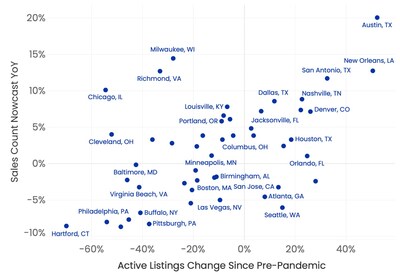
"After years of low supply, markets with restocked shelves are seeing relatively stronger sales growth," said Zillow Senior Economist Orphe Divounguy. "Construction boomed across the Sun Belt, and we saw activity slow in many markets as they went through a transition period. Those same markets are now coming out the other side as incomes are more in line with prices. Having more homes on the market is helping the market function again."
Buyers' dollars go further in this housing market than they did last year; at the national level a typical monthly mortgage payment is
The rising costs of everything else are one limiting factor, straining budgets and pausing major purchases. Inventory is another. There were
In areas that responded to the surge in demand by building additional housing, inventory has recovered faster. Housing inventory now exceeds pre-pandemic norms in 19 of the 50 most populous
"A lack of supply and stretched consumer budgets are contributing to lower sales volumes," Divounguy said. "The lack of inventory has prevented a larger price correction and limited improvements in affordability. And ultimately, shoppers can't buy what isn't for sale."
Higher inventory tends to put downward pressure on prices. And where income growth has outpaced price growth in recent years, housing affordability has also improved most. Compared to a year ago, the typical monthly mortgage payment has fallen
Nationwide, the pace of home sales at the listing level is very close to pre-pandemic norms — the median age of inventory is one day less and listings that do go pending typically do so one day faster than in 2018-2019. The big differences are sales totals, inventory and new listings, which are down
Metro Area* | Existing Home | Existing Home | Inventory | New Listings | Typical Monthly |
-17.7 % | 2.3 % | -18.7 % | -16.3 % | -3.4 % | |
-27.3 % | -8.7 % | -48.5 % | -35.5 % | 0.0 % | |
-25.5 % | -1.9 % | -11.7 % | -19.3 % | -4.0 % | |
-23.4 % | 10.1 % | -54.5 % | -38.3 % | 0.1 % | |
-10.2 % | 8.6 % | 11.9 % | -7.5 % | -7.4 % | |
-13.4 % | 3.3 % | 18.5 % | -5.6 % | -5.9 % | |
-19.7 % | 2.8 % | -28.4 % | -18.8 % | -4.5 % | |
-24.8 % | -7.7 % | -45.4 % | -24.4 % | -1.5 % | |
-19.7 % | 6.6 % | -8.1 % | -17.7 % | -7.3 % | |
-28.8 % | -4.5 % | 8.1 % | -16.0 % | -6.2 % | |
-16.3 % | -2.3 % | -18.6 % | -11.0 % | -2.6 % | |
-28.1 % | 6.1 % | -5.6 % | -14.5 % | -5.7 % | |
-14.7 % | 7.2 % | 6.6 % | -10.2 % | -5.4 % | |
-33.7 % | -3.6 % | -20.6 % | -25.5 % | -5.1 % | |
-21.5 % | -5.4 % | -21.0 % | -23.1 % | -1.1 % | |
-31.9 % | -6.1 % | 15.1 % | -4.6 % | -5.8 % | |
-15.2 % | 1.1 % | -12.9 % | -11.8 % | -2.0 % | |
-27.4 % | -0.9 % | -19.1 % | -22.5 % | -5.4 % | |
-23.4 % | 2.4 % | 15.6 % | -8.8 % | -7.6 % | |
-14.6 % | 7.2 % | 26.1 % | -8.0 % | -7.0 % | |
-13.3 % | -0.2 % | -42.6 % | -25.7 % | -3.2 % | |
-17.6 % | -2.3 % | -46.0 % | -23.4 % | -1.3 % | |
-29.1 % | 1.0 % | 24.8 % | -12.3 % | -7.3 % | |
-21.6 % | -2.4 % | 28.0 % | -0.4 % | -4.5 % | |
-18.6 % | 11.7 % | 32.7 % | -4.2 % | -6.0 % | |
-22.0 % | 5.8 % | -8.8 % | -17.9 % | -5.1 % | |
-28.4 % | 3.9 % | -16.2 % | -20.6 % | -5.8 % | |
-22.0 % | -8.3 % | -37.4 % | -12.7 % | -3.0 % | |
-19.6 % | -2.7 % | -23.5 % | -8.1 % | -1.5 % | |
-10.2 % | 20.0 % | 52.4 % | -1.4 % | -9.8 % | |
-32.8 % | -5.0 % | -9.5 % | -25.2 % | -6.5 % | |
-11.1 % | 3.3 % | -36.1 % | -22.0 % | -0.8 % | |
-13.8 % | 3.3 % | -8.6 % | -7.6 % | -2.8 % | |
-14.9 % | 3.9 % | 3.6 % | 13.5 % | -2.7 % | |
-12.9 % | 4.0 % | -52.3 % | -27.6 % | 0.2 % | |
-17.0 % | -3.2 % | 13.4 % | -6.5 % | -5.6 % | |
-2.3 % | 8.8 % | 22.7 % | 14.0 % | -4.8 % | |
-1.7 % | -3.2 % | -41.2 % | -14.5 % | -1.8 % | |
-37.0 % | -8.0 % | -54.1 % | -30.1 % | -1.1 % | |
-19.5 % | 4.8 % | 2.8 % | -17.7 % | -5.8 % | |
-14.2 % | 14.4 % | -27.9 % | -11.1 % | 1.1 % | |
-0.9 % | 3.9 % | -4.4 % | -10.5 % | -2.9 % | |
-21.5 % | 7.4 % | 22.3 % | 5.6 % | -6.2 % | |
17.1 % | 0.4 % | -4.0 % | |||
-5.9 % | 12.7 % | -33.2 % | -11.6 % | -2.0 % | |
-16.4 % | 7.8 % | -6.7 % | 2.4 % | -1.9 % | |
37.6 % | 12.7 % | 50.6 % | 28.1 % | -1.5 % | |
10.7 % | -11.5 % | -2.6 % | |||
-27.9 % | -8.6 % | -70.0 % | -48.1 % | 0.9 % | |
-34.7 % | -6.8 % | -40.8 % | -21.5 % | 0.4 % | |
-19.8 % | -1.8 % | -10.9 % | -16.1 % | -2.3 % | |
*Ordered by market size | |||||
About Zillow Group:
Zillow Group, Inc. (Nasdaq: Z and ZG) is reimagining real estate to make home a reality for more and more people.
As the most visited real estate app and website in
Zillow's ecosystem spans the entire home journey — from dreaming and shopping to renting, buying, selling and financing.
Zillow Group's affiliates, subsidiaries and brands include Zillow®, Zillow Premier Agent®, Zillow Home Loans®, Zillow Rentals®, Zillow® New Construction, Trulia®, StreetEasy®, Out East®, HotPads®, Follow Up Boss®, ShowingTime®, dotloop® and Zillow® Closing.
All marks herein are owned by MFTB Holdco, Inc., a Zillow affiliate. Zillow Home Loans, LLC is an Equal Housing Lender, NMLS #10287 (www.nmlsconsumeraccess.org). © 2026 MFTB Holdco, Inc., a Zillow affiliate.

 View original content to download multimedia:https://www.prnewswire.com/news-releases/home-sales-rebound-where-supply-has-surged-302778336.html
SOURCE Zillow