
ABB helps scale industrial AI with world's first motor featuring built-in intelligence
Sentiment and the balance of points
Rhea-AI Sentiment reads the wording of the document, how positive or negative its language is on a 1 to 5 scale. The balance of points shown with the takes weighs what the document actually discloses, so the two can disagree, for example when a trial that missed its main goal is described in upbeat language.
Rhea-AI Summary
ABB (ABB) launched Intelleqt, a low-voltage industrial motor designed to collect and process operating data from its first rotation. The motor connects to customers’ existing platforms while letting them retain ownership of their data. ABB said early fault detection can cut unplanned downtime by up to 50 percent, helping operators avoid failures that can cost up to $1.5 million per incident.
The motor debuted at the SPS trade fair in Germany and is entering a phase in which ABB will work with equipment manufacturers and end users to tailor it to their needs. ABB plans a broader rollout in 2027, initially in Europe, Japan, China and India. It also plans to invest 4.5 to 5.0 percent of group revenue in research and development to support technologies such as Intelleqt. ABB invested $1.3 billion in research and development in 2025.
Positive
- Minor point. Forward-looking: it has not happened yet and may not happen.Broader Intelleqt rollout planned for 2027, initially in Europe, Japan, China and India
- Minor point. Forward-looking: it has not happened yet and may not happen.Research and development investment plan targets 4.5 to 5.0 percent of group revenue to support technology development
Negative
- None.
Key Figures
- Energy-saving opportunities
- 30 percent or more
- Intelleqt customer benefit claim
- Unplanned downtime reduction
- up to 50 percent
- Early fault detection claim
- Failure cost per incident
- up to $1.5 million per incident
- Cost of failures the product is intended to help prevent
- Low-voltage motor market
- $18 billion
- Global IEC and NEMA market
- Broader rollout
- 2027
- Planned rollout
Key Terms
edge computing technical
original equipment manufacturers (oems) technical
AI-generated analysis. How Rhea-AI works. Not financial advice.




- As industries invest to integrate artificial intelligence across their operations, access to reliable equipment-level data is becoming the next critical challenge
- ABB's new Intelleqt™ motor delivers real-time intelligence from its first rotation, turning widely used industrial equipment into a trusted source of operational data
- Edge computing and early fault detection can reduce unplanned downtime by up to 50 percent, helping prevent failures costing up to
$1.5 million per incident
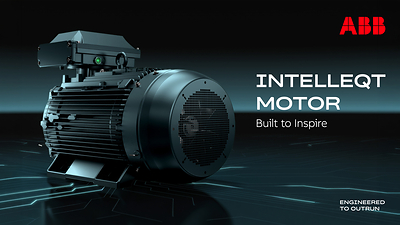
ZURICH, Nov. 24, 2026 /PRNewswire/ -- ABB today launched Intelleqt™, the world's first low-voltage motor with intelligence integrated at the factory, designed to deliver real-time operational insights from its first rotation. Its open architecture enables customers across industries to connect motor data to their existing digital platforms while retaining full ownership of their data. By delivering equipment-level intelligence through a plug-and-play solution, Intelleqt helps companies build the data foundation needed to scale AI-driven operations.
Intelleqt arrives as industries increasingly seek to move artificial intelligence from pilot projects into core operations, with data quality and availability remaining among the main barriers to adoption. Industrial AI can deliver measurable value, but scaling its deployment remains challenging.
While 84 percent of manufacturers report benefits from artificial intelligence, only 20 percent of AI use cases have successfully scaled.1 At the same time, the equipment powering critical sectors such as data centers, water infrastructure and food production remains one of the largest untapped sources of operational intelligence.
More than 300 million motor-driven systems operate worldwide, accounting for 60 percent of industrial electricity demand2. Yet most are not connected to the digital technologies used to improve reliability, efficiency and performance. As electrification, automation and industrial AI accelerate, the
"ABB's investment in research and development is always focused on solving real customer challenges," said Stefan Floeck, President of ABB's IEC Low Voltage Motors division. "The shift towards AI-driven operations is accelerating, yet most of the motors powering global industry do not generate data and remain invisible to the intelligence being built around them. ABB Intelleqt™ is a world first that opens a new chapter in motor development, transforming motors from mechanical equipment into sources of real-time intelligence."
By turning motor data into actionable insights, ABB Intelleqt helps customers improve reliability, increase productivity and identify energy saving opportunities of 30 percent or more3. Early fault detection can reduce unplanned downtime by up to 50 percent4, helping industrial operators avoid failures costing up to
ABB Intelleqt is the latest example of ABB's investment in artificial intelligence and digital technologies, bringing equipment-level intelligence to one of industry's most important and widely used assets while helping customers build the data foundation for the next generation of industrial AI.
Launched today at the SPS trade fair in Germany, ABB Intelleqt™ is now entering a customer co-creation phase, working closely with original equipment manufacturers (OEMs) and end users to develop solutions tailored to their operational needs. A broader rollout is planned for 2027, initially focusing on markets in Europe, Japan, China and India.
ABB drives shared success with customers through innovation and customer-focused research and development. Drawing on more than 140 years of engineering expertise, ABB plans to invest 4.5 to 5.0 percent of Group revenues in R&D to support the development of pioneering technologies such as ABB Intelleqt. In 2025, ABB invested
For more information about Intelleqt™, visit: [link]
ABB is a global technology leader in electrification and automation, enabling a more sustainable and resource-efficient future. By combining engineering expertise with digital capabilities, ABB helps industries operate at high performance while improving efficiency, productivity and sustainability, enabling them to outperform. At ABB, we call this "Engineered to Outrun". With more than 140 years of history, the company has around 110,000 employees worldwide. ABB's shares are listed on the SIX Swiss Exchange (ABBN) and Nasdaq Stockholm (ABB). www.abb.com
1 - Deloitte: AI in Manufacturing 2026
2 - International Energy Agency (IEA): Energy Efficiency 2025 Market Report
3 – International Energy Agency (IEA): Energy Management for Industry (2025)
4 - McKinsey: Prediction at Scale: How Industry Can Get More Value Out of Maintenance
5 - Global median:
 View original content to download multimedia:https://www.prnewswire.com/news-releases/abb-helps-scale-industrial-ai-with-worlds-first-motor-featuring-built-in-intelligence-302948504.html
SOURCE ABB
AI-generated questions and answers. How Rhea-AI works. Not financial advice.FAQ
What is ABB’s Intelleqt motor designed to do?
When and where does ABB plan a broader rollout of its Intelleqt motor?
What assumptions underlie ABB’s Intelleqt motor failure cost estimate?