
Absci Announces Positive Interim Phase 1 Data from the HEADLINE™ Trial of ABS-201, a Novel Antibody Targeting the Prolactin Receptor (PRLR)
Absci (Nasdaq: ABSI) reported positive interim Phase 1 data from the HEADLINE trial of ABS-201, an investigational anti-PRLR antibody.
Rhea-AI Summary
Absci (Nasdaq: ABSI) reported positive interim Phase 1 data from the HEADLINE trial of ABS-201, an investigational anti-PRLR antibody.
In 32 healthy volunteers across four single ascending dose cohorts (150–1800 mg IV), ABS-201 appeared well tolerated, with no serious adverse events and mostly mild TEAEs. Estimated half-life is at least 65 days, supporting potential dosing two or three times over six months. The multiple ascending dose phase in androgenetic alopecia participants has begun, with interim proof-of-concept data expected in 2H 2026 and full data in early 2027, and a Phase 2 endometriosis trial planned for later in 2026.
Positive
- No treatment-emergent serious adverse events reported across 32 ABS-201 Phase 1 SAD participants
- Most treatment-emergent adverse events were mild; only one moderate event reported, deemed unlikely related
- Estimated ABS-201 half-life of at least 65 days based on interim PK data
- Multiple ascending dose phase in androgenetic alopecia participants has been initiated
- Interim proof-of-concept data expected 2H 2026; full data anticipated early 2027
- Phase 2 trial in endometriosis planned to start later in 2026
Negative
- Treatment-emergent adverse events occurred in up to 75% of participants in one SAD cohort
- Treatment-related adverse events were reported in 5 participants across single ascending dose cohorts
News Market Reaction – ABSI
In the Jun 24 session, ABSI gained 35.96%, reflecting a significant positive market reaction.
Data tracked by StockTitan Argus on the day of publication.
Key Figures
Previous Clinical trial Reports
| Date | Event | Sentiment | 24h Move | Catalyst |
|---|---|---|---|---|
| May 13 | Phase 1 trial start | Positive | -1.7% | First Phase 1 trial of ABS-101, AI-designed anti-TL1A antibody for IBD. |
24h Move is the share-price change in the day after each event; other market factors may also have contributed.
Past clinical-trial headlines for ABSI have been followed by modest negative price reactions.
Key Terms
single ascending dose (sad) medical
multiple ascending dose (mad) medical
treatment-emergent adverse events (teaes) medical
pharmacokinetics (pk) medical
anti-drug antibodies (adas) medical
intravenously (iv) medical
AI-generated analysis. How Rhea-AI works. Not financial advice.




Study medication appears well tolerated, with favorable safety data across all blinded single ascending dose (SAD) cohorts
Estimated half-life of at least 65 days supports potential for ABS-201 targeted dosing interval of two or three injections over six-month period
First multiple ascending dose (MAD) of ABS-201 in cohort of androgenetic alopecia (AGA) participants has been initiated
Interim proof-of-concept data anticipated in the second half of 2026, with full proof-of-concept data in early 2027
VANCOUVER, Wash. and NEW YORK, June 24, 2026 (GLOBE NEWSWIRE) -- Absci Corporation (Nasdaq: ABSI), a clinical-stage biopharmaceutical company advancing breakthrough therapeutics designed with generative AI, today reported positive interim Phase 1 data from its first-in-human trial of ABS-201, an investigational anti-prolactin receptor (PRLR) antibody.
“We are particularly encouraged by the emerging safety, pharmacokinetic, and immunogenicity profile observed to date," said Ransi Somaratne, MD, Chief Medical Officer of Absci. "We look forward to further characterizing ABS-201’s clinical profile and potential in the ongoing MAD portion of the HEADLINE trial for AGA, and to initiating a Phase 2 trial for endometriosis later this year.”
Key Phase 1 Interim Findings
The ABS-201 Phase 1 trial (NCT07317544) is an ongoing, first-in-human, randomized, double-blind, placebo-controlled study designed to evaluate the safety and pharmacokinetics (PK) of ABS-201 in healthy volunteers with and without androgenetic alopecia (AGA). These data comprise 32 healthy adult participants enrolled into four planned single ascending dose (SAD) cohorts. Dose levels evaluated were 150 mg, 450 mg, 900 mg and 1800 mg administered intravenously (IV). Interim blinded safety data from these cohorts as of the June 8, 2026 data cutoff are summarized below. Following review of blinded SAD safety and PK data by the trial’s Safety Review Committee, the study has advanced into the subcutaneous multiple ascending dose (MAD) portion in participants with AGA.
Safety: Blinded, aggregate interim data suggest study drug was well tolerated and exhibited a favorable safety and tolerability profile. No serious adverse events were reported as of the data cutoff date. All treatment-emergent adverse events (TEAEs) were mild in severity except for a single moderate TEAE (headache) in SAD cohort 3, which was assessed as unlikely related to study treatment. Treatment-related TEAEs were reported in 5 participants and were all mild. The most frequently reported TEAE across cohorts was headache (4 participants). The interim safety data as of the data cutoff date are summarized as follows.
| Cohort | SAD 1 | SAD 2 | SAD 3 | SAD 4 |
| Dose (ABS-201 or matched placebo randomized 3:1) | 150 mg IV or Placebo | 450 mg IV or Placebo | 900 mg IV or Placebo | 1800 mg IV or Placebo |
| n= | 8 | 8 | 8 | 8 |
| At least one TEAE | 4 ( | 6 ( | 4 ( | 2 ( |
| At least one TESAE | 0 ( | 0 ( | 0 ( | 0 ( |
| At least one treatment-related TEAE1 | 0 ( | 2 ( | 2 ( | 1 ( |
| At least one moderate TEAE2 | 0 ( | 0 ( | 1 ( | 0 ( |
1 Assessed as possibly/likely or definitely related to study treatment; all such events were mild in severity.
2 One case of headache (SAD 3 cohort), assessed as unlikely related to study treatment.
TEAE = treatment-emergent adverse event; TESAE = treatment-emergent serious adverse event; IV = intravenous
Q8W = once every 8 weeks. Percentages are based on the number of participants dosed (N) in each cohort.
PK: Based on available interim pharmacokinetic data across all four SAD cohorts, including Day 56 follow-up in the lower-dose cohorts, half-life for ABS-201 is estimated to be at least 65 days. These results support the potential for dosing two or three times over a six month period, pending confirmation through continued follow-up across all cohorts. The following graph depicts drug concentrations by dosing group over time.
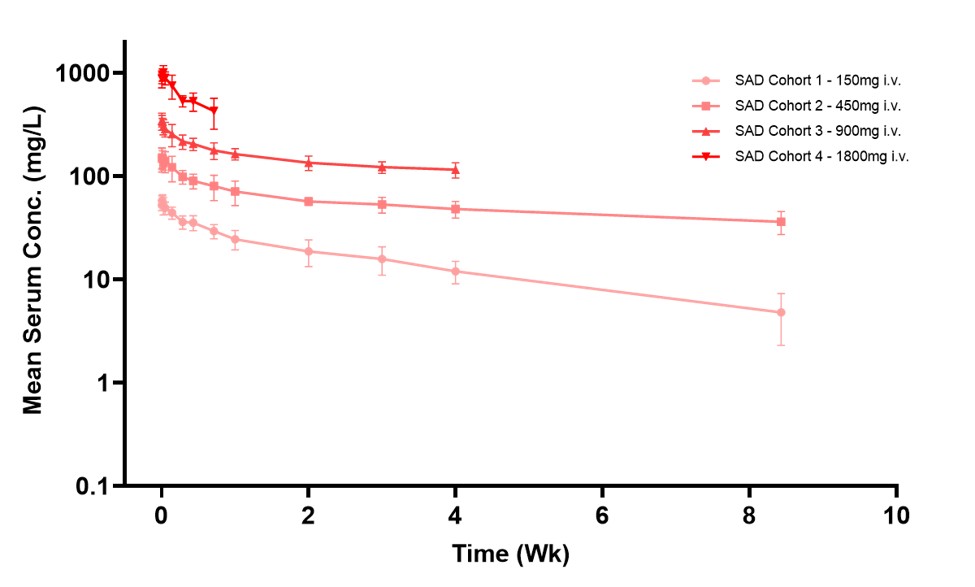
Immunogenicity: No apparent impact of anti-drug antibodies (ADAs) on PK was observed based on interim data in the SAD cohorts.
About ABS-201 and Androgenetic Alopecia
Androgenetic alopecia, commonly known as male-pattern or female-pattern hair loss, affects approximately 80 million Americans. The condition causes crown balding and receding hairlines in men, and progressive hair thinning in women. Currently, the only FDA-approved treatments – minoxidil and finasteride – show limited efficacy and notable side effects, leaving patients with limited therapeutic options.
ABS-201 represents a novel therapeutic approach targeting prolactin receptors to stimulate hair follicle regeneration and promote durable hair regrowth as demonstrated in in vivo studies. In preclinical studies, the antibody demonstrated statistically significant superior hair regrowth compared to minoxidil in a preclinical mouse model. Absci anticipates interim proof-of-concept data from its ongoing HEADLINE™ study in the second half of 2026, with full proof-of-concept data in early 2027.
About the ABS-201 HEADLINE Trial
The HEADLINE trial (NCT07317544) is a Phase 1/2a, randomized, double-blind, placebo-controlled, first-in-human trial evaluating the safety, tolerability, and preliminary proof-of-concept of an investigational treatment in participants with or without AGA. The trial is designed to enroll up to 227 healthy adult volunteers across SAD and MAD cohorts. In the SAD phase, participants received IV doses of 150 mg, 450 mg, 900 mg, or 1800 mg of ABS-201 or placebo. The MAD phase is evaluating doses of 300 mg, 600 mg, and 1200 mg SC (subcutaneous), or matching placebo. The primary endpoints are safety and tolerability. Secondary endpoints include pharmacokinetics, pharmacodynamics, immunogenicity, target area hair count (TAHC), target area hair width (TAHW), target area darkening/pigmentation (TAHD), and patient/investigator-reported outcomes. Absci anticipates reporting interim proof-of-concept data in the second half of 2026 and full proof-of-concept data in early 2027.
About Absci
Absci is advancing the future of drug discovery with generative design to create better biologics for patients, faster. Our Integrated Drug Creation™ platform combines cutting-edge AI models with a synthetic biology data engine, enabling the rapid design of innovative therapeutics that address challenging therapeutic targets. Absci’s approach leverages a continuous feedback loop between advanced AI algorithms and wet lab validation. Each cycle refines our data and strengthens our models, facilitating rapid innovation and enhancing the precision of our therapeutic designs. Alongside collaborations with top pharmaceutical, biotech, tech, and academic leaders, Absci is advancing its own pipeline of AI designed therapeutics including ABS-201™, a novel approach in hair regrowth with the potential to redefine treatment possibilities for androgenetic alopecia, commonly known as male and female pattern hair-loss. ABS-201 is also being investigated as a potential “best-in-class” therapeutic for endometriosis, a condition with significant unmet medical need and market potential. Absci is headquartered in Vancouver, WA, with AI Research Labs in New York City and Serbia, and an Innovation Center in Switzerland. Learn more at www.absci.com or follow us on LinkedIn (@absci), X (@Abscibio) and YouTube.
Absci® standard character mark, ABS-201™, and Integrated Drug Creation™ are trademarks and registered trademarks of Absci Corporation.
Forward-Looking Statements
Statements contained in this press release regarding matters that are not historical facts are “forward-looking statements” within the meaning of the Private Securities Litigation Reform Act of 1995. Because such statements are subject to risks and uncertainties, actual results may differ materially from those expressed or implied by such forward-looking statements. Such statements include, but are not limited to, statements regarding any or all of the following: development and clinical progress of Absci's pipeline programs, including ABS-201, the design, enrollment, conduct, and timelines of our ongoing Phase 1/2a HEADLINE™ trial of ABS-201 for androgenetic alopecia; the anticipated timing of an interim proof-of-concept data readout for ABS-201 in the second half of 2026 and full proof-of-concept data in early 2027; the potential advancement of ABS-201 into Phase 3 development; the therapeutic potential of ABS-201 as a treatment for endometriosis, the anticipated characteristics and product profile of ABS-201 as a drug product; projections regarding potential market opportunity based on various assumptions, including potential regulatory approval, the final approved label, and the evolving competitive landscape, any of which could cause our actual addressable market to differ materially from these projections; and Absci’s strategy and goals; and expected benefits of its collaborations with partners. Risks that contribute to the uncertain nature of the forward-looking statements include, without limitation, the risk that the Company’s research and development programs and product candidates, including those product candidates under clinical investigation, may not demonstrate the requisite safety, efficacy, or other attributes to warrant further development or to achieve regulatory approval, the risk that results observed in prior studies of the Company’s product candidates, including preclinical studies and clinical trials, will not be observed in ongoing or future studies involving these product candidates or that interim or preliminary clinical data may not be predictive of final clinical trial results, the risk of a delay or difficulties in the manufacturing of the Company’s product candidates or in the enrollment of patients in the Company’s ongoing and planned clinical trials, the risk that the Company may cease or delay preclinical or clinical development of any of its product candidates for a variety of reasons (including requirements that may be imposed by regulatory authorities on the initiation or conduct of clinical trials, changes in the therapeutic, regulatory, or competitive landscape for which the Company’s product candidates are being developed, the amount and type of data to be generated or otherwise to support regulatory approval, and any adverse events or other negative results that may be observed during preclinical or clinical development), the risk that its product candidates may not produce expected therapeutic benefits or may cause unanticipated adverse effects, and risks relating to regulatory interactions and the outcome of such interactions. For a discussion of other risks and uncertainties, please refer to those under the heading “Risk Factors” in Absci Corporation’s most recent quarterly report on Form 10-Q and in any other subsequent filings made by Absci Corporation with the U.S. Securities and Exchange Commission. Undue reliance should not be placed on these forward-looking statements, which speak only as of the date they are made. We disclaim any obligation or undertaking to update or revise any forward-looking statements contained in this press release, other than to the extent required by law.
Investor Contact
Alexander D.H. Khan
Corporate Vice President
Head of Investor Relations
investors@absci.com
Media Contact
press@absci.com
A photo accompanying this announcement is available at https://www.globenewswire.com/NewsRoom/AttachmentNg/c2d8717b-18aa-425a-9be6-4f44607e1329
