
Aduro Clean Technologies Extends Hydrochemolytic™ Technology to Paraffinic Crude Oils
Aduro Clean Technologies (NASDAQ: ADUR) announced bench-scale results showing its Hydrochemolytic™ Technology (HCT) reduced wax content and produced a stable, lighter crude from Uinta Basin paraffinic feedstocks.
Rhea-AI Summary
Aduro Clean Technologies (NASDAQ: ADUR) announced bench-scale results showing its Hydrochemolytic™ Technology (HCT) reduced wax content and produced a stable, lighter crude from Uinta Basin paraffinic feedstocks. The company filed a CIP patent application with the USPTO to extend HCT protection to paraffinic crude upgrading.
Paraffinic crudes are estimated to represent roughly 20%–33% of global production; Aduro says HCT could reduce heated-logistics needs and broaden refinery access if scaled beyond bench tests.
Positive
- Filed a continuation-in-part patent application with the USPTO
- Bench-scale reduction in wax content producing stable, lighter crude
- Targets paraffinic crudes representing 20%–33% of global production
- Uinta Basin example: regional production ~185,000 bpd (2025)
Negative
- Bench-scale only; no pilot or commercial data reported
- No quantified cost, yield, or processing economics disclosed
- No timeline or binding commercial agreements announced
Key Figures
- Paraffinic share
- 20%–33%
- Estimated share of global crude production that is paraffin-rich
- Paraffinic output
- 16.4–27.1 million barrels/day
- Estimated daily production of paraffin-rich crude oils (Energies study)
- Utah crude output
- 185,000 barrels/day
- Utah crude production in 2025, largely from the Uinta Basin
Key Terms
paraffinic crude oils technical
continuation-in-part (cip) regulatory
united states patent and trademark office (uspto) regulatory
pour points technical
fluid catalytic cracker (fcc) technical
AI-generated analysis. How Rhea-AI works. Not financial advice.




Bench-scale results demonstrate HCT reduced wax content and produced stable, lighter crude—extending a proven platform from bitumen upgrading and plastics recycling into a potential new HCT application.
LONDON, Ontario, April 23, 2026 (GLOBE NEWSWIRE) -- Aduro Clean Technologies Inc. (“Aduro” or the “Company”) (Nasdaq: ADUR) (CSE: ACT) (FSE: 9D5), a clean technology company using the power of chemistry to transform lower-value feedstocks such as waste plastics, heavy bitumen, and renewable oils, into resources for the 21st century, today announced that, through bench-scale testing, its Hydrochemolytic™ Technology (HCT) has been extended to highly paraffinic crude oils. To protect this advancement, the Company has filed a continuation-in-part (CIP) patent application with the United States Patent and Trademark Office (USPTO).
Key Highlights
- Filed a continuation-in-part (CIP) patent application with the USPTO seeking to extend HCT intellectual property protection to the upgrading of highly paraffinic crude oils.
- Bench-scale testing on Uinta Basin “yellow wax” and “black wax” feedstocks demonstrated that HCT produced crude with reduced wax content that remained stable at ambient conditions.
- Paraffinic crudes represent an estimated
20% to33% of global crude production, yet transport and processing constraints limit the range of refineries able to receive them and reduce realized market value. - This development represents a new potential application of HCT - following heavy bitumen upgrading and chemical recycling of waste plastics - further supporting HCT’s positioning as a platform technology across diverse hydrocarbon feedstocks.
The CIP extends the Company’s existing patent portfolio, which covers HCT’s prior applications in bitumen upgrading, and the chemical recycling of waste plastics. Initial experiments conducted with highly paraffinic crude oil samples, including both “yellow wax” and “black wax” feedstocks, originally sourced from Uinta Basin in Utah, have demonstrated the ability of HCT to reduce wax content and produce lighter crude that remains stable at ambient conditions at the bench scale, validating the technical application of HCT to highly paraffinic, waxy crude oils.
Paraffinic crude oils represent a significant and growing segment of global oil supply. A peer-reviewed study published in Energies estimates that approximately 16.4 to 27.1 million barrels of paraffin-rich crude oils are produced per day, representing roughly
Despite their inherent value, paraffinic crudes face structural constraints that limit how they reach and expand into different markets. High paraffin content strongly affects the cold flow properties, resulting in elevated pour points and wax formation at ambient temperatures, rendering the crude incompatible with conventional unheated pipelines. Moving paraffinic crude from wellhead to refineries typically requires unique logistics, including insulated railcars, heated storage tanks, and/or specialized offloading equipment with steam heating capabilities — all of which increase capital intensity, constrain market access, and depress realized value.
The Uinta Basin of northeastern Utah, USA illustrates these dynamics. One of the fastest-growing paraffinic crude production regions in North America, Utah produced approximately 185,000 barrels per day in 2025. The vast majority of which comes from the Uinta Basin (US Energy Information Administration). Similar transport and processing limitations affect major paraffinic streams globally, where paraffin-rich streams from producing regions across Africa, Asia, and the former Soviet Union face comparable dynamics. By improving flow properties and reducing reliance on heated logistics, technologies such as HCT have the potential to lower transportation costs, ease logistics challenges, and expand access to downstream markets, supporting improved value realization for paraffinic crude production.
Across these geographies, operators are increasingly seeking upgrading solutions that can break the dependency on specialized, high-cost handling infrastructure. Aduro's Hydrochemolytic™ Technology is designed to address these constraints by enabling targeted molecular transformation under moderate conditions to produce potentially transport-ready crude oils and intermediates that retain the favorable refining qualities of paraffinic feedstocks while reducing reliance on heated logistics and specialized receiving infrastructure.
“The Aduro approach to research is grounded in understanding how core reaction pathways can be applied across different hydrocarbon systems,” said Marcus Trygstad, Principal Scientist at Aduro. “Our work with paraffinic crude oils builds on what we have established in bitumen upgrading and the chemical recycling of waste plastics. Through bench-scale evaluation of multiple wax-rich samples, we have confirmed that Hydrochemolytic™ Technology can be applied to long-chain paraffinic structures, supporting new pathways for improving both handling and market access.”
“At Aduro, we continue to advance our Hydrochemolytic™ Technology platform through targeted applications that address real global challenges in the energy and materials sectors,” said Ofer Vicus, Chief Executive Officer of Aduro. “Paraffinic crude oils are widely produced and inherently valuable, but their full potential is often constrained by excessive handling and processing requirements. This extension reflects a practical step in expanding the relevance of our technology and its potential application across the hydrocarbon value chain. Each new application we validate strengthens HCT’s position as a platform technology, increases our value proposition, and broadens the set of potential markets and partners we can pursue over time.”
The extension into paraffinic crude oils reflects a continued expansion of HCT into adjacent hydrocarbon markets with significant business opportunities where molecular structure shapes both transport economics and access to refining value. While distinct from asphaltenic bitumen systems, paraffinic crudes present constraints that affect the capital intensity of production growth and the range of refineries able to process them. Aduro's work is focused on addressing these limitations through selective molecular conversion into more universally transportable and refinery-compatible forms. This may have significant economic impact by both reducing costs and increasing value by improving both the properties of paraffinic crude oils and their market access.
About Aduro Clean Technologies
Aduro Clean Technologies is a developer of patented water-based technologies to chemically recycle waste plastics; convert heavy crude and bitumen into lighter, more valuable oil; and transform renewable oils into higher-value fuels or renewable chemicals. The Company’s Hydrochemolytic™ Technology relies on water as a critical agent in a chemistry platform that operates at relatively low temperatures and cost, a game-changing approach that converts low-value feedstocks into resources for the 21st century.
For further information, please contact:
Abe Dyck, Head of Corporate Development / Investor Relations
ir@adurocleantech.com
+1 226 784 8889
KCSA Strategic Communications
Jack Perkins, Senior Vice President
aduro@kcsa.com
Forward Looking Statements
This news release contains forward-looking statements and forward-looking information (collectively, “forward-looking statements”) within the meaning of applicable Canadian and U.S. securities laws, including the U.S. Private Securities Litigation Reform Act of 1995. Forward-looking statements in this release include, but are not limited to, statements regarding the filing, prosecution, and ultimate outcome of the Company’s continuation-in-part patent application and any resulting intellectual property protection; the applicability of Hydrochemolytic™ Technology (HCT) to paraffinic crude oils based on bench-scale testing; the interpretation of bench-scale results and their relevance to future development activities; the potential for partial upgrading of paraffinic crude oils to improve transportability, handling, and refinery compatibility; the anticipated benefits of such upgrading, including reduced reliance on heated infrastructure and improved access to higher-value product pathways; the scalability, technical feasibility and economic viability of applying HCT to paraffinic crude oils; and the Company’s broader Research & Development, Pilot Plant, Demonstration Plant, and Commercialization Programs and the timing, sequencing, and success of those programs.
Forward-looking statements are based on management’s current expectations and assumptions, including, but not limited to: the replicability of bench-scale results across different paraffinic crude feedstocks and at larger scales; the assumption that laboratory‑scale performance may be indicative of future performance at pilot or commercial scale; the continued development and performance of HCT; the ability to advance research into pilot, demonstration, and commercial stages; the availability of required engineering, technical, and financial resources to support scale‑up and development activities; the potential for integration of the Company’s technology into existing energy and refining infrastructure on commercially reasonable terms; and the existence of market demand for solutions that improve the handling and upgrading of paraffinic crude oils without reliance on specialized or heated logistics infrastructure.
These statements are subject to a number of risks and uncertainties that may cause actual results to differ materially from those expressed or implied, including, but not limited to: the risk that bench-scale results may not be replicated at pilot, demonstration, or commercial scale; challenges in scaling up the technology or optimizing it for paraffinic crude applications; the need for additional testing and validation across a broader range of feedstocks and operating conditions; uncertainty regarding process yields, performance, cost structure, operating conditions, and commercial economics at larger scale; changes in market conditions, including crude oil pricing differentials and infrastructure constraints; competition from alternative upgrading or processing technologies; the availability of capital to support continued development; the ability to secure intellectual property protection or maintain freedom to operate; regulatory and permitting challenges; environmental, health, and safety risks associated with scale‑up or commercialization; and the Company’s ability to execute on its development and commercialization plans. Additional risks and uncertainties are described in the Company’s public filings available at www.sedarplus.ca and www.sec.gov
Readers are cautioned not to place undue reliance on forward-looking statements. Except as required by law, the Company undertakes no obligation to update or revise any forward-looking statements, whether as a result of new information, future events, or otherwise.
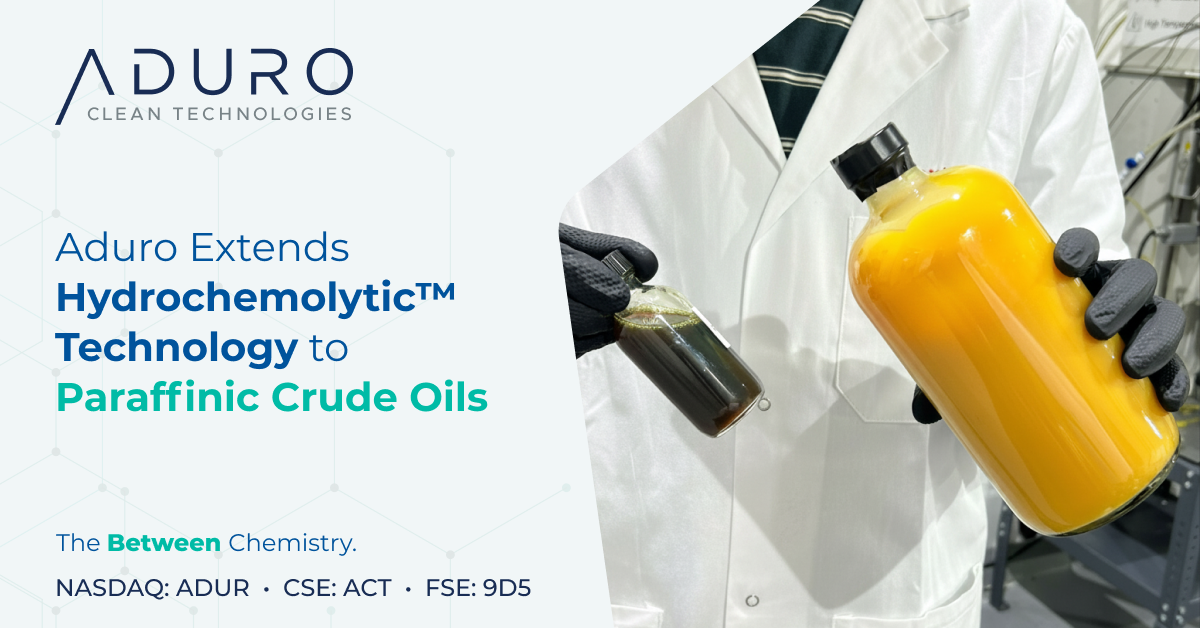
A photo accompanying this announcement is available at https://www.globenewswire.com/NewsRoom/AttachmentNg/11b572c6-c42b-4cf4-b8ba-49185b9b7191

FAQ
AI-generated questions and answers. How Rhea-AI works. Not financial advice.