
AIM ImmunoTech Highlights Ampligen’s Potential Role in the Evolving Pancreatic Cancer Treatment Landscape Following FDA Approval of Revolution Medicines’ Daraxonrasib
AIM details preliminary Ampligen survival data and outlines upcoming DURIPANC trial readouts to clarify its potential pancreatic cancer role.
Rhea-AI Summary
AIM ImmunoTech (AIM) released a CEO letter outlining how its investigational drug Ampligen could fit into pancreatic cancer treatment following the FDA approval of daraxonrasib for metastatic disease.
Ampligen is described as a TLR3 agonist designed to activate innate immunity and reshape the tumor microenvironment, in contrast to daraxonrasib, which directly inhibits RAS. In a Dutch government‑approved Named Patient Program, Ampligen monotherapy in patients with a blood neutrophil‑to‑lymphocyte ratio below 4.5 was associated with a median overall survival of 34.8 months, versus 12.5 months in well‑matched historical controls, an observed difference of 22.3 months. AIM sees potential for Ampligen both as monotherapy and in combinations such as with checkpoint inhibitors.
The ongoing Phase 2 DURIPANC trial is testing Ampligen plus durvalumab in patients with pancreatic cancer stable after FOLFIRINOX, with topline data expected in Q1 2027 and overall‑survival analysis in Q3 2027. Ampligen already has FDA and EMA orphan designations for pancreatic cancer, and AIM plans to use upcoming data to define a potential pivotal Phase 3 trial.
Positive
- Ampligen monotherapy OS signal: 34.8 vs 12.5 months in selected patients versus historical controls, 22.3‑month observed difference
- DURIPANC Phase 2 trial evaluating Ampligen plus durvalumab in post‑FOLFIRINOX pancreatic cancer patients is ongoing
- DURIPANC timelines: topline results expected Q1 2027, overall‑survival analysis planned for Q3 2027
- Regulatory status: Ampligen holds FDA Orphan Drug and EMA Orphan Medicinal Product designations for pancreatic cancer
Negative
- Ampligen status: still investigational, with rigorous pivotal Phase 3 trials yet to be conducted
- DURIPANC design: exploratory, open‑label, single‑center study with a small number of patients, limiting evidentiary strength
- Survival data source: key Ampligen monotherapy results come from a Named Patient Program versus historical controls, not a randomized trial
News Explained
The update adds a daraxonrasib benchmark while clarifying that Ampligen evidence remains from a small exploratory Phase 2 study.
The September 22 CEO letter adds a benchmark for FDA-approved daraxonrasib: median overall survival was
Those results and Ampligen’s cited
The ongoing DURIPANC trial remains an exploratory, open-label, single-center study with a small number of patients; its primary endpoint is stable disease or tumor response at
Because the study is exploratory and the company says rigorous pivotal trials are still needed, its forthcoming results would provide clinical evidence for further development rather than establish pivotal confirmation.
Key Figures
- Ampligen median overall survival
- 34.8 months
- Selected pancreatic cancer population
- Historical-control median overall survival
- 12.5 months
- Well-matched historical controls
- Observed survival increase
- 22.3 months
- Ampligen versus historical controls
- Daraxonrasib median overall survival
- 13.2 months
- Pivotal randomized study
- Standard-chemotherapy median overall survival
- 6.7 months
- Comparator arm in pivotal study
- Daraxonrasib survival improvement
- 6.5 months
- Versus standard chemotherapy
- DURIPANC topline results
- Q1 2027
- Expected Phase 2 study readout
- DURIPANC overall-survival analysis
- Q3 2027
- Expected detailed analysis
Historical Context
-
Outlined Ampligen’s pancreatic-cancer strategy and ongoing Phase 2 DURIPANC milestones
24h Move is the share-price change in the day after each event; other market factors may also have contributed.
Key Terms
tlr3 agonist medical
neutrophil-to-lymphocyte ratio medical
overall survival medical
checkpoint inhibitors medical
folfirinox medical
AI-generated analysis. How Rhea-AI works. Not financial advice.




Company CEO outlines the differentiated mechanism and clinical potential of Ampligen in pancreatic cancer
Survival data highlighted in accompanying chart show Ampligen-associated median overall survival of 34.8 months in a selected pancreatic patient population versus 12.5 months in historical controls
OCALA, Fla., Sept. 22, 2026 (GLOBE NEWSWIRE) -- AIM ImmunoTech Inc. (NYSE American: AIM) (“AIM” or the “Company”) today issued a letter to stockholders from Chief Executive Officer Thomas Equels addressing the recent U.S. Food and Drug Administration (the “FDA”) approval of daraxonrasib and outlining the Company’s view of Ampligen’s differentiated mechanism, clinical profile and potential role in the future treatment of pancreatic cancer.
The full letter follows:
Dear Fellow Stockholders,
The FDA’s recent approval of daraxonrasib is meaningful progress for people with metastatic pancreatic cancer. In fact, it is significant enough that you may be asking – and I should answer – two questions:
Question 1: How is AIM’s drug Ampligen® different from daraxonrasib?
Daraxonrasib is a selective, targeted therapy that inhibits RAS, a major driver of pancreatic cancer. A pivotal, randomized, well-controlled study demonstrated median overall survival of 13.2 months with daraxonrasib compared to 6.7 months with standard chemotherapy, for an improvement of 6.5 months (See Figure 1 below, NEJM). These results are an important part of the basis for the FDA’s approval of daraxonrasib, but they also indicate that many patients on both daraxonrasib and on standard therapy experience disease progression and mortality. Further, in laboratory studies, pancreatic tumors have been seen to develop resistance to RAS inhibition.
Ampligen has a different mechanism of action from daraxonrasib. We believe that Ampligen is the only clinically advanced investigational TLR3 agonist with a well-developed safety profile that is designed to activate innate immunity and help therapeutically reshape the tumor microenvironment to provide a natural mechanism to eliminate cancer cells. While daraxonrasib directly inhibits one driver mutation related to pancreatic cancer, Ampligen has the potential to induce a broad-spectrum therapeutic effect that amplifies a patient’s innate immune system, with data suggesting the potential for consequent stabilization of the pancreatic cancer tumor immune responses with improvement in a patient’s Quality of Life. We have seen evidence of this therapeutic potential not only in pancreatic cancer, but in a range of other solid tumors.
Question 2: What role will Ampligen serve in the future of pancreatic cancer care?
Daraxonrasib is an important therapeutic advance, but pancreatic cancer is not a simple disease where one successful targeted drug makes additional therapeutic development unnecessary. We believe Ampligen has the potential to complement and extend therapies such as daraxonrasib by helping to overcome the immune biological barriers that have historically limited treatment success in pancreatic cancer.
Further, we believe that Ampligen has significant potential in pancreatic cancer as a monotherapy. In an analysis of patients with a blood neutrophil-to-lymphocyte ratio below 4.5 who participated in a Dutch government-approved Named Patient Program, Ampligen as a monotherapy was linked to a median overall survival of 34.8 months compared with only 12.5 months in well-matched historical controls, representing an observed increase in median overall survival of 22.3 months over the historical controls (See Figure 2 below, AIMImmuno.com).
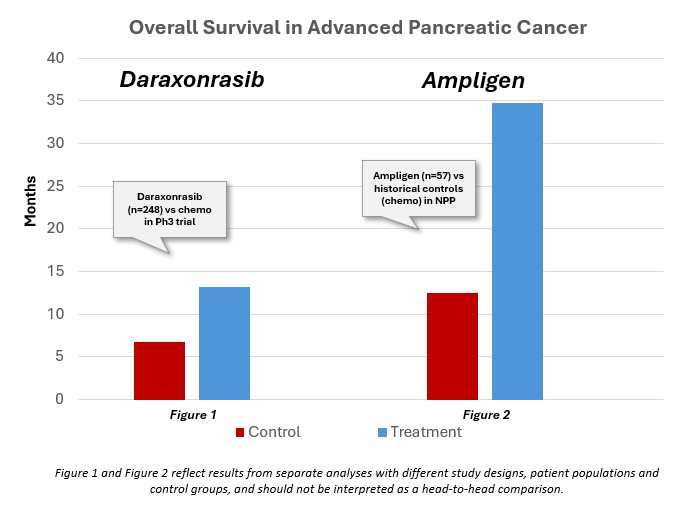
The accompanying chart visually summarizes the respective overall-survival results cited in this letter, including the separate control and treatment comparisons for daraxonrasib and Ampligen based on the separate cited datasets.
In conclusion, daraxonrasib's approval does not preclude a potentially important role for Ampligen. Daraxonrasib targets a single driver of pancreatic cancer, while Ampligen is designed to work by activating and enhancing the body’s innate immune system to target multiple types of solid tumors, including cancers of the pancreas. Based on all that we know to date, we believe that Ampligen continues to have an important potential role to serve in pancreatic cancer treatment.
AIM is also invested in Ampligen’s potential as a part of a combination therapy with checkpoint inhibitors in a broad range of other solid tumors, including pancreatic cancer. The ongoing Phase 2 DURIPANC clinical trial is evaluating Ampligen with AstraZeneca’s durvalumab (Imfinzi) in patients whose pancreatic cancer was stable post-FOLFIRINOX. This is an exploratory, open-label, single-center study with a small number of patients. Its primary endpoint is the proportion of patients who have stable disease or a tumor response 24 weeks after combination treatment begins. We anticipate topline results from the DURIPANC study in Q1 2027, followed by a detailed analysis of overall survival in Q3 2027. AIM believes that Ampligen's observed immune activity will translate into a meaningful clinical signal and allow us to establish the parameters of a follow-up, pivotal Phase 3 clinical trial.
While there is still work to be done, including rigorous pivotal trials, our goal remains clear: to determine whether Ampligen can contribute to longer and better lives for patients with pancreatic cancer. We believe it can.
AIM appreciates your continued support as we pursue that goal with scientific discipline and a clear understanding of what still must be proven.
Thomas K. Equels
Chief Executive Officer
AIM ImmunoTech Inc.
References:
- Rintatolimod in Advanced Pancreatic Cancer Enhances Antitumor Immunity through Dendritic Cell-Mediated T-Cell Responses (2024)
- Rintatolimod: A potential treatment in patients with pancreatic cancer expressing Toll-like receptor 3 (2023)
- Rintatolimod (Ampligen®) Enhances Numbers of Peripheral B Cells and Is Associated with Longer Survival in Patients with Locally Advanced and Metastasized Pancreatic Cancer Pre-Treated with FOLFIRINOX: A Single-Center Named Patient Program (2022)
- Rintatolimod Induces Antiviral Activities in Human Pancreatic Cancer Cells: Opening for an Anti-COVID-19 Opportunity in Cancer Patients? (2021)
- AIM ImmunoTech Inc.’s Drug Ampligen Awarded FDA’s Orphan Drug Designation Status for the Treatment of Pancreatic Cancer (2020)
- AIM ImmunoTech’s Subsidiary Receives Orphan Medicinal Product Designation by the European Medicines Agency for Ampligen to Treat Pancreatic Cancer (2021)
- Ampligen Breakthroughs in Treating Pancreatic Cancer (2025)
- Daraxonrasib or Chemotherapy in Previously Treated Metastatic Pancreatic Cancer (2026)
About AIM ImmunoTech Inc.
AIM ImmunoTech Inc. is an immuno-pharma company focused on the research and development of its lead product, Ampligen® (rintatolimod), for the treatment of late-stage pancreatic cancer, a lethal and unmet global health problem. Ampligen is a dsRNA and highly selective TLR3 agonist immuno-modulator that has shown broad-spectrum activity in clinical trials.
For more information, please visit aimimmuno.com and connect with the Company on X, LinkedIn, and Facebook.
Cautionary Statement
This press release contains forward-looking statements within the meaning of Section 27A of the Securities Act of 1933, as amended, and Section 21E of the Securities Exchange Act of 1934, as amended, that involve a number of risks and uncertainties. Any forward-looking statements set forth in this press release speak only as of the date hereof. Such forward-looking statements may include statements relating to: Ampligen’s potential to reshape the pancreatic tumor microenvironment and to enhance the activity of PD-1 and PD-L1 checkpoint inhibitors, including pembrolizumab and durvalumab; the potential for any such effect to be durable or long-lasting; Ampligen’s potential to complement existing therapies and to overcome biological barriers that have limited treatment success in pancreatic cancer; the potential of the Phase 2 DURIPANC study to inform patient selection, biomarker identification and the design of a potential future pivotal development program; the timing, conduct and outcome of the DURIPANC primary endpoint analyses, biomarker evaluations and overall survival follow-up; the timing and outcome of planned regulatory interactions; intellectual property expansion; the Company’s long-term pancreatic cancer development strategy and its efforts to position Ampligen for the next stage of development; and the Company’s ability to create long-term value for its stockholders. Forward-looking statements include statements attributed to, or made by, the Company’s Chief Executive Officer in the letter above. For all forward-looking statements, the Company claims the protection of the safe harbor for forward-looking statements contained in the Private Securities Litigation Reform Act of 1995. All statements in this press release other than statements of historical fact, including statements regarding the potential of Ampligen’s mechanism of action, anticipated regulatory milestones, our future results of operations and financial position, our business strategy and plans, and our objectives for future operations, are forward-looking statements. Words such as “believe,” “may,” “might,” “will,” “could,” “should,” “can,” “estimate,” “continue,” “anticipate,” “intend,” “expect,” “envision,” “potential” and similar expressions are intended to identify forward-looking statements, but the absence of these words does not mean that a statement is not forward-looking. The Company does not undertake to update any of these forward-looking statements to reflect events or circumstances that occur after the date hereof, except as required by applicable law. The Company is in various stages of seeking to determine whether Ampligen will be effective in the treatment of multiple types of viral diseases, cancers, and immune-deficiency disorders, and disclosures in the Company’s reports filed with the SEC, on its website, and in its press releases set forth its current and anticipated future activities. These activities are subject to change for a number of reasons. Significant additional testing and trials will be required to determine whether Ampligen® will be effective in the treatment of these conditions. Results obtained in preclinical studies do not necessarily predict results in humans. Human clinical trials will be necessary to prove whether or not Ampligen® will be efficacious in humans. No assurance can be given as to whether current or planned clinical trials will be successful or yield favorable data, and the trials are subject to many factors including lack of regulatory approval(s), lack of study drug, lack of adequate funding, or a change in priorities at the institutions sponsoring other trials. Even if these clinical trials are initiated, the Company cannot assure that the clinical studies will be successful or yield any useful data. No assurance can be given that the findings in preliminary studies will prove true or that such studies will yield favorable results, or that future studies will not result in findings that are different from those reported in the studies referenced in the Company’s reports filed with the SEC, on the Company’s website, and in its press releases. Operating in foreign countries carries with it a number of risks, including potential difficulties in enforcing intellectual property rights. The Company cannot assure that its potential foreign operations will not be adversely affected by these risks.
For a detailed discussion of these and other risk factors, please review the “Risk Factors” section in the Company’s most recent Annual Report on Form 10-K and subsequent Quarterly Reports on Form 10-Q filed with the U.S. Securities and Exchange Commission. These filings are available at www.sec.gov and www.aimimmuno.com. You should not place undue reliance on any forward-looking statements. The information found on the Company’s website or on other websites referenced or linked to in this press release is not incorporated by reference into this press release and such information is referenced or linked for reference purposes only.
A photo accompanying this announcement is available at https://www.globenewswire.com/NewsRoom/AttachmentNg/53bfb7cd-009a-4cc0-9b40-c044efef4b9c

Investor Contact:

JTC Team, LLC
Jenene Thomas
908.824.0775
AIM@jtcir.com
FAQ
AI-generated questions and answers. How Rhea-AI works. Not financial advice.
How does Ampligen’s mechanism differ from daraxonrasib in pancreatic cancer?
Daraxonrasib is a selective targeted therapy that inhibits RAS, a major driver of pancreatic cancer. Ampligen is described as an investigational TLR3 agonist designed to activate innate immunity and help reshape the tumor microenvironment so the body’s immune system can eliminate cancer cells. The company believes Ampligen may provide a broad‑spectrum therapeutic effect and potentially stabilize tumor immune responses, which could complement targeted agents such as daraxonrasib.
What evidence is cited for Ampligen’s potential as a monotherapy in pancreatic cancer?
An analysis from a Dutch government‑approved Named Patient Program in patients with a blood neutrophil‑to‑lymphocyte ratio below 4.5 linked Ampligen monotherapy to a median overall survival of 34.8 months. Well‑matched historical controls had a median overall survival of 12.5 months, an observed difference of 22.3 months. These data are presented alongside a chart comparing overall‑survival results for daraxonrasib and Ampligen against their respective control groups.
What is the design and primary endpoint of the DURIPANC trial?
The Phase 2 DURIPANC trial is an exploratory, open‑label, single‑center study evaluating Ampligen in combination with AstraZeneca’s checkpoint inhibitor durvalumab (Imfinzi) in patients whose pancreatic cancer was stable after FOLFIRINOX chemotherapy. The primary endpoint is the proportion of patients who have stable disease or a tumor response 24 weeks after the start of combination treatment.
How does AIM plan to use DURIPANC results in future Ampligen development?
AIM expects topline DURIPANC results in Q1 2027 and a detailed overall‑survival analysis in Q3 2027. The company believes Ampligen’s observed immune activity will translate into a meaningful clinical signal and intends to use DURIPANC data to establish the parameters of a potential follow‑up pivotal Phase 3 clinical trial in pancreatic cancer.
What existing regulatory designations does Ampligen have in pancreatic cancer?
Ampligen has been awarded Orphan Drug Designation status by the U.S. Food and Drug Administration for the treatment of pancreatic cancer. AIM’s subsidiary has also received Orphan Medicinal Product Designation from the European Medicines Agency for Ampligen to treat pancreatic cancer.