
Algo Grande Copper Makes New Skarn Discovery at Adelita; Step-Out Hole AG-CG-PH2-003 Returns a Combined 139.81 Metres of 1.3% CuEq from Cerro Grande and the New Margarita Skarn
The Margarita discovery lies about 250 metres from Phase I mineralization and remains to be tested by further drilling.
Sentiment and the balance of points
Rhea-AI Sentiment reads the wording of the document, how positive or negative its language is on a 1 to 5 scale. The balance of points shown with the takes weighs what the document actually discloses, so the two can disagree, for example when a trial that missed its main goal is described in upbeat language.
Rhea-AI Summary
Algo Grande Copper (ALGRF) reported a new gold-rich skarn discovery at Adelita in Mexico, alongside expanded Cerro Grande mineralization. Hole AG-CG-PH2-003 returned a combined 139.81 metres grading 1.3% copper-equivalent (CuEq), a measure combining metal grades, across separate composites rather than one continuous intercept. Cerro Grande 2 returned 87.98 metres at 1.6% CuEq, while four mineralized skarns in Cerro Grande 3 extended mineralization to approximately 485 metres vertical depth.
The new Margarita Skarn returned 14.37 metres at 1.1% CuEq from 624.47 metres downhole. The company interprets it to follow a previously unrecognized mineralization-controlling fault; further drilling is needed to test that interpretation. Over 4,000 metres of the approximately 7,200-metre Phase II program have been drilled. CuEq assumes 80% recovery for all metals, but recoveries have not been established.
Positive
- Minor pointCerro Grande 2 returned 87.98 metres at 1.6% CuEq, approximately 105 metres vertically above Phase I mineralization.
- Minor pointCerro Grande 3 intersected four mineralized skarns over 109.71 metres, extending mineralization to approximately 485 metres vertical depth.
- Minor pointMargarita Skarn returned 14.37 metres at 1.1% CuEq, including 1.01 metres at 6.0% CuEq.
- Minor pointPhase II drilling has completed over 4,000 metres of the approximately 7,200-metre program.
- Minor pointGround gravity survey commenced on October 22, 2026.
Negative
- Minor pointCombined 139.81-metre result comprises separate composites, not a continuous intercept.
- Minor pointCuEq grades assume 80% metallurgical recovery for all metals; recoveries remain unestablished and CuEq is illustrative only.
- Minor point. Forward-looking: it has not happened yet and may not happen.Margarita's interpreted fault control and the skarn remain to be tested by further drilling.
- Minor pointAssays remain pending for Cerro Grande holes AG-CG-PH2-004 through AG-CG-PH2-009 and Las Trancas holes 1 and 2.
AI-generated analysis. How Rhea-AI works. Not financial advice.


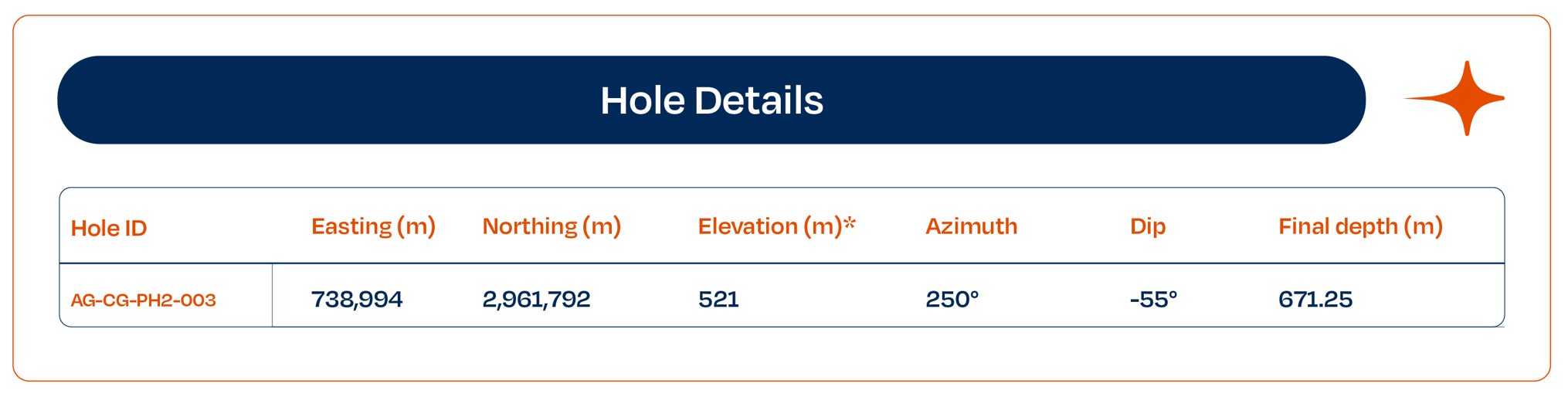
VANCOUVER, BC / ACCESS Newswire / October 28, 2026 / Hole AG-CG-PH2-003 ("Hole PH2-3") was drilled as a step-out of Phase I hole AG-GC-002 ("Hole PH1-2"). The mineralization in Hole PH2-3 is a step-out of approximately 105 metres vertically above the mineralization in Hole PH1-2, in which Algo Grande discovered three new mineralized skarn horizons at Cerro Grande ( see news release dated February 5, 2026 ). Hole PH2-3 intersected a significant expansion of the Cerro Grande 2 zone that Algo Grande discovered in Phase I, over 87.98 metres grading
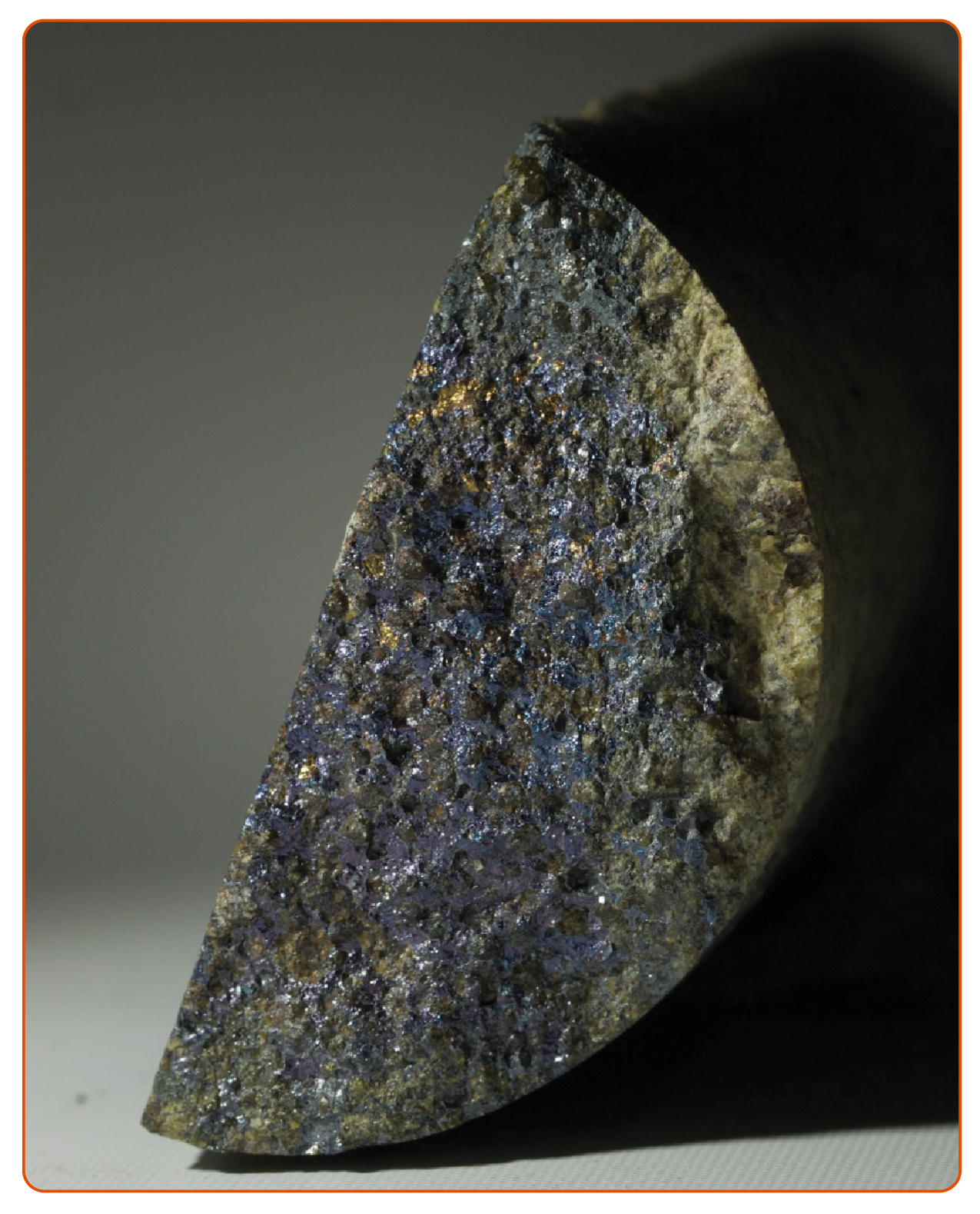
- 139.81 metres grading
1.3% CuEq combined (0.81% Cu, 35.6 g/t Ag, 0.36 g/t Au) from Cerro Grande 2, Cerro Grande 3 and the new Margarita Skarn.¹ New Discovery: The Margarita Skarn
- 14.37 metres grading
1.1% CuEq (0.50% Cu, 0.81 g/t Au, 8.7 g/t Ag) from 624.47 metres in magnetite-bornite-chalcopyrite endoskarn, including 1.01 metres grading6.0% CuEq (2.10% Cu, 4.98 g/t Au) - A new skarn with a different style: gold-rich, about 250 metres (straight-line) from Phase I mineralization in Hole PH1-2 and about 40 metres below Cerro Grande 3, interpreted to follow fault F3NW, a structural control not previously recognized at Adelita
- 14.37 metres grading
Cerro Grande Skarn :
- Cerro Grande 2: 87.98 metres grading
1.6% CuEq (1.03% Cu, 47.1 g/t Ag, 0.35 g/t Au) from 196.35 metres, including 7.40 metres at5.2% CuEq and 1.95 metres at9.8% CuEq; a step-out from the Cerro Grande 2 intercepts in Hole PH1-2 - Cerro Grande 3: four mineralized skarns over 109.71 metres (473.09 to 582.80 metres), a straight-line distance of about 125 metres from Hole PH1-2 and extending Cerro Grande to approximately 485 metres vertical depth
- Cerro Grande 2: 87.98 metres grading
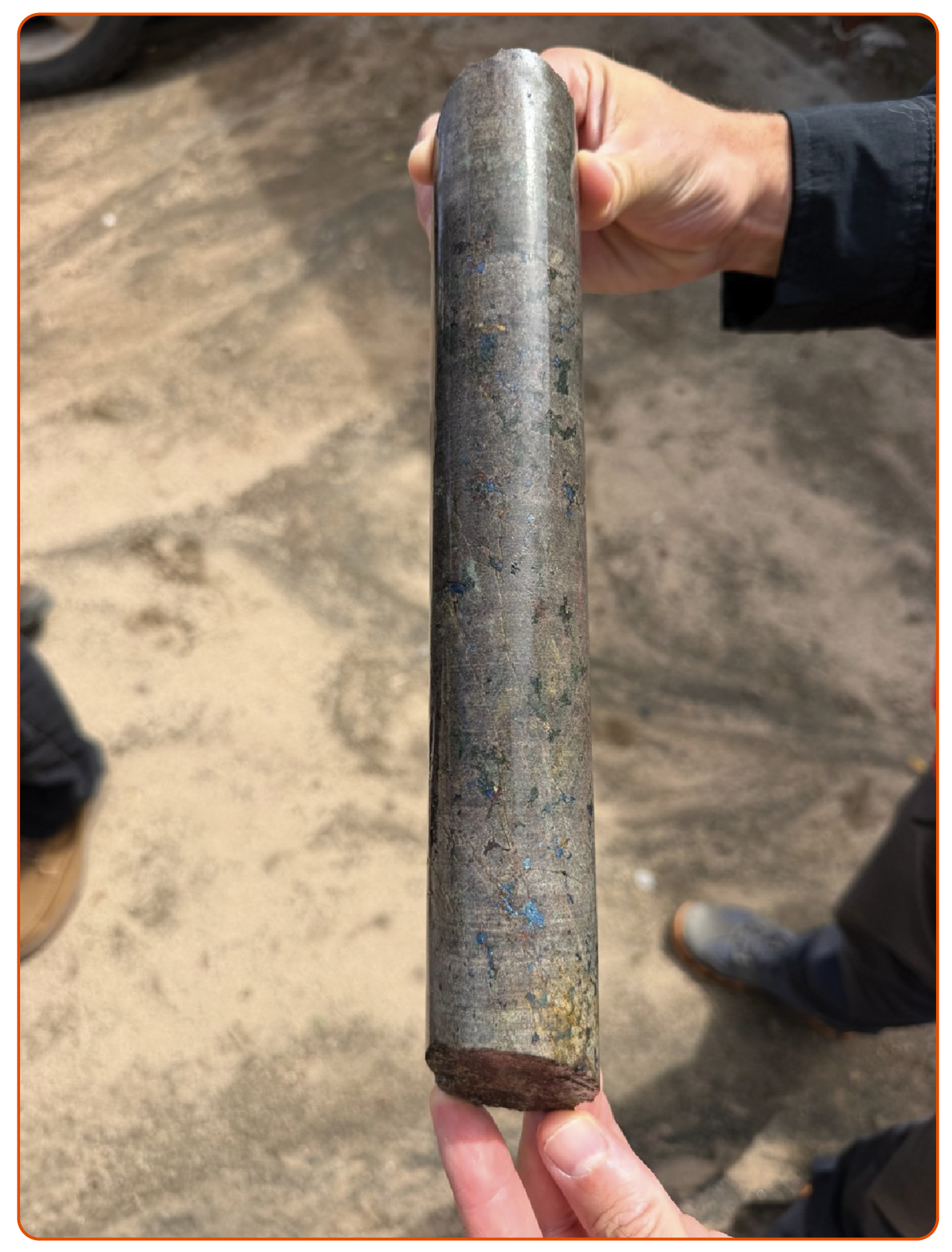
Algo Grande Copper Corp. ("Algo Grande" or the "Company") (TSXV:ALGR)(OTCID:ALGRF)(FRA:KM00) reports assay results from Hole PH2-3 at the Adelita Project, Sonora, Mexico. The hole discovered the Margarita Skarn, a new gold-rich skarn about 250 metres from Phase I mineralization intersected in Hole PH1-2, and returned a combined 139.81 metres grading
João Rocha, EurGeol, Vice President of Exploration of Algo Grande Copper, commented: "This is a major breakthrough. The Margarita Skarn is a discovery with a different style, gold-rich endoskarn, and it is interpreted to follow a new fault. That validates the thesis developed by the Algo Grande geological team of a structurally controlled system at Adelita that had not previously been recognized, and it shows the property is open for further discovery. Cerro Grande keeps growing, with Cerro Grande 2 confirming the grade and continuity of the system and Cerro Grande 3 extending it deeper, while the Margarita Skarn opens a new frontier for exploration at the Adelita property."
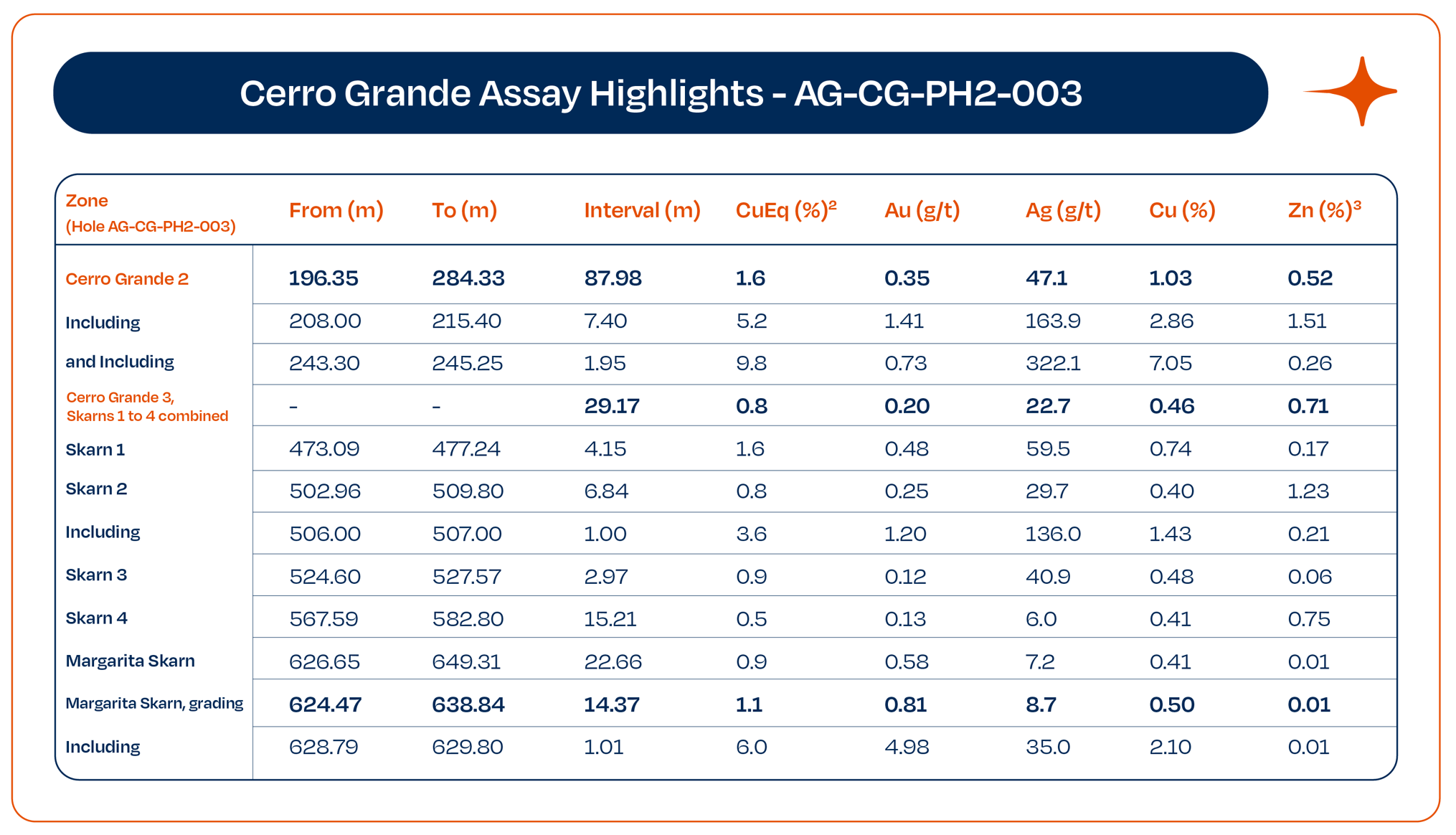
¹ The combined 139.81 metres is the length-weighted sum of three separate composites (87.98, 29.17 and 22.66 metres, for Cerro Grande 2, Cerro Grande 3 and the Margarita Skarn, respectively) and is not a continuous intercept.
² CuEq% = 0.8 x (Cu% + (Au g/t x 0.9816) + (Ag g/t x 0.0140)), using US
³ Zinc is not included in the copper equivalent (CuEq).
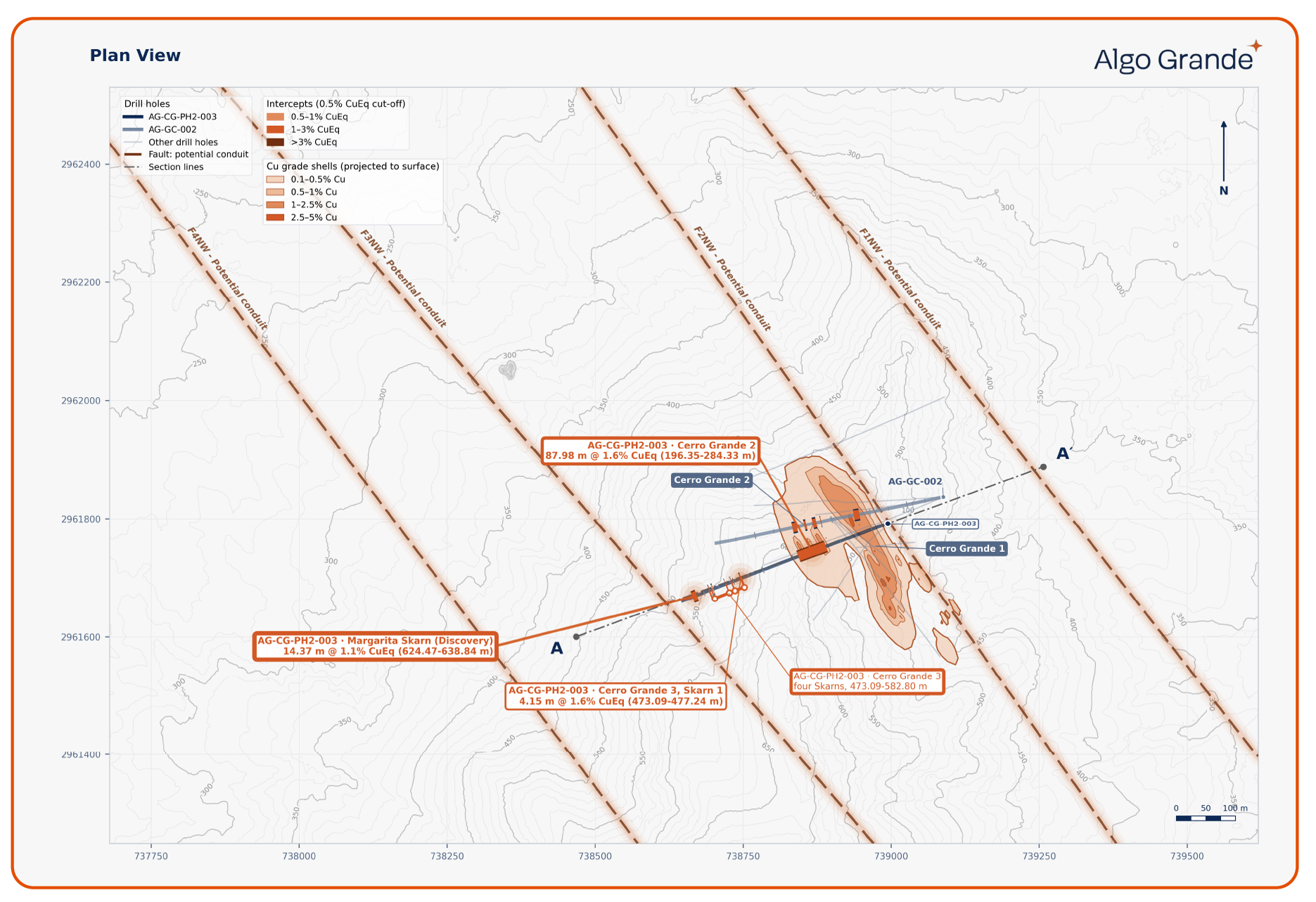
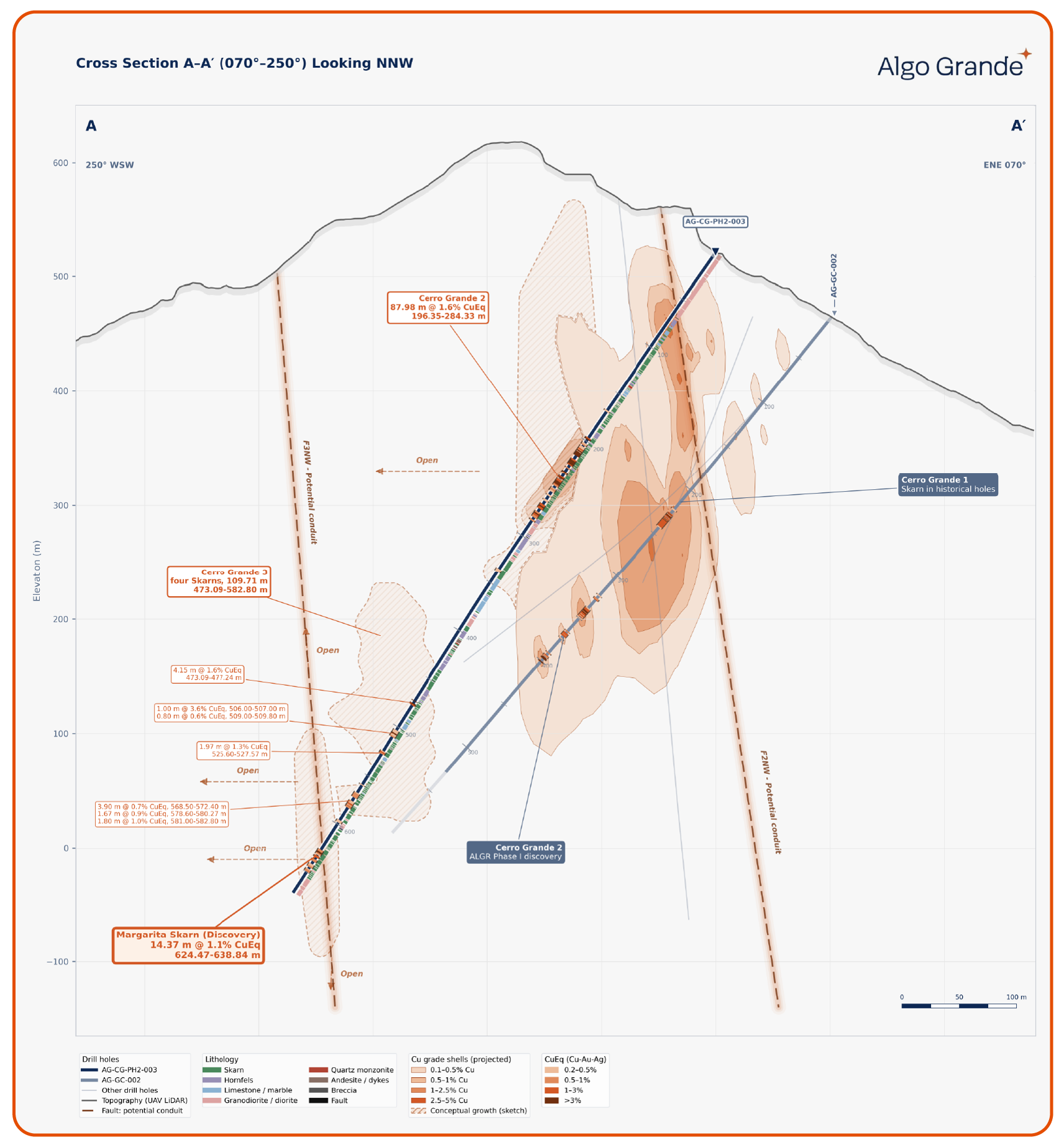
Discovery Context
The Company uses three working names for the Cerro Grande zones. Cerro Grande 1 is the skarn found in historical holes. Cerro Grande 2 comprises the skarns found in Phase I, including the three skarns near 400 metres in Hole PH1-2 (338 to 350, 365 to 374 and 390 to 401 metres downhole). The 87.98 metres intersected in Hole PH2-3 is a step-out from Cerro Grande 2 as found in Hole PH1-2. Cerro Grande 3 is four mineralized skarns over 109.71 metres (473.09 to 582.80 metres). Visual core logging for Hole PH2-3, including a 105-metre vertical step-out above Hole PH1-2, was reported in the Company's news release dated August 11, 2026 (drilling commenced per the news release dated July 31, 2026); this release reports the assay results. The Margarita Skarn interval reported herein (615.27 to 654.12 metres) supersedes the 602.0 to 654.1 metres reported from visual core logging in the Company's news release dated October 7, 2026. Hole PH1-2 was reported in the Company's news releases dated February 5, 2026 and April 2, 2026.
The Margarita Skarn lies at approximately 530 metres vertical depth, a straight-line distance of about 250 metres from mineralization on Cerro Grande 2 in Hole PH1-2, and about 40 metres below the base of the newly identified Cerro Grande 3. The Company interprets it to follow F3NW, one of four NW-trending faults (F1NW to F4NW, east to west) mapped as potential conduits, supporting its thesis of a structurally controlled system at Adelita and indicating that the property is open for further discovery beyond the Cerro Grande footprint. The structure and the Margarita Skarn remain to be tested by further drilling.
Cerro Grande 3 is composed of Skarn 1 (473.09 to 477.24 metres), Skarn 2 (502.96 to 509.80 metres), Skarn 3 (524.60 to 527.57 metres) and Skarn 4 (567.59 to 582.80 metres), in garnet exoskarn with logged chalcocite, sphalerite and chalcopyrite, separated by marble, endoskarn and unmineralized exoskarn.
Phase II Program Update
Over 4,000 metres have been drilled to date of the approximately 7,200-metre Phase II program. Hole AG-CG-PH2-009 is currently being drilled at Cerro Grande and the second hole is being drilled at Las Trancas. Assays are pending for Holes AG-CG-PH2-004 to AG-CG-PH2-009 at Cerro Grande and Holes 1 and 2 at Las Trancas, and results will be reported as they are received and reviewed. The ground gravity survey announced in the Company's news release dated October 7, 2026 commenced on October 22, 2026.
Quality Assurance / Quality Control
All drill core samples referenced in this news release were prepared and analyzed at ALS Laboratories, an independent, internationally accredited laboratory, located in Hermosillo, Mexico and Vancouver, Canada. Sample preparation used ALS methods CRU-31 (crushing), SPL-31 (splitting) and PUL-31 (pulverizing), resulting in a nominal pulp with at least
ALS employs internal quality control procedures including the routine insertion of certified reference materials, blanks and duplicates. The Company implemented an independent quality assurance and quality control program through the systematic insertion of blind certified reference materials and blank samples into the sample stream. The Company's QA/QC program identified results outside acceptance limits for certain control samples in the batches reported herein. The Company notified ALS and reviewed the affected batches; re-assays of selected samples have been completed and the results reported herein reflect the outcome of this review.
Qualified Person
The scientific and technical information disclosed in this news release has been reviewed and approved by João Rocha, EurGeol, Vice President of Exploration of Algo Grande Copper Corp., a Qualified Person as defined by National Instrument 43-101. The Qualified Person has conducted appropriate data verification procedures on the drilling and assay data disclosed herein, including review of drill collar locations, downhole survey data, sampling procedures and analytical results, and considers them appropriate and sufficient to support the information disclosed.
About Algo Grande Copper Corp.
Algo Grande Copper Corp. is a mineral exploration company advancing the Adelita Project, a district-scale, multi-system copper-silver-gold opportunity positioned in the prolific Arizona-Sonora copper belt. The 5,895-hectare Adelita Project is anchored by the high-grade Cerro Grande Cu-Au-Ag skarn discovery, which exhibits strong geophysical continuity along a defined corridor extending over 7 kilometres. Reprocessing of legacy geophysical data and field mapping indicate that a potential porphyry system may occur at depth, suggesting a classic skarn-porphyry mineralization model similar to major deposits found throughout northwestern Mexico.
ON BEHALF OF ALGO GRANDE COPPER CORP.
Enrico Gay
Chief Executive Officer
For more information, please contact:
E-mail: info@algo-grande.com
Website: https://algo-grande.com/
+1 (778) 907-2547
NEITHER THE TSX VENTURE EXCHANGE NOR ITS REGULATION SERVICES PROVIDER (AS THAT TERM IS DEFINED IN THE POLICIES OF THE TSX VENTURE EXCHANGE) ACCEPTS RESPONSIBILITY FOR THE ADEQUACY OR ACCURACY OF THIS RELEASE.
Cautionary Statement on Forward-Looking Information
This news release contains statements and information that, to the extent that they are not historical fact, constitute "forward-looking information" within the meaning of applicable securities legislation. Forward-looking information is based on the reasonable assumptions, estimates, analysis and opinions of management made in light of its experience and its perception of trends, current conditions and expected developments, as well as other factors that management believes to be relevant and reasonable in the circumstances at the date that such statements are made, but which may prove to be incorrect. Forward-looking information involves known and unknown risks, uncertainties and other factors that may cause the actual results, performance or achievements of Algo Grande to differ materially from any future results, performance or achievements expressed or implied by the forward-looking information, including, but not limited to, statements relating to the interpretation of drilling and assay results, the interpretation of the Margarita Skarn and of the structures F1NW to F4NW, the conceptual extensions shown in the figures, the receipt and interpretation of outstanding assay results, the continuity and extension of mineralization along strike and at depth, the Company's exploration plans including the ongoing Phase II drilling program, and those listed in filings made by Algo Grande with the Canadian securities regulatory authorities (which may be viewed at www.sedarplus.ca). Accordingly, readers should not place undue reliance on any such forward-looking information. Further, any forward-looking statement speaks only as of the date on which such statement is made. New factors emerge from time to time, and it is not possible for Algo Grande's management to predict all of such factors and to assess in advance the impact of each such factor on Algo Grande's business or the extent to which any factor, or combination of factors, may cause actual results to differ materially from those contained in any forward-looking statements. Algo Grande does not undertake any obligation to update any forward-looking information to reflect information, events, results, circumstances or otherwise after the date hereof or to reflect the occurrence of unanticipated events, except as required by law including securities laws.
SOURCE: Algo Grande Copper Corp.
View the original press release on ACCESS Newswire
FAQ
AI-generated questions and answers. How Rhea-AI works. Not financial advice.
What did Algo Grande Copper's Adelita drill hole AG-CG-PH2-003 return?
The hole returned a combined 139.81 metres grading 1.3% CuEq from Cerro Grande and the new Margarita Skarn. The combined result grades 0.81% copper, 35.6 g/t silver and 0.36 g/t gold. It represents separate composites rather than one continuous intercept.
What did Algo Grande Copper discover at the Margarita Skarn?
The new gold-rich Margarita Skarn returned 14.37 metres grading 1.1% CuEq from 624.47 metres downhole, including 1.01 metres at 6.0% CuEq. It lies about 250 metres from Phase I mineralization. The company interprets it to follow fault F3NW, but that interpretation remains to be tested by further drilling.
What metal prices underpin Algo Grande Copper's Adelita copper-equivalent grades?
The CuEq calculation uses US$5.20/lb copper, US$3,500/oz gold and US$50/oz silver, with an assumed 80% metallurgical recovery for all metals. Recoveries have not been established, and CuEq is illustrative only. Zinc is excluded from the calculation.