
Oak Ridge National Laboratory, IBM, and AMD Launch New Co-Design Platform for Quantum Error Correction
The effort will explore how future AMD computing hardware, networking and open software can evolve with quantum computers.
Sentiment and the balance of points
Rhea-AI Sentiment reads the wording of the document, how positive or negative its language is on a 1 to 5 scale. The balance of points shown with the takes weighs what the document actually discloses, so the two can disagree, for example when a trial that missed its main goal is described in upbeat language.
Rhea-AI Summary
AMD (NASDAQ: AMD) joined IBM and Oak Ridge National Laboratory in launching a platform to study quantum error correction. The first deployment combines IBM quantum computers with ORNL's Umbra high-performance computing system, powered by AMD Instinct MI355X GPUs and 5th Gen AMD EPYC CPUs. AMD hardware supplies classical computing for research into correcting quantum errors, decoding optimization and coordinating software.
The platform supports research aligned with the Department of Energy's Quantum Genesis Mission, whose Q Competition targets 100 logical qubits running 100,000 hard operations by late 2028. That is a research target, not a result achieved by the platform.
News Explained
Against the Q Competition’s late-2028 target, IBM reports experiments with up to 70 logical qubits and 438 hard operations; the release says the hard-operation count needs a roughly 230-fold increase.
Details
Market Reaction – AMD
On Nov 5, the day this news came out, the latest delayed price for AMD is 4.93% below the previous close. Our momentum scanner has recorded 29 alerts for this stock so far that day. The latest delayed price is $464.66. Relative volume is very high at 3.4x what this stock usually trades by this time of day.
Data tracked by StockTitan Argus (15 min delayed). Upgrade to Gold for real-time data.
Key Figures
- Quantum processor size
- 120 qubits
- IBM Quantum Nighthawk in the first deployment
- Logical-qubit target
- 100 logical qubits
- DOE Quantum Genesis Mission target by late 2028
- Hard-operation target
- 100,000 hard operations
- DOE Quantum Genesis Mission target by late 2028
- Demonstrated logical qubits
- Up to 70 logical qubits
- IBM experiments cited in the article
- Demonstrated hard operations
- 438 hard operations
- IBM experiments cited in the article
- Hard-operation increase cited
- Roughly 230-fold
- Increase stated as needed to close the gap to the mission target
Key Terms
quantum error correction technical
logical qubits technical
algorithm-aware decoders technical
AI-generated analysis. How Rhea-AI works. Not financial advice.


New initiative combines

Over the last several years, researchers have made significant advances in the field of quantum error correction, including early demonstrations of protecting quantum information from noise, achieving quantum advantage over leading classical methods using techniques with guaranteed correctness, and showing that quantum computers integrated with classical computers can run industry-relevant problems. The research challenge now is to learn how to scale these advances using more classical computing.
To address this challenge, IBM has launched a co-design platform for quantum error correction with the Quantum Science Center at Oak Ridge National Laboratory and AMD as its initial partners. The first deployment co-locates IBM's quantum computers, including its most powerful quantum processor, the 120-qubit IBM Quantum Nighthawk, with ORNL's Umbra High-Performance Computing (HPC) system, powered by AMD Instinct™ MI355X GPUs and 5th Gen AMD EPYC™ CPUs. The AMD compute provides the classical computing foundation for research into quantum error correction, decoding optimization, and software orchestration.
This co-design platform will allow researchers to evaluate the tight integration of classical and quantum computing to fuel momentum in quantum error correction research. Such work in quantum error correction is a key component in the Department of Energy's (DOE) Quantum Genesis Mission, which through its recently announced Q Competition targets 100 logical qubits running 100,000 hard operations by late 2028. Current progress by IBM in this field has demonstrated experiments with up to 70 logical qubits and 438 hard operations, which is active on the Quantum Advantage Tracker. Closing that gap means the field needs to achieve a roughly 230-fold increase in hard operation count.
"Solving the challenges of quantum error correction is essential to making quantum computing a practical tool for scientific discovery, which is a priority for Oak Ridge National Laboratory," said Travis Humble, director of the Quantum Science Center. "ORNL's strength in high-performance computing, combined with the expertise of our QSC partners – like IBM and AMD – creates an opportunity to push the boundaries of what is possible. With Umbra, we will now test new ideas, evaluate approaches at scale, and build the foundation for more reliable quantum computers."
"The question is no longer if error correction will work on quantum hardware," said Jay Gambetta, IBM Fellow and Director of IBM Research. "Today, the question is how to accelerate and optimize error correction to build systems that scientists can use to tackle meaningful problems. This new co-design platform for quantum error correction allows us to evaluate different approaches and determine the architectures, software, and workflows that will scale."
"The next era of computing will bring the new quantum paradigm together with decades of innovation across the classical hardware and software ecosystem," said Mark Papermaster, executive vice president and chief technology officer, AMD. "Together with IBM and Oak Ridge National Laboratory, we are advancing a holistic approach that integrates quantum processors, high-performance computing and AI. This co-design platform is an important step toward building the scalable, efficient computing infrastructure needed to make fault-tolerant quantum computing a reality."
IBM Nighthawk's square lattice connectivity, industry-leading speed in maximum circuits per second, and real-time pulse control lets researchers test error correction techniques. It allows teams to compare what each method requires in qubits, time, samples, and classical resources to learn where GPU accelerators, such as AMD's nodes in the Umbra system, can help the most. The co-design platform will connect with the Oak Ridge Leadership Computing Facility (OLCF) in
IBM's Quantum System API gives the researchers deep pulse-level capabilities to quantum computers. On IBM quantum hardware, researchers can measure qubits mid-calculation and act on the results in real time, set the exact timing of the signals that protect qubits from noise, see exactly what the hardware ran, and work directly with raw measurement signals. Error correction research and discovering the next generation of approaches requires these sophisticated capabilities working together on systems large enough to test real codes.
Work conducted with the co-design platform aligns with the Quantum Genesis Mission by developing error correction methods that accelerate progress toward a scientifically relevant quantum computer by 2028. Reaching that goal requires workflows that combine quantum processors with error correction techniques that leverage high-performance classical computing. These workflows include concatenated codes, space-time codes, algorithm-aware decoders, hardware-aware circuit optimization and compilation, and software orchestration all integrated in one stack.
The new co-design platform for quantum error correction builds on IBM's existing collaborations with ORNL and AMD. IBM and ORNL already work together through the Quantum Science Center, the ORNL-led DOE National Quantum Information Science Research Center established under the National Quantum Initiative. Earlier this year, IBM and ORNL unveiled results showing how workloads running on both quantum computers and the Frontier supercomputer can simulate real magnetic materials and calculate molecular configurations of a promising material for producing fusion fuel. Separately with AMD, IBM is using AMD GPUs to accelerate the classical diagonalization step in sample-based quantum diagonalization (SQD), a key quantum-centric supercomputing workflow for current quantum computers. Last year, the two companies also demonstrated an algorithm that efficiently decodes quantum errors on AMD chips.
This co-design platform lets IBM, ORNL, and AMD start leading that integration. The effort will explore how future generations of AMD compute, networking, and open software can evolve with quantum computers. What the teams learn about error correction and HPC workflows will serve as a steppingstone for the field, which may inform IBM's path to IBM Quantum Starling, IBM's first fault-tolerant quantum computer, and future SI (Super Intelligence) + HPC supercomputers — and DOE researchers will be ready to put them to work on day one.
About IBM
IBM is a leading global hybrid cloud and AI, and business services provider, helping clients in more than 175 countries capitalize on insights from their data, streamline business processes, reduce costs and gain the competitive edge in their industries. Thousands of governments and corporate entities in critical infrastructure areas such as financial services, telecommunications and healthcare rely on IBM's hybrid cloud platform and Red Hat OpenShift to affect their digital transformations quickly, efficiently and securely. IBM's breakthrough innovations in AI, quantum computing, industry-specific cloud solutions and business services deliver open and flexible options to our clients. All of this is backed by IBM's legendary commitment to trust, transparency, responsibility, inclusivity and service.
For more information, visit https://research.ibm.com.
About AMD
AMD (NASDAQ: AMD) drives innovation in high-performance and AI computing to solve the world's most important challenges. Today, AMD technology powers billions of experiences across cloud and AI infrastructure, embedded systems, AI PCs and gaming. With a broad portfolio of AI-optimized CPUs, GPUs, networking and software, AMD delivers full-stack AI solutions that provide the performance and scalability needed for a new era of intelligent computing. Learn more at www.amd.com.
AMD, EPYC, Instinct and the AMD Arrow logo and the combination thereof are trademarks of Advanced Micro Devices, Inc. Other names are for informational purposes only and may be trademarks of their respective owners.
About Oak Ridge National Lab
The Oak Ridge National Laboratory is supported by the Office of Science of the U.S. Department of Energy. The Office of Science is the single largest supporter of basic research in the physical sciences in the United States and is working to address some of the most pressing challenges of our time. For more information, please visit science.energy.gov.
Media contacts:
Brittany Forgione
IBM
Brittany.Forgione@ibm.com
Erin Angelini
IBM
edlehr@us.ibm.com
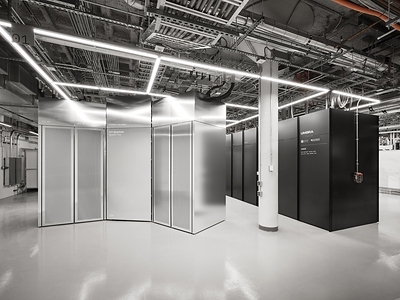

 View original content to download multimedia:https://www.prnewswire.com/news-releases/oak-ridge-national-laboratory-ibm-and-amd-launch-new-co-design-platform-for-quantum-error-correction-302929982.html
SOURCE IBM
FAQ
AI-generated questions and answers. How Rhea-AI works. Not financial advice.