
TSMC Collaborates with Ansys and Microsoft to Accelerate Photonic Simulations
Rhea-AI Summary
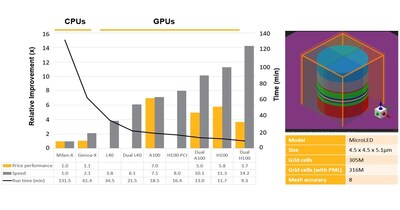
Ansys (NASDAQ: ANSS), TSMC, and Microsoft have collaborated to achieve a 10X speed-up in the simulation and analysis of silicon photonic components. This breakthrough was accomplished using Ansys Lumerical FDTD 3D electromagnetic simulation software on Microsoft Azure NC A100v4-series virtual machines powered by NVIDIA GPUs.
The collaboration aims to accelerate the development of Photonic Integrated Circuits (PICs) for applications in data communications, biomedical tools, automotive LiDAR systems, and artificial intelligence. By leveraging Azure's cloud infrastructure, the partnership enables seamless deployment, graphical interface access, scaling of distributed simulations, and post-processing for large datasets.
This advancement is important for addressing challenges in combining photonic and electronic circuits, potentially reducing costs and timeline setbacks in chip design. The collaboration demonstrates Ansys's ability to harness cloud infrastructure to deliver powerful, predictively accurate solutions for complex multiphysics silicon designs.
Positive
- 10X speed-up in simulation and analysis of silicon photonic components
- Collaboration with industry leaders TSMC and Microsoft
- Potential for cost reduction and timeline improvements in chip design
- Enhanced capabilities for complex multiphysics silicon designs
- Expansion into high-growth markets (data communications, biomedical tools, automotive LiDAR, AI)
Negative
- None.
News Market Reaction – ANSS
In the trading session that priced this news, ANSS gained 0.91%, reflecting a mild positive market reaction.
Data tracked by StockTitan Argus on the day of publication.
AI-generated analysis. How Rhea-AI works. Not financial advice.




Ansys, TSMC, and Microsoft collaborate to speed-up simulation and analysis of silicon photonic components over 10X
/ Key Highlights
- Ansys Lumerical™ FDTD 3D electromagnetic simulation software for photonic components demonstrates 10X faster simulation with Microsoft Azure Virtual Machines using NVIDIA graphics processing units (GPUs)
- With the scalability of Azure cloud, Ansys software delivers a comprehensive platform ideal for ushering in the next wave of silicon Photonic Integrated Circuit (PIC) technology for applications in data communications, biomedical tools, automotive LiDAR systems, and artificial intelligence (AI)
Silicon PIC, a type of optical communications that enables data to travel farther and faster, is integral to hyperscale data centers and Internet-of-Things applications. Combining photonic and electronic circuits is a painstaking task requiring precise multiphysics design and fabrication. A minor misstep can create continuity challenges within chips, which can result in added cost and timeline setbacks up to several months.
To alleviate challenges and unlock the ultra-bandwidth capabilities of silicon PIC, TSMC collaborated with Ansys to speed-up Lumerical FDTD simulations using highly efficient Azure virtual machines that use NVIDIA GPUs. Azure NC A100v4 VMs executed the simulations and identified optimal resources that balance cost with performance. The overall result is seamless deployment, graphical interface access, scaling of distributed simulations, and post processing for large datasets in cloud environments. For a consistent end-to-end digital engineering workflow, Azure Virtual Desktop provided a seamless transition to the cloud by delivering the same user experience as on a desktop.
"The size and complexity of our multiphysics silicon solutions makes the process of simulating all possible parameter combinations challenging," said Stefan Rusu, head of silicon photonics system design at TSMC. "This latest collaboration again highlights that Ansys effectively harnesses the latest cloud infrastructure and techniques to deliver powerful, predictively accurate solutions that produce results in a fraction of the time."
Deploying Lumerical FDTD on the cloud enables designers to swiftly identify optimal chip designs that account for the multiphysics challenges related to combining photonic circuits with electronic circuits.
"Ansys has developed unique capabilities that can be closely coupled with our leading multiphysics simulation engines for photonics," said John Lee, vice president and general manager of the semiconductor, electronics, and optics business unit at Ansys. "Collaborating with TSMC and Microsoft has accelerated technologies that address high-speed optical data transfer, which is one of the most important chip design challenges today."
Shelly Blackburn, CVP of Azure Infrastructure, Digital and App Innovation at Microsoft, highlighted the benefits of the ongoing collaboration with Ansys and TSMC. "Our collaboration is a significant advantage for users seeking the combined power of HPC and AI, using the flexibility of cloud solutions while maintaining the familiar on-premises experience," she said. "By working together, we aim to address the complexities of large-scale designs essential for high-quality semiconductor products. Utilizing the power and scalability of Microsoft Azure's cloud computing is a key strategy in overcoming these challenges."
/ About Ansys
Our Mission: Powering Innovation that Drives Human Advancement™.
When visionary companies need to know how their world-changing ideas will perform, they close the gap between design and reality with Ansys simulation. For more than 50 years, Ansys software has enabled innovators across industries to push boundaries by using the predictive power of simulation. From sustainable transportation to advanced semiconductors, from satellite systems to life-saving medical devices, the next great leaps in human advancement will be powered by Ansys.
Ansys and any and all ANSYS, Inc. brand, product, service and feature names, logos and slogans are registered trademarks or trademarks of ANSYS, Inc. or its subsidiaries in
ANSS–T
/ Contacts
Media | Mary Kate Joyce |
724.820.4368 | |
marykate.joyce@ansys.com | |
Investors | Kelsey DeBriyn |
724.820.3927 | |
 View original content to download multimedia:https://www.prnewswire.com/news-releases/tsmc-collaborates-with-ansys-and-microsoft-to-accelerate-photonic-simulations-302255918.html
SOURCE Ansys