
Global Survey Uncovers an "Aloneware" Crisis: Isolated AI Development Threatens Enterprise Stability and Adds Maintenance Costs
Sentiment and the balance of points
Rhea-AI Sentiment reads the wording of the document, how positive or negative its language is on a 1 to 5 scale. The balance of points shown with the takes weighs what the document actually discloses, so the two can disagree, for example when a trial that missed its main goal is described in upbeat language.
Rhea-AI Summary
Appian (APPN) released a global survey on the cost and upkeep of software built with standalone AI tools. The survey included 851 AI decision-makers and IT leaders at large enterprises. Appian calls applications built or modified with AI tools outside an approved enterprise platform “aloneware.”
82% of leaders surveyed allocate at least 10% of their current technology innovation budgets to work on software built outside a platform, including testing and maintenance. 71% reported faster development but more time spent on follow-on work such as testing, integration or deployment.
Key Figures
- Innovation budget allocation
- 82% allocated at least 10%
- Surveyed enterprise leaders; software built outside a platform environment
- Budget allocation of at least 20%
- 43%
- Surveyed respondents currently allocate this share
- Expected budget allocation of at least 20%
- 64%
- Surveyed respondents expect this allocation within the next two years
- Unexpected post-launch costs
- 68%
- Enterprise leaders reporting costs or resources for security, governance, and compliance remediation
- Access to technical support
- 68%
- Leaders reporting difficulty accessing accountable support for applications built outside a platform
- Keeping software up to date
- 66%
- Leaders reporting difficulty maintaining code, architecture, dependencies, and integrations
- More time on downstream development work
- 71%
- Enterprise leaders surveyed; testing, integration, troubleshooting, scaling, or deployment
- Shared architecture and maintenance
- 71%
- Respondents say a shared architectural foundation would help maintain software over time
AI-generated analysis. How Rhea-AI works. Not financial advice.


Two-thirds of AI decision-makers and IT leaders say standalone coding assistants lead to "aloneware": software that's difficult to support, understand, and maintain.
In the global survey of 851 respondents at large enterprises, Appian defines a new term: "aloneware." These are applications built or modified with AI-assisted development tools outside an approved enterprise platform environment. While these tools accelerate initial code creation, organizations face mounting friction to understand AI-generated applications and keep them functional, secure, and integrated over time.
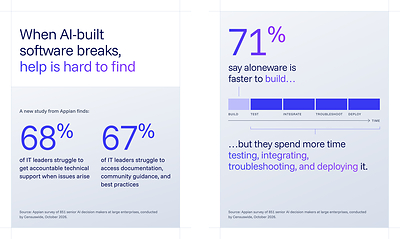
Upfront speed creates downstream work
Initial build speed is failing to deliver long-term efficiency. Just over seven in 10 (
According to Matt Calkins, CEO of Appian, "Some people get so excited about 'free' software that they forget the risks. Enterprises can now create tech debt faster than ever before."
Aloneware diverts strategic innovation budgets
The operational burden of maintaining software built outside a platform is directly diverting capital away from strategic growth. More than eight in 10 (
Compounding these budget demands, more than two-thirds (
The support void and the need for platforms
When isolated AI applications break, organizations face a critical support void. More than two-thirds (
Against this backdrop,
"The most important applications in enterprises need support," Calkins adds. "If you vibe-code them, there will be nobody to turn to when problems occur. Using AI to build applications on a commercial platform combines the speed of AI with the reliability of supported technology."
To access the complete research findings and executive report, visit appian.com/aloneware.
About the research
The research was conducted by Censuswide among 851 senior decision-makers who primarily work in AI/Engineering or IT, work at large enterprises (5,000 employees or more, or annual revenue exceeding
Censuswide is a member of the Market Research Society (MRS) and the British Polling Council (BPC), and a signatory of the Global Data Quality Pledge. The research adheres to the MRS Code of Conduct and ESOMAR principles.
- 'Completely agree' and 'Mostly agree' responses combined
- 'Significant additional cost or resource' and 'Some additional cost or resource' responses combined
- 'Very challenging' and 'Somewhat challenging' responses combined
- 'Improve significantly' and 'Improve somewhat' responses combined
About Appian
Appian provides AI automation for the most important business processes at the world's largest organizations.
On the Appian Platform, customers build AI-powered processes that accelerate work, reduce cost, and manage risk. Our platform is known for its unique power, reliability, and scale. We've been automating processes for more than 25 years and have proven expertise in enterprise operations. For more information, visit appian.com. [Nasdaq: APPN]
Follow Appian: LinkedIn, YouTube, Instagram, Facebook, and X.

 View original content to download multimedia:https://www.prnewswire.com/news-releases/global-survey-uncovers-an-aloneware-crisis-isolated-ai-development-threatens-enterprise-stability-and-adds-maintenance-costs-302947123.html
SOURCE Appian
FAQ
AI-generated questions and answers. How Rhea-AI works. Not financial advice.