
STOCK TITAN

Rare Earths Oxide Produced From Halleck Creek Ore

Rhea-AI Impact
(Neutral)
Rhea-AI Sentiment
(Neutral)
Tags

American Rare Earths (ADR: AMRRY) produced a mixed rare earth oxide (MREO) from Halleck Creek ore using the updated preliminary PFS mineral processing flowsheet on Dec 16, 2025. SGS Lakefield precipitated a mixed rare earth oxalate and calcined it at 1,000°C to form MREO, converting Ce3+ to Ce4+ to aid downstream solvent extraction. Bench results show ~97% REE recovery and ~98% magnet-REE recovery at 110% stoichiometry, and uranium in PLS fell from 1.27 ppm to 0.04 ppm (≈97%) with ion exchange; combined neutralization and ion exchange removed ≈99% uranium. Solvent-extraction simulation and further process optimization are underway for the upcoming PFS.

Loading...
Loading translation...

Positive

  • Produced MREO from Halleck Creek using updated PFS flowsheet
  • Calcined oxalate at 1,000°C converting Ce3+ to Ce4+
  • REE recovery ≈97% from oxalic acid precipitation
  • Magnet-REE recovery ≈98% at 110% stoichiometry
  • Uranium reduced from 1.27 ppm to 0.04 ppm (≈97%) via ion exchange

Negative

  • Updated preliminary PFS flowsheet is still being finalized
  • Solvent-extraction flowsheet remains simulated, not yet validated at scale
  • Further bulk-sample optimization and single-pass validation still required

News Market Reaction 1 Alert

-1.85% News Effect

On the day this news was published, ARRNF declined 1.85%, reflecting a mild negative market reaction.

Data tracked by StockTitan Argus on the day of publication.

Key Figures

Calcining temperature 1,000°C Temperature used by SGS to convert oxalate to mixed rare earth oxide
Uranium start level 1.27 ppm Uranium content in pregnant leach solution before ion exchange test
Uranium end level 0.04 ppm Uranium content after 24-hour ion exchange test with Dowex/Ambersep 21K XLT
Uranium removal (ion exchange) 97% Remaining uranium removed from solution in bench-scale ion exchange test
Total uranium removal 99% Combined primary, secondary neutralization and ion exchange removal from REE-enriched PLS
REE recovery approximately 97% Average rare earth element recovery at 110% stoichiometric oxalic acid dose
Magnet REE recovery approximately 98% Average Nd, Pr, Sm, Tb, Dy recovery at 110% stoichiometric oxalic acid dose
Stoichiometric doses 90%, 100%, 110% Oxalic acid dosing levels used in REE precipitation tests

Market Reality Check

$0.2100 Last Close
Volume Volume 7,017 is above the 20-day average of 3,735, indicating elevated trading activity into this news. high
Technical Price 12.05 is trading above the 200-day MA at 11.39, but remains 63.18% below the 52-week high.

Peers on Argus

AMRRY fell 4.37% on higher volume while key peer ARRNF rose 3.18%. Other metals peers (HUSIF, BMOOF, XTPT, CVVUF) were down between 1.25% and 6.88%, suggesting today’s move reflects stock-specific dynamics rather than a unified sector trend.

Historical Context

Date Event Sentiment Move Catalyst
Dec 08 CEO appointment Positive -5.2% New CEO named to lead transition toward U.S. rare earths production.
Nov 20 Funding partnership Positive -2.7% Expanded Tetra Tech role to pursue U.S. government funding for Halleck Creek.
Nov 19 Resource upgrade Positive +0.0% Updated Cowboy State Mine resource to 547.5M tonnes and secured drill permits.
Nov 13 AGM update Positive -1.9% AGM outlined large JORC resource, processing advances, and funding activities.
Nov 10 Flowsheet results Positive +5.8% Reported strong beneficiation metrics and updated preliminary processing flowsheet.
Pattern Detected

Recent Halleck Creek and corporate milestones have generally been positive, yet the stock often showed flat or negative next-day performance, with only the Nov 10 processing update seeing a clearly positive reaction.

Recent Company History

Over the last few months, AMRRY news has focused on advancing the Halleck Creek project and corporate positioning. Updates included a large Cowboy State Mine resource of 547.5M tonnes, a JORC resource of 2.63B tonnes at 3,292 ppm TREO, beneficiation optimization with 78.4% TREO recovery, an expanded Tetra Tech partnership for U.S. funding, and appointment of a new CEO effective Jan 5, 2026. Today’s rare earth oxide production fits this technical de-risking trajectory.

Market Pulse Summary

This announcement highlights a key de-risking step for Halleck Creek, demonstrating production of mixed rare earth oxide with high REE recoveries near 97–98% and removal of 99% of uranium from solution. It follows earlier resource growth, processing optimization, and funding-oriented updates. Investors may watch completion of the updated PFS flowsheet, solvent-extraction modeling, and subsequent pilot-scale work as critical milestones for assessing long-term project viability.

Key Terms

pre-feasibility study technical
"using the updated preliminary Pre-Feasibility Study (“PFS”) mineral processing flowsheet"
A pre-feasibility study is an initial assessment that evaluates whether a proposed project or investment idea is worth exploring further. It involves examining basic factors like costs, potential benefits, and possible challenges, similar to conducting a preliminary check before deciding to invest more time and resources. This helps investors determine if pursuing the project further is practical and likely to be successful.
pregnant leach solution technical
"using the material – a pregnant leach solution (“PLS”) – from the impurity removal testing campaign"
A pregnant leach solution is the liquid produced when ore is washed with chemicals to dissolve valuable metals; think of it like tea water that has absorbed the flavor from the leaves. It matters to investors because the metal concentration in that solution determines how much recoverable product and revenue a mine can yield, and it influences processing efficiency, operating costs and environmental or regulatory handling requirements.
solvent extraction technical
"Solvent extraction computer simulation is now underway, using the results of these tests."
Solvent extraction is a chemical separation method that uses a liquid solvent to pull a specific substance out of a mixture, similar to using oil to lift grease from water. Investors care because it affects how efficiently and cheaply a company can isolate valuable materials—like metals, oils, or pharmaceutical compounds—which influences production costs, output quality, environmental permits and the potential for regulatory or disposal liabilities.
reflux classifying concentrator technical
"scheduled for reflux classifying concentrator (“RCC”) separation and induced roll magnetic"
A reflux classifying concentrator is an industrial machine used in mining and mineral processing to separate and concentrate fine particles from a water-and-particle mix by combining gentle upward flow with internal stacked plates, so heavier minerals settle while lighter material rises. For investors it matters because the device can raise the amount of recoverable product, lower energy and water costs, and reduce waste—think of it as a more efficient kitchen sieve and settling bowl that boosts what you get out of raw material.
wet high intensity magnetic separation technical
"Additional, wet high intensity magnetic separation (“WHIMS”) of fines <53µm is scheduled"
Wet high intensity magnetic separation is a mineral-processing method that uses very strong magnets to pull tiny magnetic particles out of a water-based slurry, like using a powerful magnet to pick iron filings out of wet sand. For investors, it matters because it can raise the amount and purity of recoverable metal or mineral from ore, affect processing costs and capital spending, and influence production efficiency, waste volume and environmental compliance.
ion exchange resin technical
"test was conducted using Dowex/Ambersep 21K XLT ion exchange resin."
A solid material that captures and releases charged particles (ions) from liquids, working like a sponge that swaps unwanted bits for harmless ones to purify, separate, or recover chemicals. Investors care because these resins are key components in water treatment, pharmaceutical manufacturing and chemical production, affecting product quality, compliance, operating costs and potential recurring sales from replacement and service contracts.
magnet REE technical
"the average recovery of the magnet REE (Nd, Pr, Sm, Tb and Dy) is approximately 98%"
Magnet REE refers to the specific rare earth elements used to make high-strength permanent magnets—most commonly neodymium, praseodymium, dysprosium and terbium. These metals are the “secret sauce” that give small, lightweight magnets exceptional power, and they matter to investors because their availability and price influence costs and supply risk for electric vehicles, wind turbines, consumer electronics and defense equipment; think of them as a crucial ingredient whose shortage or price swing can change the economics of entire industries.

AI-generated analysis. Not financial advice.

Major Technical Breakthrough

Highlights

  • Rare earth oxides were produced from Halleck Creek ore using the updated preliminary Pre-Feasibility Study (“PFS”) mineral processing flowsheet1
  • A Mixed Rare Earth Oxalate and Mixed Rare Earth Oxide were created from purified leachate solution using the material from the impurity removal testing2
  • This is the most significant technical milestone achieved for the Project to date

DENVER, Dec. 16, 2025 (GLOBE NEWSWIRE) -- American Rare Earths (ASX: ARR | OTCQX: ARRNF | ADR: AMRRY) (“ARR” or the “Company”) has successfully completed another critical stage in its mineral processing program by producing a mixed rare earths oxide (“MREO”) using the updated preliminary PFS mineral processing flowsheet.

MREO from Halleck Creek (“the Project”) was produced using the material – a pregnant leach solution (“PLS”) – from the impurity removal testing campaign3. This was achieved through precipitating a mixed rare earth oxalate and then creating MREO powder (see Figure 1). This major technical milestone confirms that rare earths can be extracted into metallic oxides from Halleck Creek ore using the updated preliminary PFS mineral processing flowsheet currently being finalized for the upcoming PFS. Solvent extraction computer simulation is now underway, using the results of these tests.

SGS in Lakefield, Ontario, Canada created the MREO from the Halleck Creek PLS through a two-step process. The first step consists of precipitating the metals in solution using oxalic acid to create a mixed rare earth oxalate. Oxalic acid is highly selective in precipitating rare earth elements (“REE”) from PLS while other elements stay in solution. SGS performed three precipitation tests using variable oxalic acid addition rates. The second step, called calcining, involved SGS heating the combined mixed rare earth oxalates to 1,000oC to oxidize the material into a MREO. A beneficial effect of calcining is that it oxidizes the cerium, converting it from Ce3+ to Ce4+. Ce4+ is not soluble in the reagent which will be used to dissolve REEs from the MREO for solvent extraction.

Figure 1 – Halleck Creek Mixed Rare Earth Oxalate (left) and Mixed Rare Earth Oxide (right)
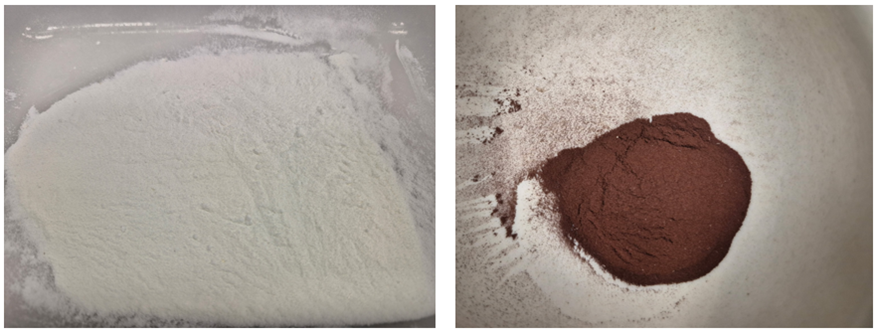
Halleck Creek Mixed Rare Earth Oxalate (left) and Mixed Rare Earth Oxide (right)

Why it matters?

Producing a MREO from Halleck Creek ore, using the updated preliminary PFS mineral processing flowsheet currently being finalized for the upcoming PFS, is the most significant technical milestone achieved for the Project to date.

MREO is the precursor used to produce individually separated rare earth products through solvent extraction, such as Neodymium-Praseodymium (“NdPr”), Terbium (“Tb”), and Dysprosium (“Dy”). In general, producing MREO is the most challenging technical step in manufacturing separated rare earth oxides. By comparison, the subsequent solvent-extraction stage is a well-established, relatively straightforward process.

Next steps in Halleck Creek’s updated preliminary PFS mineral processing flowsheet development include:

  • Solvent extraction simulation, using MetSim, is underway using the analytical results of the MREO. The simulated solvent extraction flowsheet will be used to model and define specifications and costs for a solvent extraction refinery, which is typical for a PFS.
  • Process optimization using bulk samples continues in parallel with metallurgy. Comminution testing of test pit ore, from the Cowboy State Mine area, is nearing completion at FL Smidth and Loesche. Bulk ground material from the comminution testing is scheduled for reflux classifying concentrator (“RCC”) separation and induced roll magnetic (“IRM”) concentration at Nagrom. Additional, wet high intensity magnetic separation (“WHIMS”) of fines <53µm is scheduled with Eriez.
  • Using a mineralized concentrate from the on-going optimization work, complete a single pass-through mineral processing flowsheet to replicate and validate all hydrometallurgical test results completed to date.

Additional technical details

SGS conducted a small bench scale test for uranium removal using a PLS from multiple secondary neutralization tests. The 24-hour test was conducted using Dowex/Ambersep 21K XLT ion exchange resin. The test reduced the uranium content from 1.27ppm to 0.04ppm, effectively removing 97% of the remaining uranium from solution. Between primary and secondary neutralization, and ion exchange 99% of uranium is removed from the REE enriched PLS.

SGS conducted REE precipitation on the PLS using oxalic acid in a 5% solution at 90%, 100% and 110% stoichiometric doses. The average recovery of REE sharply increased between the three tests, showing an average REE recovery of approximately 97% and the average recovery of the magnet REE (Nd, Pr, Sm, Tb and Dy) is approximately 98% under 110% stoichiometric conditions and , see Table 1Table 1, and Figure 2.

Table 1 – REE Precipitation Results from Oxalic Acid Additions

REE Precipitation Results from Oxalic Acid Additions

Figure 2 - Calculated Precipitation Percentage of REE
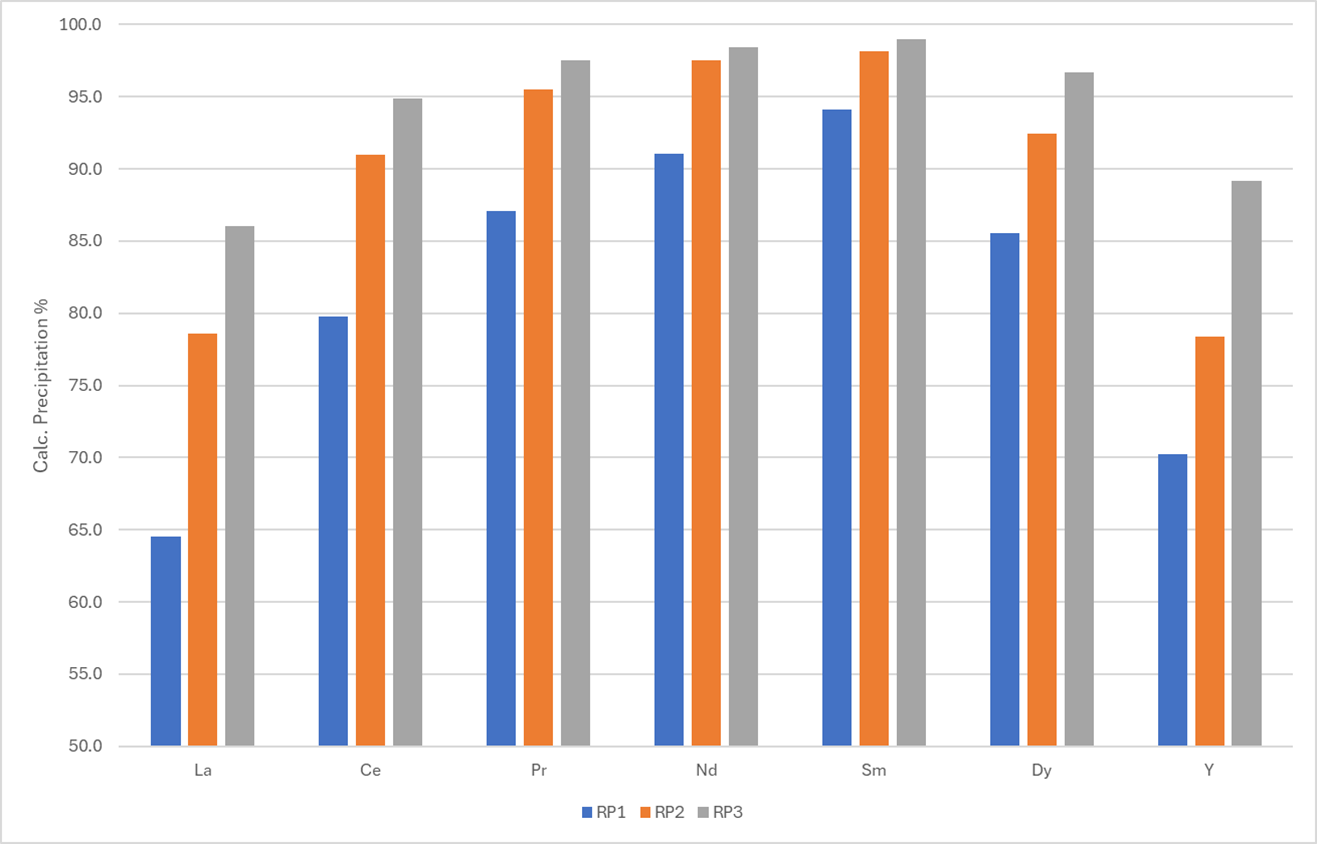
Calculated Precipitation Percentage of REE

SGS heated the combined mixed rare earth oxalates from sample RP3 at 1,000oC for two hours to oxidize the material into a mixed rare earth oxide, MREO. During the calcining process water and carbon were driven off and the elements were converted to rare earth oxides. Most notably, as stated above, calcining oxidizes cerium, converting it from Ce3+ to Ce4+. The benefit is that Ce4+ is not soluble in the reagent which will be used to dissolve REEs from the MREO for solvent extraction. The assayed results of the MREO are shown in Table 2.

Table 2 – Assay Results of Calcine Test 1
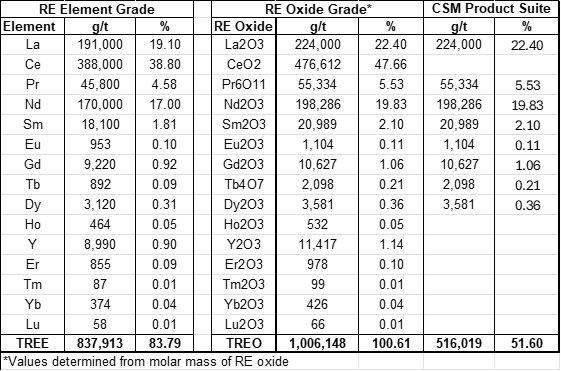
Assay Results of Calcine Test 1

This release was authorized by the board of American Rare Earths.

Investors can follow the Company’s progress at www.americanree.com

Please see here for the full JORC technical report.

About American Rare Earths Limited:

American Rare Earths (ASX: ARR | OTCQX: ARRNF | ADR: AMRRY) is a critical minerals company at the forefront of reshaping the U.S. rare earths industry. Through its wholly owned subsidiary, Wyoming Rare (USA) Inc. (“WRI”), the company is advancing the Halleck Creek Project in Wyoming—a world-class rare earth deposit with the potential to secure America’s critical mineral independence for generations. Located on Wyoming State land, the Cowboy State Mine within Halleck Creek offers cost-efficient open-pit mining methods and benefits from streamlined permitting processes in this mining-friendly state.

With plans for onsite mineral processing and separation facilities, Halleck Creek is strategically positioned to reduce U.S. reliance on imports—predominantly from China—while meeting the growing demand for rare earth elements essential to defense, advanced technologies, and economic security. As exploration progresses, the project’s untapped potential on both State and Federal lands further reinforces its significance as a cornerstone of U.S. supply chain security. In addition to its resource potential, American Rare Earths is committed to environmentally responsible mining practices and continues to collaborate with U.S. Government-supported R&D programs to develop innovative extraction and processing technologies for rare earth elements.

For additional information

Media Contact:

Susan Assadi
sassadi@americanree.com
347 977 7125

Investor Relations US Contact:

Beverly Jedynak
Beverly.jedynak@viriathus.com
312 943 1123

________________________
1 See ASX release dated November 10, 2025
2 See ASX release dated October 13, 2025
3 See ASX release dated October 13, 2025


Figures and tables accompanying this announcement are available at:

https://www.globenewswire.com/NewsRoom/AttachmentNg/88a9e78d-cd82-48ce-88a2-3a92c546aa70

https://www.globenewswire.com/NewsRoom/AttachmentNg/f82fafa0-42fe-4331-ab98-8343b2a2a9d4

https://www.globenewswire.com/NewsRoom/AttachmentNg/4778f2da-649d-49db-94de-7efdedd04b0e

https://www.globenewswire.com/NewsRoom/AttachmentNg/11d49aa6-1b2e-4240-a324-2fff29ae79d9


FAQ

What did American Rare Earths (AMRRY) announce on December 16, 2025?

The company produced a mixed rare earth oxide (MREO) from Halleck Creek ore using an updated preliminary PFS flowsheet.

What recovery rates did AMRRY report for REE and magnet REE in the Halleck Creek tests?

Reported average REE recovery ≈97% and magnet-REE recovery ≈98% at 110% oxalic acid stoichiometry.

How effective was uranium removal in AMRRY's Halleck Creek leachate tests?

Ion exchange reduced uranium from 1.27 ppm to 0.04 ppm (≈97%); combined steps removed ≈99%.

What processing step converted cerium to Ce4+ in AMRRY's tests?

Calcining the mixed rare earth oxalates at 1,000°C oxidized Ce3+ to Ce4+.

What are the next technical steps for the Halleck Creek PFS work for AMRRY (AMRRY)?

Complete MetSim solvent-extraction simulation, bulk-sample process optimization, and single pass-through validation of hydrometallurgical results.

Will the MREO production immediately enable separated rare-earth products for AMRRY (AMRRY)?

MREO is the precursor for separated oxides, but solvent-extraction refinery specifications and validation are still required before commercial separation.
American Rare Earths Limited

OTC:ARRNF

ARRNF Rankings

ARRNF Latest News

ARRNF Stock Data

122.77M
321.10M
20.1%
8.24%
Other Industrial Metals & Mining
Basic Materials
Link
Australia
Sydney
