
Atlas Critical Minerals Intersects High-Grade Graphite; All 20 Drill Holes Confirm Mineralization, with Intercepts up to 33.78 Meters at 7.97% Graphitic Carbon
Atlas Critical Minerals (NASDAQ: ATCX) reported initial results from its maiden 2026 diamond drilling program at its 100%-owned Graphite Project in Minas Gerais, Brazil.
Rhea-AI Summary
Atlas Critical Minerals (NASDAQ: ATCX) reported initial results from its maiden 2026 diamond drilling program at its 100%-owned Graphite Project in Minas Gerais, Brazil. All 20 drill holes (~2,300 m) in the first of three tenements intersected graphite, confirmed by SGS Geosol assays, including intercepts such as 33.78 m at 7.97% Cg (MPDDH-0009) and 22.66 m at 8.27% Cg (MPDDH-0007). Additional holes returned multiple near-surface intervals grading mostly 4–10% Cg over widths up to ~19 m, supported by a ground geophysical survey outlining an ~11 km mineralized trend. According to Atlas Critical Minerals, SGS has been engaged to deliver a Maiden Mineral Resource Estimate in Q4 2026, to be followed by a Preliminary Economic Assessment in Q1 2027, alongside further drilling on two remaining tenements and metallurgical optimization work.
Positive
- 20 of 20 drill holes intersected graphite over ~2,300 m in first tenement
- High-grade intercepts including 33.78 m at 7.97% Cg and 22.66 m at 8.27% Cg
- Ground geophysics outlines ~11 km mineralized trend for ongoing drill targeting
- Prior testwork achieved battery-grade and nuclear-grade graphite from project samples
- Maiden Mineral Resource Estimate targeted for Q4 2026 with PEA planned for Q1 2027
Negative
- None.
News Explained
The company has completed drilling at the first tenement and says work is now advancing through the two additional contiguous tenements, covering the remaining approximately 8.5 kilometers of open strike; the campaign has therefore moved into its remaining field program.
Details
News Market Reaction – ATCX
In the Jul 21 session, ATCX declined 1.13%, reflecting a mild negative market reaction.
Data tracked by StockTitan Argus on the day of publication.
Key Figures
- Drill holes
- 20 drill holes
- First tenement drilling program
- Intercept success
- 100%
- Completed drill holes intersected graphite mineralization
- Completed drilling
- Approximately 2,300 meters
- First tenement
- High-grade intercept
- 33.78 meters at 7.97% Cg
- Drill hole MPDDH-0009
- High-grade intercept
- 22.66 meters at 8.27% Cg
- Drill hole MPDDH-0007
- Mineralized trend
- Approximately 11 kilometers
- Geophysical trend
- Maiden resource estimate
- Q4 2026
- Expected completion with SGS
- Preliminary economic assessment
- Q1 2027
- Intended follow-up to the MRE
Historical Context
-
H.C. Wainwright initiated coverage with a positive recommendation and price target.
-
Additional mineral rights expanded the contiguous graphite project and mineralized corridor.
-
Atlas appointed a chief technical officer with critical-minerals process engineering experience.
-
Initial rare-earth metallurgical testwork reported high extraction rates across multiple categories.
-
Atlas announced participation in the Nasdaq Opening Bell ceremony.
24h Move is the share-price change in the day after each event; other market factors may also have contributed.
Key Terms
graphitic carbon technical
maiden mineral resource estimate technical
regulation s-k 1300 regulatory
induced-polarization technical
AI-generated analysis. How Rhea-AI works. Not financial advice.




Belo Horizonte, Brazil--(Newsfile Corp. - July 21, 2026) - Atlas Critical Minerals Corporation (NASDAQ: ATCX) ("Atlas Critical Minerals" or the "Company"), a diversified critical minerals exploration company, today announced strong initial results from the maiden diamond drilling program at its
Key Highlights
100% Graphite Intercept Success:
All20 completed drill holes completed (totaling ~2,300 meters) intersected graphite mineralization, confirming continuity both along strike and at depth.Outstanding High-Grade Intercepts:
33.78 meters at7.97% Cg (drill hole MPDDH-0009)
22.66 m at8.27% Cg in (MPDDH-0007)
11.00 m at8.03% Cg (MPDDH-0002)
6.00 m at9.55% Cg and 19.36 m at6.09% Cg (MPDDH-0006)Extensive Geophysical Trend Identified:
Geophysical data indicates a potential 11-kilometer (~6.8-mile) mineralized trend, providing a robust pipeline for ongoing drill targeting.Near-Surface High-Grade Mineralization:
Many of the strongest intercepts occur close to surface, suggesting potential for low-cost open-pit mining.Progressing Toward a Maiden Resource Estimate:
SGS, a leading independent mineral evaluation company, has been retained to prepare a Maiden Mineral Resource Estimate ("MRE"), expected in Q4 2026.Rapidly Growing Market: The global graphite market is forecast to reach USD 36.4 billion by 2030, growing at a
15.1% CAGR, driven by surging demand for energy storage and electric vehicle. Benchmark Mineral Intelligence estimates that 97 new graphite mines will be needed by 2035 to meet global demand.
Drilling Program and Geophysical Targeting
Atlas Critical Minerals designed its 2026 diamond drill program based on the results of prior exploration work, including geological mapping, grab sampling, and a ground geophysical survey. The full 2026 program totals approximately 6,000 meters distributed across the Project's three tenements. The Company has now completed 20 drill holes for approximately 2,300 meters at the first tenement, all intersecting graphite mineralization.
Prior to drilling, the Company completed 27.5 kilometers of ground geophysical data acquisition. Strong anomalies – characterized by high chargeability and low resistivity, typical of graphite mineralization – were identified along the entire 11-kilometer strike length, confirming substantial exploration potential.
The Company's exploration activities at the Project are conducted in accordance with Item 1300 of Regulation S-K ("Regulation S-K 1300"), the U.S. standard for mineral property disclosure. All technical work is supervised by Marc-Antoine Laporte, a recognized critical minerals geologist with SGS Canada Inc. ("SGS") who serves as a Qualified Person for graphite under Regulation S-K 1300. Mr. Laporte authored the Technical Report Summary ("TRS") for the Project, which was last filed with the U.S. Securities and Exchange Commission on November 12, 2025. The TRS includes results from initial metallurgical testwork conducted at a specialized graphite laboratory in the United States, demonstrating that material derived from Project samples achieved both battery-grade and nuclear-grade qualification standards, providing an early and positive indication of the Project's potential to produce high-purity, high-performance graphite materials.
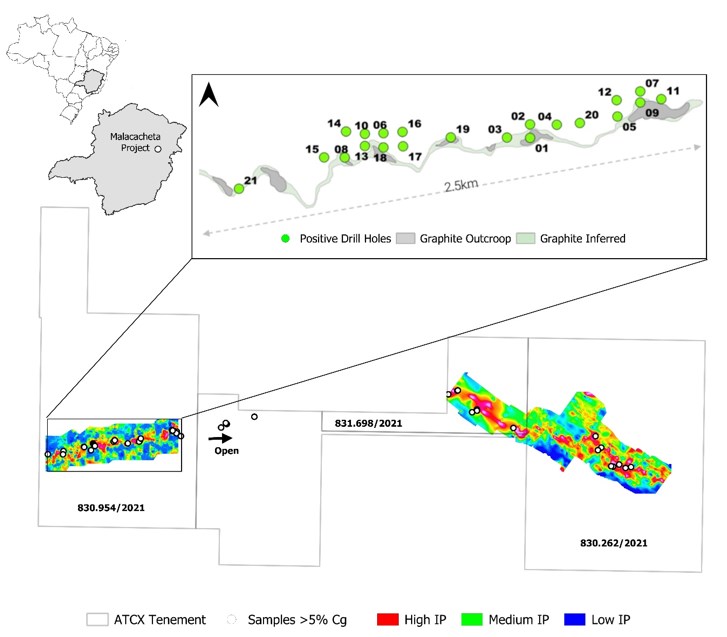
Figure 1 – Completed drill hole collars in first tenement and induced-polarization (IP) geophysical anomalies along the interpreted graphite trend.
To view an enhanced version of this graphic, please visit:
https://images.newsfilecorp.com/files/6728/305786_dc1a6508c4384a58_002full.jpg
High-Grade Assay Results
Initial assays (approximately 940 samples) returned several outstanding results. Highlights include:
| Hole ID | Depth From (m) | Depth To (m) | Length (m) | Assay (%Cg) |
| MPDDH-0009 | 23.22 | 57.00 | 33.78 | 7.97 |
| MPDDH-0007 | 26.91 | 39.00 | 12.09 | 4.48 |
| MPDDH-0007 | 55.75 | 78.41 | 22.66 | 8.27 |
Table 1 – Principal high-grade graphite interceptions at first tenement.
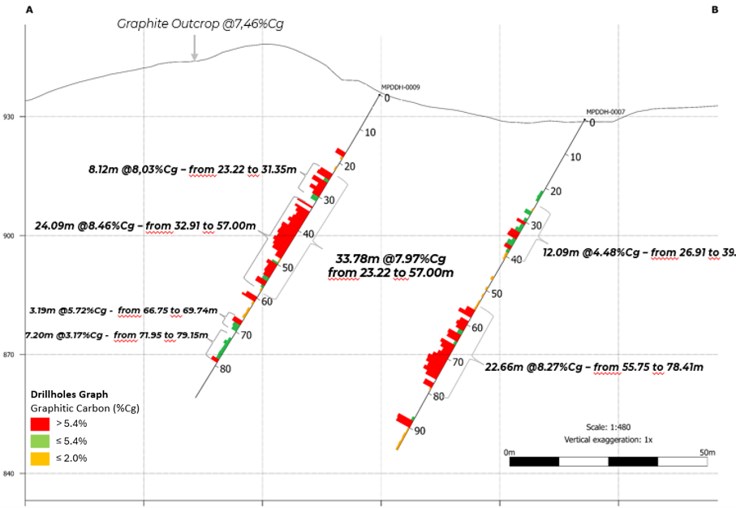
Figure 2 – Cross-section through the first tenement illustrating graphite interceptions in drill holes MPDDH-0007 and MPDDH-0009.
To view an enhanced version of this graphic, please visit:
https://images.newsfilecorp.com/files/6728/305786_dc1a6508c4384a58_003full.jpg
Numerous additional wide, high-grade intersections were returned across the first tenement, highlighting the continuity and scale of the mineralized system. Selected results include:
| Hole ID | Depth From (m) | Depth To (m) | Length (m) | Assay (%Cg) |
| MPDDH-0002 | 10.50 | 21.50 | 11.00 | 8.03 |
| MPDDH-0002 | 36.50 | 46.53 | 10.03 | 6.83 |
| MPDDH-0003 | 10.00 | 22.42 | 12.42 | 4.30 |
| MPDDH-0003 | 37.00 | 43.60 | 6.60 | 6.31 |
| MPDDH-0004 | 22.25 | 38.45 | 16.20 | 5.97 |
| MPDDH-0004 | 43.55 | 58.70 | 15.15 | 6.16 |
| MPDDH-0005 | 21.00 | 35.75 | 14.75 | 6.00 |
| MPDDH-0005 | 52.70 | 64.20 | 11.50 | 5.00 |
| MPDDH-0006 | 8.24 | 17.00 | 8.76 | 5.31 |
| MPDDH-0006 | 21.50 | 28.95 | 7.45 | 7.11 |
| MPDDH-0006 | 49.50 | 68.86 | 19.36 | 6.09 |
| MPDDH-0006 | 71.00 | 73.85 | 2.85 | 6.43 |
| MPDDH-0006 | 81.00 | 87.00 | 6.00 | 9.55 |
| MPDDH-0006 | 91.00 | 106.00 | 15.00 | 5.50 |
Table 2 – Additional high-grade graphite interceptions from first tenement.
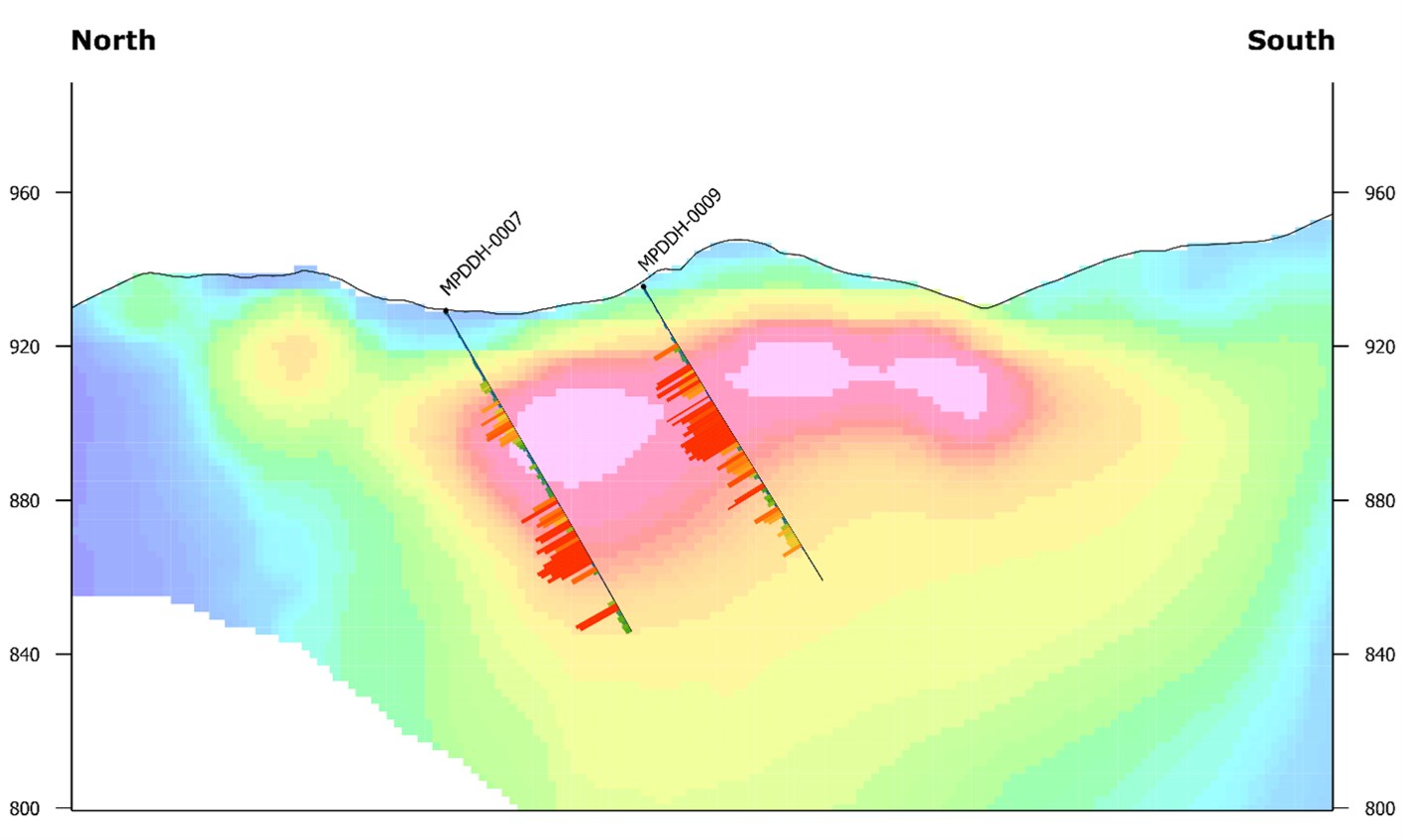
Figure 3 – Geophysical section demonstrating strong correlation between IP anomalies and graphite intersections in drilling.
To view an enhanced version of this graphic, please visit:
https://images.newsfilecorp.com/files/6728/305786_dc1a6508c4384a58_004full.jpg
Graphite: A Critical Mineral
Graphite is the dominant anode material in lithium-ion batteries, essential for energy storage systems and electric vehicles. Recognized as a critical mineral by several governments, including the U.S., high-grade natural flake graphite can be upgraded into battery-grade active anode material.
Atlas believes the Project's high in-situ grades and favorable flake characteristics, hosted within graphitic schists of the Macaúbas Group (Araçuaí Orogen), position it well to help address the rapidly growing supply gap in the Americas.
"These are outstanding initial drill results that validate our earlier exploration work," commented Marc Fogassa, Chairman and Chief Executive Officer of Atlas Critical Minerals. "Every one of the first 20 holes intersected graphite - including a nearly 34-meter interval averaging close to
Site and Core Photographs
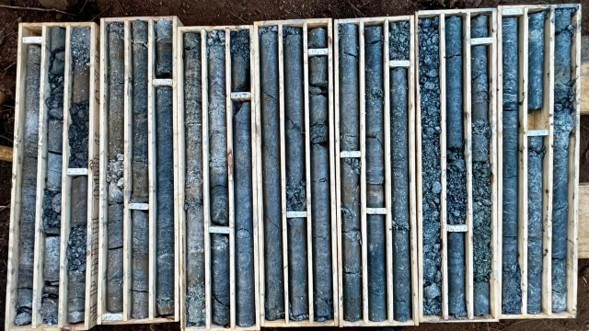
Figure 4 – High-grade saprolitic graphite schist core from drill hole MPDDH-0006.
To view an enhanced version of this graphic, please visit:
https://images.newsfilecorp.com/files/6728/305786_dc1a6508c4384a58_005full.jpg
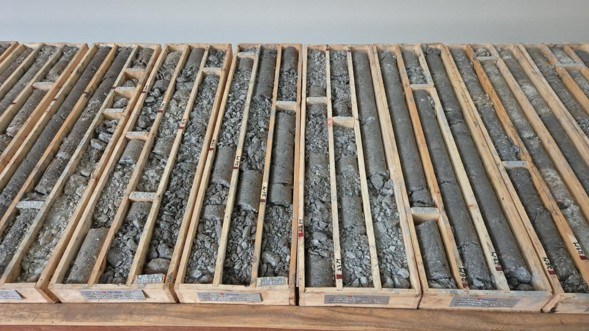
Figure 5 – High-grade saprolitic graphite schist core from drill hole MPDDH-0018.
To view an enhanced version of this graphic, please visit:
https://images.newsfilecorp.com/files/6728/305786_dc1a6508c4384a58_006full.jpg
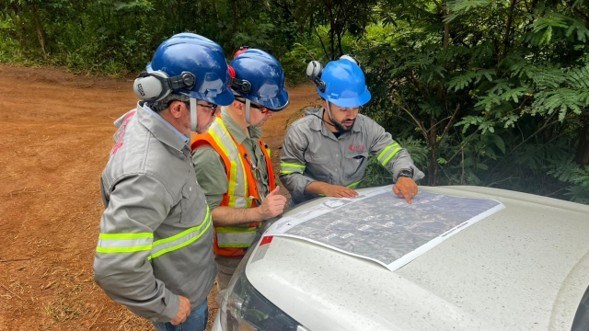
Figure 6 – SGS technical team site visit at the Atlas Critical Minerals Graphite Project.
To view an enhanced version of this graphic, please visit:
https://images.newsfilecorp.com/files/6728/305786_dc1a6508c4384a58_007full.jpg
Next Steps
Conclude the Drilling Campaign: Drilling is now advancing through the two additional, contiguous mineral tenements, covering the remaining ~8.5 kilometers of open strike.
Resource Estimation: Complete the Maiden Mineral Resource Estimate ("MRE") with SGS Canada by Q4 2026. The Company intends to follow the MRE with a Preliminary Economic Assessment ("PEA") in Q1 2027.
Mineralogical Characterization: Complete detailed studies to identify the main mineralogical phases present in the host lithologies.
Bench-Scale Metallurgical Testing: Conduct process optimization and flake-size distribution studies to assess product quality and recovery potential.
About Atlas Critical Minerals Corporation
Atlas Critical Minerals Corporation (NASDAQ: ATCX) is an exploration and development company focused on critical minerals, including rare earths, graphite, and uranium. The Company's focus is to build a diversified global supply chain for the strategic minerals essential for the artificial intelligence revolution, energy transformation, and defense uses. More information is available at www.atlascriticalminerals.com and in the Company's filings with the U.S. Securities and Exchange Commission.
Safe Harbor Statement
This press release contains forward-looking statements within the meaning of Section 27A of the Securities Act of 1933, as amended, and Section 21E of the Securities Exchange Act of 1934, as amended. Forward-looking statements are based upon the current plans, estimates and projections of Atlas Critical Minerals and its subsidiaries and are subject to inherent risks and uncertainties which could cause actual results to differ from the forward-looking statements. Therefore, you should not place undue reliance on these forward-looking statements.
Risks related to the Company and its subsidiaries are discussed in the section entitled "Risk Factors" in the Company's Form 20-F filed with the Securities and Exchange Commission (the "SEC") on February 20, 2026. Please also refer to the Company's other filings with the SEC, all of which are available at www.sec.gov. In addition, any forward-looking statements represent the Company's views only as of today and should not be relied upon as representing its views as of any subsequent date. The Company explicitly disclaims any obligation to update or revise any forward-looking statements to reflect any change in its expectations or any change in events, conditions, or circumstances on which any such statement is based.
Investor Relations
Brian W. Bernier
Vice President, Investor Relations
+1 (833) 661-7900
brian.bernier@atlas-cm.com
https://www.atlascriticalminerals.com/
@Atlas_Crit_Min

To view the source version of this press release, please visit https://www.newsfilecorp.com/release/305786
FAQ
AI-generated questions and answers. How Rhea-AI works. Not financial advice.