
Azitra, Inc. Announces Breakthough Repeat Dose and Anti-Wrinkle Ex Vivo Results for ATR-COSF Program, Demonstrating Increased Distribution and Elasticity
Azitra (NYSE American: AZTR) reported new ex vivo human skin data for its ATR-COSF cosmetic program, a supernatant from engineered S. epidermidis that secretes a recombinant human filaggrin domain (rHDfilaggrin).
Rhea-AI Summary
Azitra (NYSE American: AZTR) reported new ex vivo human skin data for its ATR-COSF cosmetic program, a supernatant from engineered S. epidermidis that secretes a recombinant human filaggrin domain (rHDfilaggrin). Multiple-dose experiments in TH2-stimulated healthy skin explants showed increased rHDfilaggrin penetration through the stratum corneum into the stratum granulosum versus prior single-dose work, with higher concentrations when formulated as a 2% lyophilized hydrogel compared with concentrated supernatant alone.
In a second ex vivo model using defatted human skin, ATR-COSF hydrogels containing 0.09–7.5% (w/w) supernatant increased elasticity in a dose-dependent manner, from 1.6-fold to 4.4-fold. A 0.28% (w/w) formulation restored elasticity to levels historically observed in healthy skin, and a 0.3% (w/w) sample showed about twice the elasticity of placebo. Safety testing found the 2% supernatant hydrogel non-irritating and non-corrosive to skin and eyes, supporting its potential as a high-value anti-wrinkle cosmetic ingredient, according to Azitra.
Positive
- Dose-dependent elasticity gains up to 4.4-fold at 7.5% w/w active
- Elasticity restored to healthy levels at 0.28% w/w supernatant
- Active-treated skin showed ~2x elasticity versus placebo at 0.3% w/w
- Multiple-dose model showed increased rHDfilaggrin penetration versus single-dose work
- 2% supernatant hydrogel classified as non-irritating and non-corrosive in testing
Negative
- None.
News Explained
The July 15 release places ATR-COSF work in ex vivo testing: Azitra will continue optimizing formulations and testing additional ex vivo wrinkle models while designing a human study.
Details
Market reaction after ATR-COSF ex vivo data: AZTR +4.97% in the Jul 15 session
In the Jul 15 session, AZTR gained 4.97%, reflecting a moderate positive market reaction. Argus tracked a peak move of +16.4% during that session. Argus tracked a trough of -5.0% from its starting point during tracking. Our momentum scanner triggered 22 alerts that day, indicating elevated trading interest and price volatility.
Data tracked by StockTitan Argus on the day of publication.
Key Figures
- Supernatant concentration
- 2% lyophilized supernatant
- Hydrogel formulation used in first ex vivo penetration study
- Dose range
- 0.0% to 7.5% w/w
- Supernatant concentrations in elasticity ex vivo model
- Elasticity measurement time
- 20 hours
- Time post application for elasticity assessment
- Incubation temperature
- 30ºC
- Incubation conditions for skin samples
- Minimal effective dose
- 0.09% w/w (1.6-fold)
- Lowest hydogel supernatant level with elasticity enhancement
- Maximal effect dose
- 7.5% w/w (4.4-fold)
- Highest elasticity enhancement in ex vivo model
- Restorative dose
- 0.28% w/w
- Dose restoring abdominoplasty skin elasticity to healthy levels ex vivo
- Active vs placebo elasticity
- ≈2x
- 0.3% w/w supernatant hydrogel vs placebo in ex vivo samples
Historical Context
-
CEO letter detailing strategic reorientation and financing-supported growth initiatives.
-
BIO International presentation on pipeline progress and new filaggrin-based initiative.
-
Adjournment of 2026 annual meeting due to failure to reach quorum.
-
Plan to open and immediately adjourn annual meeting to allow more proxy time.
-
Q1 2026 results with clinical progress, cosmeceutical initiative, and private placement pricing.
24h Move is the share-price change in the day after each event; other market factors may also have contributed.
Key Terms
ex vivo medical
stratum corneum medical
stratum granulosum medical
hydrogel medical
cytokines medical
w/w technical
AI-generated analysis. How Rhea-AI works. Not financial advice.




- ATR-COSF uses a supernatant based formulation containing an active recombinant human domain of the protein, filaggrin ("rHDfilaggrin"). This S. epidermis derived supernatant is in development as a high value cosmetic ingredient
- Ex vivo data successfully showed controlled distribution of the rHDfilaggrin into the stratum granulosum in increased amounts over prior single dose experiments in human skin
- Single dose ex vivo experiments established improvements in elasticity and reduced the appearance of new fine lines and wrinkles in human skin
The ATR-COSF program utilizes the supernatant from a strain of S. epidermidis engineered to secrete a functional unit of the human filaggrin protein. In the first study, ATR-COSF supernatant was found to provide a positive penetration and distribution profile for rHDfilaggrin in a multiple dose, ex vivo model. The study, which utilized fresh, healthy human skin explants, demonstrated a remarkable increase in rHDfilaggrin delivered through the stratum corneum and into the stratum granulosum layers, compared to single dose previous work. Additionally, improved concentration in the stratum corneum and stratum granulosum layers was seen with the formulated product in comparison to concentrated supernatant alone.
The first ex vivo model offers a biologically relevant system for evaluating skin penetration while preserving the architecture of human skin. The healthy human skin explants were first stimulated with TH2 cytokines to reduce the levels of endogenous filaggrin in the samples. The study used a
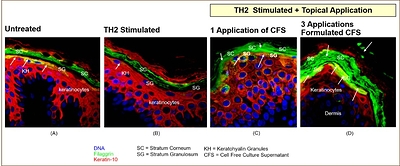
In the figure above, (A) depicts the explanted healthy human skin explant prior to any treatment. Native filaggrin as well as profilaggrin in keratohyalin granules (stained in green) are apparent in the stratum granulosum (SG) layer. (B) shows the skin sample after TH2 cytokine stimulation to reduce or eliminate native filaggrin in the stratum granulosum layer. Furthermore, TH2 cytokine stimulation markedly reduced the presence of keratohyalin granules, resulting in decreased endogenous filaggrin. This reduction facilitates the differentiation and detection of rHDfilaggrin following application. (C) shows penetration and distribution of rHDfilaggrin into the stratum granulosum layer after one application of the cell free supernatant. (D) shows penetration and distribution of rHDfilaggrin into the stratum granulosum layer after three applications of the lyophilized cell free supernatant in a hydrogel formulation.
The second ex vivo model utilized defatted human skin explants to assess the effect of the lyophilized rHDfilaggrin supernatant in a hydrogel formulation on human skin elasticity. Concentrations of the supernatant in the hydrogel were varied from
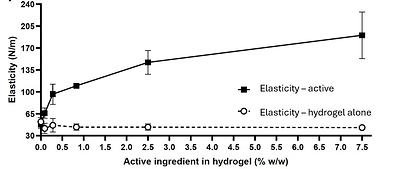
The hydrogel containing the lyophilized supernatant was active in increasing the elasticity of ex vivo human skin sections in a dose-dependent manner. Minimal and maximum effects in elasticity enhancement were observed in hydrogels containing
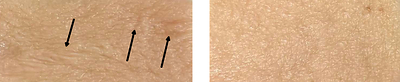
"Our team at Azitra continues to be highly motivated by the prospects of our ATR-COSF program and its potential to have a substantial effect on improving the appearance of fine lines and wrinkles. Our plan is to continue to optimize our formulations and test on additional ex vivo human wrinkle models as we head towards starting our human study, which is being designed to translate our cutting edge science into observable, visible wrinkle reduction benefits for consumers," said Francisco Salva, CEO of Azitra. "Filaggrin is a protein that is critical to the maintenance of our skin's elasticity and pliability and overall healthy appearance."
About Azitra, Inc.
Azitra, Inc. is a clinical-stage biopharmaceutical company focused on developing innovative therapies for precision dermatology and novel products across therapeutics, cosmeceuticals and biotechnology applications. The Company's portfolio is highlighted by ATR-COSF, a recombinant protein technology designed for cosmetic and skincare applications, and ATR-04, an investigational live biotherapeutic for EGFR inhibitor ("EGFRi") associated rash. Azitra has received Fast Track designation from the FDA for EGFRi associated rash, which impacts approximately 150,000 people in the U.S. Azitra is also advancing additional recombinant protein initiatives designed to support biotechnology research and manufacturing applications. Azitra's technology platforms combine engineered proteins, topical live biotherapeutics, artificial intelligence, and a proprietary microbial library to develop differentiated products for consumer, research and healthcare markets. For more information, please visit https://azitrainc.com.
Forward-Looking Statements
This press release contains forward-looking statements within the meaning of the Private Securities Litigation Reform Act of 1995, as amended. These statements may be identified by words such as "aims," "anticipates," "believes," "could," "estimates," "expects," "forecasts," "goal," "intends," "may," "plans," "possible," "potential," "seeks," "will," and variations of these words or similar expressions that are intended to identify forward-looking statements. Any such statements in this press release that are not statements of historical fact may be deemed to be forward-looking statements. These forward-looking statements include, without limitation, statements regarding the expected timing of (i) our provision of initial safety data and topline results for the Phase 1b trial for our ATR-12, (ii) the abstract detailing the Phase 1/2 clinical trial for our ATR-04 program, (iii) our provision of initial safety data and topline results for the Phase 1/2 clinical trial for our ATR-04 program, and (iv) statements about our clinical and preclinical programs, including ATR-COSF, and corporate and clinical/preclinical strategies, including our cosmeceutical strategy.
Any forward-looking statements in this press release are based on current expectations, estimates and projections only as of the date of this release and are subject to a number of risks and uncertainties that could cause actual results to differ materially and adversely from those set forth in or implied by such forward-looking statements. These risks and uncertainties include, but are not limited to: the timing of clinical trials and their results; we may experience delays in the provision of initial safety data and topline results for ATR-COSF, ATR-12 and ATR-04 and, if we do, such data and results may not be favorably received; the safety and efficacy of our product candidates; possible delays in regulatory approval or changes in regulatory framework that are out of our control; our estimation of addressable markets of our product candidates may be inaccurate; we may fail to timely raise additional required funding; more efficient competitors or more effective competing treatment may emerge; we may be involved in disputes surrounding the use of our intellectual property crucial to our success; we may not be able to attract and retain key employees and qualified personnel; earlier study results may not be predictive of later stage study outcomes; and we are dependent on third-parties for some or all aspects of our product manufacturing, research and preclinical and clinical testing. Additional risks concerning Azitra's programs and operations are described or incorporated by reference in our annual report on Form 10-K filed with the United States Securities and Exchange Commission (the "SEC") on February 27, 2026 and our quarterly report on Form 10-Q filed on May 13, 2026 with the SEC. Azitra explicitly disclaims any obligation to update any forward-looking statements except to the extent required by law.
Contact
Norman Staskey
Chief Financial Officer
staskey@azitrainc.com
Investor Relations
Tiberend Strategic Advisors, Inc.
David Irish
231-632-0002
dirish@tiberend.com
Media Relations
Tiberend Strategic Advisors, Inc.
Casey McDonald
646-577-8520
cmcdonald@tiberend.com
 View original content to download multimedia:https://www.prnewswire.com/news-releases/azitra-inc-announces-breakthough-repeat-dose-and-anti-wrinkle-ex-vivo-results-for-atr-cosf-program-demonstrating-increased-distribution-and-elasticity-302826522.html
SOURCE Azitra, Inc.
FAQ
AI-generated questions and answers. How Rhea-AI works. Not financial advice.