
STOCK TITAN

New Report Reveals Widespread Misunderstanding of Consumer Messaging App Security Across Government and Critical Infrastructure

(Moderate)
(Negative)
Tags

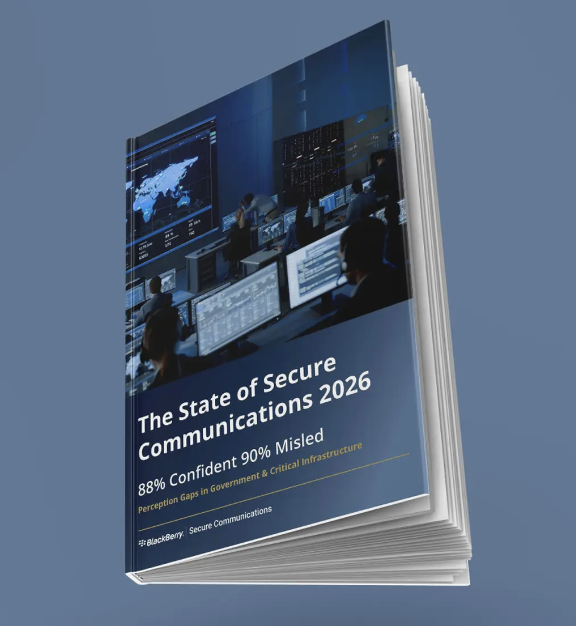
BlackBerry (NYSE:BB) released The State of Secure Communications 2026, a survey of 700 security decision-makers in government and critical infrastructure across the US, UK, Canada and Singapore.

Key findings: 83% report WhatsApp is used for sensitive discussions, 98% rely on foreign-hosted platforms despite 55% prioritizing sovereignty, and 49% have unified crisis communications.

Loading...
Loading translation...

Positive

  • 83% report WhatsApp used for sensitive discussions
  • 98% rely on foreign-hosted communication platforms
  • 55% prioritize sovereign control over communications infrastructure

Negative

  • 88% express confidence despite widespread encryption misunderstandings
  • 52% mistakenly believe encryption protects metadata
  • 49% lack a unified crisis communications platform

News Market Reaction – BB

+2.00%
2 alerts
+2.00% Session close to close
-9.8% Trough Tracked
$3.23B Market Cap
0.2x Rel. Volume

In the Apr 21 session, BB gained 2.00%, reflecting a moderate positive market reaction. Argus tracked a trough of -9.8% from its starting point during tracking. Our momentum scanner triggered 2 alerts that day, indicating moderate trading interest and price volatility.

Data tracked by StockTitan Argus on the day of publication.

Market Context

This announcement underscores a substantial gap between perceived and actual security in government ...
Analysis

This announcement underscores a substantial gap between perceived and actual security in government and critical‑infrastructure messaging, with figures like 83% WhatsApp use for sensitive talks and 98% reliance on foreign‑hosted platforms. It reinforces the strategic positioning of BlackBerry’s Secure Communications division highlighted in recent filings. Investors watching this theme often focus on how awareness of risks translates into demand for higher‑assurance platforms and how that complements earlier QNX, defence partnerships, and FY26 profitability milestones.

Key Figures

WhatsApp use for sensitive talks: 83% Reliance on foreign-hosted platforms: 98% Crisis-ready self-assessment: 90% +5 more
8 metrics
WhatsApp use for sensitive talks 83% Share of security leaders reporting WhatsApp used for sensitive discussions
Reliance on foreign-hosted platforms 98% Organizations relying on platforms unable to deliver sovereign control
Crisis-ready self-assessment 90% Organizations saying they are confident managing major incidents
Unified crisis platforms 49% Organizations with a unified crisis communications platform
Survey participants 700 Security decision-makers surveyed across four countries
Prioritize sovereign control 55% Respondents prioritizing sovereign control of communication infrastructure
Confidence in messaging app security 88% Security leaders confident in current messaging app security
Believe encryption protects metadata 52% Leaders who think encryption protects metadata like location and IP

Historical Context

5 past events · Latest: Apr 20 (Positive)
Pattern 5 events
Date Event Sentiment 24h Move Catalyst
Apr 20 Edge AI collaboration Positive +13.2% QNX OS for Safety integrated with NVIDIA IGX Thor for safety‑critical edge AI.
Apr 19 Auto platform win Positive +13.2% Leapmotor selected QNX software as core platform for D19 premium electric SUV.
Apr 16 Secure comms partnership Positive +14.1% Partnership to integrate SecuSUITE into naval and military communication systems.
Apr 15 Defence collaboration Positive +3.5% QNX platform selected for next‑gen naval programs including Canadian submarine project.
Apr 09 Earnings results Positive +8.2% FY26 earnings showed revenue growth, profitability, and strong QNX and backlog metrics.

24h Move is the share-price change in the day after each event; other market factors may also have contributed.

Pattern Detected

Recent BlackBerry news on QNX, Secure Communications, and earnings has repeatedly coincided with positive one-day price moves, suggesting the market has rewarded strategic and operational updates.

Recent Company History

Over the past weeks, BlackBerry has reported several positive developments. On Apr 9, it posted profitable FY26 results with revenue growth. Mid‑April brought naval and defence collaborations via QNX and Secure Communications, followed by an automotive win with Leapmotor’s D19 SUV and an expanded edge‑AI collaboration with NVIDIA on Apr 20. Each of these items saw positive next‑day reactions, framing today’s secure communications survey release within a string of favorable, security‑focused announcements.

Key Terms

encryption, data sovereignty, metadata, deepfake, +3 more
7 terms
encryption technical
""designed to handle sensitive communications, protect confidentiality, or meet the demands of high-security environments," ... "and encryption protects the channel, not who is on it.""
Encryption is a way of locking digital information so only someone with the correct electronic key can read it, like putting a message into a sealed, coded envelope. For investors it matters because strong encryption helps protect customer data, trade secrets and financial records from theft or tampering, supports legal and regulatory compliance, and preserves a company’s reputation and value by reducing the risk of costly breaches.
data sovereignty technical
"Ownership and control of the infrastructure behind sensitive communications is emerging as a critical blind spot, exposing gaps in data sovereignty."
Data sovereignty is the principle that digital information is subject to the laws and control of the country or entity where it is stored or processed. For investors, it matters because where data lives affects a company's legal obligations, costs, ability to sell services across borders, and exposure to government access or restrictions — like owning a house that must follow the rules of the town it sits in.
metadata technical
"52% mistakenly believe encryption protects metadata - including location data, IP addresses, and communication patterns"
Metadata is descriptive information about a piece of data—like a label on a file or an index card for a document—that explains what the data is, when it was created, who produced it, and how it was generated. For investors, metadata matters because it helps verify authenticity, track provenance, and make large data sets searchable and comparable, which supports due diligence, regulatory compliance, and more reliable analysis of financial or clinical information.
deepfake technical
"47% believe it prevents impersonation, deepfake, or spoofing attacks"
A deepfake is an audio or video created or altered by artificial intelligence to make someone appear to say or do things they never did; think of it as a highly convincing digital impersonation. For investors, deepfakes matter because they can trigger sudden swings in a company’s stock, spread false news, enable fraud or insider manipulation, and raise legal or reputation risks that affect a firm's value and regulatory exposure.
spoofing technical
"47% believe it prevents impersonation, deepfake, or spoofing attacks"
Placing fake buy or sell orders with the intent to trick other market participants and then canceling them before execution; the goal is to create a false impression of demand or supply and move a security’s price. Think of it like pretending to bid at a yard sale to make an item seem more desirable, then backing out — it can mislead investors, distort prices and trading volume, and lead to regulatory enforcement and financial losses.
View in glossary
espionage regulatory
"fresh advisories about state-backed espionage attacks targeting Signal and WhatsApp accounts"
Espionage is the secret gathering of confidential or proprietary information—such as trade secrets, strategic plans, customer data, or technology—by individuals or groups who do not have permission to access it. It matters to investors because stolen information can erode a company’s competitive edge, trigger legal or regulatory trouble, and lead to sudden declines in revenue or stock value; think of it like someone sneaking the answers out of a locked safe, leaving the owner exposed and disadvantaged.
interception-resistant technical
"with interception-resistant, government-grade secure voice and messaging"
Interception-resistant describes a product, system or communication method designed to prevent unauthorized parties from capturing or reading transmitted information even if they can access the signals. For investors, interception resistance lowers the risk of costly data breaches, regulatory fines and loss of customer trust; like a sealed envelope instead of a postcard, stronger protection helps preserve value and can be a competitive advantage in security-sensitive markets.

AI-generated analysis. How Rhea-AI works. Not financial advice.

See more from StockTitan in Google Search and AI answers. Adds StockTitan as a preferred source · opens Google
Add on Google
  • 83% report WhatsApp is used for sensitive discussions, despite widespread misunderstanding of what encryption protects

  • 98% rely on platforms unable to deliver the sovereign control they say they want

  • 90% of organizations say they are crisis-ready, yet only 49% have unified crisis communications platforms

WATERLOO, ON / ACCESS Newswire / April 21, 2026 / BlackBerry Secure Communications, a division of BlackBerry Limited (NYSE:BB)(TSX:BB), today released The State of Secure Communications 2026, a survey of 700 security decision-makers across government and critical infrastructure in the United States, the United Kingdom, Canada, and Singapore. The findings reveal a widening gap between confidence in communications security and the reality of risk exposure - with significant national security implications. Among the most striking findings: 83% of security leaders report that WhatsApp is being used for sensitive discussions inside their organizations.

The Sovereignty Paradox

Ownership and control of the infrastructure behind sensitive communications is emerging as a critical blind spot, exposing gaps in data sovereignty. While 55% prioritize sovereign control, virtually all (98%) rely on foreign-hosted platforms not built for confidential communications or high-security environments. Meanwhile, 52% are concerned telecom networks could be monitored or disrupted - a tangible risk already demonstrated by espionage campaigns targeting network operators, such as Salt Typhoon and more recently, UNC3886 in Singapore.

"Consumer messaging apps were never designed to handle sensitive communications, protect confidentiality, or meet the demands of high-security environments," said Christine Gadsby, Chief Security Advisor, BlackBerry Secure Communications. "They rely on phone numbers, not verified identities - and encryption protects the channel, not who is on it. That gap is already being exploited, as recent intelligence warnings show, and governments and critical infrastructure organizations are responding by moving toward communications infrastructure they own and trust."

Confidence Built on Misunderstanding

These findings come as intelligence agencies in the United States, the United Kingdom and Europe issue fresh advisories about state-backed espionage attacks targeting Signal and WhatsApp accounts of public officials and journalists. This highlights how the threat surface is shifting from networks to consumer messaging platforms now embedded in daily critical operations.

Yet 88% of security leaders surveyed expressed confidence in their current messaging app security. That confidence is built on a fundamental misread of what these platforms actually protect, significantly increasing risk exposure. The report reveals critical gaps in encryption literacy among the very leaders responsible for safeguarding communications:

  • 52% mistakenly believe encryption protects metadata - including location data, IP addresses, and communication patterns

  • 47% believe it prevents impersonation, deepfake, or spoofing attacks

  • 41% assume communications remain secure, even after a device has been compromised

This gap between perception and reality is now playing out in real-world incidents, with governments increasing restrictions and warnings about the use of consumer apps for sensitive communications, recognizing that encryption alone does not address the full risk.

The Risks of Improvised Crisis Response

These gaps become most visible when organizations are under pressure. While 90% say they are confident in managing major incidents, fewer than half (49%) have a unified platform to coordinate response.

In practice, the survey shows many rely on a patchwork of everyday tools - from group chats (54%) and email threads (51%) to shared spreadsheets (29%) and phone trees (19%). Familiar as they are, these tools were never designed for crisis coordination, and cannot deliver the real-time visibility, command and control or secure cross-agency communication that major incidents demand.

Limits of "Good Enough" Security

Overall, the findings point to a consistent pattern: security leaders across government and critical infrastructure are relying on communications platforms not designed for the security, sovereignty or crisis demands they now face. The issue is not encryption alone, but architecture. Many consumer platforms generate and retain metadata, operate under foreign data-access laws, and lack the controls required for high-value or classified communications.

As threats evolve, from account compromise to large-scale surveillance, what may appear "secure enough" can quickly become a costly attack surface. The question is no longer whether these platforms are being exploited. It is whether the organizations relying on them recognize the risk.

To learn how BlackBerry Secure Communications is protecting governments and critical infrastructure worldwide with interception-resistant, government-grade secure voice and messaging, visit BlackBerry.com/SecureCommunications.

Survey Methodology

The State of Secure Communications 2026 was conducted by OnePoll on behalf of BlackBerry. The survey included 700 security decision-makers across government and critical infrastructure organizations in the United States, the United Kingdom, Canada, and Singapore.
# # #

About BlackBerry

BlackBerry (NYSE:BB)(TSX:BB) provides enterprises and governments the software and services that power the world around us. Headquartered in Waterloo, Ontario, its high-performance foundational software enables automakers and industrial leaders to unlock new applications and business models without compromising safety, security, or reliability. With a deep heritage in Secure Communications, BlackBerry delivers a highly secure, extensively certified portfolio for mobile fortification, mission-critical communications, and critical events management.

For more information, visit BlackBerry.com and follow @BlackBerry.

Media Contacts:

BlackBerry Media Relations
+1 (519) 597-7273
mediarelations@BlackBerry.com

SOURCE: BlackBerry


View the original press release on ACCESS Newswire

FAQ

What did BlackBerry (BB) report about WhatsApp use in sensitive government communications on April 21, 2026?

The report found 83% of security leaders say WhatsApp is used for sensitive discussions. According to BlackBerry, this highlights reliance on consumer apps not designed for high-security or sovereign control.

How many organizations in the BlackBerry (BB) survey rely on foreign-hosted messaging platforms?

The survey shows 98% rely on foreign-hosted platforms despite sovereignty concerns. According to BlackBerry, this creates a sovereignty paradox where control priorities conflict with actual infrastructure choices.

What encryption misconceptions did BlackBerry (BB) identify among security leaders in 2026?

52% mistakenly think encryption protects metadata; 47% believe it prevents impersonation. According to BlackBerry, these gaps increase exposure to spoofing, deepfakes, and post-compromise risks.

How prepared are organizations for major incidents according to BlackBerry (BB)'s April 21, 2026 survey?

While 90% claim crisis readiness, only 49% have unified crisis communications platforms. According to BlackBerry, many still use ad hoc tools like group chats and spreadsheets for incident response.

What national-security risks did BlackBerry (BB) highlight in The State of Secure Communications 2026?

The report flags account compromise, metadata exposure, and foreign data-access laws as risks to operations. According to BlackBerry, these issues shift the threat surface from networks to consumer messaging platforms.
