
Biohaven Drives New Research in Graves' Disease: Phase 3 Pivotal Trial with BHV-1300 Underway and Three Scientific Posters at the 2026 American Thyroid Association Annual (ATA) Meeting
Early clinical results showed thyroid hormone normalization, while the Ono licensing agreement brought $80 million upfront.
Sentiment and the balance of points
Rhea-AI Sentiment reads the wording of the document, how positive or negative its language is on a 1 to 5 scale. The balance of points shown with the takes weighs what the document actually discloses, so the two can disagree, for example when a trial that missed its main goal is described in upbeat language.
Rhea-AI Summary
Biohaven (NYSE: BHVN) is enrolling patients in its pivotal Phase 3 trial of BHV-1300 for Graves' disease across more than 55 sites. The trial targets approximately 300 adults and evaluates normal thyroid function at week 26 without antithyroid drugs. Additional sites are activating through the fourth quarter of 2026 and first quarter of 2027.
In Phase 1b, weekly subcutaneous BHV-1300 1000 mg reduced disease-driving antibodies by approximately 80% by week 12; free T4 and free T3 thyroid hormones normalized at medians of 3 and 5 weeks, respectively. Biohaven received $80 million upfront from its October licensing agreement with Ono Pharmaceutical, with another $20 million milestone anticipated within a year and approximately twenty percent royalties on territorial net sales. Three ATA posters cover patient experience and preclinical BHV-1440 research, including normalization of elevated T4 within 24 hours in a mouse model.
How this balance works
Rhea-AI gives every point it takes from this document a weight. Minor counts 1, Moderate 3 and Major 9, so one Major point outweighs several Minor ones. The bar adds up the weights on each side, and when neither side holds more than 65% of the total the balance reads Mixed.
It reads the document as published, with the same rules for every company, and it does not look at what the market expected or at how the stock traded, so a point can be objectively good on a day the stock falls.
Rhea-AI Sentiment measures something else, the tone of the wording.
Hollow bars mark forward-looking points. How the balance works
Positive
- Moderate pointPhase 3 BHV-1300 enrollment is underway at more than 55 active sites in the United States and Canada.
- Moderate pointPhase 1b disease-driving antibodies fell approximately 80% by week 12 with weekly subcutaneous BHV-1300 1000 mg.
- Moderate point$80 million upfront received from Ono for the MoDE pan IgG portfolio license in specified Asian markets. 3.5% of market cap
- Minor point. Forward-looking: it has not happened yet and may not happen.Additional Phase 3 sites are activating through fourth-quarter 2026 and first-quarter 2027.
- Minor pointFree T4 and free T3 normalized at medians of 3 and 5 weeks in Phase 1b.
9 minor points
- Minor pointIgG3, IgA, IgM and IgE were preserved in the BHV-1300 Phase 1b study.
- Minor pointNearly 200 Phase 1 recipients received MoDE and TRAP degraders; most adverse events were mild and self-resolving.
- Minor point. Forward-looking: it has not happened yet and may not happen.A further $20 million milestone is available, with achievement anticipated within a year.
- Minor point. Forward-looking: it has not happened yet and may not happen.Approximately twenty percent royalties apply to net sales in Ono's licensed territory.
- Minor pointRights outside Ono's territory remain with Biohaven, alongside worldwide rights to TRAP degraders.
- Minor pointPreclinical BHV-1440 drove antibody uptake in human liver cells from three donors, averaging EC50 of 0.73 nM.
- Minor pointSingle-dose BHV-1440 in mice reduced circulating M22 antibody within two hours and normalized elevated T4 by 24 hours.
- Minor pointBHV-1440 mouse tissue findings showed antibody redistribution from thyroid to liver within 30 minutes and improved thyroid structure.
- Minor pointA BHV-1440 analog depleted anti-TSHR IgG in patient samples to levels seen in healthy controls.
Negative
- None.
Key Figures
- Phase 3 trial enrollment
- approximately 300 adults
- Randomized, double-blind, placebo-controlled study
- Primary assessment
- week 26
- Restoration of normal thyroid function without an antithyroid drug
- Anti-TSHR-IgG1 reduction
- approximately 80%
- Phase 1b study, by week 12
- Free T4 normalization
- median of 3 weeks
- Phase 1b study
- Free T3 normalization
- median of 5 weeks
- Phase 1b study
- Upfront license payment
- $80 million
- Ono Pharmaceutical license
- Potential milestone
- $20 million
- Milestone anticipated within a year
- Territory royalties
- approximately 20%
- Royalties on net sales in the licensed territory
Previous Clinical trial Reports
-
Ono licensed the MoDE IgG degrader portfolio, including BHV-1300, for specified Asian markets.
-
Biohaven enrolled the first patient in the pivotal BHV-1300 Graves' disease study.
24h Move is the share-price change in the day after each event; other market factors may also have contributed.
Key Terms
asgpr medical
igg1 medical
lysosome medical
AI-generated analysis. How Rhea-AI works. Not financial advice.


- Biohaven presents three posters at ATA, highlighting the patient experience, autoimmune biology of disease, and MoDE and TRAP platform, reflecting a research program built around a condition that remains strikingly understudied relative to its prevalence.
- No new therapy has been approved for Graves' disease in more than seventy years. Antithyroid drugs, radioactive iodine and thyroidectomy manage thyroid hormone output; none removes the autoantibody that causes the disease.
- Biohaven's Phase 3 trial of BHV-1300 in Graves' disease (NCT07661056) is enrolling at more than 55 active sites in
the United States andCanada , with additional sites opening inJapan ,UK ,Australia , and EU. BHV-1300 is the first MoDE extracellular protein degrader to reach a pivotal study. - In a Phase 1b study, weekly subcutaneous BHV-1300 1000 mg produced mean reductions in pathogenic anti-TSHR-IgG1 autoantibodies of approximately
80% by week 12, with normalization of free T4 at a median of 3 weeks and free T3 at a median of 5 weeks in patients who were hyperthyroid despite antithyroid drug therapy, while sparing IgG3. - A pivotal trial, a key collaboration expanding the technology into
Asia , and three scientific posters at ATA underscore the company's progress in advancing its Graves' disease program—from molecular science and autoimmune biology to the patient experience—in a disease that has seen no new therapy in seventy years.
A Pivotal Trial Advances the Science for Patients
Graves' disease is diagnosed and driven by autoantibodies against the thyroid-stimulating hormone receptor (TSHR). Classical immunology work established that thyroid-stimulating activity in patients with Graves' disease is largely confined to the IgG1 subclass, in contrast to the unrestricted subclass distribution of other thyroid autoantibodies. BHV-1300 was selected for this disease on exactly that basis. As a small-molecule degrader of IgG1, IgG2 and IgG4, it engages the body's own hepatic clearance machinery to remove the pathogenic subclass that carries the disease-driving activity, while sparing IgG3, which mediates protection against bacteria, viruses and parasites.
BHV-1300 is built on Biohaven's MoDE™ extracellular protein degrader technology, exclusively licensed from Yale University, where it originated in the laboratory of David Spiegel, M.D., Ph.D. The principle is subtraction, not suppression: a MoDE extracellular protein degrader is designed to remove the disease-causing protein from the body rather than suppress its production or block its activity. One end of the bifunctional small molecule binds the target in circulation, and the other engages the asialoglycoprotein receptor (ASGPR), which is abundant on liver cells and is part of the body's natural system for clearing proteins from circulation. The target is then taken up by the liver cell and degraded in the lysosome, while ASGPR recycles to the cell surface. Dr. Spiegel was the first to patent targeted extracellular protein degraders that use ASGPR. Biohaven is pioneering the clinical use of an extracellular protein degrader that pairs a targeting mechanism with ASGPR in the liver to remove a disease-causing target in patients.
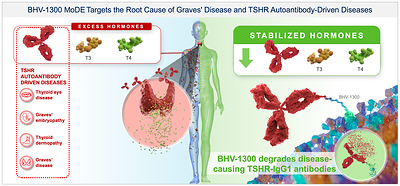
Figure 1. BHV-1300 degrades the disease-causing TSHR-IgG1 autoantibody that drives Graves' disease, stabilizing thyroid hormone levels and targeting the root autoimmune cause of Graves' disease and associated TSHR autoantibody-driven conditions, including thyroid eye disease, thyroid dermopathy and Graves' embryopathy.
That design has translated to patients. In a Phase 1b study, BHV-1300 lowered TSHR-IgG1 by approximately
The Phase 3 study is a randomized, double-blind, placebo-controlled trial in approximately 300 adults, evaluating restoration of normal thyroid function at week 26 in the absence of an antithyroid drug. It is open at more than 55 sites across
Extending the Reach of the Technology
In October 2026, Ono Pharmaceutical licensed the MoDE pan IgG degrader portfolio, led by BHV-1300 and including next-generation degraders BHV-1310 and BHV-1320, in
Documenting the Burden of Graves' Disease and the Lived Experience of Patients With the Disease
Graves' disease affects roughly
A series of semi-structured interviews were conducted, and findings were coded into symptom and impact concepts. Symptoms were highly concurrant: 13 of 14 participants (
Using the same interview data, reported symptoms and impacts were mapped against the ThyPRO-39 short form, item by item, to assess the coverage of this scale developed for a range of benign thyroid disorders to the specific experiences of patients with Graves' Disease. Concepts mapped to 31 of 38 items and every scale had at least one patient endorsed item, supporting its patient-centricity in this population.
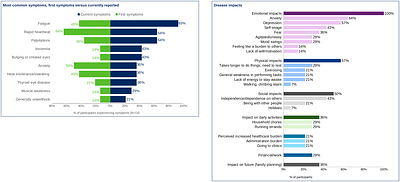
Figure 2. Most common symptoms reported by participants with Graves' disease, first symptoms versus currently reported (left), and disease impacts across emotional, physical, social, daily activity, healthcare, financial and family planning domains (right). N=14.
"Patients told us something our standard measures may not have fully captured. The people who said their thyroid levels were well controlled were still describing fatigue, palpitations, anxiety and effects on how they see themselves," said Michele Potashman, Ph.D., Head of Clinical Outcomes Assessments and Health Economics at Biohaven. "Biochemical control is not the same as feeling well. What these interviews make clear is how much the daily lives of patients are still impacted while their disease is considered managed". As the autoantibody that drives Graves' disease may still be present in patients who have achieved biochemical control, therapies that address the direct cause of the disease are of great interest to patients.
Characterizing the Autoantibody Biology
Alongside the clinical and patient-experience work, Biohaven continues to investigate the autoantibody biology underlying Graves' disease and its associated conditions. The third poster presents the preclinical characterization of BHV-1440, a TRAP degrader engineered to bind anti-TSHR autoantibodies and direct them to ASGPR for lysosomal degradation.
BHV-1440 bound the patient-derived anti-TSHR antibody M22 and ASGPR simultaneously, inducing formation of a ternary complex and driving internalization of M22 in primary human hepatocytes across three donors with an average EC50 of 0.73 nM. In a mouse passive-transfer model, a single subcutaneous dose of BHV-1440 reduced circulating M22 within two hours and returned elevated T4 to baseline levels by 24 hours. The tissue findings are the most informative: within 30 minutes of dosing, anti-TSHR antibody signal fell in thyroid tissue while hepatic signal rose and colocalized with the lysosomal marker LAMP1, tracing the antibody from its site of action to its site of disposal. Moreover, BHV-1440 restored follicular histology toward normal. In patient samples, a biotinylated BHV-1440 analog depleted anti-TSHR IgG to the levels seen in healthy controls.
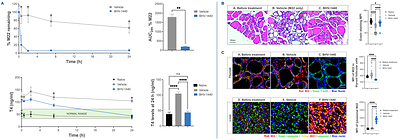
Figure 3. Preclinical activity of BHV-1440. (A) A single subcutaneous dose rapidly depletes circulating anti-TSHR antibody M22 and normalizes T4 levels over 24 hours. (B) Subcutaneous BHV-1440 restores eosin staining of follicular lumens and normalizes thyroid histology. (C) BHV-1440 reduces M22 signal in thyroid tissue with a corresponding increase in hepatic lysosomal M22.
"Graves' disease has gone more than seventy years without a new approved therapy, despite affecting millions of patients. We are committed to changing that with a comprehensive strategy that elevates the science and the patient experience," said Tova Gardin, M.D., MPP, Chief Translational Officer of Biohaven. "We are advancing a pivotal trial of an investigational therapy designed to address the pathogenic autoantibody at the root of the disease, while simultaneously advancing research to better define the patient experience, strengthen how it is measured, and deepen our understanding of the underlying biology. Our goal is to deliver meaningful progress for a patient community that has waited far too long."
Presentation Details
|
Poster 1 |
The Under-Recognized Burden of Graves' Disease: Insights Obtained from |
|
Poster 2 |
Qualitative Interview-Based Validation of the ThyPRO-39 Short Form in Graves' |
|
Poster 3 |
BHV-1440: Novel TRAP™ Degrader for the Treatment of Graves' Disease |
|
Meeting |
2026 ATA Annual Meeting, November 4 to 7, 2026 |
|
Location |
|
About Graves' Disease
Graves' disease is the most common cause of hyperthyroidism and is driven by autoantibodies that stimulate the TSH receptor. It affects roughly
About BHV-1300
BHV-1300 is an investigational small molecule and potential first-in-class extracellular IgG degrader, rationally designed to leverage the body's natural hepatic clearance mechanisms to selectively target and remove IgG1, IgG2 and IgG4, the principal drivers of many immune-mediated diseases. BHV-1300 spares IgG3 to preserve patient immune protection against bacteria, viruses and parasites, does not accelerate clearance of co-administered biologic therapies, and avoids the class effects of cholesterol elevation, albumin reduction and headache associated with FcRn inhibitors. In ongoing Phase 1 studies, subcutaneously administered BHV-1300 produced rapid, deep and sustained reductions in total IgG of up to
About BHV-1440
BHV-1440 is an investigational TRAP degrader designed to selectively bind anti-TSHR autoantibodies and direct them to liver cells for lysosomal degradation. BHV-1440 is in preclinical research, has not been approved by any regulator, and its safety and efficacy have not been established.
About the MoDE and TRAP Degrader Platforms
Originating from research in the laboratory of Dr. David Spiegel at Yale University, Biohaven's MoDE platform is the first clinically validated technology enabling the targeted degradation of disease-causing proteins in the extracellular space. Each MoDE is a bispecific small molecule that binds a pathogenic target and directs it to the liver through the asialoglycoprotein receptor (ASGPR) for rapid and deep degradation via the body's own endosomal and lysosomal pathways. This approach offers a differentiated profile relative to FcRn-targeting antibodies, including rapid onset of action, deep and tunable lowering, patient-friendly subcutaneous self-administration, and the potential to be combined with standard-of-care biologic therapies. Biohaven's next-generation TRAP degraders extend the platform with highly selective molecules, each engineered to remove a single specific disease-causing protein. Together, the MoDE and TRAP platforms form the foundation of a broad, diverse and rapidly expanding pipeline of precision immunology therapeutics with the potential to address a wide range of immune-mediated and other diseases.
About Biohaven
Biohaven Ltd. (NYSE: BHVN) is a biopharmaceutical company focused on the discovery, development, and commercialization of life-changing treatments across immunology, neuroscience, and oncology. Biohaven is advancing an innovative portfolio of therapeutics built on proven drug development experience and multiple proprietary platforms, including Kv7 ion channel modulation for epilepsy; MoDE and TRAP extracellular protein degradation for immunological diseases; next generation ADC platform for oncology; and myostatin inhibition for neuromuscular and metabolic diseases, including obesity. For more information, visit www.biohaven.com.
Forward-Looking Statements
This news release contains forward-looking statements within the meaning of the Private Securities Litigation Reform Act of 1995, including statements about the potential of BHV-1300, BHV-1440 and other MoDE and TRAP degraders, the conduct, timing, site activation, enrollment and outcome of the Phase 3 trial of BHV-1300 in Graves' disease, the development and commercialization of Biohaven's product candidates, the anticipated benefits of the collaboration with Ono Pharmaceutical including the receipt of milestone and royalty payments, and the future development of Biohaven's degrader programs. Words such as "designed to," "intends," "potential," "believe," "may," "will" and "continue" identify forward-looking statements. These statements are not guarantees of future performance and involve risks and uncertainties, including whether planned clinical sites activate on the anticipated timeline, whether enrollment proceeds as expected, whether preclinical results will be reproduced in humans, whether early clinical findings will be confirmed in larger controlled trials, the outcomes of clinical trials, decisions by the U.S. Food and Drug Administration and other regulators, the availability of funding and partners, and the other risks described in Biohaven's filings with the U.S. Securities and Exchange Commission, including the sections titled "Risk Factors." Qualitative interview studies described in this release were conducted in a small, self-reported sample and are not designed to estimate prevalence or to support efficacy claims. Forward-looking statements speak only as of the date of this release, and Biohaven undertakes no obligation to update them except as required by law.
MoDE and TRAP are trademarks of Biohaven Therapeutics Ltd.
Investor Contact
Jennifer Porcelli, Vice President, Investor Relations
jennifer.porcelli@biohavenpharma.com | +1 (201) 248-0741
Media Contact
Mike Beyer, Sam Brown Inc.
mikebeyer@sambrown.com | +1 (312) 961-2502

 View original content to download multimedia:https://www.prnewswire.com/news-releases/biohaven-drives-new-research-in-graves-disease-phase-3-pivotal-trial-with-bhv-1300-underway-and-three-scientific-posters-at-the-2026-american-thyroid-association-annual-ata-meeting-302930094.html
SOURCE Biohaven Ltd.
FAQ
AI-generated questions and answers. How Rhea-AI works. Not financial advice.
What is Biohaven's Phase 3 BHV-1300 trial testing in Graves' disease?
The trial evaluates restoration of normal thyroid function at week 26 without an antithyroid drug in approximately 300 adults. It is randomized, double-blind and placebo-controlled, meaning treatment assignment is concealed from patients and investigators and compared with an inactive treatment.
What did Biohaven's BHV-1300 Phase 1b study show?
Weekly subcutaneous BHV-1300 1000 mg produced mean reductions in disease-driving anti-TSHR-IgG1 antibodies of approximately 80% by week 12. Free T4 normalized at a median of 3 weeks and free T3 at a median of 5 weeks in patients who remained hyperthyroid despite antithyroid drug therapy.
Which territories and drugs does Biohaven's Ono licensing agreement cover?
Ono licensed the MoDE pan IgG degrader portfolio, led by BHV-1300 and including BHV-1310 and BHV-1320, in Japan, South Korea, Taiwan and ASEAN. Biohaven retains rights outside that territory, including the United States, Europe and China, and retains worldwide rights to its TRAP degraders.