
Biohaven's Novel FGFR3-Directed ADC with Proprietary TopoIx Payload, BHV-1530, Shows Clinical Activity and Confirmed Responses in FGFR3-Altered Urothelial and Head and Neck Cancers, Oral Presentation at ENA 2026
Sentiment and the balance of points
Rhea-AI Sentiment reads the wording of the document, how positive or negative its language is on a 1 to 5 scale. The balance of points shown with the takes weighs what the document actually discloses, so the two can disagree, for example when a trial that missed its main goal is described in upbeat language.
Rhea-AI Summary
Biohaven (BHVN) reported Phase 1 responses to BHV-1530, an investigational FGFR3-targeted drug, in urothelial and head and neck cancers.
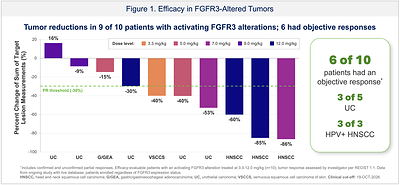
At the October 19, 2026 cutoff, 6 of 10 evaluable patients had partial responses, confirmed or unconfirmed, at doses of 3.3 mg/kg or higher in tumors with activating FGFR3 alterations. This included 3 of 5 patients with urothelial cancer and 3 of 3 with HPV-positive head and neck squamous cell carcinoma. All responders remained on treatment, some for more than 6 months.
Among 30 treated patients, there were no dose-limiting toxicities, treatment-related serious adverse events or treatment-related deaths. Nausea (43%) and fatigue (37%) were all Grade 1 or 2. After meeting with the FDA, Biohaven plans a pivotal study as early as the first half of 2027, starting with FGFR3-altered urothelial cancer, to support potential accelerated approval.
How this balance works
Rhea-AI gives every point it takes from this document a weight. Minor counts 1, Moderate 3 and Major 9, so one Major point outweighs several Minor ones. The bar adds up the weights on each side, and when neither side holds more than 65% of the total the balance reads Mixed.
It reads the document as published, with the same rules for every company, and it does not look at what the market expected or at how the stock traded, so a point can be objectively good on a day the stock falls.
Rhea-AI Sentiment measures something else, the tone of the wording.
Hollow bars mark forward-looking points. How the balance works
Positive
- Moderate pointPartial responses occurred in 6 of 10 evaluable patients with activating FGFR3 alterations at 3.3 mg/kg or higher, including confirmed and unconfirmed responses.
- Moderate point. Forward-looking: it has not happened yet and may not happen.Pivotal study could start as early as the first half of 2027 in FGFR3-altered urothelial cancer to support potential accelerated approval.
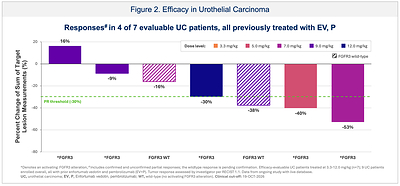
- Minor pointUrothelial cancer partial responses occurred in 3 of 5 patients with FGFR3 alterations after progression on enfortumab vedotin plus pembrolizumab, including one previously treated with an FGFR inhibitor.
- Minor pointHPV-positive head and neck cancer partial responses occurred in all 3 patients with activating FGFR3 alterations.
- Minor pointTreatment continuation at the October 19, 2026 cutoff included all responders, some for more than 6 months.
8 minor points
- Minor pointTumor reductions occurred in 9 of 10 evaluable patients with activating FGFR3 alterations at 3.3 mg/kg or higher.
- Minor pointPhase 1 safety showed no dose-limiting toxicities, treatment-related serious adverse events, treatment-related deaths or interstitial lung disease among 30 treated patients.
- Minor pointFGFR inhibitor class toxicities of high blood phosphate, nail dystrophy and central serous retinopathy were not observed.
- Minor pointFDA Type C meeting was completed in the fourth quarter of 2026.
- Minor pointTumor reductions in urothelial cancer were also observed in both patients whose tumors had no FGFR3 alteration.
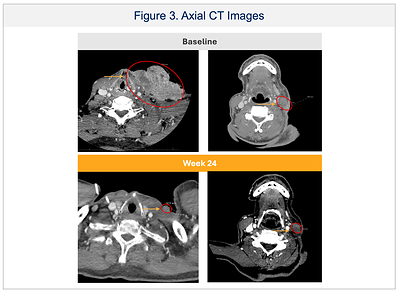
- Minor pointOne confirmed head and neck cancer response deepened from a 67% target-lesion reduction at Week 6 to 86% at Week 24.
- Minor pointFree drug payload exposure was below 1% of exposure to the intact antibody-drug conjugate.
- Minor pointDrug half-life of 7 to 14 days supported dosing every three weeks.
Negative
- Minor pointNausea occurred in 43% of treated patients; all cases were Grade 1 or 2.
- Minor pointFatigue occurred in 37% of treated patients; all cases were Grade 1 or 2.
- Minor pointBlood-related side effects occurred and were mostly low grade.
- Minor pointOne partial response in urothelial cancer without an FGFR3 alteration was pending confirmation.
Key Figures
- Patients with responses
- 6 of 10
- FGFR3-activated tumors; doses ≥3.3 mg/kg
- Patients with tumor reduction
- 9 of 10
- Efficacy-evaluable patients with activating FGFR3 alterations
- Responses by tumor type
- 3 of 5 with UC; 3 of 3 with HPV-positive HNSCC
- Patients with FGFR3-altered tumors
- Target-lesion reduction
- 67% at Week 6; 86% at Week 24
- Confirmed partial response in one HPV-positive HNSCC case
- Half-life
- 7 to 14 days
- Pharmacokinetic data; supports Q3W dosing
- FDA Type C meeting
- 4Q 2026
- Meeting completed
- Pivotal study timing
- As early as 1H 2027
- Planned start, beginning with UC
Historical Context
-
Earlier BHV-1530 disclosure noted confirmed partial responses and no dose-limiting or FGFR-class toxicities.
24h Move is the share-price change in the day after each event; other market factors may also have contributed.
Key Terms
antibody-drug conjugate medical
recist v1.1 medical
pharmacokinetic medical
dose-limiting toxicities medical
interstitial lung disease medical
AI-generated analysis. How Rhea-AI works. Not financial advice.


Phase 1 data presented in an oral plenary session at the 38th EORTC-NCI-AACR Symposium on Molecular Targets and Cancer Therapeutics (ENA 2026) in
- Responders to BHV-1530 in UC included patients who failed prior enfortumab vedotin plus pembrolizumab (EV+P) and oral FGFR tyrosine kinase inhibitors. All responders remained on treatment at data cutoff, some beyond 6 months.
- BHV-1530 was well tolerated with no FGFR class toxicities: no DLTs, treatment-related SAEs or deaths, and no ILD; no hyperphosphatemia, nail dystrophy or central serous retinopathy.
- Biohaven completed FDA Type C meeting in 4Q 2026 and plans to initiate a pivotal study evaluating BHV-1530 in FGFR3-altered tumors, starting with UC, expected to begin as early as 1H 2027 to support potential accelerated approval.
Among 10 efficacy-evaluable patients with activating FGFR3 alterations, treated with BHV-1530 at doses of 3.3 mg/kg or higher, 9/10 had a tumor reduction and 6 achieved a partial response (PR; confirmed or unconfirmed, by investigator assessment per RECIST v1.1; Figure 1). Responses were observed in tumors with FGFR3 mutations and fusions, including in 3 of 5 patients with UC and all 3 patients with HPV-positive HNSCC. All responders remained on treatment as of the data cutoff, some for more than 6 months.
Gerald S. Falchook, M.D. commented, "Many patients in this study had progressed on multiple prior therapies, including enfortumab vedotin plus pembrolizumab and FGFR inhibitors in urothelial cancer, so seeing durable responses is very encouraging." Dr. Falchook added, "We also saw deep responses in HPV-positive head and neck cancer, where options after immunotherapy are limited. Importantly, BHV-1530 has been well tolerated, with no dose-limiting toxicities and none of the hyperphosphatemia, nail or retinal toxicities that often restrict FGFR tyrosine kinase inhibitor therapy."
In UC, where all patients had progressed on prior EV+P, partial responses occurred in 3 of 5 patients with FGFR3-altered tumors, including a patient who had also received a prior FGFR inhibitor. Tumor reductions were also observed in the 2 patients with FGFR3 wild-type tumors, including one partial response pending confirmation (Figure 2).
Dr. Falchook presented the clinical case of a patient with HPV-positive metastatic HNSCC and an FGFR3 S249C mutation, who had received four prior lines of therapy including chemoradiation, a platinum doublet and immunotherapy. This patient achieved a confirmed partial response, with a
BHV-1530 was well tolerated across all dose levels in 30 patients, with no dose-limiting toxicities, treatment-related serious adverse events or treatment-related deaths. The most common adverse events, nausea (
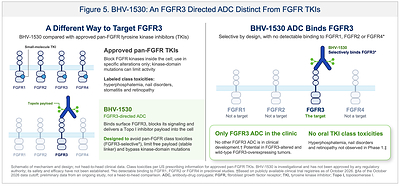
Nushmia Khokhar, M.D., Chief Medical Officer of Oncology at Biohaven stated, "Unlike FGFR tyrosine kinase inhibitors, which block kinase signaling inside the cell, BHV-1530 is an ADC designed to bind FGFR3 on the tumor cell surface, be internalized and release a potent topoisomerase I payload, independent of kinase-domain resistance mutations."
Dr. Khokhar added, "Following a recent Type C meeting with the FDA, we are excited to advance BHV-1530 into a pivotal study in FGFR3-altered tumors, beginning with urothelial cancer, as early as the first half of 2027, with the goal of supporting a potential accelerated approval."
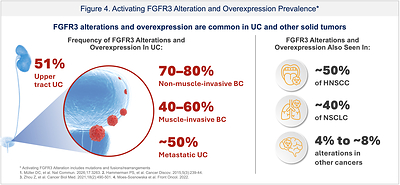
FGFR3 is frequently altered or overexpressed in UC. Activating mutations or fusions, together with overexpression of the wild-type receptor, are found in about half of metastatic UC and in
BHV-1530 takes a different approach to FGFR3 than approved pan-FGFR tyrosine kinase inhibitors, which block kinase signaling across the FGFR family (Figure 5). The investigational antibody-drug conjugate is designed to bind selectively to FGFR3 on the tumor cell surface and deliver its TopoIx payload inside the cell, with no detectable binding to FGFR1, FGFR2 or FGFR4 in preclinical studies.
About Study BHV1530-101
BHV1530-101 (NCT06874335) is a Phase 1, first-in-human, multicenter study of BHV-1530 as monotherapy and in combination with an anti-PD-1 antibody in adults with advanced solid tumors. Patients with UC, HNSCC or non-small cell lung cancer (NSCLC) were enrolled irrespective of FGFR3 alteration status, without a minimum FGFR3 expression threshold. Patients with other solid tumors were eligible if their tumors harbored an activating FGFR3 alteration.
About BHV-1530
BHV-1530 is an antibody-drug conjugate directed against FGFR3, a validated but underexploited target in urothelial cancer and other FGFR3-driven cancers and is a first-in-class potential FGFR3-directed ADC incorporating Biohaven's proprietary TopoIx payload. Unlike approved FGFR tyrosine kinase inhibitors, which are restricted to genomically selected patients and constrained by class-related toxicities, BHV-1530 is designed to target FGFR3 with the potential to address both FGFR3-altered and wild-type overexpressing tumors. BHV-1530 is being studied in an ongoing Phase 1 dose-escalation trial in unselected patients with advanced urothelial cancer, head and neck squamous cell carcinoma, and non-small cell lung cancer who have failed standard-of-care therapy, as well as other tumor types harboring FGFR3 genomic alterations. Biohaven has initiated combination cohorts evaluating BHV-1530 with anti-PD-1 therapy, including the combination with LIBTAYO® (cemiplimab) which is now enrolling.
About Biohaven
Biohaven Ltd. (NYSE: BHVN) is a biopharmaceutical company focused on the discovery, development, and commercialization of life-changing treatments in key therapeutic areas, including immunology, neuroscience, and oncology. Biohaven is advancing its innovative portfolio of therapeutics, leveraging its proven drug development experience and multiple proprietary drug development platforms. Biohaven's extensive clinical and preclinical programs include Kv7 ion channel modulation for epilepsy; MoDE™ and TRAP™ extracellular protein degradation for immunological diseases; and myostatin inhibition for neuromuscular and metabolic diseases, including obesity. For more information, visit www.biohaven.com.
Forward-Looking Statements
This news release includes forward-looking statements within the meaning of the Private Securities Litigation Reform Act of 1995, including statements regarding the expected timing, conduct, and outcomes of Biohaven's ongoing and planned clinical trials of BHV-1530, including the combination with cemiplimab under the clinical supply agreement with Regeneron, the potential therapeutic benefits, efficacy, safety, and tolerability of BHV-1530, and the timing of planned regulatory interactions and filings. The use of certain words, including "continue," "plan," "will," "believe," "may," "expect," "anticipate," "on track," "potential," and similar expressions, is intended to identify forward-looking statements. Investors are cautioned that any forward-looking statements are not guarantees of future performance or results and involve substantial risks and uncertainties. Actual results, developments and events may differ materially from those in the forward-looking statements as a result of various factors, including: the expected timing, commencement and outcomes of Biohaven's planned and ongoing clinical trials; the timing of planned interactions and filings with the FDA; the timing and outcome of expected regulatory filings; complying with applicable U.S. regulatory requirements; the potential commercialization of Biohaven's product candidates and the expected timing thereof; the potential for Biohaven's product candidates to be successful therapies; and the effectiveness and safety of Biohaven's product candidates. Additional important factors to be considered in connection with forward-looking statements are described in Biohaven's filings with the Securities and Exchange Commission, including within the sections titled "Risk Factors" and "Management's Discussion and Analysis of Financial Condition and Results of Operations." The forward-looking statements are made as of the date of this news release, and Biohaven does not undertake any obligation to update any forward-looking statements, whether as a result of new information, future events or otherwise, except as required by law.
MoDE and TRAP are trademarks of Biohaven Therapeutics Ltd.
Libtayo is a registered trademark of Regeneron Pharmaceuticals, Inc.
Investor Contact:
Jennifer Porcelli
Vice President, Investor Relations
jennifer.porcelli@biohavenpharma.com
+1 (201) 248-0741
Media Contact:
Mike Beyer
Sam Brown Inc.
mikebeyer@sambrown.com
+1 (312) 961-2502

 View original content to download multimedia:https://www.prnewswire.com/news-releases/biohavens-novel-fgfr3-directed-adc-with-proprietary-topoix-payload-bhv-1530-shows-clinical-activity-and-confirmed-responses-in-fgfr3-altered-urothelial-and-head-and-neck-cancers-oral-presentation-at-ena-2026-302944663.html
SOURCE Biohaven Ltd.
FAQ
AI-generated questions and answers. How Rhea-AI works. Not financial advice.