
BioVie Announces Topline Results from Phase 2 ADDRESS‑LC Trial Evaluating Bezisterim for the Treatment of Neurological Symptoms Associated with Long COVID
Phase 2 data show exploratory but statistically significant subgroup improvements and placebo‑like safety, fully funded by a $13.13 million DoW grant.
Rhea-AI Summary
BioVie (BIVI) reported topline Phase 2 ADDRESS‑LC results for bezisterim in Long COVID, showing statistically significant benefits in pre‑specified subgroups with high baseline fatigue, cognitive impairment and/or post‑exertional malaise (PEM).
The 203‑patient randomized, double‑blind, placebo‑controlled trial tested 22 clinical endpoints without a single primary endpoint. In the overall intent‑to‑treat population, 21 of 22 endpoints numerically favored bezisterim, but none reached statistical significance, which the company links to many patients having low baseline symptom burden. In pre‑specified high‑burden subgroups, effect sizes more than doubled and multiple clinically related endpoints achieved statistical significance across fatigue, PEM and objective cognitive measures, though these findings are exploratory and require confirmation in a prospective Phase 3 trial.
Bezisterim’s safety and tolerability were similar to placebo, with fewer treatment‑emergent adverse events and no serious adverse events in the bezisterim arm. The study is fully funded by a $13.13 million U.S. Department of War award.
Positive
- 21 of 22 endpoints numerically favored bezisterim in the 203‑patient ITT population
- High‑symptom subgroups achieved multiple statistically significant fatigue, PEM and cognitive endpoints
- Bezisterim arm had 41.6% patients with treatment‑emergent adverse events vs 55.9% on placebo
- No serious adverse events in bezisterim group vs one in placebo
- Trial fully funded by a $13.13 million U.S. Department of War award
Negative
- In full ITT population, no endpoint reached statistical significance (p<0.05)
- Statistically significant benefits are based on exploratory subgroup analyses requiring Phase 3 confirmation
- Phase 2 design used no single primary endpoint, limiting definitive efficacy conclusions
Details
Market reaction after Phase 2 clinical data: BIVI -6.54%
Following this news, BIVI has declined 6.54%, reflecting a notable negative market reaction. Argus tracked a trough of -15.9% from its starting point during tracking. Our momentum scanner has triggered 7 alerts so far, indicating moderate trading interest and price volatility. The stock is currently trading at $1.92. Trading volume is very high at 3.7x the average, suggesting heavy selling pressure.
Data tracked by StockTitan Argus (15 min delayed). Upgrade to Gold for real-time data.
Key Figures
- Trial enrollment
- 203 patients
- Phase 2 ADDRESS-LC trial
- Endpoints favoring treatment
- 21 of 22 endpoints
- Overall study population
- Fatigue subgroup endpoints
- 5 endpoints
- Patients with the most severe half of fatigue symptoms
- Cognitive subgroup endpoints
- 4 endpoints
- Patients with substantial objective cognitive impairment
- Treatment-emergent adverse events
- 41.6% vs. 55.9%
- Bezisterim vs. placebo
- Drug-related headache
- 4% vs. 4.9%
- Bezisterim vs. placebo
- Serious adverse events
- 0 vs. 1
- Bezisterim arm vs. placebo
- Fully funded award
- $13.13 million
- U.S. Department of War PRMRP award supporting ADDRESS-LC
Previous Clinical trial,covid-19 Reports
-
Company presented the Phase 2 ADDRESS-LC study design for bezisterim.
-
BioVie enrolled the first patient in the Phase 2 ADDRESS-LC trial.
-
BioVie secured approvals for additional Long COVID trial grant funding.
24h Move is the share-price change in the day after each event; other market factors may also have contributed.
Key Terms
blood-brain barrier medical
post-exertional malaise medical
Cohen’s d technical
intent-to-treat medical
treatment-emergent adverse event medical
AI-generated analysis. How Rhea-AI works. Not financial advice.




Statistically significant benefits observed in bezisterim-treated Long COVID patients
in pre-specified subgroups with high baseline fatigue, cognitive impairment, and/or post‑exertional malaise
Bezisterim showed a consistent advantage over placebo on 21 out of 22 individual endpoints in the overall study population
An estimated 17–20 million U.S. adults live with Long COVID and currently have no FDA‑approved treatment options
Conference call scheduled for 8:30 a.m. today, September 15, 2026, to discuss results.
CARSON CITY, Nev., Sept. 15, 2026 (GLOBE NEWSWIRE) -- BioVie Inc. (NASDAQ: BIVI) (“BioVie” or the “Company”), a clinical-stage company developing innovative drug therapies for neurological and neurodegenerative diseases, today announced topline results from the Company’s Phase 2 ADDRESS-LC trial (NCT06847191) evaluating its investigational drug candidate bezisterim, an oral drug that crosses the blood-brain barrier and is believed to reduce inflammation and improve insulin sensitivity, in Long COVID. In pre-specified subgroup analyses submitted to the FDA prior to data unblinding, patients with greater baseline burden on one or more symptoms (approximately
“I am excited by the findings in the ADDRESS-LC study. These results are among the most promising we have seen in this field so far and clearly warrant progressing to a confirmatory Phase III trial,” said Michael Peluso, MD, MHS, Associate Professor of Medicine, University of California, San Francisco. “If bezisterim can truly help the patients with high symptomatic burden, that would be a significant benefit for the patient community”
“We have not seen anything like this from any other trial,” commented Ezra Spier, Long COVID patient advocate and ADDRESS-LC Patient Advisor. “We have not seen results that are this clear or compelling before, and this could have a significant impact for Long COVID patients.”
The ADDRESS-LC trial was a Phase 2, multicenter, randomized, double-blinded, placebo-controlled exploratory study that enrolled 203 patients to evaluate whether bezisterim could improve key neurological symptoms of Long COVID, including fatigue, brain fog, cognitive impairment and post-exertional malaise (PEM). The purpose of the Phase 2 trial was to identify the clinical endpoints where bezisterim may have the greatest effect and within which patient subpopulations. The ADDRESS-LC trial explored 22 different measures to assess clinical outcomes and a series of different biomarkers.
“The results suggest that bezisterim may help improve symptoms of fatigue, post‑exertional malaise, and cognitive impairments in patients with high symptom burden, which represents approximately
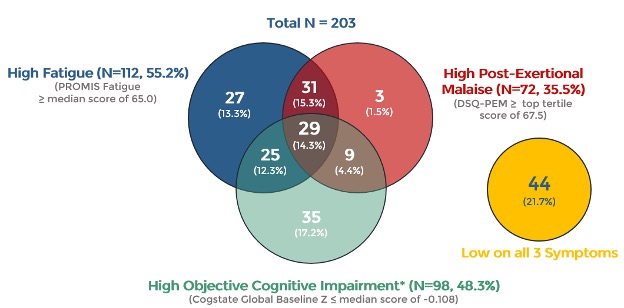
The enrolled patients were grouped into distinct symptom-severity segments based on baseline characteristics that were pre-specified in the Statistical Analysis Plan submitted to the FDA prior to unblinding; including patients with high severity of individual symptoms of fatigue, PEM and objective cognitive impairment, as well as those with two or more in combination. This wide spectrum of disease burden highlights the evolving understanding of the heterogeneity of the disease and the precision medicine approach needed to evaluate each patient segment with the most appropriate clinical endpoint.
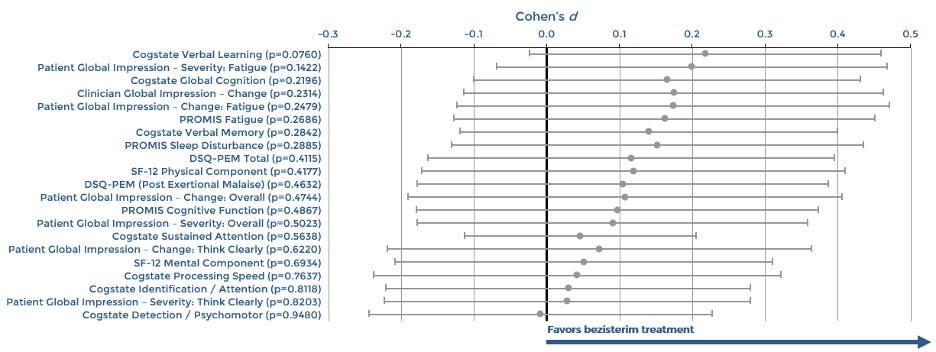
When the full Intent‑to‑Treat (ITT) population of 203 patients is evaluated without segmentation, bezisterim shows numerical trends favoring treatment over placebo across nearly all individual endpoints, as reflected in the Cohen’s d effect sizes. Cohen’s d quantifies the magnitude of difference between treatment and control groups, and a positive value indicates that the treatment effect was greater in the bezisterim arm than in the placebo arm. In this heterogenous ITT population, no individual endpoint reached statistical significance (p<0.05), likely because patients with low baseline symptom burden had little room to improve, which may have diluted the overall signal. Twenty-one of the 22 endpoints showed numerical trends favoring bezisterim.
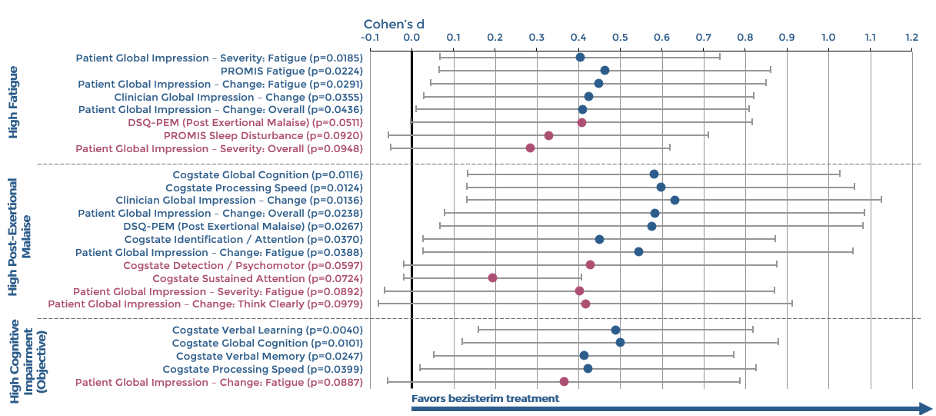
In pre-specified subgroup analyses, differential treatment effects emerged when focusing on patients with high baseline symptom burden. Despite reducing sample size (N), the treatment effect sizes more than doubled compared to the ITT population, as seen with higher Cohen’s d values, and the endpoints that reached statistical significance increased suggesting a coherent explanation for the clinical improvements. The most severe half of patients with fatigue symptoms showed statistically significant improvements on five endpoints (3 out of 5 of which are fatigue-specific), along with trends in post-exertional malaise and sleep. Patients with high post-exertional malaise experienced statistically significant improvements across malaise, fatigue, and objective cognitive measures. And patients who entered the trial with substantial objective cognitive impairment demonstrated statistically significant improvements on four clinically coherent objective cognitive endpoints. These subgroup findings are exploratory and require confirmation in an adequately powered prospective study. The summary “forest chart” chart below shows only those endpoints that reach statistically significant or are trending, and the charts for all endpoints can be found in the full data announcement presentation that will be discussed during today’s conference call.
“I am super excited for the Long COVID community because of this data,” stated Grace McComsey, Professor of Medicine and infectious diseases researcher. “At Case Western Reserve University, we have been a part of almost every negative study so far. It’s great to see a trial showing such potential effectiveness while using a well-tolerated oral drug.”
“Research has demonstrated that Long COVID is not a single disease, but a complex and heterogeneous syndrome with multiple clinical and biological subtypes,” said Joseph Palumbo, MD, BioVie’s EVP of Research & Development and Chief Medical Officer. “A key challenge in clinical development is not only establishing efficacy but also identifying the patients most likely to benefit and understanding the drivers of that response. Consistent with observations from our other clinical programs, the ADDRESS-LC trial showed that patients with higher disease burden at baseline experienced the greatest and most rapid improvements with bezisterim treatment. These findings support an intuitive strategy for identifying the patients most likely to benefit from treatment, grounded in both clinical presentation and underlying biology. This approach has the potential to enhance clinical outcomes and guide the design of future registrational studies.”
Bezisterim’s safety and tolerability were similar to placebo. Overall,
Conference call to discuss results
BioVie management will host a conference call at 8:30 a.m. EDT today, September 15, 2026, to discuss the findings and results. A live Q&A session with management will follow the presentation.
To register for the conference call, please visit: https://lifescievents.com/event/bkvp81/
About Long COVID
An estimated 17-20 million U.S. adults reported to be living with Long COVID,4 with 3.8 million experiencing significant limitation to their daily lives.5 Almost 50 percent of those with Long COVID develop persistent or intermittent symptoms.6 The neurological and neuropsychiatric symptoms are among the most common and disabling manifestations of the condition and include fatigue, PEM, sleep disturbance, and persistent sense of difficulty with thinking and memory.7 Chronic innate inflammation accompanied by ongoing immune dysregulation is among the leading hypotheses proposed to explain the symptoms in Long COVID, with numerous investigators describing findings in Long COVID that appear to be supportive of the intended biological targets of bezisterim. Currently, there are no FDA-approved treatment options for Long-COVID.
About the ADDRESS-LC trial
The Phase 2 ADDRESS-LC study (NCT06847191), which is fully funded by a grant from the U.S. Department of War (DoW), is a randomized (1:1), placebo-controlled, signal-finding proof-of-concept, multicenter trial evaluating the efficacy, safety and tolerability of bezisterim in adult participants with Long COVID who have cognitive impairment sequelae and fatigue. The study compared bezisterim, administered as a 20 mg oral capsule twice daily, with a matching placebo to assess its effects on neurocognitive and fatigue-related symptoms. The trial evaluated 22 clinical outcome measures, with no single endpoint pre-specified as the primary determinant of study success. Endpoints include assessing changes in overall clinical benefit, subjective and objective cognitive function, fatigue, sleep disturbance, Quality of Life and PEM. As a signal-finding study, the trial was designed to identify efficacy signals, measure treatment effect magnitude, and identify patient subgroups most likely to benefit, to inform the design of future Phase 3 trials
About Bezisterim
Bezisterim (NE3107) is an investigational oral drug that crosses the blood-brain barrier and works to reduce inflammation and improve insulin sensitivity without suppressing the immune system and with a low risk of drug-drug interactions. By modulating key pathways involved in neuroinflammation (ERK, NFκB, TNFα), bezisterim may have therapeutic potential in several disease indications, including Parkinson’s disease (PD), Long COVID (LC), and Alzheimer’s disease (AD).
In PD, BioVie completed the SUNRISE-PD trial, which enrolled 57 patients to establish proof of mechanism and proof of concept in individuals with early-stage disease who had not previously been treated with carbidopa/levodopa. Topline results showed that patients treated with bezisterim experienced improvements with blood-based markers of inflammation, as well as a broad range of biomarkers associated with cellular health and neuronal integrity. Clinically, patients treated with bezisterim demonstrated greater improvements than those receiving placebo across multiple measures of daily functioning, motor symptoms, and non-motor symptoms.
For LC, the ADDRESS-LC trial enrolled approximately 200 patients to evaluate whether bezisterim may help reduce brain fog, fatigue, and other lingering neurological symptoms associated with LC. The hypothesis being studied is that these symptoms may be triggered by persistent circulation of spike protein fragments that trigger inflammation via NFκB activation (which bezisterim has been shown to modulate).
In AD, BioVie has conducted Phase 2 and Phase 3 trials. Preliminary data from these trials suggest improvements in cognition and biomarkers, supporting further trials to evaluate its potential as a therapy for the six million Americans living with AD.
Terms of the U.S. Department of War (DoW) Award
The work is supported by the Assistant Secretary of War for Health Affairs and endorsed by the DoW by a fully funded award in the amount of
About BioVie Inc.
BioVie Inc. (NASDAQ: BIVI) is a clinical-stage biopharmaceutical company focused on developing therapies for neurological disorders and advanced liver disease. Its lead investigational drug candidate, bezisterim (NE3107), targets neuroinflammation and insulin resistance, which are believed to be key drivers of Alzheimer’s and Parkinson’s disease. Bezisterim is also being studied for Long COVID, where persistent inflammation is thought to underlie symptoms such as brain fog and fatigue.
In liver disease, BioVie is advancing BIV201, a continuous infusion of terlipressin treatment that has received FDA Orphan and Fast Track designations. The active agent is approved in the U.S. and in about 40 countries for related complications of advanced liver cirrhosis, and the Company plans to study BIV201 in a Phase 3 trial for the reduction of further decompensation in patients with cirrhosis and ascites. For more information, visit www.bioviepharma.com.
Forward-Looking Statements
This press release contains forward-looking statements, which may be identified by words such as "expect," "look forward to," "anticipate," "intend," "plan," "believe," "seek," "estimate," "will," "project," “potential,” “may,” or words of similar meaning. Forward-looking statements in this release include, but are not limited to, statements regarding: the potential for bezisterim to address unmet clinical needs in Long COVID and Parkinson’s disease; the design and conduct of future clinical trials, including a potentially pivotal Phase 3 trial; the potential clinical significance of subgroup analyses and biomarker observations; and the Company’s ability to advance bezisterim through clinical development. The clinical endpoints reported in this release are exploratory in nature. The Phase 2 ADDRESS-LC trial did not achieve statistical significance on any endpoint in the overall intent-to-treat population; statistically significant results were observed only in pre-specified subgroup analyses. Subgroup analyses are hypothesis-generating and may not be replicated in future trials. Changes in biomarkers may not correlate with clinical benefit or support regulatory approval. The FDA has not validated these endpoints as surrogate endpoints for Long COVID. Although BioVie Inc. believes such forward-looking statements are based on reasonable assumptions, it can give no assurance that its expectations will be attained. Actual results may vary materially from those expressed or implied by the statements herein due to risks related to the early stage of development of bezisterim and other product candidates, the possibility that results observed in this Phase 2 study of 203 patients may not be replicated in larger or longer-duration trials, the exploratory nature of subgroup analyses, the Company's ability to successfully raise sufficient capital on reasonable terms or at all, available cash on hand and contractual and statutory limitations that could impair our ability to pay future dividends, our ability to complete our pre-clinical or clinical studies and to obtain approval for our product candidates, the possibility that clinical trial results may not be indicative of results in subsequent or larger trials, our ability to successfully defend potential future litigation, changes in local or national economic conditions as well as various additional risks, many of which are now unknown and generally out of the Company's control, and which are detailed from time to time in reports filed by the Company with the SEC, including quarterly reports on Form 10-Q, reports on Form 8-K and annual reports on Form 10-K. BioVie Inc. does not undertake any duty to update any statements contained herein (including any forward-looking statements), except as required by law.
For Investor Relations Inquiries:
Contact:
Chuck Padala
Managing Director, LifeSci Advisors, LLC
chuck@lifesciadvisors.com
For Media Inquiries:
Contact:
Melyssa Weible
Managing Partner, Elixir Health Public Relations
mweible@elixirhealthpr.com
| 1 | Geng L, et al. JAMA. 2025;333(8):694–700. doi:10.1001/jama.2024.24184 |
| 2 | Eight Phase 2 clinical trials have been conducted by various organizations to assess 13 interventions in Long COVID. None of the interventions have demonstrated benefit thus far. Source: https://recovercovid.org/funding |
| 3 | Objective cognitive assessments are conducted using an iPad that gives patients tasks to complete and measure the person’s actual cognitive performance. |
| 4 | U.S. Department of Health and Human Services (https://www.hhs.gov/longcovid/index.html) |
| 5 | Bonuck et al. Commun Med. 2026;6:177. doi:10.1038/s43856-026-01516-7. |
| 6 | Thaweethai et al. Nat Commun. 2025;16(1):9557. doi:10.1038/s41467-025-65239-4. |
| 7 | Geng et al. JAMA. 2025 Feb 25;333(8):694-700. doi: 10.1001/jama.2024.24184. |
Photos accompanying this announcement are available at:
https://www.globenewswire.com/NewsRoom/AttachmentNg/a305c2ae-97bb-466a-b843-541cb0eb7598
https://www.globenewswire.com/NewsRoom/AttachmentNg/f3710d26-092a-4d5f-8170-4265c9cfb673
https://www.globenewswire.com/NewsRoom/AttachmentNg/b8325cd1-e936-4e15-a18e-271e929be6b2

FAQ
AI-generated questions and answers. How Rhea-AI works. Not financial advice.
What was the design and dosing regimen of the ADDRESS‑LC Phase 2 trial?
The ADDRESS‑LC study was a randomized 1:1, multicenter, double‑blind, placebo‑controlled, signal‑finding proof‑of‑concept trial in adults with Long COVID who had cognitive impairment sequelae and fatigue. Participants received bezisterim as a 20 mg oral capsule twice daily or a matching placebo. The trial evaluated 22 clinical outcome measures covering overall clinical benefit, subjective and objective cognitive function, fatigue, sleep disturbance, quality of life and PEM.
How were Long COVID patients segmented into subgroups in this study?
Patients were grouped into symptom‑severity segments based on baseline characteristics that were pre‑specified in the Statistical Analysis Plan submitted to the FDA before unblinding. Segments included patients with high severity of individual symptoms of fatigue, PEM, and objective cognitive impairment, as well as those with two or more of these symptoms in combination. This segmentation was intended to reflect disease heterogeneity and support a precision‑medicine approach to endpoint selection.
What specific improvements were seen in the high‑symptom subgroups?
In the most severe half of patients with fatigue, bezisterim produced statistically significant improvements on five endpoints, three of which were fatigue‑specific, with additional trends in PEM and sleep. Patients with high PEM showed statistically significant improvements across malaise, fatigue, and objective cognitive measures. Those with substantial objective cognitive impairment at baseline had statistically significant improvements on four clinically coherent objective cognitive endpoints.
How did investigators quantify treatment effects versus placebo?
Treatment effects were summarized using Cohen’s d, which measures the magnitude of difference between the bezisterim and placebo arms, with positive values favoring bezisterim. In the heterogeneous intent‑to‑treat population, bezisterim showed positive Cohen’s d values on most endpoints, and in high‑burden subgroups the Cohen’s d values more than doubled compared with the overall population.
What additional details are provided about bezisterim and its mechanism?
Bezisterim (NE3107) is an investigational oral drug that crosses the blood‑brain barrier and is described as reducing inflammation and improving insulin sensitivity without suppressing the immune system and with low risk of drug‑drug interactions. By modulating neuroinflammatory pathways including ERK, NFκB and TNFα, it is being studied in Parkinson’s disease, Long COVID and Alzheimer’s disease, with prior trials suggesting improvements in inflammatory biomarkers and clinical measures in Parkinson’s and Alzheimer’s populations.
Who funded the ADDRESS‑LC trial and under what terms?
The Phase 2 ADDRESS‑LC study is fully funded by a $13.13 million award from the U.S. Department of War through the Peer‑Reviewed Medical Research Program under Award No. HT9425‑24‑1‑0113. The work is supported by the Assistant Secretary of War for Health Affairs, and the press release notes that the opinions and conclusions are those of the author and not necessarily endorsed by the Assistant Secretary of Defense for Health Affairs or the Department of War.
How can investors and stakeholders access the conference call on these results?
BioVie management scheduled a conference call at 8:30 a.m. EDT on September 15, 2026, to review the findings and results, followed by a live Q&A session. To register for the call, participants are directed to visit https://lifescievents.com/event/bkvp81/.