
BioVie Announces Update to Parkinson’s Phase 3 Development Program
BioVie (BIVI) is advancing its Phase 3 development program of bezisterim for early-stage Parkinson’s disease following correspondence with the FDA on an End-of-Phase 2 meeting to align on trial design.
Sentiment and the balance of points
Rhea-AI Sentiment reads the wording of the document, how positive or negative its language is on a 1 to 5 scale. The balance of points shown with the takes weighs what the document actually discloses, so the two can disagree, for example when a trial that missed its main goal is described in upbeat language.
Rhea-AI Summary
BioVie (BIVI) is advancing its Phase 3 development program of bezisterim for early-stage Parkinson’s disease following correspondence with the FDA on an End-of-Phase 2 meeting to align on trial design.
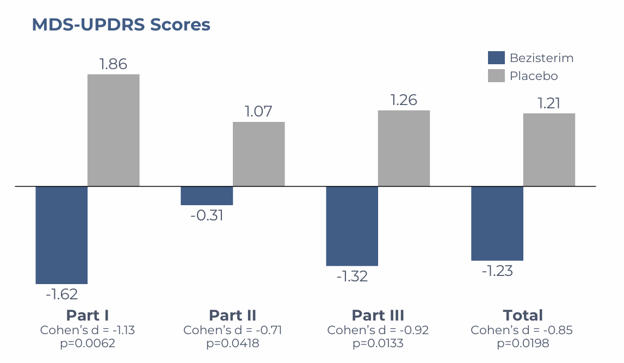
The company is working with Parkinson’s experts to finalize a Phase 3 trial using MDS‑UPDRS Part III (motor symptoms) as the primary endpoint, with MDS‑UPDRS Part I (non‑motor symptoms) planned as a co‑primary or secondary endpoint. Phase 2 SUNRISE‑PD data in 57 early-stage, levodopa‑naïve patients showed that bezisterim‑treated patients with elevated inflammatory markers, measured by platelet levels, achieved statistically significant differences versus placebo across MDS‑UPDRS Parts I, II, III, and total score in exploratory analyses. BioVie plans an enrichment strategy focusing on patients with higher inflammation, which it believes could support a Phase 3 trial of approximately 175 patients.
The company has requested an End‑of‑Phase 2 meeting and anticipates formal written FDA feedback on the proposed Phase 3 design before year‑end.
Positive
- Phase 2 SUNRISE-PD showed statistically significant MDS-UPDRS differences vs placebo in inflamed subgroup across Parts I–III and total score (exploratory).
- Planned Phase 3 design centers on MDS-UPDRS Part III motor endpoint, with Part I non-motor symptoms also prioritized.
- Enrichment strategy using higher-inflammation patients may allow a Phase 3 trial of approximately 175 participants.
- Regulatory progress with an End-of-Phase 2 FDA meeting requested and written feedback expected before year-end 2026.
Negative
- Phase 2 findings are exploratory and require validation in a larger, longer-duration trial before reliance.
- Bezisterim remains investigational with safety and efficacy not established for any indication.
- SUNRISE-PD was a relatively small 12-week study of 57 patients, limiting robustness of clinical conclusions.
Details
News Market Reaction – BIVI
On Sep 8, the day this news came out, BIVI closed 3.50% above the previous close. Argus tracked a peak move of +3.5% during that session. Our momentum scanner recorded 7 alerts for this stock that day.
Data tracked by StockTitan Argus for the Sep 8 session.
Key Figures
- Study Duration
- 12 weeks
- SUNRISE-PD trial
- Sample Size
- 57 patients
- SUNRISE-PD trial
- Proposed Phase 3 Enrollment
- approximately 175 patients
- Enrichment strategy for Parkinson’s disease
- FDA Feedback Timing
- before year-end
- Formal written feedback on proposed Phase 3 design
Previous Clinical trial Reports
-
Reported statistically significant MDS-UPDRS advantages in patients with higher baseline platelet counts.
24h Move is the share-price change in the day after each event; other market factors may also have contributed.
Key Terms
end-of-phase 2 meeting regulatory
mds-updrs medical
blood-brain barrier medical
nfκb medical
fda regulatory
AI-generated analysis. How Rhea-AI works. Not financial advice.




Company Corresponded with the FDA on an End of Phase 2 Meeting to Align on Phase 3 trial Design for Evaluation of Bezisterim in Early-stage Parkinson’s Disease
CARSON CITY, Nev., Sept. 08, 2026 (GLOBE NEWSWIRE) -- BioVie Inc. (NASDAQ: BIVI) (“BioVie” or the “Company”), a clinical-stage company developing innovative drug therapies for neurological and neurodegenerative diseases, today announced next stage of engagement with the Food and Drug Administration (FDA) to advance the Company’s Phase 3 development program evaluating bezisterim in Parkinson’s disease.
“We are working closely with leading experts in Parkinson’s disease clinical development to finalize a Phase 3 trial design that includes MDS-UPDRS1 Part III as the primary endpoint, consistent with the FDA’s longstanding focus on motor symptom improvement in evaluating Parkinson’s therapies,” said Joseph Palumbo, MD, BioVie’s EVP of Research and Development and Chief Medical Officer. “At the same time, our Phase 2 data suggest that bezisterim’s most meaningful clinical benefits may be in non-motor symptoms, as reflected in MDS-UPDRS Part I results, which we have selected as a co-primary or secondary endpoint. Accordingly, MDS-UPDRS Part I is expected to play an important role in the Phase 3 program, and the Company looks forward to discussing its optimal placement within the endpoint hierarchy with the FDA. Importantly, the Phase 2 findings observed patients with higher levels of inflammation derived greater benefit from treatment also provide for an enrichment strategy that we believe could support a Phase 3 trial of approximately 175 patients. By targeting both the motor and non-motor dimensions of Parkinson’s disease, we believe bezisterim has the potential to become the first therapy to provide meaningful benefits across the full spectrum of Parkinson’s symptoms. Based on the strength of our Phase 2 results, we believe we have a compelling foundation for a successful Phase 3 program. We have corresponded with the FDA to request an End-of-Phase 2 Meeting and look forward to discussing our proposed trial design with the FDA later this fall. We anticipate receiving formal written feedback before year-end.”
In the SUNRISE-PD trial, a 12-week study of 57 patients, bezisterim-treated patients with elevated inflammatory markers, as measured by platelet levels, showed statistically significant differences versus placebo across MDS-UPDRS Parts I, II, and III, as well as the total MDS-UPDRS score. These exploratory endpoints require validation in a larger, longer-duration trial.
About Bezisterim
Bezisterim (NE3107) is an investigational oral drug that crosses the blood-brain barrier and works to reduce inflammation and improve insulin sensitivity without suppressing the immune system and with a low risk of drug-drug interactions. By modulating key pathways involved in neuroinflammation (ERK, NFκB, TNFα), bezisterim may have therapeutic potential in several disease indications, including Parkinson’s disease (PD), Long COVID (LC), and Alzheimer’s disease (AD). The safety and efficacy of bezisterim have not been established for any indication.
In PD, BioVie completed the SUNRISE-PD trial, which enrolled 57 patients to establish proof of mechanism and proof of concept in individuals with early-stage disease who had not previously been treated with carbidopa/levodopa. Topline results showed that patients treated with bezisterim experienced changes in blood-based markers of inflammation, as well as a broad range of biomarkers associated with cellular health and neuronal integrity. These biomarker findings are exploratory and have not been validated by the FDA as surrogate endpoints for Parkinson’s disease. Clinically, patients treated with bezisterim showed numerical improvements compared to placebo across multiple measures of daily functioning, motor symptoms, and non-motor symptoms.
For LC, the ADDRESS-LC trial enrolled approximately 200 patients to evaluate whether bezisterim may help reduce brain fog, fatigue, and other lingering neurological symptoms associated with LC. The hypothesis being studied is that these symptoms may be triggered by persistent circulation of spike protein fragments that trigger inflammation via NFκB activation (which bezisterim has been shown to modulate). Topline data is expected late summer 2026.
In AD, BioVie has conducted Phase 2 and Phase 3 trials. Preliminary data from these trials suggest improvements in cognition and biomarkers, supporting further trials to evaluate its potential as a therapy for the six million Americans living with AD.
About BioVie Inc.
BioVie Inc. (NASDAQ: BIVI) is a clinical-stage biopharmaceutical company focused on developing therapies for neurological disorders and advanced liver disease. Its lead investigational drug candidate, bezisterim (NE3107), targets neuroinflammation and insulin resistance, which are believed to be key drivers of Alzheimer’s and Parkinson’s disease. Bezisterim is also being studied for Long COVID, where persistent inflammation is thought to underlie symptoms such as brain fog and fatigue.
In liver disease, BioVie is advancing BIV201, a continuous infusion of terlipressin treatment that has received FDA Orphan and Fast Track designations. The active agent is approved in the U.S. and in about 40 countries for related complications of advanced liver cirrhosis, and the Company plans to study BIV201 in a Phase 3 trial for the reduction of further decompensation in patients with cirrhosis and ascites. For more information, visit www.bioviepharma.com.
Forward-Looking Statements
This press release contains forward-looking statements, which may be identified by words such as "expect," "look forward to," "anticipate" "intend," "plan," "believe," "seek," "estimate," "will," "project," “potential,” “may,” or words of similar meaning. Forward-looking statements in this release include, but are not limited to, statements regarding: the potential for bezisterim to address unmet clinical needs in Parkinson’s disease; the design and conduct of future clinical trials, including a potentially pivotal Phase 3 trial; the potential clinical significance of biomarker and proteomic observations; and the Company’s ability to advance bezisterim through clinical development. The biomarker and proteomic endpoints reported in this release are exploratory in nature. Changes in such biomarkers may not correlate with clinical benefit or support regulatory approval. The FDA has not validated these biomarkers as surrogate endpoints for Parkinson’s disease. Although BioVie Inc. believes such forward-looking statements are based on reasonable assumptions, it can give no assurance that its expectations will be attained. Actual results may vary materially from those expressed or implied by the statements herein due to risks related to the early stage of development of bezisterim and other product candidates, the possibility that results observed in this Phase 2 study of 57 patients over 12 weeks may not be replicated in larger or longer-duration trials, the Company's ability to successfully raise sufficient capital on reasonable terms or at all, available cash on hand and contractual and statutory limitations that could impair our ability to pay future dividends, our ability to complete our pre-clinical or clinical studies and to obtain approval for our product candidates, the possibility that clinical trial results may not be indicative of results in subsequent or larger trials, our ability to successfully defend potential future litigation, changes in local or national economic conditions as well as various additional risks, many of which are now unknown and generally out of the Company's control, and which are detailed from time to time in reports filed by the Company with the SEC, including quarterly reports on Form 10-Q, reports on Form 8-K and annual reports on Form 10-K. BioVie Inc. does not undertake any duty to update any statements contained herein (including any forward-looking statements), except as required by law.
For Investor Relations Inquiries:
Contact:
Chuck Padala
Managing Director, LifeSci Advisors, LLC
chuck@lifesciadvisors.com
For Media Inquiries:
Contact:
Melyssa Weible
Managing Partner, Elixir Health Public Relations
mweible@elixirhealthpr.com
_______________________
1 The Movement Disorders Society’s Unified Parkinson’s Disease Rating Scale. Part I (Non-motor), Part II (Activities of Daily Living); and Part III (Motor)
A photo accompanying this announcement is available at https://www.globenewswire.com/NewsRoom/AttachmentNg/750e75d4-7a2e-40ca-96fa-dc29b9964fde

FAQ
AI-generated questions and answers. How Rhea-AI works. Not financial advice.
What role will MDS-UPDRS endpoints play in BioVie’s planned Phase 3 Parkinson’s trial?
The company plans to use MDS-UPDRS Part III, which assesses motor symptoms, as the primary endpoint, reflecting the FDA’s focus on motor improvement in Parkinson’s therapies. MDS-UPDRS Part I, which captures non-motor symptoms, is expected to be a co-primary or secondary endpoint, and BioVie intends to discuss its exact placement in the endpoint hierarchy with the FDA.
What was the design and key outcome of the SUNRISE-PD Phase 2 trial?
SUNRISE-PD was a 12-week Phase 2 study enrolling 57 early-stage Parkinson’s patients who had not previously been treated with carbidopa/levodopa. In patients with elevated inflammatory markers, measured by platelet levels, bezisterim-treated participants showed statistically significant differences versus placebo across MDS-UPDRS Parts I, II, III, and total score in exploratory analyses. These endpoints require validation in a larger, longer trial.
How is bezisterim proposed to work biologically?
Bezisterim (NE3107) is an oral investigational drug that crosses the blood-brain barrier and is designed to reduce inflammation and improve insulin sensitivity without suppressing the immune system and with a low risk of drug-drug interactions. It modulates pathways involved in neuroinflammation, including ERK, NFκB, and TNFα, and may have therapeutic potential in Parkinson’s disease, Long COVID, and Alzheimer’s disease. Its safety and efficacy have not been established.
What did BioVie observe in biomarkers and clinical measures in SUNRISE-PD?
Topline results showed that bezisterim-treated patients experienced changes in blood-based markers of inflammation and in a broad range of biomarkers associated with cellular health and neuronal integrity. Clinically, bezisterim-treated patients showed numerical improvements versus placebo across multiple measures of daily functioning, motor symptoms, and non-motor symptoms. The biomarker findings are exploratory and have not been validated by the FDA as surrogate endpoints.
What other indications is BioVie studying bezisterim in?
Bezisterim is also being studied in Long COVID (LC) and Alzheimer’s disease (AD). The ADDRESS-LC trial enrolled about 200 patients to assess whether bezisterim may reduce brain fog, fatigue, and other neurological LC symptoms, with topline data expected in late summer 2026. In AD, BioVie has conducted Phase 2 and Phase 3 trials, and preliminary data suggest improvements in cognition and biomarkers that support further trials.
What other pipeline asset does BioVie have in liver disease?
BioVie is developing BIV201, a continuous infusion terlipressin treatment for advanced liver disease. The active agent has FDA Orphan and Fast Track designations and is approved in the U.S. and in about 40 countries for related complications of advanced liver cirrhosis. The company plans to study BIV201 in a Phase 3 trial aimed at reducing further decompensation in patients with cirrhosis and ascites.
When does BioVie expect key next steps for the Parkinson’s Phase 3 program?
BioVie has requested an End-of-Phase 2 meeting with the FDA to discuss its proposed Phase 3 trial design for bezisterim in early-stage Parkinson’s disease and expects to hold that discussion later in the fall, with formal written FDA feedback anticipated before year-end 2026.