
Sulista Rare Earth District Grows to 17 km Strike
Brazilian Rare Earths (ASX: BRE / OTCQX: BRELY) reports exploration success at Sulista, expanding the district to a >17 km strike and confirming Sulista East as a >1 km, >230 m vertical anchor deposit.
Sentiment and the balance of points
Rhea-AI Sentiment reads the wording of the document, how positive or negative its language is on a 1 to 5 scale. The balance of points shown with the takes weighs what the document actually discloses, so the two can disagree, for example when a trial that missed its main goal is described in upbeat language.
Rhea-AI Summary
Brazilian Rare Earths (ASX: BRE / OTCQX: BRELY) reports exploration success at Sulista, expanding the district to a >17 km strike and confirming Sulista East as a >1 km, >230 m vertical anchor deposit. Over 4,000 m diamond drilling plus geophysics and auger work support a maiden JORC MRE expected mid-2026.
Key assay highlights include up to 16.7% TREO, 28,295 ppm NdPr, and significant Nb, Sc, Ta and U grades; a new +10,000 m drill program is underway across multiple growth corridors.
Positive
- District strike expanded to 17 km, increasing exploration scale
- Sulista East defined over >1,000 m strike and >230 m depth
- High-grade assays up to 16.7% TREO and 28,295 ppm NdPr
- Multiple mineralised centres (Sulista East, Outcrop Ridge, Sulista West) supporting hub-and-spoke strategy
- Maiden JORC Mineral Resource Estimate targeted mid-2026
Negative
- Exploration results are early-stage; maiden JORC MRE not yet published
- Large upcoming +10,000 m drilling program implies higher near-term capital expenditure
- Mineralisation remains open; economic extraction and metallurgical performance unproven
- No production timeline or economic study provided yet to demonstrate project viability
AI-generated analysis. How Rhea-AI works. Not financial advice.




SYDNEY, March 11, 2026 (GLOBE NEWSWIRE) -- Brazilian Rare Earths Limited (ASX: BRE / OTCQX: BRELY) (‘BRE’) announces new exploration results at the Sulista Project, located approximately 80 km southwest of Monte Alto in Bahia, Brazil.
The latest exploration campaign has delivered excellent results across multiple targets, materially expanding the Sulista mineralised footprint and reinforcing Sulista East as the anchor deposit within a rapidly growing district-scale rare earth development opportunity.
Sulista East extends beyond 1 km strike, district growth corridors expand to 17 km
- BRE’s prior release on 17 September 2025 established Sulista as a +10 km strike high-grade rare earth district with multiple mineralised corridors
- Since that announcement, BRE has completed over 4,000 m of exploration diamond drilling at Sulista East, together with airborne geophysics, auger drilling, geological mapping and regional prospecting across the large-scale district
- The latest exploration results materially enhance the high-grade district architecture, extending Sulista’s target exploration strike to more than 17-kilometres, and further underpin a maiden JORC-compliant Mineral Resource Estimate anticipated in mid-2026
Sulista East: Strike doubles and mineralised horizons expand
- Sulista East has now been defined over more than 1,000 metres of drill-tested strike and to depths exceeding 230 metres below surface, with multiple stacked mineralised horizons and true thicknesses of up to 40 metres. Mineralisation remains open in both directions along strike and at depth
- Step-out drilling has materially extended the high-grade bedrock system, with JITDD0059 intersecting multiple broad parallel mineralised zones totalling more than 40 metres of cumulative true thickness
- Highlights for step-out drilling include grades of up to
11.8% TREO, with elevated magnet rare earth and critical mineral values up to 26,846 ppm NdPr, 1,911 ppm DyTb and 7,839 ppm Y₂O₃ - Shallow rare earth mineralisation in both regolith and bedrock continues to return strong results, including 10.4 m at
5.5% TREO from 18.7 m (JITDD0051), 14.0 m at4.2% TREO from 37.0 m (JITDD0053), and 24.0 m at3.7% TREO from 14.0 m (JITDD0057) - Sulista South has emerged as a major southern extension to the ~7.5 km Sulista East trend, supported by large-scale magnetic and radiometric anomalies and pathfinder auger results, with a new +10,000 metre diamond drilling program now underway
Outcrop Ridge: Drilling confirms a second high-grade centre within the Sulista district
- Drilling at Outcrop Ridge has confirmed a second high-grade centre within the Sulista district, with high-grade mineralisation extending from surface outcrops into underlying bedrock
- Outcrop Ridge lies along strike from previously reported Sulista West high-grade REE-Nb-Sc-Ta-U mineralisation. Together, Sulista West and Outcrop Ridge now define a second high-grade centre advancing in parallel with Sulista East
- Drilling highlights include ultra-high-grade rare earth grades of up to
16.7% TREO with 28,295 ppm NdPr, 1,910 ppm DyTb and 14,599 ppm Y2O3 - Drill hole VR3DD0004 returned 34 m at
3.6% TREO from 2 m, including 7 m at11.0% TREO and 3 m at15.7% TREO, demonstrating vertical continuity from surface and highlighting the fertility of the broader Sulista West trend - Significant critical mineral grades: Assays up to 4,927 ppm niobium oxide (Nb2O5), 197 ppm scandium oxide (Sc2O3), 217 ppm tantalum oxide (Ta2O5), and 2,262 ppm uranium oxide (U3O8)
Figure 1: Sulista District - Sulista East, Outcrop Ridge + Sulista West
plus 7 km North Expansion Corridor and Southern +10,000 m Drilling Corridor1
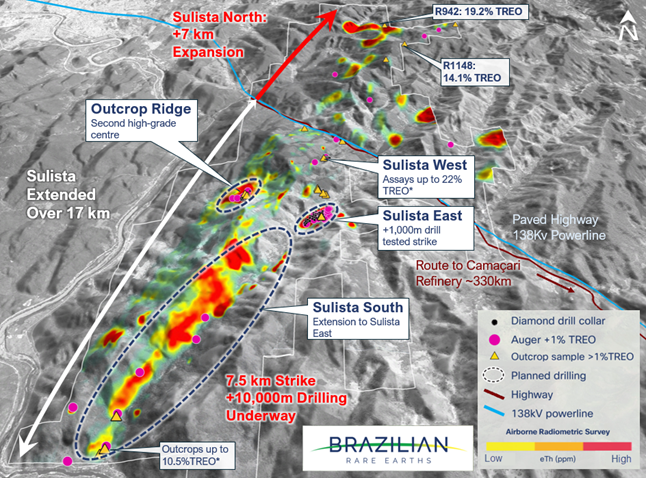
* Denotes previously reported exploration result
Sulista North: A new large-scale exploration growth corridor
- Sulista North has expanded the district footprint by more than 7 km northwards and represents a major new regional growth corridor, with ultra-high-grade surface mineralisation and intense geophysical vectors indicating proximity to fertile hard-rock source zones
- Field-based follow-up of airborne geophysical targets led to the discovery of an ultra-high-grade chevkinite-bearing outcrop, with grab sample R942 returning
19.2% TREO, together with exceptional critical mineral grades of 27,365 ppm Nb₂O₅, 2,643 ppm Ta₂O₅ and 8,389 ppm U₃O₈ - Pathfinder auger drilling intersected high-grade REE-Nb-Sc-Ta-U mineralisation, including grades of up to
12.6% TREO, 19,309 ppm NdPr, 1,835 ppm DyTb, 6,730 ppm Y₂O₃, 4,361 ppm Nb₂O₅, 170 ppm Ta₂O₅, 314 ppm Sc₂O₃ and 1,195 ppm U₃O₈ in hole STU1610, indicating potential proximity to a high-grade bedrock source - Additional northern targets include multiple mineralised surface samples and shallow auger anomalies distributed across a broad corridor, reinforcing BRE’s view that Sulista is evolving into a repeatable, district-scale mineral system
Brazilian Rare Earths’ CEO and Managing Director, Bernardo da Veiga, commented:
“Sulista is advancing from discovery into delineation of a high-grade, scalable rare earth district, now extending over 17-kilometres of strike.
Sulista East has grown to more than one kilometre of drill-tested strike and beyond 230 metres vertically, confirming a large, continuous anchor deposit with exceptional growth potential to the south.
At the same time, new drilling at Outcrop Ridge, together with earlier results at Sulista West, confirms that high-grade mineralised centres are repeating across the district. Sulista North and Sulista South significantly expand our pipeline of drill-ready exploration growth corridors.
Together, these results strengthen the basis for our near-term scoping study and support our hub-and-spoke development strategy across the Rocha da Rocha Province.”
A link to the full release can be found here.
Contacts
Bernardo Da Veiga, Managing Director and CEO
investors@brazilianrareearths.com
www.brazilianrareearths.com
1 Refer to ASX Announcements dated 6 June 2024 (Original ASX Announcement) for details of previously reported exploration results. BRE is not aware of any new information or data that materially affects the information included in the Original ASX Announcement
A photo accompanying this announcement is available at https://www.globenewswire.com/NewsRoom/AttachmentNg/c7437de7-0a6f-4dc2-acc7-f15b9e721622

FAQ
AI-generated questions and answers. How Rhea-AI works. Not financial advice.