
Velhinhas Airborne Geophysics and Drilling Unlocks +9 km Rare Earth Corridor
Brazilian Rare Earths (OTCQX: BRELY) reported new exploration results from the Velhinhas Corridor, south of the Monte Alto rare earth deposit in Bahia, Brazil.
Sentiment and the balance of points
Rhea-AI Sentiment reads the wording of the document, how positive or negative its language is on a 1 to 5 scale. The balance of points shown with the takes weighs what the document actually discloses, so the two can disagree, for example when a trial that missed its main goal is described in upbeat language.
Rhea-AI Summary
Brazilian Rare Earths (OTCQX: BRELY) reported new exploration results from the Velhinhas Corridor, south of the Monte Alto rare earth deposit in Bahia, Brazil.
The high-resolution airborne survey outlines over 9 km of rare earth target trends across four parallel zones, supported by ultra-high-grade surface samples up to 39.6% TREO and reconnaissance drilling with grades up to 19.6% TREO plus significant NdPr, DyTb, yttrium, niobium, scandium, tantalum and uranium. A +5,000 m follow-up drilling program with an additional rig is underway.
Positive
- More than 9 km of cumulative rare earth exploration corridor trends defined at Velhinhas
- Four parallel north-northeast trending mineralised corridors confirmed by airborne geophysics
- Ultra-high-grade surface samples reported, including 39.6% TREO, 20.9% TREO and 13.5% TREO
- Reconnaissance drilling includes 19.6% TREO and 33,607 ppm NdPr plus other critical elements
- Velhinhas extends Monte Alto rare earth mineralisation to over 8 km south of the deposit
- Additional drill rig mobilised for a +5,000 m follow-up diamond drilling campaign
Negative
- None.
Details
News Market Reaction – BRELY
On Jun 11, the day this news came out, BRELY closed 26.97% below the previous close.
Data tracked by StockTitan Argus for the Jun 11 session.
Key Figures
- Exploration corridor length
- more than 9 km
- Cumulative rare earth target trends at Velhinhas
- Surface grade TREO
- 39.6% TREO
- Ultra-high-grade surface sample at Velhinhas
- Surface grade TREO
- 20.9% TREO
- Ultra-high-grade surface sample at Velhinhas
- Surface grade TREO
- 13.5% TREO
- High-grade surface sample at Velhinhas
- Drill grade TREO
- 19.6% TREO
- Reconnaissance diamond drilling at Velhinhas
- NdPr grade
- 33,607 ppm NdPr
- Diamond drill assay at Velhinhas
- Dy₂O₃ grade
- 1,463 ppm Dy₂O₃
- Diamond drill assay at Velhinhas
- Planned drilling
- +5,000 m
- Follow-up drilling campaign to test geophysical anomalies
Historical Context
-
Announced demerger of Amargosa into new ASX-listed Alurion Resources.
-
Quarterly report on expanded Monte Alto/Sulista work and trial mining licence.
-
Secured Trial Mining Licence for Monte Alto up to 2,000 tpa production.
-
Reported new ultra-high-grade Monte Alto drilling intercepts and strike extension.
-
Announced very high rare earth recoveries from low-temperature leaching tests.
24h Move is the share-price change in the day after each event; other market factors may also have contributed.
Key Terms
airborne geophysical survey technical
reconnaissance diamond drilling technical
dy₂o₃ technical
tb₄o₇ technical
y₂o₃ technical
AI-generated analysis. How Rhea-AI works. Not financial advice.




Ultra-high-grade surface samples with grades up to
SYDNEY, June 11, 2026 (GLOBE NEWSWIRE) -- Brazilian Rare Earths Limited (ASX: BRE) (OTCQX: BRELY / BRETF) announces results from a high-resolution airborne geophysical survey and reconnaissance diamond drilling at the Velhinhas Corridor, located immediately south of the ultra-high-grade Monte Alto Rare Earths Deposit in Bahia, Brazil.
The new airborne magnetic and radiometric survey defines more than 9 km of cumulative rare earth target exploration trends across at least four parallel north-northeast trending zones. These exploration target trends are spatially associated with ultra-high-grade surface samples, shallow pathfinder mineralisation and diamond drill intercepts, providing a district-scale framework for systematic exploration across Velhinhas.
KEY HIGHLIGHTS
- New District-Scale Growth Corridor: High-resolution airborne geophysics has defined more than 9 km of cumulative exploration corridor trends across the Velhinhas project, beginning ~5 km south of the ultra-high-grade Monte Alto Deposit and extending rare earth mineralisation to over 8 km south of Monte Alto
- Multiple Parallel Exploration Trends: Survey confirms four north-northeast trending mineralised corridors, converting numerous ultra-high-grade surface results into a district-scale exploration model analogous with Sulista
- Exceptional Surface Grades: Ultra-high-grade surface samples include
39.6% TREO,20.9% TREO and13.5% TREO, confirming a strong high-grade surface expression of an extensive mineralised system - Drilling Results Confirm High-Grade Mineralisation: Reconnaissance diamond drilling returned grades of
19.6% TREO, 33,607 ppm NdPr, 1,463 ppm Dy₂O₃, 248 ppm Tb₄O₇, 7,431 ppm Y₂O₃ and 1,087 ppm U₃O₈ - Critical Mineral Grades: High-grade assays are accompanied by NdPr, DyTb, yttrium, niobium, scandium, tantalum and uranium, consistent with BRE’s high-value REE-Nb-Sc-Ta-U systems at Monte Alto and Sulista
- Monte Alto District Growth Accelerates: Velhinhas expands the Monte Alto growth story, highlighting the potential for a district-scale rare mineralised system extending south from the ultra-high-grade Monte Alto Deposit
- Follow-up Drilling Underway: BRE has mobilised an additional diamond drill rig and is advancing a +5,000 m drilling campaign to test priority geophysical anomalies, expand bedrock mineralisation and support future target definition
FIGURE 1: ROCHA DA ROCHA RARE EARTH AND CRITICAL MINERAL PROVINCE
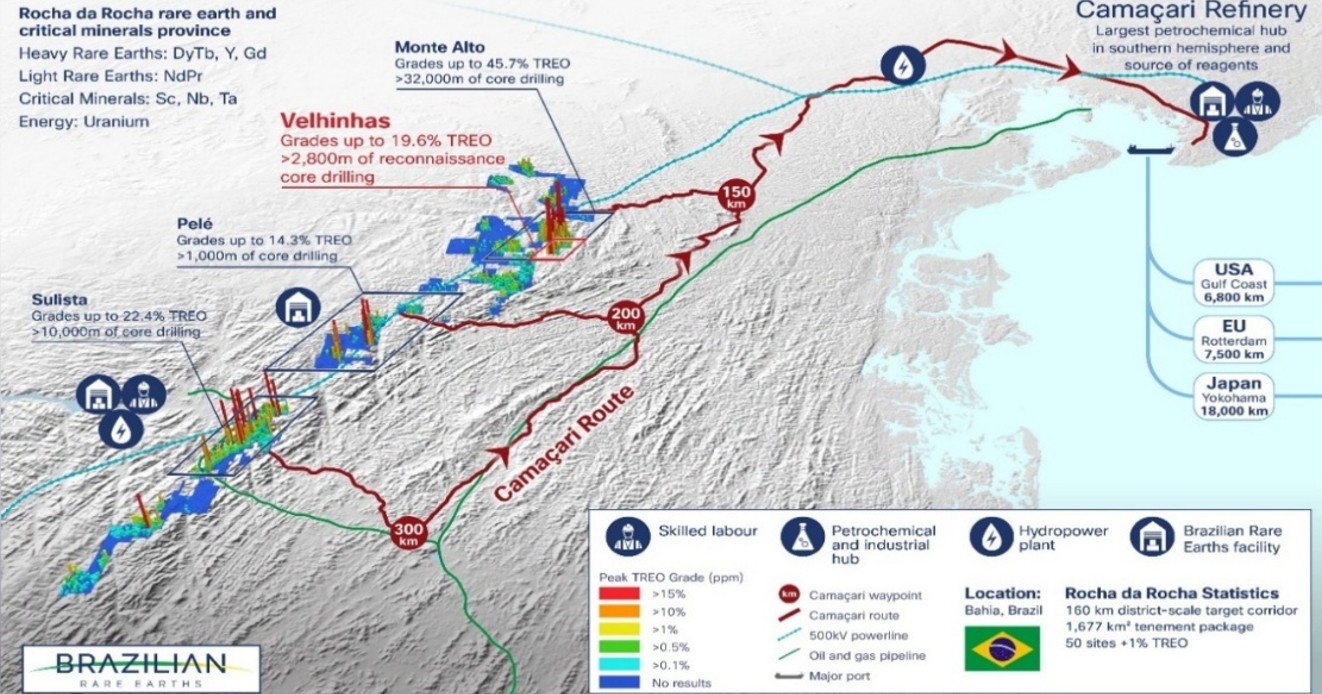
Denotes previously reported exploration result1
CEO COMMENTARY
“The Velhinhas results are an important step in expanding Monte Alto from a large ultra-high-grade deposit into a broader rare earth and critical minerals growth corridor.
High-resolution geophysics has defined multiple large-scale, parallel magnetic-radiometric trends extending south of Monte Alto, while reconnaissance diamond drilling has confirmed high-grade REE-Nb-Sc-Ta-U mineralisation from surface through regolith and into bedrock.
What is most exciting is the repeatability of the system.
At Monte Alto, systematic drilling has defined a remarkable ultra-high-grade rare earth and critical minerals deposit. At Sulista, geophysics and drilling have demonstrated how these mineralised systems can repeat and scale across an extensive district. Velhinhas now applies that same exploration model to the broader Monte Alto District, with multiple parallel targets, ultra-high-grade surface expression and early drilling success across the corridor.
With follow-up drilling now underway, our objective is clear: test the highest-priority geophysical targets, extend high-grade mineralisation at depth and continue building the scale of what is emerging as a major high-grade rare earth and critical minerals district.”
A link to the full release can be found here.
Forward-Looking Statements and Information
This Announcement may contain “forward-looking statements” and “forward-looking information”, including statements and forecasts which include (without limitation) expectations regarding industry growth and other trend projections, forward-looking statements about the BRE’s Projects, future strategies, results and outlook of BRE and the opportunities available to BRE. Often, but not always, forward-looking information can be identified by the use of words such as “plans”, “expects”, “is expected”, “is expecting”, “budget”, “outlook”, “scheduled”, “target”, “estimates”, “forecasts”, “intends”, “anticipates”, or “believes”, or variations (including negative variations) of such words and phrases, or state that certain actions, events or results “may”, “could”, “would”, “might”, or “will” be taken, occur or be achieved. Such information is based on assumptions and judgments of BRE regarding future events and results. Readers are cautioned that forward-looking information involves known and unknown risks, uncertainties and other factors which may cause the actual results, targets, performance or achievements of BRE to be materially different from any future results, targets, performance or achievements expressed or implied by the forward-looking information.
Forward-looking statements are not guarantees of future performance and involve known and unknown risks, uncertainties, assumptions and other important factors, many of which are beyond the control of the Company, the Directors and management of the Company. Key risk factors associated with an investment in the Company are detailed in Section 3 of the Prospectus dated 13 November 2023. These and other factors could cause actual results to differ materially from those expressed in any forward-looking statements.
Forward-looking information and statements are (further to the above) based on the reasonable assumptions, estimates, analysis and opinions of BRE made on the perception of trends, current conditions and expected developments, as well as other factors that BRE believes to be relevant and reasonable in the circumstances at the date such statements are made, but which may prove to be incorrect. Although BRE believes that the assumptions and expectations reflected in such forward-looking statements and information (including as described in this Announcement) are reasonable, readers are cautioned that this is not exhaustive of all factors which may impact on the forward-looking information.
The Company cannot and does not give assurances that the results, performance or achievements expressed or implied in the forward-looking information or statements detailed in this Announcement will actually occur and prospective investors are cautioned not to place undue reliance on these forward-looking information or statements.
Forward looking statements in these materials speak only at the date of issue. Subject to any continuing obligations under applicable law or any relevant stock exchange listing rules, in providing this information the Company does not undertake any obligation to publicly update or revise any of the forward-looking statements or to advise of any change in events, conditions or circumstances on which any such statement is based.
Competent Persons Statement
The information in this announcement that relates to Exploration Results is based on, and fairly represents, information compiled or reviewed by Mr Leon McGarry, a Competent Person who is a Professional Geoscientist (P.Geo.) and registered member of the ‘Association of Professional Geoscientists of Ontario’ (APGO no. 2348), a ‘Recognized Professional Organization’ (RPO). Mr McGarry is Chief of Geology and a full-time employee of Brazilian Rare Earths. Mr McGarry has sufficient experience which is relevant to the style of mineralisation and type of deposit under consideration and to the activity which he is undertaking to qualify as a Competent Person as defined in the 2012 Edition of the ‘Australasian Code for Reporting of Mineral Resources and Ore Reserves’. Mr. McGarry consents to the inclusion in this report of the results of the matters based on his information in the form and context in which it appears.
CONTACTS
Bernardo Da Veiga, Managing Director and CEO
investors@brazilianrareearths.com
www.brazilianrareearths.com
| 1 | Refer Prospectus dated 13 November 2023 (released on ASX Announcements Platform on 19 December 2023) and ASX Announcement dated 11 June 2024, 26 August 2024, 23 October 2024 and 18 February for details of previously announced exploration results (Original ASX Announcements). BRE is not aware of any new information or data that materially affects the information included in the Original ASX Announcements | |
A photo accompanying this announcement is available at:
https://www.globenewswire.com/NewsRoom/AttachmentNg/3560a625-dc66-4420-9b88-31a55ab21b5c

FAQ
AI-generated questions and answers. How Rhea-AI works. Not financial advice.